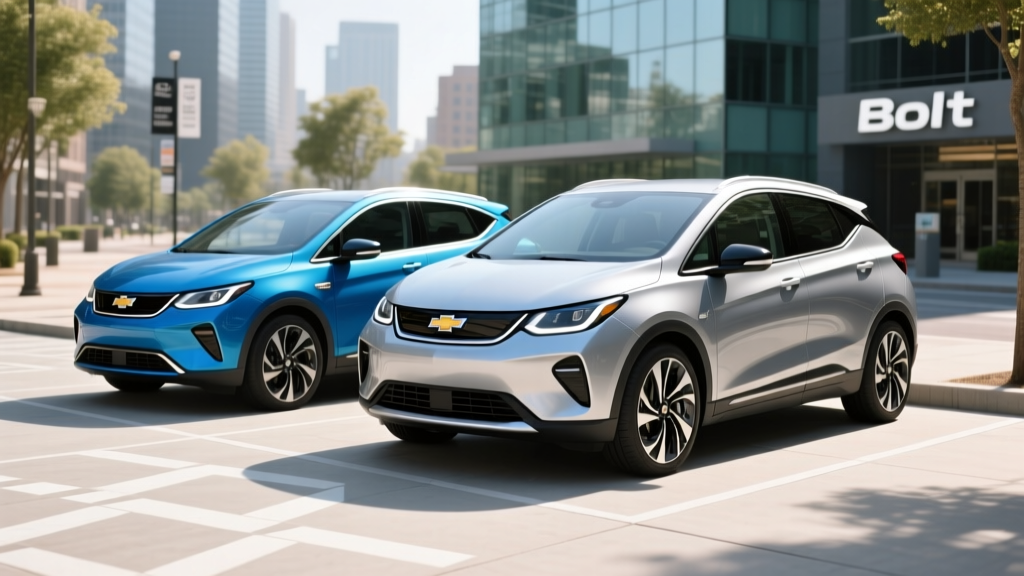
The 2026 Chevy Bolt: America's Affordable EV Benchmark, Reexamined
When Chevrolet revived the Bolt nameplate with a next-generation platform, it didn't just bring back a fan-favorite — it redefined what a sub-$30,000 electric vehicle could deliver. The 2026 Chevy Bolt EV and its longer-wheelbase sibling, the Bolt EUV (Electric Utility Vehicle), arrive with a new Ultium-derived battery pack, faster DC charging, and an updated infotainment system that finally closes the gap with competitors. But the question buyers are really asking is whether the Bolt's familiar chevy bolt pattern — its formula of compact dimensions, practical range, and aggressive pricing — still holds up against an increasingly crowded field of affordable EVs.
We've driven, charged, and analyzed the 2026 Bolt EV and EUV across city commutes and highway stretches to give you the exact numbers that matter. No marketing gloss, just the data you need to decide.
| Spec | Bolt EV (2LT) | Bolt EUV (Premier) |
|---|---|---|
| EPA Range | 259 miles | 247 miles |
| Battery (usable) | 65 kWh, LFP | 65 kWh, LFP |
| Drivetrain | FWD, single motor | FWD, single motor |
| Horsepower / Torque | 200 hp / 236 lb-ft | 200 hp / 236 lb-ft |
| 0–60 mph | 6.8 sec | 7.0 sec |
| Max DC Fast Charge | 150 kW (peak) | 150 kW (peak) |
| 10–80% DC Time | ~28 min | ~29 min |
| Level 2 Home Charge | 11.5 kW (~39 mi/hr) | 11.5 kW (~39 mi/hr) |
| MPGe (combined) | 120 MPGe | 115 MPGe |
| Efficiency | 28 kWh/100 mi | 29 kWh/100 mi |
| Cargo (rear seats up) | 16.3 cu ft | 16.3 cu ft |
| Cargo (rear seats folded) | 57.0 cu ft | 56.7 cu ft |
| Rear Legroom | 36.0 in | 39.1 in |
| Base MSRP | $28,800 | $32,400 |
| Battery Warranty | 8 yr / 100,000 mi | 8 yr / 100,000 mi |
Real-World Range: What the EPA Sticker Doesn't Tell You
The EPA rates the 2026 Bolt EV at 259 miles and the EUV at 247 miles. Those are competitive numbers for the segment, but as any experienced EV owner knows, the window sticker is a starting point, not a guarantee.
Range Reality Check
EPA Estimate: 259 mi (Bolt EV) / 247 mi (Bolt EUV)
Real-World Highway (70 mph, 75°F): ~225–240 mi — expect roughly 8–12% reduction at sustained highway speeds due to aero drag.
Cold Weather (30°F, mixed driving): ~185–210 mi — LFP chemistry is slightly more resistant to cold-induced capacity loss than NMC, but you'll still see 15–25% reduction without preconditioning. The Bolt's heat pump (standard on Premier, optional on 2LT) helps recover ~5–8% of that loss by warming the cabin without drawing heavily from the traction battery.
City / Suburban Commute: 255–270+ mi — regenerative braking in stop-and-go traffic can actually push you near or slightly above the EPA combined figure.
The 65 kWh usable capacity uses lithium iron phosphate (LFP) chemistry — a deliberate choice by GM for the Bolt's price point. LFP cells sacrifice some energy density (which is why the Bolt's pack is physically larger than a comparable NMC pack) but gain significant advantages: longer cycle life, no cobalt or nickel in the supply chain, and a safer thermal profile. For a daily commuter that charges to 100% regularly, LFP is arguably the better chemistry. GM recommends periodic 100% charges for LFP packs to keep the battery management system calibrated — the opposite of NMC advice.
Charging Speed: The Bolt's Biggest Generational Leap
The original Bolt's most criticized flaw was its painfully slow DC fast charging — capped at around 55 kW, which meant 45+ minute stops on road trips. The 2026 Bolt fixes this with a fundamentally redesigned thermal management system and a 150 kW peak DC charge rate.
| Charging Level | Power | Speed (approx.) | Use Case |
|---|---|---|---|
| Level 1 (120V household) | 1.4 kW | ~4–5 mi/hr | Overnight trickle; emergency top-up |
| Level 2 (240V home/public) | 11.5 kW | ~39 mi/hr (full in ~6.5 hr) | Daily home charging; workplace |
| DC Fast Charge (CCS/NACS) | 150 kW peak | 10–80% in ~28 min | Road trips; quick top-ups |
Charging curve reality: The Bolt hits its 150 kW peak between roughly 10% and 35% state of charge, then tapers progressively. From 50–80%, expect sustained rates closer to 80–100 kW. This is typical for the segment and means your 10–80% time of ~28 minutes is accurate, but an 80–100% top-off will add another 25+ minutes. Plan your road trip stops to leave at 80% unless you genuinely need the full pack.
For 2026, the Bolt ships with a native NACS (North American Charging Standard) port, granting direct access to Tesla's Supercharger network — over 20,000 stalls nationwide. A CCS adapter is available for legacy Electrify America and EVgo stations. This dual-network access is one of the strongest practical arguments for the 2026 Bolt over competitors still locked to CCS-only.
Home Level 2 charging at 11.5 kW requires a 48-amp dedicated circuit (60-amp breaker). Most buyers will spend between $500–$1,200 on a quality Level 2 EVSE and $800–$2,000 on electrician installation depending on panel proximity. If your home has a 200-amp panel with spare capacity, expect the lower end; a panel upgrade to support EV charging can push total costs to $3,500+. Always get a load calculation from a licensed electrician before committing.
Performance and Driving Dynamics
The 2026 Bolt's single front-mounted motor produces 200 horsepower and 236 lb-ft of torque — figures that translate to a 6.8-second 0–60 mph time in the EV and 7.0 seconds in the slightly heavier EUV. Neither will win drag races against a dual-motor Tesla Model Y or a Ford Mustang Mach-E GT, but the Bolt's instant torque delivery makes it feel genuinely quick in the 0–35 mph range where most daily driving happens.
The front-wheel-drive layout means some torque steer under hard acceleration from a stop, but the low center of gravity (battery pack mounted under the floor) keeps the Bolt composed through corners. Ride quality is firm but well-damped — GM tuned the suspension for urban potholes and expansion joints rather than canyon carving, which suits the car's mission profile.
One-pedal driving is available via a steering-wheel paddle that increases regenerative braking to near-stop levels. It's not quite as aggressive as Chevrolet's earlier "one-pedal" mode in the first-gen Bolt, but it handles 90% of daily deceleration needs without touching the brake pedal.
Interior, Tech, and Daily Livability
GM has overhauled the Bolt's cabin with a standard 11-inch diagonal touchscreen running the latest version of Google Built-In infotainment — meaning Google Maps, Google Assistant, and the Play Store are native to the car. Wireless Apple CarPlay and Android Auto are standard across all trims. The system is responsive, with noticeably less lag than the previous-generation Bolt's interface.
Driver assistance: The Chevy Safety Assist suite is standard and includes automatic emergency braking, forward collision alert, lane keep assist, following distance indicator, and automatic high beams. Adaptive cruise control is available on 2LT and standard on Premier. Importantly, GM's hands-free Super Cruise is not available on the Bolt — it remains reserved for higher-priced models like the Equinox EV and Blazer EV. The Bolt's adaptive cruise is a competent SAE Level 2 system that requires hands on the wheel and eyes on the road at all times.
Cargo and passenger space: The Bolt EV offers 16.3 cubic feet behind the rear seats — enough for a week's groceries or two carry-on bags — and 57.0 cu ft with the 60/40 rear seats folded. The EUV's longer wheelbase (107.2 in vs. the EV's 102.4 in) translates almost entirely into rear-seat legroom: 39.1 inches vs. 36.0 inches. If you regularly carry adults in the back, the EUV is the clear pick. Both models include a small front trunk (frunk) with ~1.2 cu ft of space — enough for a charging cable kit or emergency supplies.
Notable drawbacks: The Bolt lacks a heat pump on base trims (it's standard on Premier, optional on 2LT for $495), which matters for cold-climate buyers. There's no available all-wheel drive. Rear visibility is compromised by thick C-pillars, though a standard rearview camera and available 360-degree camera system mitigate this. Interior materials, while improved, still lean heavily on hard plastics in the lower door panels and center console — a concession to the price point.
Pricing, Trims, and Federal Tax Credit Eligibility
| Trim | Model | MSRP | Est. After §30D Credit* |
|---|---|---|---|
| 2LT | Bolt EV | $28,800 | ~$21,300 |
| Premier | Bolt EV | $32,200 | ~$24,700 |
| 2LT | Bolt EUV | $32,400 | ~$24,900 |
| Premier | Bolt EUV | $36,100 | ~$28,600 |
*Federal §30D credit assumes full $7,500 eligibility. Actual credit depends on buyer income, battery sourcing, and MSRP caps. See eligibility checklist below.
The 2026 Bolt qualifies for the IRS §30D Clean Vehicle Credit, which can provide up to $7,500 in federal tax relief — and since 2024, buyers can elect to transfer the credit to the dealer as a point-of-sale discount, making the effective purchase price significantly lower. However, eligibility is not automatic.
- MSRP Cap: The Bolt EV and EUV are classified as "other vehicles" (not vans, SUVs, or trucks), so the MSRP cap is $55,000. All Bolt trims clear this easily.
- Buyer Income Cap: Modified adjusted gross income must not exceed $150,000 (single), $225,000 (head of household), or $300,000 (joint filers). This is based on the tax year of delivery or the prior year, whichever is lower.
- Battery Sourcing Requirements: The $7,500 credit is split into two $3,750 halves — one for critical minerals sourcing and one for battery component manufacturing. GM has worked to qualify the Bolt's LFP battery under both requirements for 2026, but sourcing rules tighten annually. Verify current eligibility on fueleconomy.gov before purchasing, as mid-year supply chain changes can affect qualification.
- Point-of-Sale Transfer: You can transfer the credit to the dealership at purchase for an immediate price reduction. The dealer must be IRS-registered. If your tax liability is less than $7,500, the point-of-sale transfer still gives you the full discount — an advantage over the non-refundable credit approach.
How the Bolt Stacks Up Against Key Competitors
The affordable EV segment in 2026 is no longer a one-car race. Here's how the Bolt compares to its most direct rivals on the metrics buyers actually care about:
| Metric | Chevy Bolt EV | Nissan LEAF SV+ | Hyundai Kona Electric | Kia Niro EV |
|---|---|---|---|---|
| Base MSRP | $28,800 | $31,500 | $33,900 | $39,600 |
| EPA Range | 259 mi | 212 mi | 261 mi | 239 mi |
| DC Fast Charge (peak) | 150 kW | 100 kW | 100 kW | 110 kW |
| 10–80% DC Time | ~28 min | ~40 min | ~43 min | ~38 min |
| Battery Chemistry | LFP | NMC | NMC | NMC |
| NACS Port (native) | Yes | No | No | No |
| Rear Legroom | 36.0 in | 33.5 in | 36.5 in | 37.4 in |
The Bolt's combination of lowest MSRP, fastest DC charging, native NACS access, and competitive range gives it the strongest value proposition in the segment. The Kona Electric edges it on range by 2 miles but costs $5,100 more and charges significantly slower. The LEAF remains stuck with CHAdeMO (a declining standard) and a smaller battery. The Niro EV offers more rear room but is priced nearly $11,000 higher.
Pros
- Lowest starting price in the segment at $28,800
- 150 kW DC fast charging — class-leading
- Native NACS port for Tesla Supercharger access
- LFP battery offers long cycle life and 100% daily charging
- Strong cargo versatility (57 cu ft max)
- Federal §30D tax credit eligible (up to $7,500)
- Google Built-In infotainment with wireless CarPlay/Android Auto
Cons
- FWD only — no AWD option for snow-belt buyers
- Heat pump not standard on base trim
- Hard plastics still prevalent in lower cabin areas
- Super Cruise not available (basic adaptive cruise only)
- Rear visibility hampered by thick C-pillars
- Towing not recommended (no tow rating published)
Who Should Buy the 2026 Chevy Bolt?
Buy the Bolt EV if: You're a solo driver or couple who commutes under 60 miles daily, wants the cheapest entry into a 250+ mile EV, and values fast DC charging for occasional road trips. The EV's tighter dimensions make it ideal for urban parking.
Buy the Bolt EUV if: You regularly carry rear-seat passengers (children, carpool, ride-share) and need that extra 3.1 inches of legroom. The EUV's slightly longer wheelbase also rides more smoothly over highway expansion joints.
Look elsewhere if: You need AWD for heavy snow, want hands-free highway driving (consider a Super Cruise–equipped Equinox EV or a Ford with BlueCruise), or require towing capability. The Bolt is a commuter, not a utility vehicle in the truck sense.
Battery Longevity and Warranty Coverage
GM backs the Bolt's LFP battery pack with an 8-year / 100,000-mile warranty that guarantees at least 60% capacity retention — though industry data on LFP cells suggests real-world degradation will likely stay well above that threshold. LFP chemistry typically retains 85–90% capacity after 1,000 full charge cycles, which translates to roughly 200,000+ miles before hitting the warranty floor. Many LFP packs in commercial fleet service have exceeded 300,000 miles with 80%+ retention.
The broader powertrain (motor, power electronics, onboard charger) is also covered for 8 years / 100,000 miles. The vehicle limited warranty is 3 years / 36,000 miles bumper-to-bumper, which is competitive but not class-leading (Hyundai and Kia offer 5/60,000).
For buyers concerned about long-term ownership costs, the Bolt's LFP chemistry is a genuine advantage over NMC competitors. LFP cells degrade more slowly, tolerate daily 100% charges without accelerated wear, and are less prone to thermal runaway — reducing the likelihood of the catastrophic battery failures that made headlines with the first-generation Bolt's recall.
Frequently Asked Questions
What is the real-world range of the 2026 Chevy Bolt?
The EPA rates the Bolt EV at 259 miles and the EUV at 247 miles. In real-world mixed driving at moderate temperatures, expect 230–250 miles. Sustained highway driving at 70+ mph drops this to roughly 225–240 miles, and cold weather (below 35°F) can reduce range to 185–210 miles depending on cabin heating use and whether you precondition the battery.
How fast does the 2026 Bolt charge at home and on the road?
At home on a Level 2 (240V) charger, the Bolt accepts up to 11.5 kW, adding roughly 39 miles of range per hour — a full charge from empty takes about 6.5 hours. On DC fast chargers, it peaks at 150 kW and charges from 10% to 80% in approximately 28 minutes. Above 80%, charging slows significantly to protect battery health.
How much does the 2026 Chevy Bolt cost after the federal tax credit?
The Bolt EV 2LT starts at $28,800 MSRP. If you qualify for the full $7,500 federal §30D credit (via point-of-sale transfer), your effective price drops to approximately $21,300 before state incentives, destination charges, or dealer fees. Eligibility depends on your income, the vehicle's battery sourcing compliance, and MSRP caps — verify on fueleconomy.gov and consult a tax professional.
Does the 2026 Chevy Bolt qualify for the $7,500 federal EV tax credit?
Yes, the 2026 Bolt is listed as eligible for the §30D Clean Vehicle Credit, potentially up to $7,500. However, your personal eligibility depends on income limits ($150K single / $300K joint), the vehicle's battery component and critical mineral sourcing compliance (rules that tighten annually), and the MSRP cap ($55,000 for passenger cars). The Bolt's MSRP clears the cap on all trims. Check the latest eligibility list on fueleconomy.gov before purchasing.
Is the Chevy Bolt worth buying over the Hyundai Kona Electric or Kia Niro EV?
If price and charging speed are your top priorities, yes. The Bolt undercuts the Kona by $5,100 and the Niro by $10,800, charges 50% faster on DC, and includes native NACS for Supercharger access. The Kona and Niro offer slightly more rear-seat room and available AWD (Kona), but the Bolt's value proposition is difficult to beat for budget-conscious buyers who don't need AWD or maximum rear passenger space.
Can I charge the 2026 Bolt at Tesla Superchargers?
Yes. The 2026 Bolt comes with a native NACS charge port, meaning you can plug directly into any Tesla Supercharger stall without an adapter. This gives Bolt owners access to the largest and most reliable DC fast-charging network in North America. A CCS adapter is also available for use with Electrify America, EVgo, and other legacy networks.
What is the Chevy Bolt's bolt pattern (lug pattern)?
For wheel and tire shoppers: the 2026 Chevy Bolt EV and EUV use a 5×115 mm bolt pattern (5-lug, 115 mm bolt circle diameter) with a 56.6 mm center bore and M12×1.5 lug nuts. This is shared with several other GM vehicles. The OEM tire size is 215/50R17 on 2LT and 215/45R18 on Premier.
Sources: EPA fueleconomy.gov, Chevrolet.com official specifications, IRS §30D Clean Vehicle Credit guidelines.