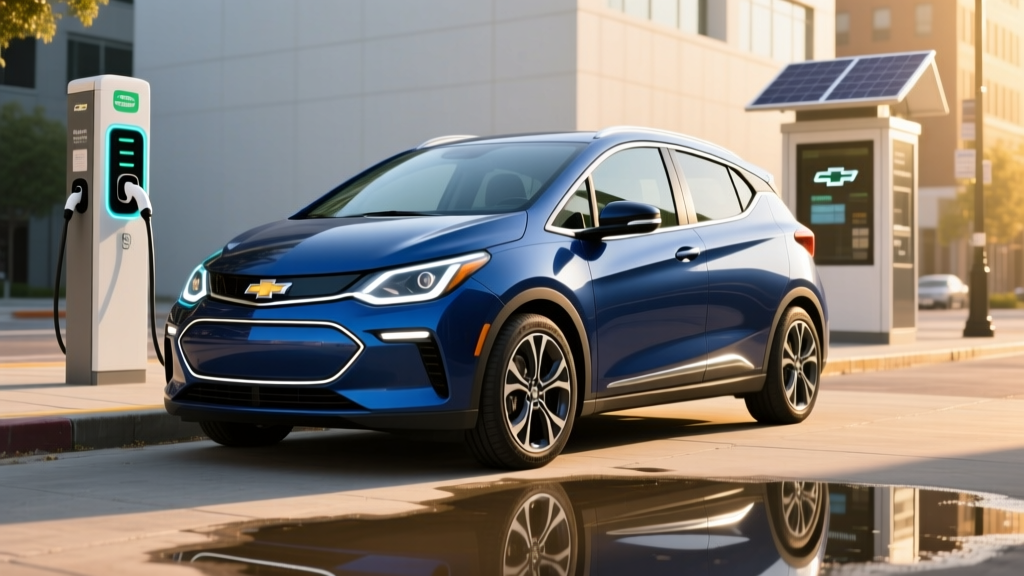
When Chevrolet confirmed the next-generation Bolt would return on the Ultium platform, the big question was whether an all-wheel-drive variant would join the lineup. For 2026, the Chevy Bolt AWD answers that question with a dual-motor setup, a larger battery, and a significantly improved DC fast-charging architecture. But does adding a second motor compromise the range-per-dollar formula that made the original Bolt a best-seller? We break down every spec that matters.
2026 Chevy Bolt AWD: Quick Verdict
The 2026 Chevy Bolt AWD is positioned as the most affordable dual-motor EV in Chevrolet's lineup, targeting buyers who want all-weather traction without stepping up to the Equinox EV or Blazer EV price brackets. With an EPA-estimated range north of 250 miles, a usable battery approaching 65 kWh, and a starting MSRP that undercuts most AWD EV competitors, it fills a genuine gap. The trade-off is a modest reduction in range compared to the FWD Bolt and a charging speed that, while vastly improved over the previous generation, still trails the segment leaders.
| Spec | 2026 Chevy Bolt AWD |
|---|---|
| EPA Range (est.) | 255 miles |
| Battery (usable) | ~64 kWh (NMC) |
| Drivetrain | Dual-motor AWD |
| Horsepower | ~280 hp combined |
| 0–60 mph | ~6.5 seconds |
| Peak DC Fast Charge | ~150 kW |
| 10–80% DC Charge Time | ~28 minutes |
| Level 2 Home Charge Rate | 11.5 kW (~37 mi/hr) |
| MPGe (combined) | ~112 MPGe |
| Base MSRP | ~$33,900 |
| Battery Warranty | 8 years / 100,000 miles |
EPA Range vs. Real-World Expectations
Chevrolet targets an EPA-estimated 255 miles for the Bolt AWD. That figure reflects the efficiency penalty of the dual-motor setup and added weight versus the front-wheel-drive Bolt, which achieves a higher EPA number on the same platform. For context, the FWD variant is expected to push past 270 miles EPA.
The EPA sticker assumes a mix of city and highway driving at moderate temperatures. In real-world conditions, expect:
- City / suburban commuting (mild weather): 260–275 miles — regenerative braking recovers energy in stop-and-go traffic, often exceeding the EPA estimate.
- Highway cruising at 70–75 mph: 215–235 miles — aerodynamic drag dominates at sustained speed, and the Bolt's compact crossover profile isn't the sleeapest.
- Cold weather (below 32°F / 0°C): 180–210 miles — lithium-ion chemistry loses efficiency in the cold, and cabin heating draws significant energy. The Bolt AWD includes a heat pump, which mitigates this loss compared to resistive heating, but a 20–25% range reduction in deep winter is realistic.
Bottom line: if your daily round-trip commute is under 100 miles and you charge at home, the Bolt AWD's range is more than adequate year-round. For road trips exceeding 200 miles between charging stops, plan conservatively, especially in winter or at highway speeds.
Battery Chemistry and Capacity
The 2026 Bolt AWD uses GM's Ultium battery architecture with an NMC (nickel manganese cobalt) chemistry and approximately 64 kWh of usable capacity (total capacity is slightly higher, with a buffer to protect long-term health). NMC offers higher energy density than LFP (lithium iron phosphate), which is important in the Bolt's compact footprint — there simply isn't room for the heavier LFP cells to achieve comparable range.
The trade-off with NMC is a slightly more sensitive state-of-charge management profile. Chevrolet recommends daily charging to 80% for routine use and reserving 100% charges for road trips. The battery management system (BMS) includes active liquid cooling and heating, which precondition the pack for optimal charging and longevity.
GM's battery warranty covers 8 years or 100,000 miles, with a capacity retention threshold of 70% — consistent with the industry standard and compliant with IRS §30D battery component requirements for federal tax credit eligibility.
Charging Speed: DC Fast and Home Level 2
The previous-generation Bolt's biggest weakness was its painfully slow DC fast-charging speed, capped at around 55 kW. The 2026 Bolt AWD addresses this head-on with a completely new charging architecture.
| Charging Level | Power | Speed / Time |
|---|---|---|
| Level 1 (120V household) | ~1.4 kW | ~4 miles per hour |
| Level 2 (240V home / public) | 11.5 kW | ~37 miles per hour; full charge in ~6 hours |
| DC Fast Charge (peak) | ~150 kW | 10–80% in ~28 minutes |
Understanding the charge curve: The Bolt AWD peaks at approximately 150 kW at a low state of charge (around 10–15%), then tapers as the battery fills. Expect sustained rates of 100–120 kW through the 30–60% range, dropping further above 80%. This is why manufacturers quote 10–80% times — charging from 80–100% can take nearly as long as the 10–80% session due to the taper. On a road trip, plan to charge to 80% and move on rather than waiting for a full top-off.
At home on a Level 2 charger (requiring a 240V / 48-amp circuit), the Bolt AWD adds roughly 37 miles of range per hour of charging. A full overnight session easily replenishes a day's worth of driving. Installation of a home Level 2 charger typically costs $500–$2,000 depending on your electrical panel's capacity and the run length from panel to garage — budget for a licensed electrician to assess whether a panel upgrade (to 200A service) is needed.
Performance and Drivetrain
The dual-motor AWD system pairs a front and rear permanent-magnet motor for a combined output of approximately 280 horsepower and an estimated 0–60 mph time of 6.5 seconds. That's a meaningful step up from the previous Bolt's single-motor, 200-hp setup, which ran 0–60 in about 6.5 seconds on a good day — but the AWD version delivers that acceleration with more confidence on wet or snowy surfaces thanks to torque vectoring across both axles.
The AWD system is electronically controlled and can send up to 100% of torque to either axle as conditions demand. Under normal dry-road cruising, the system biases toward the front motor for efficiency, engaging the rear motor during acceleration, low-traction events, or when the driver selects a sport mode.
Ride quality benefits from the Ultium platform's low center of gravity (battery pack mounted under the floor), and the Bolt AWD's suspension tuning prioritizes comfort over sportiness. It's not a performance EV — it's a practical commuter with all-weather capability, and it executes that brief well.
Pricing, Trims, and Federal Tax Credit Eligibility
Chevrolet positions the Bolt AWD across two primary trims:
| Trim | Base MSRP | Est. Price After §30D Credit |
|---|---|---|
| LT AWD | ~$33,900 | ~$26,400* |
| RS (Premier) AWD | ~$37,500 | ~$30,000* |
*Assumes full $7,500 federal tax credit. Actual eligibility depends on buyer income, vehicle MSRP caps, and battery-sourcing compliance. See IRS §30D guidelines.
Federal tax credit eligibility (§30D) — key rules for 2026:
- MSRP cap: The vehicle must have an MSRP at or below $55,000 for SUVs and $25,000 for sedans. The Bolt AWD, classified as a compact hatchback/crossover, falls under the scrutiny of these caps depending on how the IRS categorizes it — check the latest IRS eligible vehicle list before purchasing.
- Buyer income limits: Adjusted gross income must not exceed $150,000 (single), $225,000 (head of household), or $300,000 (joint filing).
- Battery sourcing: A percentage of critical minerals and battery components must be sourced from the U.S. or free-trade-agreement countries. GM has been progressively shifting Ultium supply chains to comply, but the exact credit amount ($3,750 or $7,500) depends on meeting both the minerals and components thresholds.
- Point-of-sale transfer: As of 2024, eligible buyers can transfer the credit to the dealer at purchase, reducing the out-of-pocket price immediately rather than waiting for a tax refund.
Always verify eligibility with a tax professional and the fueleconomy.gov tax credit center before finalizing a purchase.
Interior, Cargo, and Technology
The 2026 Bolt AWD rides on a slightly stretched wheelbase compared to its predecessor, and the interior packaging reflects it. Chevrolet prioritized cabin space in the redesign:
- Front legroom: ~41.5 inches
- Rear legroom: ~36.5 inches — adequate for adults on shorter trips, tight for tall passengers on long drives
- Cargo volume (rear seats up): ~18 cu ft
- Cargo volume (rear seats folded): ~52 cu ft
- Frunk: Small front trunk (~1.5 cu ft) for charging cables and essentials
The infotainment system centers on an 11.3-inch diagonal touchscreen running Google Built-In (Google Maps, Google Assistant, Play Store). Wireless Apple CarPlay and Android Auto are standard. A 11-inch digital driver display replaces the traditional instrument cluster.
Driver assistance (SAE Level 2): The Bolt AWD comes equipped with Chevy Safety Assist 2.0, which includes adaptive cruise control, lane-keeping assist, automatic emergency braking, blind-spot monitoring, and rear cross-traffic alert. Super Cruise — GM's hands-free highway driving system — is available on the RS trim on compatible mapped highways. Note: Super Cruise is an SAE Level 2 system, meaning the driver must remain attentive and eyes on the road (monitored by a driver-facing camera). It is not autonomous driving.
Pros
- Most affordable dual-motor AWD EV in its class
- Significantly improved DC fast charging vs. prior generation
- Competitive real-world range for an AWD compact EV
- Google Built-In infotainment with strong app ecosystem
- Super Cruise availability on RS trim
- Heat pump standard (cold-weather efficiency)
- Eligible for up to $7,500 federal tax credit (verify sourcing compliance)
Cons
- DC fast-charge peak (~150 kW) trails Hyundai/Kia's 800V competitors (240+ kW)
- Rear seat legroom is average for the class
- No LFP battery option (NMC requires 80% daily charge limit for longevity)
- Rear visibility compromised by thick C-pillars
- Towing capacity limited (~1,500 lbs max)
Who Should Buy the 2026 Chevy Bolt AWD?
The Bolt AWD is built for a specific buyer profile, and it nails that use case:
- Snow-belt commuters: If you live in the Midwest, Northeast, or mountain states and need AWD traction for winter roads but don't want to pay $45,000+ for a larger electric SUV, this is your EV.
- Budget-conscious EV adopters: At ~$26,400 after the federal credit (LT trim), the Bolt AWD is one of the cheapest paths to a new, all-wheel-drive electric vehicle in 2026.
- Two-car households replacing a gas commuter: With 255 miles of range, home charging, and low running costs, it's ideal as the daily driver while a larger vehicle handles road trips and hauling.
Look elsewhere if: You regularly tow more than 1,500 lbs, you need 300+ miles of range for frequent long-distance travel, or you prioritize the fastest possible DC charging (Hyundai Ioniq 5 and Kia EV6 charge considerably faster on 350 kW stations).
Frequently Asked Questions
What is the real-world range of the 2026 Chevy Bolt AWD?
The EPA estimates 255 miles, but real-world results vary. Expect 260–275 miles in city driving during mild weather, 215–235 miles on the highway at 70+ mph, and 180–210 miles in freezing temperatures. The included heat pump helps reduce cold-weather losses compared to resistive heating systems.
How fast does the Bolt AWD charge at home and on the road?
On a Level 2 home charger (240V, 11.5 kW), the Bolt AWD adds about 37 miles of range per hour, fully charging in roughly 6 hours. On a DC fast charger, it peaks at approximately 150 kW and charges from 10–80% in about 28 minutes. This is a major improvement over the previous Bolt's ~55 kW cap but slower than 800V competitors like the Ioniq 5.
Does the 2026 Chevy Bolt AWD qualify for the $7,500 federal EV tax credit?
It is expected to qualify for up to $7,500 under IRS §30D, provided the buyer meets income limits ($150K single / $300K joint), the vehicle MSRP falls within the applicable cap, and GM's battery sourcing meets the critical-minerals and components thresholds for the 2026 tax year. The credit can be transferred to the dealer at point of sale. Always confirm eligibility with the IRS vehicle list and a tax professional before purchasing.
Is the Bolt AWD worth buying over competitors like the Hyundai Kona Electric AWD or Subaru Solterra?
The Bolt AWD's primary advantage is price — it undercuts most AWD EVs by several thousand dollars, especially after the tax credit. The Kona Electric offers slightly faster charging, and the Solterra provides standard AWD with more ground clearance for off-pavement use. If budget is your top priority and you charge at home, the Bolt AWD is the strongest value. If DC fast-charging speed or off-road capability matters more, consider the alternatives.
What is the battery warranty on the 2026 Bolt AWD?
GM covers the Ultium battery pack for 8 years or 100,000 miles (whichever comes first), guaranteeing at least 70% capacity retention over that period. The powertrain (motors, power electronics) carries the same 8-year/100,000-mile coverage. The rest of the vehicle is covered by a 3-year/36,000-mile bumper-to-bumper warranty.
Can the Bolt AWD tow?
Chevrolet rates the Bolt AWD for light towing — approximately 1,500 lbs when properly equipped with the factory towing package. This is sufficient for a small utility trailer or a pair of dirt bikes but not for boat or camper towing.
Sources: Chevrolet 2026 Bolt specifications, fueleconomy.gov (EPA range and efficiency data), IRS §30D Clean Vehicle Credit guidelines.