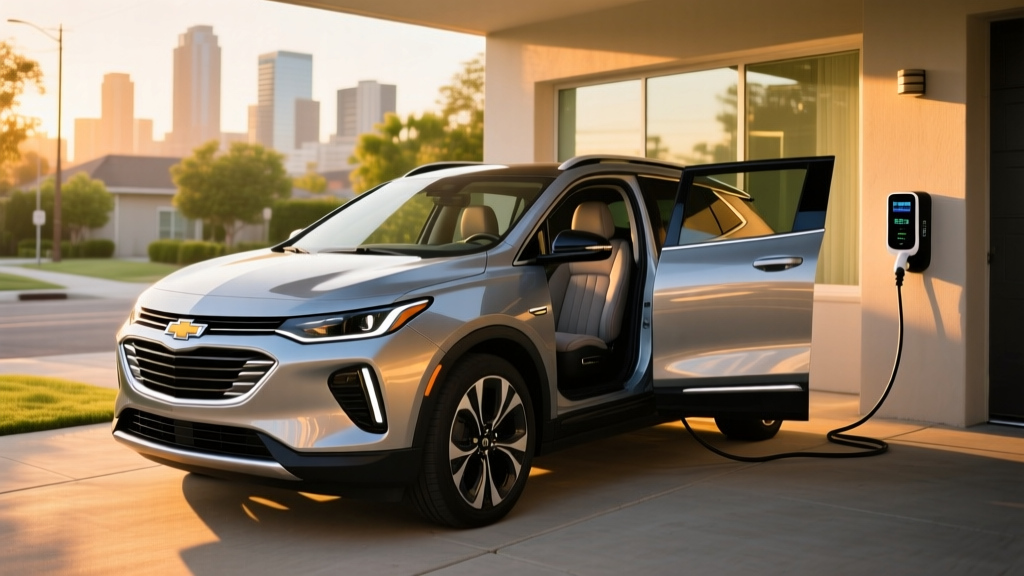
The 2026 Chevrolet Equinox EV remains one of the most accessible long-range electric SUVs on the market, with an EPA-estimated range up to 319 miles and a starting MSRP that undercuts most competitors. But the sticker price is only the beginning. For buyers eyeing 2026 Chevrolet Equinox EV lease deals, the real question is what this SUV costs to own once you factor in charging, insurance, maintenance, depreciation, and the shifting landscape of federal and state incentives.
This guide walks through the complete 5-year ownership picture with hard numbers — no cherry-picked savings, no glossed-over costs. Whether you're leasing or buying, you'll know exactly what to budget.
2026 Equinox EV: The Numbers That Matter
Before we get into costs, here's the spec baseline for the 2026 model year. Chevrolet offers the Equinox EV in LT and RS trims with front-wheel drive (FWD) and all-wheel drive (AWD) configurations.
| Spec | LT FWD | RS AWD |
|---|---|---|
| EPA Range | 319 mi | 285 mi |
| Battery (usable) | 85 kWh (NMC) | 85 kWh (NMC) |
| Motor Output | 213 hp / 236 lb-ft | 288 hp / 334 lb-ft |
| 0-60 mph | ~8.0 sec | ~6.2 sec |
| Max DC Fast Charge | 150 kW | 150 kW |
| 10-80% DC Charge | ~32 min | ~32 min |
| Level 2 Charge Rate | 11.5 kW | 11.5 kW |
| MPGe (combined) | 115 MPGe | 103 MPGe |
| Base MSRP | $33,600 | $43,400 |
| Battery/Powertrain Warranty | 8 yr / 100,000 mi | |
Federal Tax Credit: Do You Actually Qualify?
The federal EV tax credit under IRS §30D can reduce your effective cost by up to $7,500 — but eligibility in 2026 depends on a stack of requirements that catch many buyers off guard. Here's the full checklist:
- MSRP Cap: The vehicle's manufacturer's suggested retail price must not exceed $80,000 for SUVs (the Equinox EV clears this easily at all trims).
- Buyer Income Limits: Modified adjusted gross income (MAGI) must be ≤$150,000 (single filers), ≤$225,000 (head of household), or ≤$300,000 (joint filers). This is based on the tax year you take delivery or the prior year — whichever is lower.
- Battery Sourcing — Critical Minerals: A percentage of critical minerals in the battery must be sourced from the U.S. or a free-trade-agreement country. This threshold increases annually. The Equinox EV's Ultium battery uses GM's North American supply chain, but exact compliance varies by build date and battery lot.
- Battery Components: A percentage of battery components must be manufactured or assembled in North America. Again, this threshold tightens each year under the Inflation Reduction Act.
- Point-of-Sale Transfer: As of 2024, you can transfer the credit to the dealer at purchase, effectively reducing the sale price by up to $7,500 at the time of transaction — rather than waiting to claim it on your tax return. This applies to purchases, not leases.
- Lease Loophole (§45W): If you lease the Equinox EV, the credit technically goes to the lessor (the financing company) under the commercial clean vehicle credit (§45W). Many lessors pass this savings through as a reduced lease payment — commonly called "lease cash" — but they are not legally required to. Always confirm with the dealer whether the $7,500 is being applied to your lease.
5-Year Total Cost of Ownership: The Full Picture
Here's what owning a 2026 Equinox EV LT FWD actually costs over five years, compared to a similarly priced gas-powered compact SUV (we'll use the 2026 Chevy Equinox AWD gas model at ~$30,000 MSRP and 28 MPG combined as the baseline).
| Cost Category | Equinox EV LT FWD | Gas Equinox AWD |
|---|---|---|
| Purchase Price (base MSRP) | $33,600 | $30,000 |
| Federal Tax Credit | −$7,500 (if eligible) | $0 |
| Effective Purchase Price | $26,100 | $30,000 |
| 5-Year Fuel/Energy (60,000 mi) | $3,120 | $7,500 |
| 5-Year Maintenance | $1,200 | $3,200 |
| 5-Year Insurance (est.) | $9,750 | $7,500 |
| Depreciation (5-yr est.) | $12,500 | $13,800 |
| Total 5-Year Cost | $52,670 | $62,000 |
Assumptions: 12,000 miles/year; home charging at $0.14/kWh average; gas at $3.50/gallon; insurance based on national EV average premiums; depreciation based on current EV resale trends. Actual costs vary by region, driving habits, and utility rates.
The Equinox EV comes out roughly $9,300 ahead over five years — but only if you qualify for the full federal credit and charge primarily at home. Remove the tax credit and the gap narrows to about $1,800, making the case heavily dependent on your eligibility and charging setup.
Charging vs. Gas: The Per-Mile Math
This is where EVs typically shine, but the savings depend entirely on how and where you charge.
| Scenario | Cost per kWh / Gallon | Cost per Mile | Annual Cost (12k mi) |
|---|---|---|---|
| Home Level 2 (avg US utility) | $0.14/kWh | $0.044 | $528 |
| Home with time-of-use (off-peak) | $0.09/kWh | $0.028 | $336 |
| Public DC Fast Charging | $0.35–$0.48/kWh | $0.11–$0.15 | $1,320–$1,800 |
| Gas SUV (28 MPG combined) | $3.50/gal | $0.125 | $1,500 |
The Equinox EV LT FWD consumes roughly 31 kWh per 100 miles (derived from its 115 MPGe rating per fueleconomy.gov). At the national average residential electricity rate of ~$0.14/kWh, that's about 4.3 cents per mile — roughly a third of what a comparable gas SUV costs.
However, if you rely exclusively on public DC fast chargers (Electrify America, EVgo, etc.) at $0.35–$0.48/kWh, your per-mile cost jumps to $0.11–$0.15, which is comparable to or even exceeds gasoline. Home charging access is the single biggest variable in EV operating costs.
Maintenance Savings: Where the EV Advantage Is Real
EVs have far fewer moving parts than internal combustion vehicles, and the maintenance savings compound over time.
| Service Item | Equinox EV | Gas Equinox |
|---|---|---|
| Oil Changes | None — ever | Every 5,000–7,500 mi (~$40–$75 each) |
| Brake Pads | 80,000–120,000+ mi (regen braking reduces wear) | 30,000–50,000 mi |
| Transmission Fluid | None (single-speed reduction gear) | Every 30,000–60,000 mi |
| Coolant Flush | Every ~5 years (battery thermal system) | Every 30,000–50,000 mi |
| Air Filter | Cabin filter only (~$25–$40) | Engine + cabin filters |
| Spark Plugs | None | Every 60,000–100,000 mi |
| Estimated 5-Year Total | ~$1,200 | ~$3,200 |
Over five years and 60,000 miles, you'll save roughly $2,000 on maintenance with the Equinox EV. The biggest factor is regenerative braking, which uses the electric motor to slow the vehicle and recapture energy, dramatically reducing friction brake wear. Many EV owners report original brake pads lasting well past 100,000 miles.
Insurance: The Cost Nobody Talks About
Here's the part most EV cost calculators gloss over: insurance premiums for electric vehicles are typically 15–30% higher than for comparable gas vehicles. For the Equinox EV, expect annual premiums in the $1,700–$2,200 range depending on your state, driving record, and coverage level — compared to roughly $1,400–$1,600 for the gas Equinox.
Why the premium?
- Higher repair costs: EV battery packs and power electronics are expensive to replace after a collision. Even minor rear-end damage can total a battery.
- Specialized labor: Fewer body shops have high-voltage certification, which drives up labor rates for EV repairs.
- Vehicle price: Even with a lower effective cost after tax credits, insurers base premiums on the MSRP and actual repair/replacement cost data.
- Claim severity: Industry data shows EV claims tend to be higher-cost per incident, even if frequency is similar.
The Equinox EV is one of the more affordable EVs to insure (compared to a Tesla Model Y or Ford F-150 Lightning), but budget an extra $250–$500 per year over the gas equivalent. Get quotes from your insurer before signing a lease or purchase agreement.
Depreciation and Resale Value: The Evolving Picture
EV depreciation has been volatile. In 2023–2024, Tesla's aggressive price cuts cascaded through the used EV market, depressing resale values across all brands. By 2025–2026, the market has stabilized somewhat, but EVs still generally depreciate faster than comparable gas vehicles in the first three years.
For the Equinox EV specifically:
- Estimated 5-year depreciation: ~45–55% of MSRP, meaning a $33,600 LT FWD might be worth $15,000–$18,500 after five years.
- Gas Equinox comparison: ~40–50% depreciation over the same period.
- Leasing advantage: If you lease, depreciation is the lessor's problem. The lease residual is locked in at signing, and you walk away at term-end regardless of market value. This can be a smart hedge against uncertain EV resale values.
- Battery health factor: A well-maintained battery with documented State of Health (SoH) above 90% at the 5-year mark will support stronger resale. GM's 8-year/100,000-mile battery warranty (covering degradation below 60% of original capacity) provides a floor of confidence for second owners.
State, Local, and Utility Incentives
- State rebates: California's CVRP, Colorado's innovative motor vehicle credit, New York's Drive Clean rebate, and others offer $1,000–$5,000+ depending on income and vehicle price.
- Utility rebates: Many electric utilities offer $250–$1,500 rebates for purchasing an EV and/or installing a Level 2 home charger. Check with your local provider.
- HOV lane access: Several states grant single-occupant HOV lane access to EVs — a significant commute-time saver in metro areas.
- Reduced registration fees: Some states offer reduced annual EV registration; others actually charge higher fees to offset lost gas tax revenue.
Frequently Asked Questions
How much does it really cost to own a 2026 Equinox EV over 5 years?
With the federal tax credit, our analysis puts the 5-year total cost of ownership for an LT FWD at approximately $52,670 — roughly $9,300 less than a comparable gas Equinox AWD. Without the credit, the savings narrow to about $1,800, driven mainly by fuel and maintenance savings offset by higher insurance and slightly higher purchase price.
Do I qualify for the $7,500 federal EV tax credit?
You may qualify if your income is under the MAGI caps ($150K single / $300K joint), the vehicle MSRP is under $80,000 (all Equinox EV trims qualify), and the battery meets critical-mineral and component-sourcing thresholds. If you lease rather than buy, the credit goes to the lessor under §45W — confirm they pass it through to your lease terms. Always verify current rules at irs.gov.
How much do I save on fuel and maintenance?
Charging at home at $0.14/kWh, you'll spend about $528/year on electricity versus $1,500/year on gas for a comparable SUV — saving roughly $972/year or $4,860 over five years. Maintenance savings add another ~$2,000 over five years thanks to no oil changes, no spark plugs, and dramatically reduced brake wear from regenerative braking.
Are EVs more expensive to insure?
Yes, typically 15–30% more. For the Equinox EV, budget $1,700–$2,200/year versus $1,400–$1,600 for the gas version. Higher repair costs, specialized labor, and elevated claim severity drive the premium. Get quotes before committing.
How well does the Equinox EV hold its value?
Expect roughly 45–55% depreciation over five years — somewhat steeper than the gas Equinox. The used EV market is still stabilizing after the 2023–2024 price disruption. Leasing transfers depreciation risk to the lessor, which can be advantageous in an uncertain resale environment.
What's the best way to evaluate an Equinox EV lease deal?
Calculate the total lease cost: (monthly payment × number of months) + amount due at signing + acquisition fee + disposition fee. Compare this against the total cost of purchasing (including tax credit, financing interest, and projected resale value). Factor in your annual mileage — most leases cap at 10,000–12,000 miles/year with per-mile overage charges of $0.15–$0.25.