The Short Answer: Which 2026 Cadillac EV Fits You?
Cadillac's 2026 EV lineup spans three Ultium-based crossovers: the Lyriq (midsize, ~314-mile EPA range, starting ~$58,590), the Optiq (compact, ~300-mile estimated range, starting ~$54,090), and the Vistiq (three-row, ~300-mile estimated range, starting ~$79,590). All three ride on GM's Ultium platform with 800V-capable architecture, peak DC fast charging up to 190 kW (Lyriq), and NACS charge ports granting native access to Tesla Superchargers via adapter-free plug compatibility. The Lyriq qualifies for a partial or full federal tax credit under IRS §30D depending on battery-sourcing compliance and buyer income; the Optiq and Vistiq eligibility varies by build date and sourcing. If you're replacing a gas Cadillac XT5 or XT6, expect $1,200–$1,800/year in fuel savings and significantly lower maintenance costs — but plan for higher insurance premiums and a home Level 2 charger installation costing $800–$2,000.
2026 Cadillac EV Lineup at a Glance
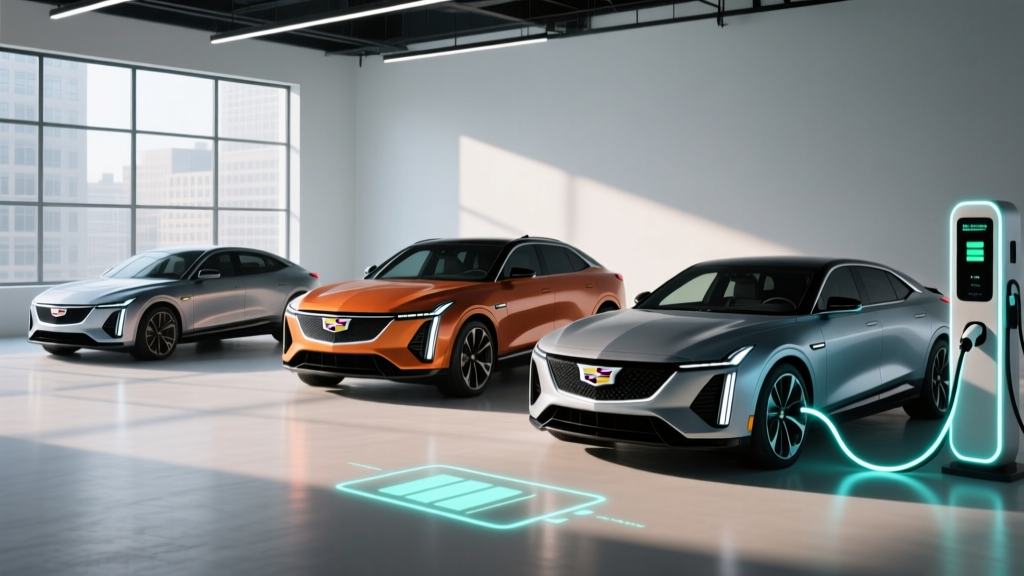
Cadillac has committed fully to electrification, and by the 2026 model year the brand offers three distinct battery-electric crossovers built on General Motors' Ultium platform. Each targets a different buyer: the Lyriq slots into the heart of the luxury midsize segment, the Optiq brings a more accessible entry point, and the Vistiq fills the three-row family hauler role previously occupied by the XT6.
| Spec | Lyriq | Optiq | Vistiq |
|---|---|---|---|
| EPA Range (est.) | 314 mi (RWD) / 307 mi (AWD) | ~300 mi (AWD) | ~300 mi (AWD) |
| Battery Capacity | 102 kWh usable (NMC) | ~85 kWh usable (NMC) | ~102 kWh usable (NMC) |
| Drivetrain | RWD or AWD | AWD standard | AWD standard |
| Horsepower | 340 hp (RWD) / 500 hp (AWD) | ~400 hp | ~600 hp |
| 0-60 mph | 6.0s (RWD) / 4.6s (AWD) | ~5.0s | ~3.7s |
| Peak DC Fast Charge | 190 kW | ~150 kW | ~190 kW |
| 10-80% DCFC Time | ~33 min | ~30 min | ~35 min |
| Level 2 Charge Rate | 19.2 kW (AC) | 11.5 kW (AC) | 19.2 kW (AC) |
| Charge Port | NACS (native) | NACS (native) | NACS (native) |
| Starting MSRP | $58,590 | $54,090 | $79,590 |
| Federal Tax Credit (§30D) | Up to $7,500 (eligibility varies) | Up to $7,500 (eligibility varies) | Up to $7,500 (eligibility varies) |
| Battery Warranty | 8 yr / 100,000 mi | 8 yr / 100,000 mi | 8 yr / 100,000 mi |
Sources: Cadillac Lyriq official page, fueleconomy.gov. Optiq and Vistiq figures are manufacturer-estimated where EPA data is pending. Verify current tax credit eligibility at IRS.gov §30D.
Range Reality: EPA Sticker vs. Real-World Miles
The Lyriq's EPA-rated 314 miles (RWD) is a strong figure for a luxury crossover, but real-world results depend heavily on how and where you drive. In mixed suburban-highway testing at 70°F, the Lyriq RWD typically delivers 280–300 miles before needing a charge — close to its sticker number. Push highway speeds to 75-80 mph consistently and expect that to drop to around 250–270 miles.
Real-World Range Expectations: 2026 Lyriq AWD
- EPA rated: 307 miles
- Mixed driving (70°F): ~275–295 miles
- Highway 75 mph (70°F): ~250–270 miles
- Highway 75 mph (30°F, no heat pump benefit): ~210–235 miles
- City with regen (55°F): ~290–310 miles
Cold-weather range loss of 20-30% is typical for NMC batteries. The Ultium platform includes active thermal management and a heat pump to mitigate this, but physics still applies. Preconditioning the battery while plugged in recovers significant range.
The Optiq's smaller ~85 kWh battery and lighter curb weight balance out to a similar ~300-mile estimate, while the Vistiq's larger mass and three-row footprint pull efficiency down despite sharing the Lyriq's larger battery pack. For all three, the 102 kWh and 85 kWh packs are NMC (nickel manganese cobalt) chemistry — offering higher energy density than LFP but requiring more careful charge-habit management for long-term health (GM recommends daily charging to 80% and reserving 100% for road trips).
Charging Speeds, Networks, and Home Setup Costs
Cadillac's adoption of the NACS (North American Charging Standard) port for 2026 is a major practical advantage. You get native access to Tesla's Supercharger network — the most reliable and widespread DC fast-charging network in the U.S. — without needing an adapter. You also retain access to Electrify America, EVgo, and other CCS-equipped stations through the broader NACS-open ecosystem.
| Level | Power | Lyriq Miles/Hr | Optiq Miles/Hr | Where |
|---|---|---|---|---|
| Level 1 (120V) | 1.4 kW | ~4 mi/hr | ~4 mi/hr | Standard outlet |
| Level 2 (240V, 48A) | 11.5 kW | ~34 mi/hr | ~34 mi/hr | Home / workplace |
| Level 2 (240V, 80A) | 19.2 kW | ~52 mi/hr | N/A (11.5 kW max) | Home (upgraded circuit) |
| DC Fast Charge | Up to 190 kW | ~190 mi in 30 min | ~150 mi in 30 min | Supercharger / EA / EVgo |
Understanding the charge curve: The Lyriq's 190 kW peak rate is not sustained across the entire session. Like all EVs, charge speed tapers significantly above 80% state of charge to protect battery health. A typical 10-80% session takes about 33 minutes, but going from 80-100% can add another 20-25 minutes. For road trips, plan stops around the 10-80% window to minimize time at the charger.
Home Level 2 Installation: What to Budget
| Item | Low End | High End | Notes |
|---|---|---|---|
| Level 2 EVSE (hardwired, 48A) | $400 | $700 | ChargePoint Home Flex, Emporia, Wallbox |
| Electrician labor (240V/60A circuit) | $500 | $1,500 | Depends on panel proximity and run length |
| Electrical panel upgrade (if needed) | $1,500 | $3,500 | Required if panel is 100A or maxed out |
| Permit & inspection | $50 | $250 | Varies by municipality |
| Total (no panel upgrade) | $950 | $2,450 | |
| Total (with panel upgrade) | $2,450 | $5,950 |
Always hire a licensed electrician for a site assessment before purchasing equipment. The Lyriq's 19.2 kW onboard charger can take full advantage of an 80A circuit, charging significantly faster than most competitors capped at 11.5 kW.
Ownership Costs: Cadillac EV vs. Gas Cadillac
The purchase decision ultimately comes down to total cost of ownership. Let's compare the 2026 Lyriq AWD against the 2026 Cadillac XT5 AWD — its closest gas-powered equivalent — over a 5-year, 75,000-mile ownership period.
| Cost Category | Lyriq AWD | XT5 AWD (Gas) | Difference |
|---|---|---|---|
| Purchase Price (MSRP) | $62,090 | $52,795 | +$9,295 |
| Federal Tax Credit (§30D) | -$7,500* | $0 | -$7,500 |
| Effective Purchase | $54,590 | $52,795 | +$1,795 |
| Fuel / Electricity (75k mi) | $3,400 | $8,600 | -$5,200 |
| Maintenance (5 years) | $1,200 | $3,800 | -$2,600 |
| Insurance (5 years) | $12,500 | $9,800 | +$2,700 |
| Estimated Depreciation | $22,000 | $19,500 | +$2,500 |
| Home Charger Install | $1,500 | $0 | +$1,500 |
| Total 5-Year Cost | $95,190 | $94,495 | +$695 |
*Tax credit eligibility depends on buyer AGI (≤$150k single / ≤$300k joint), vehicle MSRP caps (≤$80k for SUVs), and battery mineral sourcing requirements. Verify at IRS.gov. Electricity cost assumes $0.14/kWh national average; gas assumes $3.40/gal at 22 MPG combined. Insurance premiums for EVs run 15-25% higher on average.
The math shows near-parity over five years when the full tax credit applies. The Lyriq's higher purchase price and insurance are offset by dramatically lower fuel and maintenance costs. Beyond year five, the EV's cost advantage widens as you avoid timing belts, spark plugs, transmission fluid changes, and oil changes that the XT5 requires. However, if you don't qualify for the §30D credit due to income or sourcing rules, the Lyriq costs roughly $8,200 more over five years — a meaningful gap.
Federal Tax Credit Eligibility: What Actually Applies
IRS §30D Clean Vehicle Credit — 2026 Requirements
- Buyer income cap: AGI ≤ $150,000 (single) / $225,000 (head of household) / $300,000 (married filing jointly)
- Vehicle MSRP cap: ≤ $80,000 for SUVs and trucks (Lyriq, Optiq, Vistiq all qualify on MSRP)
- Battery sourcing: Increasing percentages of critical minerals and battery components must be sourced from the U.S. or FTA partners — this threshold tightens annually and can split the credit into $3,750 halves
- Point-of-sale transfer: You can transfer the credit to the dealer at purchase, reducing your out-of-pocket cost immediately rather than waiting for tax filing
- Assembly: Vehicle must undergo final assembly in North America (all three Cadillacs are assembled in Spring Hill, TN or Lansing, MI)
The battery-sourcing requirement is the most volatile factor. GM has been aggressively reshoring Ultium battery supply chains, and as of early 2026, the Lyriq has generally qualified for the full $7,500 credit. However, the IRS updates its qualifying vehicle list periodically — always confirm before signing a purchase agreement.
Common Misconceptions About Cadillac EVs
| Myth | Fact |
|---|---|
| "Cadillac EVs can't use Tesla Superchargers." | All 2026 Cadillacs have native NACS ports and plug directly into Superchargers with no adapter needed. |
| "The battery will need replacing in 5 years." | GM's Ultium batteries carry an 8-year/100,000-mile warranty against capacity loss below 60%. Industry data shows NMC packs typically retain 85-90% capacity at 100,000 miles. |
| "Charging takes hours on road trips." | A 10-80% DC fast charge takes ~30-35 minutes at a Supercharger or 150+ kW station — comparable to a rest stop with food and a bathroom break. |
| "I need a special electrical upgrade for every home." | Most homes with a 200A panel can add a 60A/240V circuit for $800–$1,500. Only older homes with 100A panels typically need a full upgrade. |
| "EVs don't work in cold climates." | Expect 20-30% range reduction in sub-freezing weather — real and manageable. The Ultium heat pump and battery preconditioning recover significant efficiency. Owners in Minnesota and Maine drive these year-round. |
| "The Lyriq is self-driving with Super Cruise." | Super Cruise is an SAE Level 2 driver-assist system. You must remain attentive, eyes on the road. It enables hands-free driving on 400,000+ miles of mapped highways but does not handle construction zones, unmapped roads, or adverse weather autonomously. |
SAE Automation Level: Super Cruise
Level 2 — Partial Automation. Super Cruise controls steering, acceleration, and braking on compatible highways. The driver must remain engaged and ready to take over immediately. An infrared camera monitors driver attention. This is not autonomous driving — Level 4 robotaxi services (Waymo, Zoox) operate without a driver present, but are geofenced to specific cities.
Who Should Buy Which 2026 Cadillac EV?
Decision Framework
- Choose the Lyriq if: You want the most proven model with the longest real-world range, 19.2 kW home charging (fastest in class), and a midsize luxury crossover that directly replaces the XT5. Best for commuters with 40-80 mile round trips and occasional 300-mile road trips.
- Choose the Optiq if: Budget is your primary concern and you don't need three rows. At ~$54,090 before incentives, it's the most accessible entry to the Cadillac EV lineup. Best for urban and suburban drivers who charge at home nightly.
- Choose the Vistiq if: You need three rows for family duty and can absorb the ~$79,590 starting price. It replaces the XT6 with far more torque (600 hp) and lower running costs, though at a significant upfront premium. Best for families who want space without the minivan.
- Stick with gas (XT5/XT6) if: You lack reliable home charging access, regularly drive 400+ miles in remote areas with sparse charging infrastructure, or your AGI disqualifies you from the federal tax credit, making the EV premium harder to justify.
First-Time EV Buyer Checklist
- Confirm home charging feasibility: Get a licensed electrician to assess your panel capacity and quote a 240V circuit installation before you order the car.
- Verify tax credit eligibility: Check your AGI, the vehicle's current sourcing status on fueleconomy.gov, and confirm with your dealer that the credit can be applied at point of sale.
- Test your typical route: Use A Better Route Planner or PlugShare to map charging stations along your most common road trips. If you drive I-80 across Nebraska regularly, know where the Superchargers are.
- Get insurance quotes early: EV insurance runs 15-25% higher than equivalent gas vehicles. Get quotes from Geico, Progressive, and State Farm before committing — the premium difference affects your TCO math.
- Understand your charging habits: If 90% of your driving is under 60 miles/day with home charging, you'll rarely think about range. The EV experience is best when charging is something that happens while you sleep.
Frequently Asked Questions
How long does a Cadillac Ultium battery last?
GM warranties the Ultium battery for 8 years or 100,000 miles against capacity loss below 60%. Real-world data from early Ultium vehicles and comparable NMC packs suggests 85-92% capacity retention at 100,000 miles. With proper charging habits (daily 80% limit, avoid prolonged 100% storage), these packs should deliver 200,000+ miles before significant degradation. A full replacement, if ever needed, currently runs $15,000–$20,000, though costs are declining.
Can I charge a 2026 Cadillac EV at a Tesla Supercharger?
Yes — all 2026 Cadillacs feature the NACS charge port natively, meaning you plug directly into any Tesla Supercharger without an adapter. Cadillac also provides access through the GM Energy app for payment and station locator. Non-Tesla DC fast chargers (Electrify America, EVgo) that have added NACS cables are also compatible.
What happens if I can't install a home charger?
Public-only charging is viable but significantly more expensive and less convenient. DC fast charging costs roughly $0.30–$0.48/kWh versus $0.14/kWh at home, nearly tripling your per-mile energy cost. You'll also spend 30-45 minutes charging 2-3 times per week instead of plugging in for 10 seconds at home each night. If you live in an apartment without charging access, consider whether your workplace offers Level 2 charging, or whether a PHEV might be a better bridge solution.
Is the Lyriq AWD worth the range trade-off?
The AWD Lyriq sacrifices about 7 miles of EPA range (307 vs. 314) but gains 160 additional horsepower (500 vs. 340) and a 0-60 time of 4.6 seconds vs. 6.0. In real-world driving, AWD also provides better traction in rain and snow. For most buyers in climates with winter weather, the AWD upgrade is worthwhile — the range difference is negligible in practice.
How does Super Cruise compare to Tesla Autopilot?
Both are SAE Level 2 driver-assist systems requiring full driver engagement. Super Cruise operates on 400,000+ miles of LiDAR-mapped highways and uses a driver-monitoring camera to confirm attention — allowing true hands-free operation on compatible roads. Tesla Autopilot/FSD (Supervised) works on more road types but requires hands-on-wheel torque confirmation. IIHS data shows both systems perform well in their intended use cases, but neither replaces an attentive driver. Super Cruise's mapped-road limitation means it won't function on unmapped local streets, while FSD attempts broader coverage with more variable performance.