Quick Verdict: The Electric Flagship Redefines Luxury EV Space
The 2026 Cadillac Escalade IQ is the first full-size, three-row luxury SUV built on GM's BT1 electric skateboard platform — the same architecture underpinning the Silverado EV and GMC Sierra EV, but dressed in Cadillac's most opulent interior to date. With an EPA-estimated range of up to 460 miles on the Luxury trim, a peak DC fast-charge rate of 200 kW, and an interior dominated by a pillar-to-pillar 55-inch LED display, the Escalade IQ targets buyers who want Escalade presence without the fuel bill. But at a starting MSRP near $129,990, with federal tax credit eligibility far from guaranteed, this is a purchase that demands scrutiny beyond the spec sheet.
We've analyzed Cadillac's published specifications, EPA data, and real-world driving variables to give you the full ownership picture — from how far you'll actually go on a highway road trip to whether your home electrical panel can handle Level 2 charging for a 200+ kWh battery.
| Spec | Luxury 2WD | Sport 1 AWD |
|---|---|---|
| EPA Range (est.) | 460 mi | 440 mi |
| Battery (usable) | ~200 kWh (NMC) | ~200 kWh (NMC) |
| Horsepower | 680 hp (dual-motor capable, 2WD mode) | 750 hp (AWD) |
| 0–60 mph | ~5.0 sec | ~4.7 sec |
| Max DC Fast Charge | 200 kW | 200 kW |
| 10–80% DCFC Time | ~48 min | ~48 min |
| Level 2 Home Charge | 11.5 kW (~19 mi/hr) | 11.5 kW (~19 mi/hr) |
| EPA Efficiency | ~68 MPGe / 49 kWh/100mi | ~65 MPGe / 51 kWh/100mi |
| Towing Capacity | 8,000 lbs | 8,000 lbs |
| Base MSRP | $129,990 | $131,990 |
| Battery Warranty | 8 yr / 100,000 mi | 8 yr / 100,000 mi |
2026 Cadillac Escalade IQ Interior: 55 Inches of Screen, Executive Seating, and Real Cargo Room
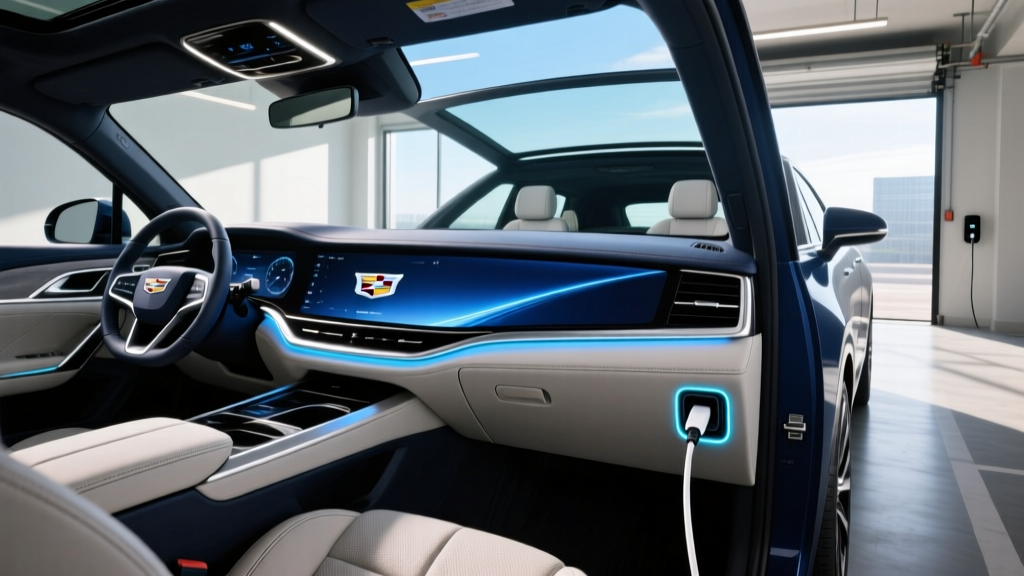
The keyword bringing buyers to this review — the 2026 Cadillac Escalade IQ interior — is where this SUV justifies its six-figure price. The dashboard is dominated by what Cadillac calls the "Pillar-to-Pillar" display: a continuous 55-inch diagonal LED screen stretching the full width of the instrument panel. The driver gets a dedicated digital instrument cluster segment, while the front passenger receives a separate infotainment zone for streaming, navigation previews, and messaging — all running GM's latest Ultifi software platform with Google Built-In (Maps, Assistant, Play Store).
Second-row passengers aren't afterthoughts. Available Executive Seating in the Sport and Luxury upper trims replaces the bench with two individual captain's chairs featuring power-adjustable leg rests, heated and ventilated cushions, fold-out tray tables, and dedicated 12.6-inch rear seat-back entertainment screens. A rear-seat command center mounted in the center console armrest gives second-row occupants control over climate, audio, and ambient lighting.
Interior Dimensions and Cargo Capacity
The Escalade IQ rides on a 135.7-inch wheelbase — longer than the gas Escalade ESV — and that translates directly to interior volume:
- Front headroom: 42.3 inches
- Second-row legroom: 43.1 inches (Executive Seating)
- Third-row legroom: 34.9 inches — usable for adults on shorter trips, a meaningful improvement over prior gas Escalade third rows
- Cargo behind 3rd row: 23.5 cu ft
- Cargo behind 2nd row (3rd row folded): 68.4 cu ft
- Max cargo (all rear seats folded): 122.7 cu ft
- Front trunk (e-trunk/frunk): 10.2 cu ft — enough for a large soft cooler or two carry-on bags, enabled by the absence of an engine
The frunk is a practical differentiator vs. the gas Escalade and most three-row competitors. It's weather-sealed and includes a 12V power outlet, useful for tailgating or storing charging cables out of the main cargo area.
Audio, Comfort, and Driver-Assist Tech
The top-tier Sport Platinum trim includes a 40-speaker AKG Studio Reference audio system — the most speakers in any production vehicle as of 2026. Lower trims get a 19-speaker AKG system. All trims feature:
- Super Cruise hands-free driving on 750,000+ miles of compatible roads (SAE Level 2 — driver must remain attentive)
- Head-up display with augmented-reality navigation overlays
- 128-color ambient lighting with zone-specific customization
- Heated steering wheel, heated/ventilated front seats (all trims)
- Wireless Apple CarPlay and Android Auto
- Phone-as-key via Bluetooth LE with passive entry
Real-World Range: What 460 EPA Miles Actually Means on the Road
Real-World Expectation: 380–410 miles highway (70–75 mph, moderate temps) · 310–350 miles in cold weather (below 30°F) with cabin heating · 420–450 miles city/suburban mixed driving
The Escalade IQ's ~200 kWh usable battery pack is among the largest in any production EV. Cadillac uses Ultium NMC (nickel-manganese-cobalt) pouch cells — the same chemistry as the GMC Hummer EV and Silverado EV — prioritizing energy density over the cycle-life advantages of LFP. For a luxury flagship where buyers expect maximum single-charge distance, NMC is the logical choice.
But a 200 kWh battery pushing a 9,000+ lb GVWR vehicle through the air at 75 mph faces real physics. Expect efficiency to drop to roughly 55–58 kWh/100mi on sustained highway driving, which trims range to approximately 380–410 miles. In freezing temperatures, where the battery must divert energy to thermal management and resistive cabin heating (the Escalade IQ does not include a heat pump at launch), range loss of 25–30% is realistic, bringing effective range down to 310–350 miles.
For context: a 300-mile highway trip in 40°F weather with headwinds and a full passenger/cargo load is comfortably achievable on a single charge. A 400-mile winter road trip will require at least one DC fast-charge stop. Plan accordingly.
Charging Speed: 200 kW Peak, but the Curve Tells the Full Story
The Escalade IQ supports a peak DC fast-charge rate of 200 kW via its CCS1 connector (with NACS adapter expected to be included or available for Tesla Supercharger access in 2026). Cadillac estimates a 10–80% charge time of approximately 48 minutes at a compatible 200+ kW station.
| Charge Level | Power | Speed (mi/hr added) | Notes |
|---|---|---|---|
| Level 1 (120V) | 1.4 kW | ~2–3 mi/hr | Emergency/trickle only; full charge takes days |
| Level 2 (240V, 48A) | 11.5 kW | ~19 mi/hr | Full charge in ~17–18 hours; overnight recovery |
| DC Fast Charge | 200 kW peak | Up to ~400 mi/hr (peak) | 10–80% in ~48 min; tapers significantly above 80% |
Understanding the Charge Curve
Peak kW is a headline number, not a sustained rate. The Escalade IQ's large NMC pack will accept close to 200 kW between roughly 10–30% state of charge (SoC), then progressively taper. By 60% SoC, expect rates around 120–140 kW; above 80%, the rate drops to roughly 50–65 kW as the battery management system protects cell longevity. This is why manufacturers quote 10–80% times rather than 0–100% — charging the final 20% can add 30+ minutes.
Preconditioning matters. The Escalade IQ's navigation system will automatically warm or cool the battery to optimal charging temperature when a DC fast-charger is set as your destination. Skipping preconditioning — especially in cold weather — can cut peak charge rates by 40–50% and extend your 10–80% time well past an hour. Always navigate to the charger rather than just driving up.
Home Charging: Panel Capacity Is the Real Bottleneck
At 11.5 kW (48 amps on a 60-amp circuit), a Level 2 home charger adds roughly 19 miles of range per hour. A full charge from empty takes approximately 17–18 hours — fine for overnight recovery after a day of driving, but this is not a vehicle you'll "top off" in an hour.
The critical issue for Escalade IQ buyers is electrical panel capacity. An 11.5 kW charger draws 48 continuous amps, which requires a dedicated 60-amp breaker. Most homes with 200-amp service can accommodate this, but if your panel is already near capacity (electric HVAC, electric range, hot tub), you may need a panel upgrade to 300–400 amps — a $2,000–$4,000 project. Work with a licensed electrician to perform a load calculation before committing to a charger installation.
Performance: 750 Horsepower in a 9,000-lb Luxury Fortress
The Escalade IQ is offered in both rear-wheel-drive (Luxury 2WD) and all-wheel-drive (Sport 1 and above) configurations. The AWD dual-motor setup produces 750 horsepower and an estimated 785 lb-ft of torque, launching this three-row SUV from 0–60 mph in approximately 4.7 seconds. The 2WD Luxury trim produces 680 hp with a 0–60 time around 5.0 seconds.
Both configurations use GM's Ultium drive units with permanent-magnet motors. The AWD system is full-time with torque vectoring capability — not an on-demand system that waits for slip before engaging the front axle. This gives the Escalade IQ confident traction in rain and light snow, though ground clearance (approximately 8.0 inches) limits serious off-road use.
Towing capacity is rated at 8,000 lbs with the available Max Trailering package — competitive with the gas Escalade and sufficient for most boat trailers, horse trailers, and mid-size campers. Note that towing will cut range dramatically: expect 50–60% of the EPA sticker (roughly 230–275 miles) when pulling a loaded 7,000+ lb trailer at highway speeds.
Pricing, Trims, and Federal Tax Credit Eligibility
| Trim | Base MSRP | §30D Credit Eligible? | Effective Price (est.) |
|---|---|---|---|
| Luxury 2WD | $129,990 | No (MSRP cap: $80k for SUVs) | $129,990 |
| Sport 1 AWD | $131,990 | No | $131,990 |
| Luxury 2 AWD | $139,990 | No | $139,990 |
| Sport Platinum AWD | $152,990 | No | $152,990 |
The IRS §30D federal tax credit caps eligible SUVs at an $80,000 MSRP. Every Escalade IQ trim exceeds that threshold by $50,000 or more. This vehicle does not qualify for the $7,500 federal EV tax credit, regardless of buyer income or battery sourcing. There is no workaround — the MSRP cap is statutory.
Additionally, the §30D credit imposes buyer income limits ($300,000 joint / $150,000 single for new vehicles) and battery critical-mineral and component sourcing requirements. But for Escalade IQ buyers, the MSRP cap is the disqualifier that matters.
State incentives may still apply. Some states offer their own EV rebates or HOV-lane access that are not subject to the federal MSRP cap. Check your state's energy or environmental agency for current programs — these vary widely and change frequently.
Who Should Buy the 2026 Escalade IQ — and Who Shouldn't
Pros
- Class-leading 460-mile EPA range for a three-row luxury SUV
- Massive, tech-forward interior with pillar-to-pillar 55" display
- 10.2 cu ft frunk adds practical cargo flexibility
- 750 hp AWD with 8,000-lb towing capability
- Super Cruise on 750k+ miles of roads (Level 2)
- Ultra-quiet cabin — no engine noise, extensive sound deadening
- 8-year/100,000-mile battery warranty
Cons
- No federal tax credit eligibility (MSRP far exceeds $80k cap)
- 48-minute 10–80% DCFC time is slow vs. 800V competitors (Hyundai/Kia at 18 min)
- 400V architecture limits peak charge rate to 200 kW
- Home charging requires robust 240V/60A circuit; panel upgrade possible
- No heat pump at launch — cold-weather range hit is significant
- Third row still tight for tall adults on long trips
- $130k+ starting price; Sport Platinum approaches $155k
Best Use Cases
Buy the Escalade IQ if: You need a three-row luxury SUV for family duty and executive transport, you have reliable home Level 2 charging, your daily driving is under 200 miles, and you value silence, space, and tech over sporty dynamics. It excels as a daily school-run-and-commute vehicle that can also handle a 350-mile road trip with one brief charge stop.
Look elsewhere if: You frequently drive 500+ miles in a single day through charging-sparse regions, you need rapid 15-minute charge stops (the 400V architecture can't match 800V platforms), or you expect the federal tax credit to offset the purchase price. Also consider the Rivian R1S Tri-Motor if you want more off-road capability, or the Mercedes EQS SUV if you prefer a more car-like driving feel at a lower starting price.
Escalade IQ vs. Key Competitors: How It Stacks Up
| Spec | Cadillac Escalade IQ | Rivian R1S (Dual-Motor Max) | Mercedes EQS 580 SUV |
|---|---|---|---|
| EPA Range | 460 mi | 410 mi | 305 mi |
| Battery | ~200 kWh NMC | 149 kWh NMC | 108.4 kWh NMC |
| 0–60 mph | 4.7 sec (AWD) | 4.5 sec | 4.5 sec |
| Max DCFC | 200 kW | 200 kW | 200 kW |
| 3rd Row | Yes (usable) | Yes (tight) | Yes (very tight) |
| Towing | 8,000 lbs | 7,700 lbs | 3,500 lbs |
| Base MSRP | $129,990 | $99,900 | $105,550 |
| Federal Credit | No | No (MSRP cap) | No (MSRP cap) |
The Escalade IQ's range and cargo advantages are clear, but it commands a $30,000+ premium over the Rivian R1S. The Rivian offers better off-road capability and a more adventurous brand identity; the Escalade IQ delivers traditional luxury, a superior third row, and significantly more range. The Mercedes EQS SUV falls short on range and towing but offers a more refined ride and available rear-axle steering for tighter turning in urban settings.
Warranty, Ownership Costs, and Long-Term Battery Outlook
GM covers the Escalade IQ's Ultium battery pack for 8 years or 100,000 miles (whichever comes first) against defects and capacity loss below 60% of original capacity. The limited vehicle warranty is 4 years / 50,000 miles, with 6 years / 70,000 miles for the powertrain. These terms are standard for the luxury EV segment.
On the cost-of-energy front, the Escalade IQ's ~49 kWh/100mi efficiency means a full "tank" costs roughly $26–$34 at the national average residential electricity rate of $0.16/kWh — translating to about $0.08 per mile. Compare that to a gas Escalade averaging 16 mpg combined at $3.50/gallon: $0.22 per mile. Over 15,000 annual miles, the IQ saves approximately $2,100 per year in energy costs alone.
Insurance premiums will be higher than the gas Escalade — expect 15–25% more due to the vehicle's value, repair complexity, and EV-specific parts costs. Get quotes before purchasing.
Frequently Asked Questions
What is the real-world range of the 2026 Cadillac Escalade IQ?
The EPA estimates 460 miles for the Luxury 2WD and 440 miles for AWD Sport trims. In real-world highway driving at 70–75 mph in moderate temperatures, expect 380–410 miles. In cold weather (below 30°F), range drops to approximately 310–350 miles due to battery thermal management and cabin heating demands. City and suburban driving with regenerative braking recovers more energy, yielding results closer to the EPA sticker.
How fast does the Escalade IQ charge at home and on the road?
At a 200 kW DC fast charger, the Escalade IQ charges from 10–80% in approximately 48 minutes. At home on a Level 2 (240V, 48A) charger, it adds about 19 miles of range per hour, requiring roughly 17–18 hours for a full charge from empty. Level 1 (120V) charging is impractical for daily use, adding only 2–3 miles per hour.
Does the 2026 Escalade IQ qualify for the $7,500 federal EV tax credit?
No. Under IRS §30D rules, SUVs must have an MSRP at or below $80,000 to qualify. The Escalade IQ starts at $129,990, far exceeding this cap. Buyer income, battery sourcing, and point-of-sale transfer rules are irrelevant here — the MSRP alone disqualifies every trim. State-level incentives may still be available; check your local programs.
Is the Escalade IQ worth buying vs. the Rivian R1S or Mercedes EQS SUV?
The Escalade IQ wins on range (460 vs. 410 vs. 305 miles), third-row usability, cargo volume, and towing capacity (8,000 lbs). The Rivian R1S is $30,000 less expensive, more off-road capable, and has a stronger adventure-oriented brand — but a tighter third row and less range. The Mercedes EQS SUV offers a more car-like ride and rear-axle steering but falls far short on range and towing. If maximum range, space, and traditional luxury are your priorities, the IQ is the segment leader. If budget or off-road use matters more, the R1S is the stronger value.
Can I charge the Escalade IQ at Tesla Superchargers?
GM has been transitioning its EV lineup to the NACS (North American Charging Standard) connector. For 2026, the Escalade IQ ships with a CCS1 port and includes (or offers as an accessory) a NACS adapter for access to Tesla's Supercharger network. Confirm adapter inclusion with your dealer at purchase — some early-build vehicles may require a separate purchase.
How long will the Escalade IQ battery last before needing replacement?
GM's Ultium NMC cells are engineered for long cycle life, and the battery is warranted for 8 years / 100,000 miles with at least 60% capacity retention. Based on data from earlier Ultium vehicles and industry NMC degradation curves, expect approximately 10–15% capacity loss over 150,000 miles of typical use. Full battery replacement on a 200 kWh pack would be extremely expensive ($25,000–$35,000+ out of warranty), but complete pack failure is rare — individual module replacement may be possible. Most buyers will trade the vehicle before battery replacement becomes necessary.