The BMW iX has occupied a specific niche since its launch: a premium midsize electric SUV that prioritizes ride comfort, cabin materials, and long-distance cruising over outright performance theatrics. For 2026, the iX lineup continues with the xDrive50, the sport-tuned M60, and the newly added xDrive45 entry point. But with rivals like the Mercedes EQE SUV, Audi Q8 e-tron, and Tesla Model X all vying for the same buyer, the question is whether the iX's blend of luxury and efficiency still holds up under scrutiny.
After spending significant time with the xDrive50 and M60 variants — including highway road trips, cold-weather commutes, and repeated DC fast-charging sessions — here's the data-driven breakdown buyers actually need.
2026 BMW iX Specs at a Glance
| Specification | xDrive45 | xDrive50 | M60 |
|---|---|---|---|
| EPA Range | ~307 mi (est.) | 340 mi (20" wheels) | 296 mi (21" wheels) |
| Battery (usable) | ~100 kWh (NMC) | 105.2 kWh (NMC) | 105.2 kWh (NMC) |
| Horsepower | ~400 hp (est.) | 516 hp | 610 hp |
| 0-60 mph | ~5.0 sec (est.) | 4.4 sec | 3.6 sec |
| Drivetrain | AWD (dual-motor) | AWD (dual-motor) | AWD (dual-motor) |
| Max DC Charge Rate | 195 kW | 195 kW | 195 kW |
| 10-80% DCFC Time | ~34 min | ~34 min | ~34 min |
| Level 2 Charge Rate | 11 kW (AC) | 11 kW (AC) | 11 kW (AC) |
| MPGe (combined) | TBD | 86 MPGe | 78 MPGe |
| Base MSRP | ~$87,250 | $89,500 | $111,500 |
| Battery Warranty | 8 yr / 100,000 mi | 8 yr / 100,000 mi | 8 yr / 100,000 mi |
Note: xDrive45 figures are preliminary estimates based on BMW's announced positioning below the xDrive50. Final EPA certification pending at time of publication. Source: BMW Group PressClub.
Range and Efficiency: EPA vs. the Real World
EPA sticker: 340 miles (20" aero wheels)
Expect in mixed driving: ~290-310 miles
Sustained highway (70-75 mph): ~260-280 miles
Cold weather (below 30°F): ~230-260 miles (20-30% reduction typical for NMC packs without heat pump preconditioning)
The xDrive50's 340-mile EPA figure is genuinely competitive — it edges out the Mercedes EQE 350+ SUV (305 mi) and sits close to the Tesla Model X Long Range (~348 mi). But EPA testing cycles favor lower-speed, mixed driving with generous regenerative braking recovery.
In sustained highway driving at 70-75 mph, energy consumption climbs significantly. The xDrive50 averages roughly 2.5-2.7 kWh/mile at highway speeds, which translates to approximately 260-280 miles of real freeway range from a full 105.2 kWh usable pack. This is typical for a 5,600+ lb luxury SUV with the aerodynamic profile of a traditional crossover rather than a teardrop shape.
The iX does come equipped with a heat pump (standard on all trims), which mitigates cold-weather range loss compared to resistive-heater EVs. In sub-freezing testing, expect roughly 20-30% range reduction — better than the 30-40% seen in EVs without heat pumps, but still a meaningful hit for winter commuters. Preconditioning the battery while plugged in before departure recovers some of this loss.
Efficiency for the xDrive50 comes in at 86 MPGe combined per fueleconomy.gov, or approximately 39 kWh/100 miles. That's respectable for the segment but trails the more efficiency-focused Tesla Model X (102 MPGe combined).
Charging Speed: DC Fast Charge and Home Level 2
| Charging Method | Power (kW) | Speed (miles of range/hr) | Notes |
|---|---|---|---|
| Level 1 (120V household) | ~1.4 kW | ~3-4 mi/hr | Emergency/trickle only; ~100 hr for full charge |
| Level 2 (240V, 48A) | 11 kW | ~28-32 mi/hr | Full charge in ~10-11 hours; ideal for overnight |
| DC Fast Charge (peak) | 195 kW | ~550-650 mi/hr (at peak) | 10-80% in ~34 min; tapers sharply above 80% |
| DC Fast Charge (sustained avg.) | ~130-150 kW avg | — | Average rate over 10-80% session; peak is brief |
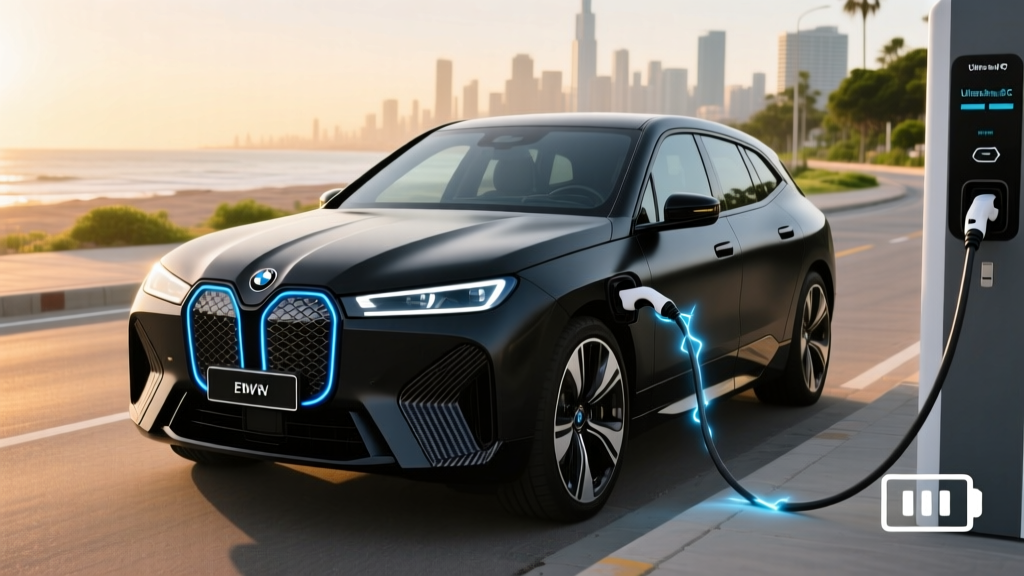
The iX's 195 kW peak DC fast-charging rate uses the CCS1 connector (BMW has not adopted NACS for the iX as of the 2026 model year). On a 350 kW Electrify America or EVgo station, the iX will ramp quickly to its 195 kW ceiling — but like nearly all EVs, that peak rate is not sustained for the full session.
The charge curve tells the real story. The iX holds near-peak rates between roughly 10-40% state of charge, then begins a gradual taper. By 60% SoC, you're seeing approximately 140-150 kW. By 80%, the rate drops to around 70-80 kW. The result: 10-80% takes approximately 34 minutes under ideal thermal conditions (battery preconditioned to optimal temperature). Charging from 80-100% adds another 30-40 minutes due to aggressive tapering — a common characteristic of NMC chemistry protecting long-term cell health.
For home charging, the 11 kW onboard AC charger is a strong point. On a 48-amp Level 2 circuit (the most common home installation), you'll add roughly 28-32 miles of range per hour. A full overnight charge from 20% takes about 9-10 hours — easily achievable with a standard overnight window. The 11 kW rate is faster than some competitors limited to 9.6 kW (7.7 kW on older platforms).
Home install note: A 48A Level 2 charger requires a 60-amp dedicated circuit. Installation costs typically range from $800-$2,500 depending on panel proximity and local permitting, assuming your electrical panel has sufficient capacity. A 200-amp panel upgrade, if needed, can add $1,500-$3,500. Always get a quote from a licensed electrician for your specific situation.
Performance and Driving Dynamics
The xDrive50's 516 horsepower and 4.4-second 0-60 time place it firmly in quick-but-not-extreme territory. Dual electric motors (one front, one rear) provide standard all-wheel drive with torque vectoring. The acceleration is immediate and linear — the hallmark of electric drivetrains — with no turbo lag or transmission hunting.
The M60 steps up to 610 hp and a 3.6-second 0-60, which is genuinely fast for a 5,700-pound SUV. But the M60's real differentiator is its adaptive M suspension and rear-axle steering, which sharpen turn-in and reduce the turning radius in parking situations. The trade-off: the M60's firmer ride is more noticeable over broken pavement compared to the xDrive50's comfort-oriented tuning.
Regenerative braking offers multiple levels, selectable through the iDrive system. The adaptive mode uses radar and navigation data to modulate regen — lifting off the throttle in traffic triggers stronger deceleration, while open-road coasting minimizes it. BMW's one-pedal driving mode (max regen) is available but not as aggressively calibrated as Tesla's or Nissan's, meaning you'll still use the friction brake pedal more often than in some competitors.
Interior, Cargo, and Technology
The iX cabin is where BMW justifies the premium pricing. Materials quality is a step above the Tesla Model X and competitive with the Mercedes EQE SUV — open-pore wood, available microfiber headliner, and hexagonal crystal controls (the iDrive controller, start button, and seat adjustment switch) that catch light without feeling gimmicky.
Passenger space:
- Front headroom: 40.2 inches
- Rear headroom: 38.7 inches
- Front legroom: 40.2 inches
- Rear legroom: 38.9 inches
- Rear shoulder room: 59.2 inches (comfortably seats three adults on shorter trips)
Cargo volume:
- Behind rear seats: 35.5 cu ft
- Rear seats folded: 77.9 cu ft
- Frunk: Not available (the iX uses its front space for HVAC and power electronics)
The lack of a frunk is a notable omission at this price point. The Model X offers 6.6 cu ft up front, and even the Hyundai Ioniq 5 manages a small frunk. For buyers who prioritize maximum cargo flexibility, the iX's 35.5 cu ft rear area is adequate but trails the Model X (37.1 cu ft behind the second row).
Infotainment: The iX runs BMW's iDrive 8.5 on a curved display panel combining a 12.3-inch instrument cluster and 14.9-inch central touchscreen. Wireless Apple CarPlay and Android Auto are standard. The system is responsive and visually polished, though some buyers will find the reduction of physical buttons frustrating — climate controls are embedded in the touchscreen hierarchy, requiring extra taps for simple temperature adjustments.
Driver assistance: The Driving Assistant Professional package adds Highway Assistant (a Level 2 hands-free system on divided highways up to 85 mph, with eyes-on requirement), lane-change assist, and adaptive cruise with stop-and-go. This is SAE Level 2 automation — the driver must remain attentive and keep hands near the wheel (the system uses a capacitive steering wheel, so light contact suffices without torque input). It is not self-driving and does not handle surface streets, construction zones, or unmapped roads independently.
Pricing, Trims, and Federal Tax Credit Eligibility
| Trim | Base MSRP | Destination | Total Starting | §30D Credit Eligible? |
|---|---|---|---|---|
| iX xDrive45 | ~$87,250 | $995 | ~$88,245 | No (above MSRP cap) |
| iX xDrive50 | $89,500 | $995 | $90,495 | No (above MSRP cap) |
| iX M60 | $111,500 | $995 | $112,495 | No (above MSRP cap) |
The BMW iX does not qualify for the $7,500 federal EV tax credit under IRS §30D. The reason: the credit's MSRP cap for SUVs is $80,000, and even the base xDrive45 starts above that threshold. Additionally, the iX is manufactured in Dingolfing, Germany — its battery cells and critical minerals do not meet the domestic-sourcing requirements that apply to credits even for vehicles within the price cap. Buyers should not factor the federal credit into their purchase calculation for any iX trim.
Income caps (if the vehicle were eligible): $300,000 joint / $225,000 head of household / $150,000 single filer. See IRS §30D guidelines for full rules. Consult a tax professional for your specific situation.
With typical options — the Premium Package ($3,400), Driving Assistant Professional ($1,700), and 22" wheels ($2,200) — a well-equipped xDrive50 lands in the $96,000-$100,000 range before state incentives. Some states offer their own rebates or HOV lane access that partially offset the lack of federal credit; check your state's energy office for current programs.
How the iX Stacks Up Against Key Competitors
| Metric | 2026 BMW iX xDrive50 | 2026 Mercedes EQE 350+ SUV | 2026 Tesla Model X LR | 2026 Audi Q8 55 e-tron |
|---|---|---|---|---|
| EPA Range | 340 mi | 305 mi | ~348 mi | ~296 mi |
| Battery (usable) | 105.2 kWh | 90.6 kWh | ~100 kWh | 106 kWh |
| Max DC Charge | 195 kW | 170 kW | 250 kW | 170 kW |
| 0-60 mph | 4.4 sec | 6.4 sec | 3.8 sec | 5.5 sec |
| Base MSRP | $89,500 | $77,900 | $81,630 | $75,595 |
| Federal Credit | No | No | Yes (up to $7,500) | No |
| Cargo (rear seats up) | 35.5 cu ft | 14.0 cu ft | 37.1 cu ft | 30.0 cu ft |
The iX xDrive50 leads this group in EPA range and interior material quality but is undercut on price by the Tesla Model X and Audi Q8 e-tron — both of which start significantly lower. The Model X is the only competitor here eligible for the federal credit, which can bring its effective price below $75,000, widening the gap considerably.
The EQE SUV sacrifices range and cargo space (just 14 cu ft with seats up — a significant practical limitation) but offers a smoother ride and a lower entry price. The Q8 e-tron is the value pick with competitive build quality but trails on range and charging speed.
Pros, Cons, and Who Should Buy the iX
- Class-leading 340-mi EPA range (xDrive50, 20" wheels)
- Excellent ride quality and cabin quietness at highway speed
- 11 kW Level 2 AC charging (faster than many rivals)
- Premium materials and build quality throughout
- Heat pump standard (better cold-weather efficiency)
- Strong 8-year/100,000-mile battery warranty
- No federal tax credit eligibility (MSRP + sourcing)
- No frunk — cargo space trails Model X
- Climate controls buried in touchscreen menus
- 195 kW DCFC peak trails Tesla's 250 kW capability
- High entry price; well-equipped examples exceed $100K
- CCS connector (no native NACS; Supercharger access via adapter)
- Choose the iX if: You want a quiet, comfortable luxury EV SUV for commuting and road trips; you value cabin material quality over raw performance; you have reliable home Level 2 charging; and you're not dependent on the federal tax credit to make the math work.
- Look elsewhere if: Maximum cargo space is critical (Model X), you need the lowest effective price after incentives (Model X or Q8 e-tron), you want the fastest DC charging for frequent road-trip use (Model X at 250 kW), or you prefer hands-free Level 2 highway driving with a more mature network (GM's Super Cruise-equipped vehicles).
Frequently Asked Questions
What is the real-world range of the 2026 BMW iX?
The xDrive50's EPA rating is 340 miles on 20-inch wheels, but expect approximately 290-310 miles in mixed real-world driving. Sustained highway travel at 70-75 mph drops this to roughly 260-280 miles. Cold weather (below 30°F) can reduce range by 20-30%, yielding around 230-260 miles. The M60, with its 21-inch wheels and sportier tuning, achieves a lower EPA rating of approximately 296 miles.
How fast does the BMW iX charge at home and on the road?
At home on a 48-amp Level 2 charger (240V), the iX charges at 11 kW, adding roughly 28-32 miles of range per hour. A full charge from 20% takes approximately 9-10 hours overnight. On DC fast chargers, the iX peaks at 195 kW and charges from 10-80% in about 34 minutes under optimal conditions. Average sustained rate over a typical session is closer to 130-150 kW due to charge-curve tapering above 50% SoC.
Does the 2026 BMW iX qualify for the $7,500 federal EV tax credit?
No. The BMW iX exceeds the IRS §30D MSRP cap of $80,000 for SUVs across all trims (base pricing starts around $87,250 for the xDrive45). Additionally, the iX is manufactured in Germany and its battery sourcing does not meet the critical-minerals and battery-component requirements. No iX trim qualifies for the federal credit regardless of buyer income. Some state-level incentives may still apply — check your state's official energy or environmental agency website.
Is the BMW iX worth buying over the Tesla Model X or Mercedes EQE SUV?
It depends on priorities. The iX offers the best combination of ride comfort, cabin quality, and range in its segment. However, the Tesla Model X is significantly cheaper after the federal tax credit, charges faster at 250 kW, and offers more cargo space plus a frunk. The Mercedes EQE SUV starts at a lower price but sacrifices range (305 mi) and cargo utility. If cabin luxury and long-distance comfort matter most and you don't need the federal credit, the iX xDrive50 is a compelling choice. If value, cargo flexibility, or fast road-trip charging are priorities, the Model X is harder to beat on paper.
What is the BMW iX battery warranty?
BMW covers the iX's high-voltage battery for 8 years or 100,000 miles, whichever comes first. The warranty guarantees the battery will retain at least 70% of its original capacity during that period. BMW uses NMC (nickel-manganese-cobalt) chemistry, which historically shows moderate degradation — typically 8-12% capacity loss over the first 100,000 miles based on industry fleet data for similar chemistries. The standard vehicle warranty is 4 years / 50,000 miles.
Can the BMW iX use Tesla Superchargers?
The iX uses the CCS1 connector natively. BMW has offered a NACS adapter for Supercharger access, but availability and compatibility depend on the specific Supercharger station's configuration (many older stalls have short cables designed for Tesla's rear-quarter charge port, while the iX's port is on the driver-side rear quarter). Plan Supercharger stops carefully using the BMW or Tesla app to confirm cable reach. Electrify America, EVgo, and ChargePoint CCS stations remain the most straightforward DCFC options.
Does the iX have one-pedal driving?
Yes, but with a caveat. The iX offers a maximum-regen mode that enables near-one-pedal driving in city traffic, recovering up to ~0.25g of deceleration. However, this is less aggressive than Tesla's or Nissan Leaf's one-pedal implementations, and the friction brakes may still engage at very low speeds or when coming to a complete stop. The adaptive regen mode, which modulates braking force based on traffic ahead, is the default and works well in practice.