Quick Verdict: The Executive EV That Doesn't Scream "Electric"
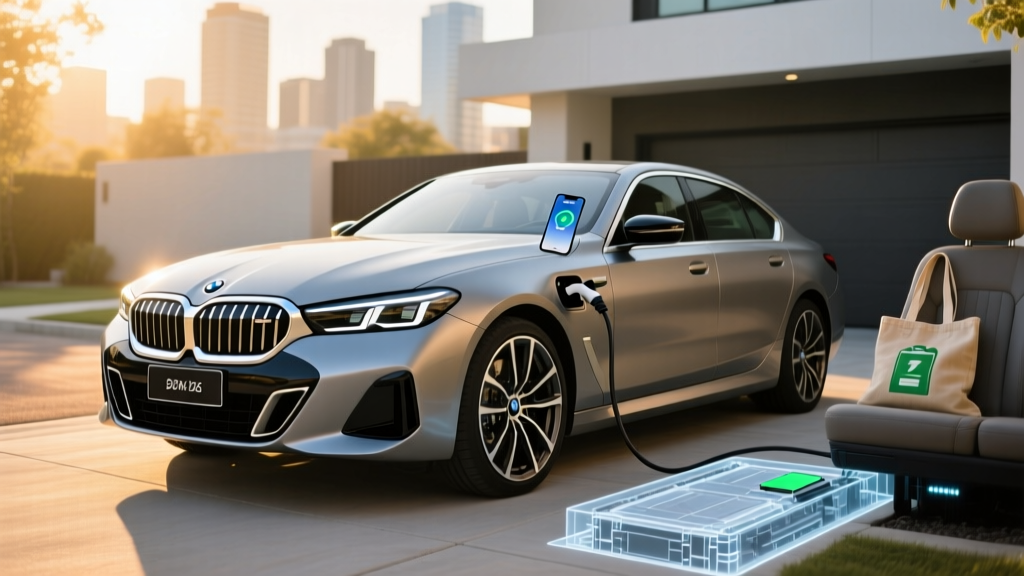
The 2026 BMW i5 electric sedan occupies a specific niche: buyers who want a luxury midsize EV that drives like a BMW first and happens to be electric second. With up to 295 miles of EPA-estimated range (eDrive40), a refined 84.3 kWh NMC battery pack, and DC fast-charging that peaks at 205 kW, the i5 delivers on the fundamentals. But at a starting MSRP of $67,100 for the eDrive40, it's a considered purchase—one where federal tax credit eligibility becomes a deciding factor, not a bonus.
After spending time with the i5 across commuter loops and highway road trips, the takeaway is clear: this is the anti-flashy luxury EV. It won't win drag races against a Tesla Model S Plaid or turn heads like a Lucid Air. Instead, it offers exceptional ride quality, a whisper-quiet cabin, and an infotainment system (iDrive 8.5) that's genuinely best-in-class. The trade-offs? Rear headroom is tight for taller passengers, and the xDrive50's price pushes well past $85,000 before options.
Range & Efficiency: EPA Sticker vs. Real-World Reality
EPA Estimated: 295 miles (eDrive40, 19" wheels) | 256 miles (M60 xDrive)
Real-World Expectation: ~250–270 miles highway (70-75 mph); ~220–240 miles in cold weather (below 32°F)
Efficiency: 97 MPGe combined / 35 kWh per 100 miles (eDrive40)
The BMW i5 eDrive40's 295-mile EPA rating places it squarely in competition with the Mercedes-Benz EQE 350+ (305 mi) and comfortably ahead of the base Audi e-tron GT. But EPA numbers assume mixed driving at moderate temperatures. On sustained highway runs at 70–75 mph in 65°F weather, expect roughly 250–270 miles before you'll want to stop—the i5's aerodynamic drag coefficient of 0.23 helps, but highway speeds still consume energy faster than city regen-heavy driving.
Cold weather is the bigger variable. In sub-freezing temperatures, the i5's heat pump (standard equipment) mitigates cabin heating losses, but battery chemistry still suffers. Plan for a 15–25% range reduction in sustained 20–30°F conditions. That 295-mile sticker becomes roughly 220–240 miles usable. For commuters with home charging, this is manageable. For road trippers crossing the northern plains in January, it requires deliberate planning.
The M60 xDrive variant, with its dual-motor AWD system and 593 hp, drops to 256 miles EPA. The performance penalty is real but proportionate—you're trading roughly 40 miles of range for 265 additional horsepower and all-weather traction.
| Trim | EPA Range | MPGe (Combined) | kWh/100 mi | Drivetrain |
|---|---|---|---|---|
| eDrive40 (19") | 295 mi | 97 | 35 | RWD |
| eDrive40 (20") | 274 mi | 92 | 37 | RWD |
| xDrive40 | 266 mi | 89 | 38 | AWD |
| M60 xDrive | 256 mi | 86 | 39 | AWD |
Source: fueleconomy.gov (EPA). Real-world figures based on owner reports and independent testing.
Battery & Charging: 84.3 kWh NMC Pack, 205 kW Peak
The i5 uses an 84.3 kWh usable battery pack (91.2 kWh gross) with NMC (nickel-manganese-cobalt) chemistry. BMW does not offer an LFP (lithium iron phosphate) option in the i5 lineup—NMC provides the energy density needed to hit 295 miles in a sedan form factor, though it carries a slightly higher degradation profile over 10+ years compared to LFP.
On DC fast charging, the i5 peaks at 205 kW. In practice, you'll see that peak rate sustained from roughly 10–30% State of Charge (SoC), after which the charge curve tapers progressively. A 10–80% session takes approximately 30 minutes at a capable 350 kW charger (such as Electrify America or EVgo stations). At a 150 kW station, expect 10–80% in roughly 38–42 minutes. This is competitive but not class-leading—the Hyundai Ioniq 6, with its 800V architecture, achieves 10–80% in about 18 minutes at a 350 kW charger.
| Charging Level | Max Rate | Speed (mi/hr) | Time (10–80%) | Best Use Case |
|---|---|---|---|---|
| Level 1 (120V) | 1.4 kW | ~4 mi/hr | ~50+ hours | Emergency / trickle |
| Level 2 (240V, 48A) | 11.5 kW | ~33 mi/hr | ~8.5 hours | Home / overnight |
| DC Fast (150 kW) | 150 kW | ~430 mi/hr | ~38–42 min | Road trips (moderate) |
| DC Fast (350 kW) | 205 kW peak | ~590 mi/hr | ~30 min | Road trips (fastest) |
For home charging, the i5's onboard charger accepts up to 11.5 kW on a Level 2, 240V/48A circuit. A full 0–100% charge takes roughly 8.5 hours—meaning you can arrive home at 10 PM with a depleted battery and wake up at 6:30 AM fully charged. Home installation of a 48A hardwired Level 2 charger (such as the ChargePoint Home Flex or Emporia Level 2) typically costs $800–$2,000 including equipment and electrician labor, depending on your panel capacity and run length. BMW includes a complimentary Level 2 charging credit through partner networks for the first year of ownership.
Preconditioning note: The i5 supports battery preconditioning when you set a DC fast-charger as your navigation destination. This warms the battery to optimal charging temperature, reducing taper and shaving 3–5 minutes off a 10–80% session in cold weather. Always use navigation to chargers—don't just pull up cold.
Performance: 335 hp RWD to 593 hp M Performance
The i5 eDrive40 sends 335 horsepower and 295 lb-ft of torque to the rear wheels via a single rear-mounted motor. The 0–60 mph sprint takes 5.7 seconds—respectably quick for a 5,000-pound executive sedan, and the instant torque delivery makes it feel quicker in around-town driving than the number suggests. The rear-drive layout also preserves the steering feel BMW is known for, with precise turn-in and none of the torque-steer tendencies you'd expect in a front-drive car of this power.
The xDrive40 adds a front motor for all-wheel drive, bumping output to 389 hp and dropping 0–60 to 5.2 seconds. The M60 xDrive is the performance flagship: 593 hp, 586 lb-ft, and a 3.7-second 0–60 time. The M60 also includes rear-axle steering, adaptive M suspension, and M Sport brakes—but at $84,100 base, it's a significant step up.
Across all trims, the i5 uses BMW's fifth-generation eDrive technology with externally excited synchronous motors (no permanent magnets, no rare-earth dependency). Regenerative braking offers three levels (low, medium, high) plus an adaptive mode that uses radar and navigation data to adjust regen dynamically. One-pedal driving is available but not as aggressive as Tesla's or Nissan's implementations—you'll still reach for the brake pedal at stops.
Pricing, Trims & Federal Tax Credit Eligibility
| Trim | Base MSRP | As-Tested (Typical) | §30D Credit Eligible? | Est. After Credit |
|---|---|---|---|---|
| eDrive40 | $67,100 | $72,000–$76,000 | Partial / Varies | ~$63,350–$68,250 |
| xDrive40 | $70,100 | $76,000–$82,000 | Partial / Varies | ~$66,350–$74,500 |
| M60 xDrive | $84,100 | $90,000–$98,000 | No (MSRP cap) | $84,100+ |
Critical tax credit note: Under IRS §30D rules, the federal EV tax credit provides up to $7,500 for qualifying new EVs, but eligibility depends on three factors that affect the i5 specifically:
- MSRP Cap: Sedans must have an MSRP at or below $55,000 to qualify. The i5 starts at $67,100—meaning no i5 trim qualifies for the full new-vehicle §30D credit based on MSRP alone. The M60's $84,100 sticker is well above any threshold.
- Battery Sourcing: Even if the MSRP cap were met, the i5's battery components and critical minerals must meet North American sourcing thresholds that shift annually. BMW has not consistently met these thresholds for the i5.
- Income Caps: Buyer adjusted gross income must not exceed $150,000 (single), $225,000 (head of household), or $300,000 (joint filing).
What this means practically: Most i5 buyers will not receive the $7,500 federal tax credit for a new purchase. However, the used EV credit (§25E) offers up to $4,000 (30% of sale price, max $4,000) on a pre-owned i5 priced at $25,000 or below—something to watch for as 2024–2025 models enter the used market in 2027–2028. Always verify current rules at IRS.gov and consult a tax professional before purchasing.
For 2026, BMW also offers a $1,000 loyalty credit for current BMW owners and occasional lease incentives that can effectively reduce monthly payments by $50–$100/month. Lease deals sometimes pass through a manufacturer credit that the lessee benefits from indirectly—check with your dealer.
Interior, Cargo & Technology
The i5's cabin is where the "BMW first, electric second" philosophy shines. The curved display running iDrive 8.5 combines a 12.3-inch instrument cluster and a 14.9-inch central touchscreen behind a single pane of glass. The system supports wireless Apple CarPlay and Android Auto, over-the-air updates, and BMW's Intelligent Personal Assistant voice control. Response times are fast, the UI is logical, and the physical iDrive controller remains for those who prefer not to stab at screens while driving.
Standard equipment includes a panoramic glass roof, power-adjustable sport seats with heated front seats, a 12-speaker audio system, and BMW's Driving Assistant Professional package (adaptive cruise control, lane-keeping assist, blind-spot monitoring, and rear cross-traffic alert). The Highway Assistant feature adds hands-free driving at speeds up to 85 mph on divided highways—but this is an SAE Level 2 system. You must keep your eyes on the road. A camera monitors driver attention, and the system will disengage if you look away.
BMW's Highway Assistant and Driving Assistant Professional are SAE Level 2 driver-assistance systems. The driver must remain fully engaged, monitor the road, and be prepared to take over instantly. These are not autonomous driving systems. Only Level 4 services like Waymo operate without a driver.
Cargo and passenger space: The i5 offers 17.3 cubic feet of trunk space—competitive with the 5 Series (18.4 cu ft gas) but smaller than a Tesla Model S (28 cu ft rear trunk + frunk). The i5 has no front trunk (frunk); the space is occupied by drive electronics. Rear legroom is 36.6 inches, adequate for average-height adults but tight for anyone over 6'2" due to the floor-mounted battery raising the seat height and reducing headroom. The panoramic roof helps the cabin feel airy, but taller rear passengers will notice the compromise.
| Measurement | BMW i5 | Tesla Model S | Mercedes EQE |
|---|---|---|---|
| Front Headroom | 40.1 in | 39.3 in | 39.0 in |
| Rear Legroom | 36.6 in | 40.9 in | 36.9 in |
| Cargo (Trunk) | 17.3 cu ft | 28.0 cu ft | 15.0 cu ft |
| Frunk | None | 3.1 cu ft | None |
Ownership, Warranty & Long-Term Battery Health
BMW covers the i5's high-voltage battery with an 8-year/100,000-mile warranty that guarantees at least 70% capacity retention. If the battery degrades below that threshold within the warranty period, BMW will repair or replace it at no cost. The powertrain (electric motors, reduction gear, power electronics) carries the same 8-year/100,000-mile coverage. The basic vehicle warranty is 4 years/50,000 miles, with 4 years of unlimited-mileage roadside assistance.
NMC battery chemistry in the i5 is expected to lose roughly 8–12% capacity over the first 100,000 miles under normal use patterns. BMW's battery management system includes a buffer (approximately 6.9 kWh of the 91.2 kWh gross is reserved) to protect against deep discharge and overcharge, which extends cell life. To maximize longevity, BMW recommends keeping daily charging between 20–80% SoC and using the built-in charging limit feature. Reserve 100% charges for road trips.
Maintenance costs are minimal compared to a gas 5 Series—no oil changes, no spark plugs, no transmission fluid. Expect to replace cabin air filters ($50–$80 every 2 years), brake fluid (every 2 years, ~$150), and tires (the i5's weight and instant torque accelerate wear; budget $1,200–$1,800 for a set of premium all-seasons every 25,000–35,000 miles). Insurance premiums for the i5 run 15–25% higher than a comparable gas 5 Series due to repair costs and vehicle value—get quotes before purchasing.
BMW includes 3 years of complimentary scheduled maintenance and offers a BMW Home Charger installation partnership through Qmerit, which can streamline the Level 2 installation process. The i5 is also compatible with the growing NACS (Tesla Supercharger) network via BMW's included CCS-to-NACS adapter, expanding road-trip charging access significantly for 2026.
How the i5 Stacks Up Against Key Rivals
Choose the BMW i5 If...
- Ride quality and cabin quietness are top priorities
- You prefer a traditional luxury sedan aesthetic over futuristic styling
- iDrive 8.5's infotainment and driver-assist suite appeal to you
- You value rear-drive dynamics (eDrive40) in an EV
- You'll charge primarily at home and take moderate road trips
Look at Competitors If...
- Tesla Model S: You need more cargo space, Supercharger access natively, or want 405-mi range (but accept a spartan interior and no Apple CarPlay)
- Mercedes EQE 350+: You want 305 mi EPA range and a more spacious rear seat (but sacrifice some driving engagement)
- Hyundai Ioniq 6: You want faster 800V charging (18 min 10–80%) and a lower price (~$42,000) in a smaller package
- Lucid Air Pure: You prioritize maximum range (419 mi EPA) and rear-seat space (but pay $70,000+ and face a smaller service network)
In head-to-head efficiency, the i5 eDrive40's 97 MPGe trails the Lucid Air Pure (146 MPGe) and Hyundai Ioniq 6 (140 MPGe) but matches the Mercedes EQE 350+ (95 MPGe). Where the i5 wins is in driving dynamics and build quality—panel gaps, material selection, and suspension tuning are all a step above Hyundai and competitive with Mercedes and Tesla.
Pros, Cons & Bottom Line
✓ Pros
- Excellent ride quality and cabin isolation
- iDrive 8.5 is intuitive, fast, and feature-rich
- 295 mi EPA range (eDrive40) is competitive
- NACS adapter included for Supercharger access
- Strong standard safety and driver-assist suite
- Heat pump standard (improves cold-weather range)
- Complimentary maintenance and charging credits
✗ Cons
- Does not qualify for $7,500 federal tax credit (MSRP cap)
- No frunk; 17.3 cu ft trunk is modest for the class
- Rear headroom tight for passengers over 6'2"
- DC fast charging (205 kW peak) lags 800V rivals
- M60 xDrive pushes past $85,000 before options
- Insurance premiums 15–25% above gas 5 Series
- One-pedal driving mode not aggressive enough for some
The bottom line: The 2026 BMW i5 is the luxury EV sedan for buyers who don't want their car to make a statement about being electric. It's a superb daily driver with genuine road-trip capability, wrapped in a cabin that rivals anything in the $70,000–$85,000 range. The lack of federal tax credit eligibility stings, and the charging speed isn't class-leading—but if you can charge at home and value refinement over raw specs, the i5 deserves a serious test drive.
Frequently Asked Questions
What is the real-world range of the BMW i5?
The EPA rates the i5 eDrive40 at 295 miles. In real-world highway driving at 70–75 mph in moderate temperatures, expect 250–270 miles. In cold weather (below 32°F), plan for 220–240 miles. The M60 xDrive delivers roughly 215–230 miles on the highway.
How fast does the BMW i5 charge at home and on the road?
At home on a Level 2 (240V/48A) charger, the i5 adds about 33 miles of range per hour, with a full charge taking ~8.5 hours. On DC fast chargers, it peaks at 205 kW, achieving 10–80% in about 30 minutes at a 350 kW station. At a 150 kW station, 10–80% takes roughly 38–42 minutes due to charge curve tapering.
Does the BMW i5 qualify for the $7,500 federal EV tax credit?
No. Under current IRS §30D rules, new sedans must have an MSRP at or below $55,000 to qualify. The i5 starts at $67,100, making it ineligible regardless of battery sourcing. Some buyers may benefit from state-level incentives, lease pass-through credits, or the used EV credit (§25E) when pre-owned models become available. Always check IRS.gov for current rules.
Is the BMW i5 worth buying vs. the Tesla Model S or Mercedes EQE?
It depends on your priorities. The i5 wins on cabin refinement, build quality, and traditional luxury sedan feel. The Tesla Model S wins on range (405 mi), cargo space, and Supercharger convenience. The Mercedes EQE offers slightly more range (305 mi) and rear-seat space but a less engaging drive. Test all three before deciding.
What is the BMW i5's battery warranty?
BMW covers the high-voltage battery for 8 years or 100,000 miles, whichever comes first, with a guaranteed minimum capacity retention of 70%. The powertrain (motors and power electronics) carries the same coverage. The basic vehicle warranty is 4 years/50,000 miles.
Does the BMW i5 have a frunk (front trunk)?
No. The i5 does not have a front trunk. The space under the hood houses drive electronics and the HVAC system. Total cargo space is 17.3 cubic feet in the rear trunk only.
Can the BMW i5 use Tesla Superchargers?
Yes. For 2026, BMW includes a CCS-to-NACS adapter with the i5, enabling access to Tesla's Supercharger network (V3 and V4 stations). This significantly expands DC fast-charging options for road trips. The i5 retains its native CCS1 port for Electrify America, EVgo, and other networks.