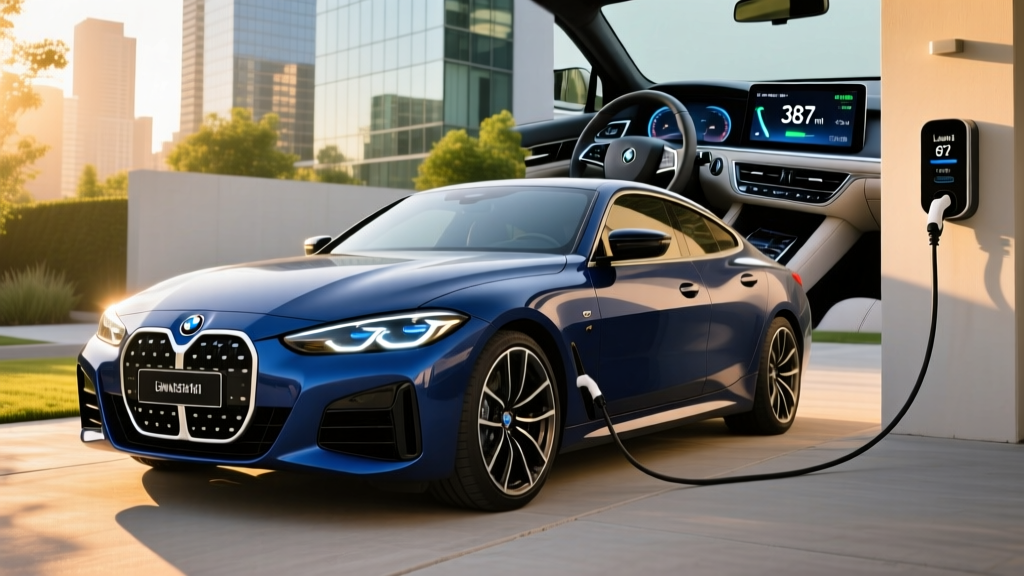
Quick Verdict: The i4 BMW Electric Balances Sport Sedan DNA with Practical EV Ownership
The BMW i4 remains one of the most compelling electric sport sedans on the market in 2026, pairing the 3 Series–derived driving dynamics with a mature, 800V-capable platform and competitive range. Available in eDrive40 (RWD), xDrive40 (AWD), and the high-performance M50 (AWD) trims, the i4 slots into a crowded segment against the Tesla Model 3, Hyundai Ioniq 6, and Polestar 2. Its standout qualities — refined ride, excellent infotainment, and DC fast-charging speeds that actually deliver on road trips — are tempered by a tight rear seat and a price that climbs quickly with options.
This review breaks down everything a prospective buyer needs: exact EPA range figures, real-world range expectations in highway and cold-weather driving, the 81.5 kWh battery pack details, charging speeds across Level 1, Level 2, and DC fast charging, and a thorough look at federal tax credit eligibility under current IRS §30D rules.
Range and Efficiency: EPA Numbers vs. Real-World Expectations
EPA Estimated Range: Up to 318 miles (eDrive40, 19-inch wheels) | 276 miles (M50)
Real-World Expectation: Plan for 250–280 miles on highway-heavy road trips at 70–80 mph; 190–230 miles in sub-30°F winter conditions with cabin heating. City and mixed driving in moderate temperatures consistently hits or slightly exceeds EPA estimates thanks to strong regenerative braking.
The 2026 BMW i4 uses an 81.5 kWh usable (83.9 kWh gross) lithium-ion battery pack with NMC (nickel manganese cobalt) chemistry. This is a higher-energy-density choice than LFP, giving BMW the ability to pack substantial range into the CLAR platform's floor without compromising the sedan's low center of gravity.
Efficiency varies meaningfully by trim. The eDrive40, with its single rear motor, achieves an EPA-rated 109 MPGe combined (roughly 30 kWh/100 mi). The dual-motor M50 drops to approximately 87 MPGe combined (38 kWh/100 mi) — a significant efficiency penalty for the extra 207 horsepower.
| Trim | Drivetrain | EPA Range (mi) | MPGe Combined | kWh/100 mi |
|---|---|---|---|---|
| eDrive40 (19" wheels) | RWD | 318 | 109 | 30 |
| eDrive40 (20" wheels) | RWD | 282 | 98 | 34 |
| xDrive40 | AWD | 293 | 100 | 33 |
| M50 | AWD | 276 | 87 | 38 |
The wheel-size effect is real: stepping from 19-inch to 20-inch wheels on the eDrive40 costs you 36 miles of EPA range. For buyers prioritizing maximum distance per charge, the 19-inch Aero wheels are the clear choice.
Charging Speeds: DC Fast Charging, Level 2, and the Charge Curve
Understanding the i4's charging capabilities requires separating peak power from sustained delivery. The i4 supports up to 205 kW peak DC fast charging on a compatible CCS1 connector. That peak rate holds roughly from 10% to 45% State of Charge (SoC), after which the charge curve tapers progressively — a thermal management strategy that protects the NMC cells while still delivering competitive fill-up times.
| Charge Level | Power (kW) | Connector | Speed | Notes |
|---|---|---|---|---|
| Level 1 (120V) | ~1.4 kW | J1772/NACS adapter | ~4 mi/hr | Emergency/top-up only; 80+ hours for full charge |
| Level 2 (240V, 32A) | 7.7 kW | J1772/NACS adapter | ~25 mi/hr | Standard home outlet; ~10 hours 0–100% |
| Level 2 (240V, 48A) | 11.5 kW | J1772/NACS adapter | ~37 mi/hr | Requires 60A circuit; ~7 hours 0–100% |
| DC Fast Charge | Up to 205 kW peak | CCS1 (NACS adapter included) | 10–80% in ~31 min | Peak holds to ~45% SoC; tapers above 80% |
On a road trip, the 10–80% time of approximately 31 minutes is competitive but not class-leading — the Hyundai Ioniq 6 and Kia EV6, with their 800V architectures, achieve 10–80% in roughly 18 minutes on a 350 kW charger. The i4's 400V platform limits it here, though 205 kW peak is strong enough that most Electrify America and EVgo 150–350 kW stalls will deliver a satisfying experience.
For home charging, BMW includes a Flexible Fast Charger capable of 7.7 kW on a standard NEMA 14-50 outlet. Upgrading to a hardwired 48-amp Level 2 wallbox (requiring a 60-amp dedicated circuit) unlocks the full 11.5 kW onboard charger, which is worthwhile for daily drivers covering 60+ miles.
Performance: 0-60 Times, Horsepower, and Driving Dynamics
The 2026 i4 lineup covers a wide performance spectrum:
| Trim | Horsepower | Torque (lb-ft) | 0–60 mph (sec) | Top Speed (mph) | Drivetrain |
|---|---|---|---|---|---|
| eDrive40 | 335 hp | 317 | 5.5 | 118 | RWD (single motor) |
| xDrive40 | 396 hp | 443 | 4.6 | 130 | AWD (dual motor) |
| M50 | 536 hp | 586 | 3.7 | 140 | AWD (dual motor) |
The eDrive40's 5.5-second 0–60 is brisk enough for confident highway merging and passing. The M50's 3.7-second sprint puts it in genuine M-car territory, with instantaneous electric torque that makes internal-combustion M3 owners take notice at stoplights. All trims feature BMW's adaptive regenerative braking, which intelligently adjusts regen intensity based on traffic and navigation data — effectively enabling one-pedal driving in most scenarios without requiring a specific toggle.
Ride quality is a genuine differentiator. The CLAR platform gives the i4 a planted, composed feel that neither the Model 3 nor the Ioniq 6 quite matches. Road noise isolation is strong, and the optional adaptive M suspension on the M50 manages to be both firm in Sport mode and surprisingly compliant over broken pavement.
Interior, Cargo, and Technology
The i4's cabin uses BMW's Curved Display — a 12.3-inch instrument cluster merged with a 14.9-inch infotainment touchscreen running iDrive 8.5. The system is responsive, supports wireless Apple CarPlay and Android Auto, and includes a capable voice assistant. Physical climate controls are absent, which frustrates some drivers, though the touchscreen layout is logical enough to adapt to within a week.
Driver assistance is robust: the Driving Assistant Professional package adds BMW's Highway Assistant (a Level 2 hands-off-capable system on divided highways up to 85 mph, with driver monitoring via interior camera). This is a strong SAE Level 2 system — not self-driving — and the driver must remain attentive at all times. It competes favorably with Ford's BlueCruise and GM's Super Cruise in real-world smoothness, though Super Cruise's hands-free mapping coverage is broader.
Cargo and Passenger Dimensions
| Measurement | Value |
|---|---|
| Front legroom | 41.5 in |
| Rear legroom | 34.5 in |
| Front headroom | 39.0 in |
| Rear headroom | 36.6 in |
| Cargo volume (rear seats up) | 16.6 cu ft |
| Cargo volume (rear seats folded) | 45.6 cu ft |
| Frunk | None |
The rear seat is the i4's most significant practical weakness. At 34.5 inches of legroom, it's tight for adults on longer trips — noticeably less than the Tesla Model 3 (35.3 in) and far behind the Hyundai Ioniq 6 (38.2 in). The floor hump from the CLAR platform's shared ICE/EV architecture also compromises the middle-rear seating position. There is no frunk, which limits small-item storage compared to purpose-built EV platforms.
Pricing, Trim Levels, and Federal Tax Credit Eligibility
| Trim | Base MSRP | As-Tested (Typical Options) | §30D Credit Eligibility |
|---|---|---|---|
| eDrive40 | $57,900 | $62,000–$66,000 | Unlikely — exceeds MSRP cap for sedans ($55,000) |
| xDrive40 | $62,900 | $68,000–$73,000 | No — exceeds sedan MSRP cap |
| M50 | $70,700 | $76,000–$82,000 | No — exceeds sedan MSRP cap |
This is the hard truth for i4 shoppers: no 2026 BMW i4 trim qualifies for the full $7,500 federal EV tax credit under §30D. The IRS classifies the i4 as a sedan (not an SUV), and the sedan MSRP cap is $55,000. Even the base eDrive40 starts at $57,900, disqualifying it before income limits, critical-mineral sourcing, and battery-component rules even enter the equation.
However, the used EV credit (up to $4,000 or 30% of sale price, whichever is less) applies to pre-owned i4 models that are at least two model years old and priced under $25,000 — a path worth exploring as 2023–2024 i4 examples enter the secondary market. Income caps for the used credit are $75,000 single / $150,000 joint filers.
State incentives may partially offset the lack of federal credit. California's CVRP, Colorado's innovative motor vehicle credit, and various utility rebates can reduce effective cost by $2,000–$7,500 depending on jurisdiction. Always verify current state-level programs through your state energy office or dealer, as these change frequently.
Battery Warranty, Degradation, and Long-Term Ownership
BMW covers the i4's high-voltage battery with an 8-year / 100,000-mile warranty that guarantees at least 70% of original capacity retention. If the battery degrades below this threshold within the warranty period, BMW will repair or replace it at no cost.
NMC chemistry in the i4's fifth-generation eDrive system has shown strong real-world durability. Data aggregated from European and North American i4 owners indicates approximately 4–6% capacity loss over the first 50,000 miles, with the curve flattening significantly after that. At this rate, most i4 batteries should retain 85%+ capacity at 150,000 miles — well above BMW's warranty threshold.
The broader powertrain (electric motors, power electronics) carries a separate 8-year / 100,000-mile warranty. Corrosion protection runs 12 years with unlimited mileage. These are competitive with Tesla's 8-year / 120,000-mile battery warranty, though Tesla offers slightly more mileage coverage.
Pros
- Composed, sport-sedan ride quality that outclasses most EV competitors
- Strong 205 kW DC fast-charging with practical 10–80% times
- iDrive 8.5 infotainment is polished, responsive, and feature-rich
- Highway Assistant is one of the best Level 2 systems available
- M50 delivers genuine sports-car acceleration (3.7s 0–60)
- Competitive 318-mile EPA range (eDrive40, 19" wheels)
Cons
- No trim qualifies for the $7,500 federal tax credit (sedan MSRP cap)
- Rear seat is tight for adults (34.5" legroom)
- No front trunk (frunk) — a missed opportunity for small-item storage
- 400V architecture limits DC charging vs. 800V competitors
- Options escalate price rapidly; a well-equipped eDrive40 exceeds $65K
- Physical climate controls absent — touchscreen-only HVAC
How the BMW i4 Stacks Up Against Key Competitors
| Spec | BMW i4 eDrive40 | Tesla Model 3 LR | Hyundai Ioniq 6 SEL | Polestar 2 LR SM |
|---|---|---|---|---|
| Base MSRP | $57,900 | $47,740 | $46,700 | $54,300 |
| EPA Range | 318 mi | 363 mi | 361 mi | 315 mi |
| DC Fast Charge (peak) | 205 kW | 250 kW | 350 kW | 205 kW |
| 10–80% DCFC Time | ~31 min | ~27 min | ~18 min | ~30 min |
| 0–60 mph | 5.5 sec | 4.2 sec | 5.1 sec | 5.9 sec |
| Rear Legroom | 34.5 in | 35.3 in | 38.2 in | 33.5 in |
| Federal Tax Credit | No (MSRP cap) | Partial (sourcing rules) | Yes (if income eligible) | No (MSRP cap, sourcing) |
The i4 wins on ride quality, interior materials, and driver-assist polish. It loses on price, rear-seat space, and charging speed versus the 800V Ioniq 6. The Model 3 remains the value and range king, but its minimalist interior and inconsistent panel gaps steer luxury-minded buyers elsewhere. The Polestar 2 is a close rival in ethos but offers less range and a smaller rear seat.
Who Should Buy the BMW i4 Electric?
Choose the BMW i4 if:
- You prioritize driving dynamics and ride refinement over maximum range-per-dollar
- You primarily commute solo or with one passenger and rarely carry rear-seat adults
- You want a luxury-badge EV without stepping up to the $80K+ i5 or i7
- You have reliable home Level 2 charging and use DC fast charging primarily for road trips
- You value BMW's dealer network and certified service infrastructure
Look elsewhere if:
- Federal tax credit eligibility is a dealbreaker (consider the Ioniq 6 or Model 3)
- You regularly carry adults in the rear seat (Ioniq 6 or Model 3 are roomier)
- Fastest possible DC charging is a priority (Ioniq 6/EV6 with 800V win here)
- You need cargo versatility — no frunk and limited total volume vs. hatchback rivals
Frequently Asked Questions
What is the real-world range of the 2026 BMW i4?
On the eDrive40 with 19-inch wheels, expect 250–280 miles on highway-dominant road trips at 70–80 mph, and roughly 190–230 miles in sub-30°F winter conditions. Mixed city/suburban driving in moderate temperatures consistently matches or slightly exceeds the 318-mile EPA estimate.
How fast does the BMW i4 charge at home and on DC fast chargers?
On a 48-amp Level 2 home charger (11.5 kW), the i4 gains roughly 37 miles of range per hour and charges from empty to full in about 7 hours. On a DC fast charger, it peaks at 205 kW and reaches 10–80% in approximately 31 minutes, though the charge curve tapers meaningfully above 45% SoC.
Does the BMW i4 qualify for the federal EV tax credit?
No. The IRS classifies the i4 as a sedan, and the §30D sedan MSRP cap is $55,000. The base eDrive40 starts at $57,900, so no trim qualifies. State incentives and the used-EV credit (for 2+ year-old models under $25,000) remain options.
Is the BMW i4 worth buying over the Tesla Model 3 or Hyundai Ioniq 6?
It depends on priorities. The i4 offers superior ride quality, a more polished interior, and one of the best Level 2 driver-assist systems available. The Model 3 wins on range (363 mi), price ($47,740 base), and Supercharger network access. The Ioniq 6 dominates on DC charging speed (~18 min 10–80%), rear-seat room, and tax credit eligibility. Test-driving all three is strongly recommended.
What are the biggest drawbacks of the BMW i4?
The tight rear seat (34.5" legroom), lack of a frunk, no federal tax credit eligibility, and a 400V charging architecture that falls behind 800V competitors are the primary compromises. Options also push pricing well above the base MSRP.
How long will the BMW i4 battery last?
BMW warranties the battery for 8 years / 100,000 miles with a 70% capacity retention guarantee. Real-world data from existing i4 owners suggests approximately 4–6% degradation in the first 50,000 miles, with the rate slowing considerably afterward. Expecting 85%+ capacity at 150,000 miles is reasonable based on current NMC cell performance.