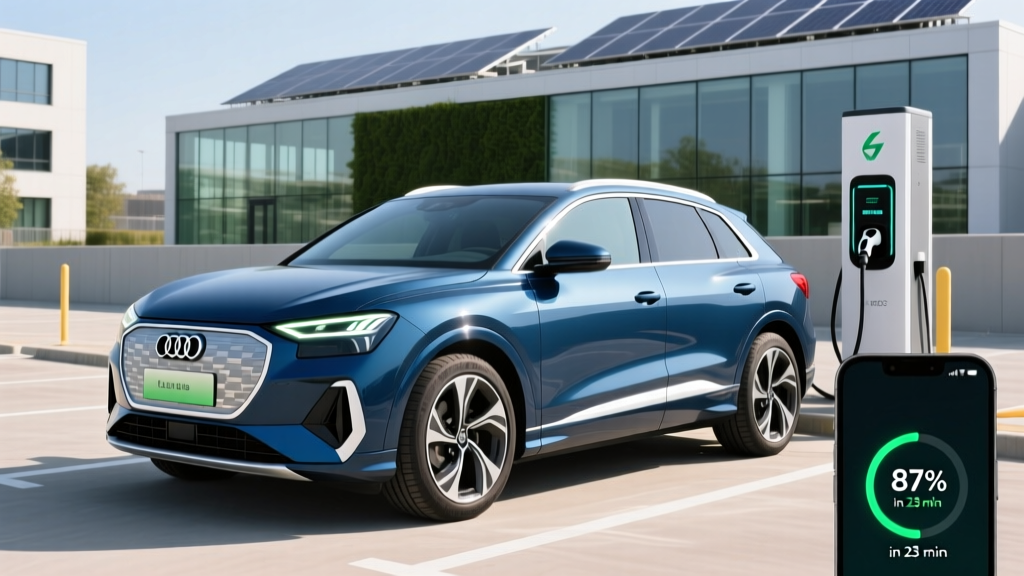
The Audi Q4 e-tron occupies a specific niche in the premium compact EV segment: it's the luxury-branded sibling of the Volkswagen ID.4, built on the same MEB platform but wrapped in a more refined interior, sharper styling, and Audi's trademark build quality. For 2026, Audi has refreshed the Q4 e-tron with a larger 82 kWh battery pack, faster DC charging, and updated infotainment — addressing the most common complaints from earlier model years. But does the premium badge justify the price premium over its corporate cousin, and how does it stack up against the BMW iX1, Genesis GV60, and Tesla Model Y?
After spending time with the Q4 e-tron in mixed driving — city commuting, highway road trips, and multiple DC fast-charging sessions — here's the data-driven breakdown every buyer needs before signing.
2026 Audi Q4 e-tron Core Specifications
| Specification | Q4 45 e-tron (RWD) | Q4 55 e-tron quattro (AWD) |
|---|---|---|
| Base MSRP | $49,800 | $56,300 |
| EPA Range | 265 miles | 242 miles |
| Battery (usable) | 82 kWh, NMC | 82 kWh, NMC |
| Efficiency (combined) | 114 MPGe / 29 kWh/100mi | 105 MPGe / 32 kWh/100mi |
| Horsepower | 282 hp | 340 hp |
| 0–60 mph | 7.6 sec | 5.0 sec |
| Drivetrain | Single-motor RWD | Dual-motor AWD |
| Max DC Fast Charge | 175 kW | 175 kW |
| 10–80% DC Charge Time | ~28 min | ~28 min |
| Level 2 Home Charge | 11 kW (~30 mi/hr) | 11 kW (~30 mi/hr) |
| Battery Warranty | 8 yr / 100,000 mi | 8 yr / 100,000 mi |
| Cargo Volume | 24.8 cu ft (rear seats up) / 54.4 cu ft (folded) | 24.8 cu ft / 54.4 cu ft |
Data sourced from fueleconomy.gov and Audi USA specifications. Efficiency and range figures are EPA estimates for the 2026 model year.
Real-World Range: What the EPA Sticker Doesn't Tell You
The Q4 55 e-tron quattro carries an EPA estimate of 242 miles. In mixed real-world driving — 70 mph highway cruising at 72°F — expect approximately 215–225 miles before reaching 10% SoC. In cold weather (below 32°F), that drops to roughly 180–200 miles depending on cabin heat usage and whether you precondition the battery. The RWD Q4 45 e-tron's 265-mile EPA rating translates to about 235–245 miles real-world in temperate conditions.
The Q4 e-tron's efficiency is respectable but not class-leading. At 29–32 kWh per 100 miles, it trails the Tesla Model Y Long Range (~27 kWh/100mi) but runs close to the Genesis GV60. The MEB platform's thermal management is adequate, though the pack lacks the aggressive active heating of Hyundai's E-GMP architecture — meaning cold-weather DC charging sessions take longer unless you precondition via the myAudi app before arriving at the charger.
For context on a 300-mile road trip: the Q4 55 quattro requires one full charge stop, adding roughly 30 minutes if you use a 150+ kW Electrify America or ChargePoint station. That's competitive with most of the segment, though the Model Y's Supercharger network integration still offers a more seamless experience.
Charging Speed: DC Fast Charge and Home Level 2
The 2026 Q4 e-tron's headline upgrade is the jump to 175 kW peak DC fast charging, up from 135 kW in earlier model years. This is a meaningful improvement, but the charge curve tells the full story:
| Charging Level | Power / Voltage | Miles Added Per Hour | Notes |
|---|---|---|---|
| Level 1 (120V) | ~1.4 kW | ~3–4 mi/hr | Emergency/trickle only |
| Level 2 (240V, 48A) | 11 kW | ~30 mi/hr | Full charge in ~9 hours |
| DC Fast Charge | Peak 175 kW (CCS) | ~190 mi in 30 min (10–80%) | Tapers above 80% SoC |
The 175 kW peak is achieved only between roughly 10% and 35% State of Charge (SoC) on a compatible CCS1 station. Beyond 50%, the rate tapers to approximately 120 kW, and above 80% it drops sharply to around 40–50 kW. This is typical NMC chemistry behavior — Audi prioritizes battery longevity over sustained peak charging. The 10–80% time of approximately 28 minutes is competitive, though Hyundai/Kia's 800V architecture (Ioniq 5, EV6) still holds the segment crown at ~18 minutes.
One practical note: the Q4 e-tron uses the CCS1 connector for DC charging. While Audi has confirmed NACS adoption for future models, the 2026 Q4 e-tron retains CCS. Tesla Supercharger access is available via a CCS-to-NACS adapter (sold separately, ~$200), which unlocks roughly 16,000 additional fast-charging stalls nationwide. Plan for this accessory cost if you road-trip frequently.
Driving Dynamics and Performance
The dual-motor Q4 55 e-tron quattro delivers 340 hp and 402 lb-ft of torque, launching to 60 mph in 5.0 seconds. That's brisk for a compact luxury crossover, though it won't embarrass a Model Y Performance (3.5 seconds). The single-motor Q4 45 e-tron's 282 hp and 7.6-second 0–60 time is adequate for commuting and merging but noticeably less urgent.
Where the Q4 e-tron earns its Audi badge is ride refinement. The suspension tuning — particularly with the optional S line sport package and adaptive dampers — is more composed over broken pavement than the ID.4 and noticeably quieter at highway speeds. The steering is weighted well but numb, a common MEB-platform trait. Regenerative braking offers three levels selectable via steering-wheel paddles, but there's no true one-pedal driving mode — a missed opportunity that Audi has stubbornly refused to address, unlike competitors such as the BMW iX1 or Chevrolet Equinox EV.
The quattro AWD system is fully electric (no mechanical linkage between axles), with the front motor engaging on demand for traction or hard acceleration. In rain and light snow, the system performs confidently, though ground clearance of 7.0 inches limits any serious off-pavement ambitions.
Interior, Technology, and Cargo Practicality
The Q4 e-tron's cabin is where the Audi premium over the ID.4 becomes tangible. Soft-touch materials, aluminum inlays, and Audi's 10.1-inch MMI touchscreen (upgraded to 11.6 inches on Prestige trims) create a genuinely upscale environment. The 10.25-inch digital instrument cluster is clear and configurable, and the available augmented-reality head-up display overlays navigation arrows onto the road ahead — a feature that remains rare in this price bracket.
Infotainment runs on Audi's latest MIB4 software, which is a significant improvement over the laggy MIB3 in 2022–2024 models. Wireless Apple CarPlay and Android Auto are standard. The system supports over-the-air updates, and the voice assistant handles natural-language commands reasonably well.
Cargo space is generous for the segment: 24.8 cubic feet behind the rear seats and 54.4 cubic feet with the 60/40 split folded. That edges out the BMW iX1 (22.8 cu ft) but falls short of the Tesla Model Y (30.2 cu ft). There's no frunk (front trunk) — the MEB platform's power electronics occupy that space. Rear-seat legroom of 38.5 inches is comfortable for adults on longer trips.
Driver-Assistance Technology
Audi's Adaptive Cruise Assist with lane centering is a Level 2 driver-assistance system. It manages steering, acceleration, and braking on highways, but the driver must remain fully engaged with hands on the wheel and eyes on the road. This is not autonomous or self-driving. The system is competent in highway traffic and well-marked lanes, but it does not handle construction zones, complex merges, or unmapped roads reliably.
Standard safety features include automatic emergency braking with pedestrian detection, lane-departure warning, blind-spot monitoring, and rear cross-traffic alert. The available Park Assist Plus handles parallel and perpendicular parking automatically. The Q4 e-tron earned a Top Safety Pick+ rating from IIHS for the previous model year, and the 2026 retains the same structural safety provisions.
Pricing, Trims, and Federal Tax Credit Eligibility
The 2026 Audi Q4 e-tron lineup is structured across three trims for each powertrain:
| Trim | MSRP | Est. After §30D Credit* |
|---|---|---|
| Q4 45 e-tron Premium | $49,800 | $42,300 |
| Q4 45 e-tron Premium Plus | $53,400 | $45,900 |
| Q4 55 e-tron Premium Plus | $56,300 | $48,800 |
| Q4 55 e-tron Prestige | $61,200 | $53,700 |
*Federal tax credit figures assume full eligibility under IRS §30D. Actual credit depends on multiple factors — see checklist below. As of 2026, the credit can be transferred to the dealer at point of sale as an immediate purchase-price reduction.
- MSRP cap: SUVs must be priced at or below $80,000. All Q4 e-tron trims qualify.
- Buyer income limits: Modified AGI ≤ $150,000 (single), ≤ $225,000 (head of household), ≤ $300,000 (joint). Exceed these thresholds and you receive no credit.
- Battery sourcing: The credit splits into two halves — $3,750 for critical-minerals sourcing and $3,750 for battery-component assembly. As of 2026, the Q4 e-tron's supply chain qualifies for a portion of the full $7,500; confirm the exact eligible amount with your Audi dealer at purchase, as sourcing requirements tighten annually under the Inflation Reduction Act.
- Point-of-sale transfer: You can elect to transfer the credit to the dealer, reducing your out-of-pocket cost at signing rather than waiting for a tax refund.
- VIN verification: Always confirm the vehicle's VIN on fueleconomy.gov before finalizing your purchase.
Warranty and Long-Term Ownership Costs
Audi covers the Q4 e-tron's high-voltage battery with an 8-year / 100,000-mile warranty guaranteeing a minimum of 70% capacity retention. The limited vehicle warranty runs 4 years / 50,000 miles, which is typical for the luxury segment but less generous than Hyundai/Genesis (5 yr / 60,000 mi) or Tesla (4 yr / 50,000 mi with 8 yr / 120,000 mi battery coverage).
The 82 kWh pack uses NMC (nickel-manganese-cobalt) chemistry, which offers higher energy density than LFP but is more sensitive to sustained high SoC storage. Best practice: set your daily charge limit to 80% and avoid leaving the vehicle at 100% SoC for extended periods. If you're considering a used Q4 e-tron in the future, request a battery State of Health (SoH) report from an Audi dealer — this is a straightforward OBD-II scan that reveals remaining capacity.
Insurance costs for the Q4 e-tron run approximately 15–25% higher than a comparable gas-powered Audi Q5, reflecting the elevated repair costs of EV battery packs and aluminum body panels. Get a quote before committing — premiums vary significantly by ZIP code and driving record.
Q4 e-tron vs. Key Competitors: Which Should You Choose?
- You prioritize cabin refinement, ride quality, and brand prestige over maximum range or fastest charging.
- You want a luxury compact EV SUV under $60,000 with strong build quality and dealer service network.
- You value the augmented-reality HUD and Audi's driver-assist suite.
- Maximum range is your top priority — the Tesla Model Y Long Range (330 mi EPA) or Hyundai Ioniq 5 (305 mi EPA) deliver more.
- You need the fastest DC charging — Hyundai/Kia's 800V platform charges 10–80% in ~18 minutes vs. the Q4's ~28.
- You want one-pedal driving or the lowest cost per mile — Tesla's efficiency and Supercharger network are hard to beat.
| Spec | Audi Q4 55 e-tron | BMW iX1 xDrive28 | Genesis GV60 Advanced | Tesla Model Y LR |
|---|---|---|---|---|
| EPA Range | 242 mi | 240 mi | 248 mi | 330 mi |
| Battery | 82 kWh NMC | 64.7 kWh NMC | 77.4 kWh NMC | 75 kWh NMC |
| DC Fast Charge | 175 kW / ~28 min | 130 kW / ~34 min | 235 kW / ~18 min | 250 kW / ~20 min |
| 0–60 mph | 5.0 sec | 5.6 sec | 5.3 sec | 4.8 sec |
| Starting MSRP | $56,300 | $52,800 | $53,350 | $48,990 |
| Cargo (rear up) | 24.8 cu ft | 22.8 cu ft | 24.0 cu ft | 30.2 cu ft |
Pros and Cons
- Refined, quiet cabin with genuine luxury materials
- Improved 175 kW DC charging for 2026
- Comfortable ride quality with adaptive suspension option
- Strong IIHS safety ratings
- Augmented-reality HUD is a segment standout
- All trims fall under the $80,000 MSRP cap for the §30D tax credit
- Range trails Tesla Model Y and Hyundai Ioniq 5
- No one-pedal driving mode
- CCS connector requires adapter for Tesla Supercharger access
- Efficiency (kWh/100mi) is middling for the class
- Cold-weather charging curve is slower than 800V competitors
- No front trunk (frunk) for additional storage
Frequently Asked Questions
What is the real-world range of the 2026 Audi Q4 e-tron?
The Q4 55 e-tron quattro's EPA rating is 242 miles. In real-world highway driving at 70 mph in mild temperatures, expect 215–225 miles. Cold weather (below freezing) reduces that to approximately 180–200 miles. The RWD Q4 45 e-tron's 265-mile EPA rating yields roughly 235–245 miles in temperate mixed driving.
How fast does the Q4 e-tron charge at home and on the road?
At home on a Level 2 (240V, 48A) charger, the Q4 e-tron accepts up to 11 kW, adding about 30 miles of range per hour — a full charge takes approximately 9 hours. On a DC fast charger, it peaks at 175 kW and charges from 10% to 80% in roughly 28 minutes, though the rate tapers significantly above 80% SoC.
Does the 2026 Q4 e-tron qualify for the federal EV tax credit?
All Q4 e-tron trims fall under the $80,000 MSRP cap for SUVs under IRS §30D. However, your personal eligibility depends on income limits (≤$150K single / ≤$300K joint) and the vehicle's battery-sourcing compliance, which determines whether you receive the full $7,500 or a partial credit. Confirm the exact amount with your dealer and verify the VIN on fueleconomy.gov before purchasing. The credit can be applied at point of sale.
Is the Q4 e-tron worth buying over the Tesla Model Y or Ioniq 5?
It depends on your priorities. The Q4 e-tron wins on cabin luxury, ride comfort, and brand cachet. The Model Y wins decisively on range (330 mi), efficiency, Supercharger access, and cargo space. The Ioniq 5 wins on DC charging speed (~18 min 10–80%) and value. If a premium interior and composed ride matter more than maximum range, the Q4 e-tron is a strong choice.
What battery chemistry does the Q4 e-tron use?
The 2026 Q4 e-tron uses an 82 kWh (usable) NMC (nickel-manganese-cobalt) lithium-ion battery pack. NMC offers higher energy density than LFP (lithium iron phosphate) but benefits from daily charge limits set to 80% to maximize long-term health. Audi warranties the pack for 8 years or 100,000 miles at a minimum 70% capacity retention threshold.
Can I charge the Q4 e-tron at Tesla Superchargers?
The Q4 e-tron uses the CCS1 connector natively. Tesla Supercharger access requires a CCS-to-NACS adapter (approximately $200 from Audi or third-party suppliers). Once equipped, you can access Tesla's 15,000+ Supercharger stalls via the myAudi app or the Tesla app, though charge speeds may be limited to the station's per-stall allocation.
Final Verdict: Who Should Buy the 2026 Audi Q4 e-tron?
The 2026 Audi Q4 e-tron is the right EV for buyers who want a premium compact electric SUV with a genuinely refined driving experience and don't need class-leading range or the fastest charging. It's well-suited for daily commuters and suburban families who charge at home overnight and take occasional road trips where a 28-minute DC fast-charge stop is acceptable. The improved 175 kW charging, updated infotainment, and 82 kWh battery make the 2026 model year the best version yet — and with potential federal tax credit savings of up to $7,500 at point of sale, the effective price becomes competitive with non-luxury alternatives.
If range and charging speed are your non-negotiable priorities, the Tesla Model Y and Hyundai Ioniq 5 are objectively better choices. But if you want a luxury badge, a serene cabin, and a composed ride without stepping up to the $70,000+ Audi Q8 e-tron or BMW iX, the Q4 e-tron makes a compelling case at its price point.