Quick Verdict: The Executive EV Sedan Done Right
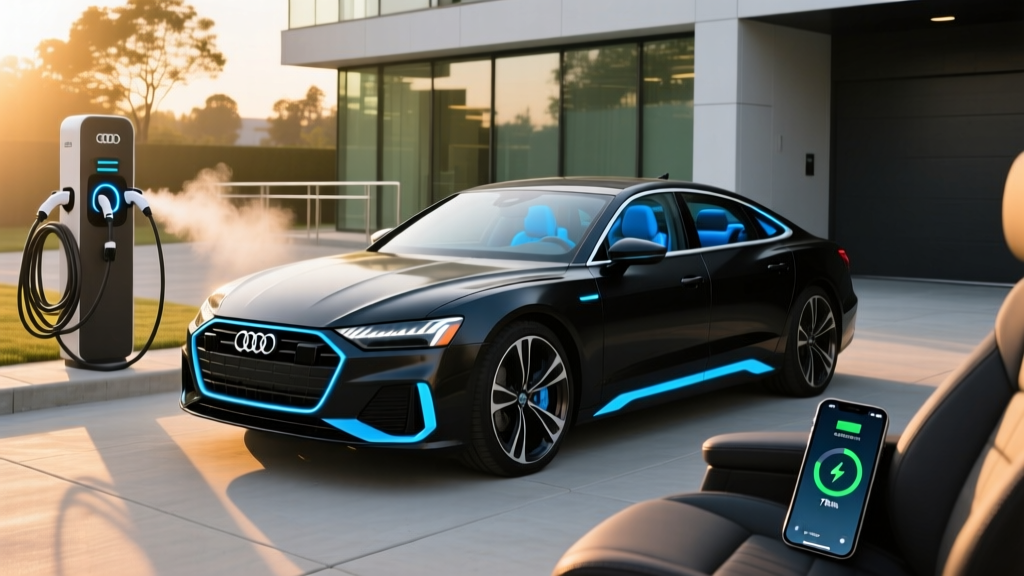
The 2026 Audi A6 e-tron arrives as a direct answer to the Tesla Model S and Mercedes EQE, built on Volkswagen Group's dedicated PPE (Premium Platform Electric) architecture co-developed with Porsche. With up to 340 miles of EPA-estimated range, class-leading 800-volt charging at 270 kW peak, and Audi's signature build quality, the A6 e-tron positions itself as the luxury electric sedan for buyers who want refinement over raw performance theatrics. It isn't the cheapest option in the segment, but for executive commuters and road-trip-capable sedan shoppers, it's arguably the most complete package available in 2026.
Range Reality Check
EPA Estimate: 340 miles (Premium Plus RWD, 19" wheels)
Real-World Expectation: Plan for 280–310 miles on highway-dominant trips at 70–75 mph. In cold weather (below 32°F), expect 20–25% range reduction without preconditioning, bringing usable range closer to 255–275 miles. City driving with regenerative braking recovers efficiency and can push actual range above the EPA figure.
Range, Battery, and Efficiency
The A6 e-tron is offered with a single large battery pack: a 100 kWh gross capacity (approximately 94.5 kWh usable) lithium-ion unit using NMC (nickel-manganese-cobalt) chemistry. Audi opted for NMC over LFP to prioritize energy density and cold-weather performance — a sensible choice for a luxury sedan where range and refinement matter more than lowest possible cost.
The rear-wheel-drive Premium Plus trim achieves the headline 340-mile EPA figure, while the dual-motor quattro variants sacrifice roughly 30–40 miles for the traction and performance of all-wheel drive. Efficiency across the lineup sits in the 98–105 MPGe combined range, translating to roughly 32–34 kWh per 100 miles — competitive with the Mercedes EQE but trailing the lighter, more aero-optimized Tesla Model S Long Range.
| Spec | Premium Plus (RWD) | Prestige quattro |
|---|---|---|
| EPA Range | 340 miles | 306 miles |
| Battery (Gross / Usable) | 100 kWh / ~94.5 kWh | 100 kWh / ~94.5 kWh |
| Chemistry | NMC | NMC |
| Drivetrain | Rear-Wheel Drive | Dual-Motor AWD (quattro) |
| Horsepower | 375 hp | 509 hp (boost mode) |
| 0–60 mph | 5.2 seconds | 3.7 seconds |
| Top Speed | 130 mph (electronically limited) | 155 mph |
| MPGe (Combined) | 105 MPGe | 98 MPGe |
| Efficiency | 32 kWh/100 mi | 34 kWh/100 mi |
| Base MSRP | $74,900 | $85,400 |
Charging Speed: Where the 800-Volt Platform Pays Off
This is where the PPE architecture separates the A6 e-tron from most competitors. The 800-volt electrical system enables a peak DC fast-charge rate of 270 kW at compatible chargers — meaning a 10–80% charge in approximately 21 minutes under ideal thermal conditions. That's meaningfully faster than the Mercedes EQE's ~200 kW peak and competitive with the Hyundai Ioniq 5 and Porsche Taycan.
However, the charging curve matters more than the peak number. The A6 e-tron sustains above 200 kW through roughly 40% SoC before tapering. By 70% SoC, expect roughly 150 kW, and above 85%, the rate drops sharply to protect the battery. On a typical road-trip stop (10–80%), you'll average around 185 kW effective — still excellent for the segment.
| Charging Level | Power / Rate | Speed / Time |
|---|---|---|
| Level 1 (120V household) | 1.4 kW | ~4 miles per hour |
| Level 2 (240V home, 48A) | 11.5 kW | ~35 miles per hour / full charge in ~9 hrs |
| Level 2 (240V home, 32A) | 7.7 kW | ~24 miles per hour / full charge in ~13 hrs |
| DC Fast Charge (peak) | 270 kW | 10–80% in ~21 minutes |
| DC Fast Charge (50 kW station) | 50 kW | 10–80% in ~1 hr 40 min |
The A6 e-tron uses the NACS (North American Charging Standard) connector for the 2026 model year in the US market, granting native access to Tesla Supercharger stations without an adapter — a significant practical advantage over CCS-only vehicles as the Supercharger network remains the most reliable DC fast-charging infrastructure in North America.
For home Level 2 charging, the onboard charger accepts up to 11.5 kW. On a dedicated 60-amp circuit (48-amp continuous), you'll recover the full battery overnight in about 9 hours. Most owners will install a Audi-recommended Level 2 wallbox or a quality third-party unit like the ChargePoint Home Flex or Emporia Level 2.
Performance and Driving Dynamics
The RWD Premium Plus model delivers 375 horsepower and a 5.2-second 0–60 time — more than adequate for highway merging and passing, though not sports-sedan territory. The Prestige quattro model, with its dual-motor setup producing 509 hp in boost mode, hits 60 mph in 3.7 seconds and pulls with the effortless surge that defines electric luxury.
Ride quality is where Audi's engineering investment shows. The standard adaptive air suspension absorbs highway imperfections with the composure expected of a $75,000+ sedan, and the available rear-axle steering tightens the turning circle for urban maneuvering. Regenerative braking offers three levels selectable via steering-wheel paddles, plus an adaptive mode that uses radar and navigation data to modulate regen automatically — approaching a slower car or an upcoming exit, the car increases regen without driver input.
One limitation worth noting: the A6 e-tron is not rated for towing, which may matter to buyers cross-shopping with electric SUVs. If towing is a requirement, the Audi Q8 e-tron or Rivian R1S would be more appropriate.
Interior, Cargo, and Technology
The cabin uses Audi's latest MMI touch response dual-screen layout: an 11.4-inch upper display for navigation and media, and an 8.6-inch lower display for climate and handwriting input. The 10.9-inch digital instrument cluster (Virtual Cockpit Plus) and an available 10.9-inch front-passenger display round out the screen real estate. Wireless Apple CarPlay and Android Auto are standard.
Material quality is excellent — open-pore wood, available Valcona leather, and aluminum inlays give the interior a tactile premium feel that still outpaces Tesla's minimalist approach. The flat floor (thanks to the dedicated EV platform) creates generous rear legroom at 38.2 inches, and front passengers enjoy 41.3 inches.
Cargo capacity comes in at 15.3 cubic feet in the trunk — competitive with the BMW i5 and slightly less than the Mercedes EQE's 15.5 cu ft. There is no front trunk (frunk), as Audi allocated that space to HVAC and power-electronics components. This is a notable miss compared to the Hyundai Ioniq 6, which offers a small frunk for charging cables.
Driver assistance comes via Audi's Adaptive Cruise Assist with lane guidance — a solid SAE Level 2 system. It handles highway steering, braking, and acceleration competently, but it is not a hands-off or "self-driving" system. The driver must maintain steering-wheel contact and situational awareness at all times. Audi does not currently offer a hands-free highway system comparable to GM's Super Cruise or Ford's BlueCruise.
ADAS Limitation Notice
Audi Adaptive Cruise Assist is an SAE Level 2 driver-assistance system. It requires continuous driver supervision and is not autonomous. Lane-centering performance is reliable on well-marked highways but can struggle in construction zones or faded lane markings. Always keep hands on the wheel and eyes on the road.
Pricing, Trims, and Federal Tax Credit Eligibility
The 2026 Audi A6 e-tron is available in three trims:
| Trim | Drivetrain | Base MSRP | Est. After §30D Credit* |
|---|---|---|---|
| Premium Plus | RWD | $74,900 | $67,400 |
| Premium Plus quattro | AWD | $78,900 | $71,400 |
| Prestige quattro | AWD | $85,400 | $77,900 |
*Tax credit estimates assume full $7,500 eligibility under IRS §30D. Actual eligibility depends on buyer income, battery-component sourcing, and critical-mineral requirements. Consult a tax professional.
The A6 e-tron falls under the IRS sedan MSRP cap of $55,000 for the federal tax credit — which means the base Premium Plus RWD at $74,900 exceeds the cap and does not qualify for the $7,500 new-vehicle credit. This is a significant consideration. Buyers should verify current-year eligibility on the IRS clean vehicle credit page, as rules around MSRP caps, adjusted gross income limits ($150,000 single / $300,000 joint), and battery-sourcing requirements can shift.
- MSRP Cap (Sedans): $55,000 — A6 e-tron exceeds this at all trims
- Buyer Income Cap: $150K single / $225K head of household / $300K joint (modified AGI)
- Battery Sourcing: Critical minerals and battery components must meet escalating domestic-sourcing thresholds
- Point-of-Sale Transfer: If eligible, the credit can be applied at purchase to reduce out-of-pocket cost
- Recommendation: Consult a tax professional and check fueleconomy.gov for the latest qualifying vehicle list
The lack of federal credit eligibility puts the A6 e-tron at a disadvantage versus lower-priced competitors like the Tesla Model 3 Long Range and Hyundai Ioniq 6, both of which may qualify. However, state-level incentives (California's CVRP, Colorado's innovative motor vehicle credit, and others) may partially offset the cost — check your state's energy office for current programs.
Competitor Comparison: A6 e-tron vs. the Field
The luxury electric sedan segment in 2026 is crowded. Here's how the A6 e-tron stacks up against its primary rivals:
| Spec | Audi A6 e-tron (RWD) | BMW i5 eDrive40 | Mercedes EQE 350+ | Tesla Model S LR |
|---|---|---|---|---|
| EPA Range | 340 mi | 295 mi | 305 mi | 405 mi |
| Battery (usable) | ~94.5 kWh | 84.3 kWh | 90.6 kWh | ~95 kWh |
| Peak DC Charge | 270 kW | 205 kW | 170 kW | 250 kW |
| 10–80% Time | ~21 min | ~28 min | ~32 min | ~25 min |
| 0–60 mph | 5.2 sec | 5.7 sec | 6.2 sec | 3.1 sec |
| Base MSRP | $74,900 | $70,200 | $74,900 | $72,990 |
| §30D Credit Eligible | No (MSRP cap) | No (MSRP cap) | No (MSRP cap) | No (MSRP cap) |
Which Should You Choose?
Choose the Audi A6 e-tron if: You prioritize DC fast-charging speed (270 kW is best-in-class), value build quality and cabin materials, prefer NACS native Supercharger access, and want a refined ride over raw acceleration.
Choose the Tesla Model S Long Range if: Maximum range (405 mi EPA) and performance (3.1 sec 0–60) are your top priorities, and you're comfortable with Tesla's minimalist interior and panel-gap variability.
Choose the BMW i5 if: You want a slightly lower entry price, enjoy sportier driving dynamics, and don't mind slower charging speeds.
Choose the Mercedes EQE if: Hyperscreen technology and a softer, more isolating ride appeal to you, and charging speed is less critical for your driving patterns.
Battery Warranty, Degradation, and Long-Term Ownership
Audi backs the A6 e-tron's battery pack with an 8-year / 100,000-mile warranty covering defects and capacity loss below 70% of original capacity. The powertrain (motors, power electronics) carries the same 8-year/100,000-mile coverage, while the basic vehicle warranty is 4 years / 50,000 miles.
NMC chemistry in the A6 e-tron's pack is proven across the VW Group's EV lineup. Based on degradation data from the Porsche Taycan (which shares the PPE platform lineage), expect approximately 8–12% capacity loss over the first 100,000 miles under normal use. Audi's thermal management system — liquid cooling with active preconditioning — helps mitigate degradation by keeping cells in the optimal 68–95°F range during charging and heavy use.
For buyers concerned about long-term battery replacement cost, current PPE-platform battery replacement estimates range from $15,000–$22,000 out of warranty, though prices are expected to decline as battery-cell costs continue their downward trend through 2030.
Pros, Cons, and Who Should Buy
Pros
- Class-leading 270 kW DC fast charging (10–80% in ~21 min)
- NACS connector for native Tesla Supercharger access
- 340 miles EPA range (RWD) is competitive in the segment
- Exceptional build quality and cabin materials
- Air suspension provides excellent ride comfort
- 800V architecture future-proofs charging performance
- Generous rear legroom (38.2") for passengers
Cons
- No federal §30D tax credit (exceeds $55K sedan MSRP cap)
- No front trunk (frunk) for cable storage
- Driver-assist system lags behind GM Super Cruise / Ford BlueCruise
- Premium pricing — well-equipped Prestige quattro exceeds $90K
- Not rated for towing
- Real-world highway range ~280–310 mi falls short of EPA sticker
Best for: Executive commuters with home Level 2 charging who take regular 200–300 mile road trips and value charging speed, cabin refinement, and brand prestige. The A6 e-tron is ideal for buyers upgrading from an A6 or A7 who want to electrify without sacrificing the Audi ownership experience.
Not ideal for: Budget-conscious buyers (consider the Hyundai Ioniq 6 or Tesla Model 3), those who need towing capability, or drivers who want hands-free highway driving assistance.
Frequently Asked Questions
What is the real-world range of the 2026 Audi A6 e-tron?
The EPA rates the RWD Premium Plus at 340 miles, but real-world highway driving at 70–75 mph typically yields 280–310 miles. In cold weather below freezing, expect 255–275 miles without preconditioning. City driving with regenerative braking can exceed the EPA estimate.
How fast does the A6 e-tron charge at home and on the road?
At home on a 240V Level 2 charger (48A), the A6 e-tron charges at 11.5 kW, adding about 35 miles per hour and fully charging in roughly 9 hours. On DC fast chargers, it peaks at 270 kW and charges from 10–80% in approximately 21 minutes.
Does the Audi A6 e-tron qualify for the federal EV tax credit?
No. Under current IRS §30D rules, sedans must have an MSRP at or below $55,000 to qualify. The A6 e-tron starts at $74,900, exceeding this cap at all trim levels. State incentives may still apply — check your state's EV rebate programs.
How does the A6 e-tron compare to the Tesla Model S?
The Model S Long Range offers more EPA range (405 vs. 340 miles) and faster acceleration (3.1 vs. 5.2 seconds 0–60), but the A6 e-tron charges faster (270 vs. 250 kW peak), has a more traditional luxury interior, and offers a quieter, more composed ride. The Model S is for performance seekers; the A6 e-tron is for refinement seekers.
Is the A6 e-tron's battery LFP or NMC?
The A6 e-tron uses NMC (nickel-manganese-cobalt) chemistry, which offers higher energy density and better cold-weather performance than LFP. The trade-off is slightly higher cost and a marginally shorter cycle life, though the 8-year/100,000-mile warranty provides long-term protection.
Can I use Tesla Superchargers with the A6 e-tron?
Yes. The 2026 A6 e-tron comes equipped with the NACS connector natively, meaning you can plug directly into Tesla Supercharger stalls without an adapter. This is a major practical advantage for road-trip charging reliability.
What is the battery warranty on the A6 e-tron?
Audi covers the high-voltage battery for 8 years or 100,000 miles, whichever comes first. The warranty covers defects and capacity degradation below 70% of the original usable capacity. The powertrain components (motors, inverters) share the same coverage period.