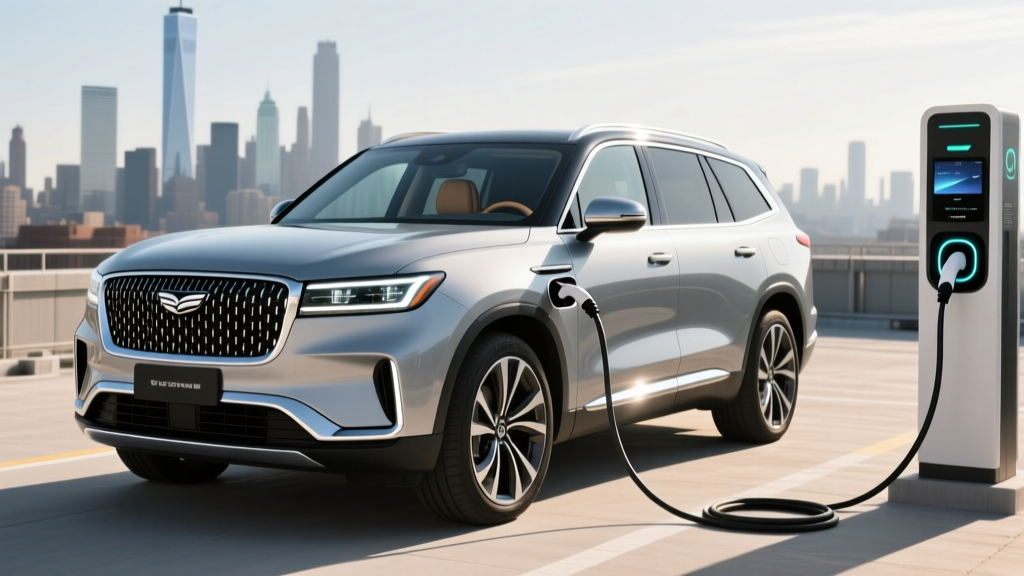
The 2025 Wagoneer S Launch Edition is Stellantis' first serious battery-electric entry under the Wagoneer nameplate, and it arrives with a clear mission: deliver luxury SUV credibility on the STLA Large platform without the body-on-frame bulk of its gas-powered siblings. With 600 horsepower, a claimed 300-mile EPA range, and a starting price that undercuts European rivals, it's positioned squarely against the Tesla Model X, BMW iX, and Rivian R1S. But specs on paper don't tell the whole story. After digging into the real-world range behavior, charging curve, ownership costs, and tax credit eligibility, here's what buyers actually need to know.
Quick Verdict: Who Should Buy the Wagoneer S Launch Edition?
The Launch Edition suits luxury-oriented families and commuters who want American-brand dealer support, standard AWD, and strong straight-line performance without paying six figures. It's best for buyers with home Level 2 charging access who prioritize cabin technology and a premium interior over class-leading range or third-row seating. If you need three rows, look at the Rivian R1S or Tesla Model X. If you want maximum range per dollar, the Hyundai Ioniq 5 or Tesla Model Y still lead. But for a tech-forward, two-row luxury EV with genuine performance credentials, the Wagoneer S makes a compelling case.
Choose the Wagoneer S if: You want a premium two-row EV SUV with standard AWD, sub-4-second 0-60 performance, Stellantis dealer network support, and an interior that rivals European luxury brands.
Look elsewhere if: You need a third row, you're chasing maximum range (350+ mi), you want access to the full Tesla Supercharger network without an adapter, or you don't have reliable home charging.
Range, Efficiency, and Battery Specs
The Wagoneer S Launch Edition carries a 100 kWh lithium-ion battery pack using NMC (nickel-manganese-cobalt) chemistry — the energy-dense choice that prioritizes range and performance over the longer cycle life of LFP. Stellantis targets a 300-mile EPA-estimated range, which lands it in the middle of the luxury EV SUV pack.
EPA-Estimated Range: 300 miles
Real-World Expectation: Expect 260–280 miles in mixed highway/city driving at moderate temperatures. Sustained 75+ mph highway runs will push range toward 240–255 miles due to aerodynamic drag on the SUV body. In cold weather (below 30°F), plan for 20–30% range reduction, bringing usable range down to roughly 210–240 miles depending on cabin heating demands. The heat pump helps, but it can't fully offset the physics of battery chemistry at low temperatures.
Efficiency is rated at approximately 2.0–2.2 kWh/mile (roughly 45–50 MPGe combined), which is reasonable for a 5,800+ lb performance SUV but trails lighter competitors like the BMW iX xDrive50 (which achieves around 2.0 kWh/mile with less power). The dual-motor AWD system is standard, and there's no RWD option to squeeze out extra miles.
| Specification | Value |
|---|---|
| EPA Range (est.) | 300 miles |
| Battery Capacity | 100 kWh (NMC chemistry) |
| Drivetrain | Dual-motor AWD |
| Horsepower | 600 hp |
| Torque | 617 lb-ft |
| 0–60 mph | 3.4 seconds |
| Max DC Fast Charge | ~175 kW (peak) |
| 10–80% DC Charge Time | ~23 minutes |
| Level 2 Charge Rate | 11.5 kW onboard charger |
| Efficiency | ~45 MPGe combined / ~2.1 kWh/mi |
| Cargo Volume (behind 2nd row) | 30.5 cu ft |
| Cargo Volume (seats folded) | 61.0 cu ft |
| Base MSRP | $65,200 (before destination) |
| Battery/Powertrain Warranty | 8 years / 100,000 miles |
Charging Speed: DC Fast, Level 2, and Real-World Behavior
The Wagoneer S supports DC fast charging at up to approximately 175 kW on compatible CCS-equipped stations. That's adequate for road-trip duty but falls short of the 250+ kW peaks offered by Hyundai's E-GMP platform and Tesla's V3/V4 Superchargers. The 10–80% charge time lands around 23 minutes under ideal thermal conditions.
| Charging Level | Power | Estimated Miles Added per Hour | Typical Use Case |
|---|---|---|---|
| Level 1 (120V household) | ~1.4 kW | ~4 mi/hr | Emergency / overnight trickle |
| Level 2 (240V home) | 11.5 kW | ~33 mi/hr | Daily home charging (~9 hrs for full charge) |
| DC Fast Charge | Up to ~175 kW | ~175+ mi/hr (at peak) | Road trips; 10–80% in ~23 min |
A few charging-curve realities matter here. Like most NMC packs, the Wagoneer S will sustain peak charge rates only through roughly 40–50% State of Charge, after which the rate tapers progressively to protect cell longevity. If you arrive at a charger at 10% SoC, you'll see the fastest speeds in the 10–50% window, with a noticeable slowdown above 70%. Preconditioning the battery via navigation-routed charging (if equipped) is essential for achieving advertised peak rates — arriving cold can add 5–10 minutes to your session.
For home charging, the 11.5 kW onboard charger is competitive and means a full charge from empty takes roughly 9 hours on a properly installed 48-amp Level 2 circuit. Budget $500–$2,000 for a quality Level 2 home station and professional installation (panel upgrades can push costs higher on older homes). The Wagoneer S uses the CCS1 connector; a NACS adapter will be necessary for Tesla Supercharger access as Stellantis transitions to the North American Charging Standard on future models.
Performance and Drivetrain
With 600 horsepower and 617 lb-ft of torque from its dual-motor AWD setup, the Wagoneer S Launch Edition posts a 3.4-second 0–60 mph time — firmly in sports-sedan territory from a two-row SUV. That puts it ahead of the BMW iX M60 (3.6 sec) and roughly on par with the Tesla Model X Plaid's base dual-motor variant, though the Model X Plaid tri-motor is in a different league entirely at 2.5 seconds.
The STLA Large platform delivers a low center of gravity thanks to the under-floor battery pack, and the air suspension (standard on Launch Edition) adapts ride height for comfort or aerodynamics. Towing capacity is rated at approximately 3,500 pounds — enough for a small utility trailer or a pair of jet skis, but well below the body-on-frame Wagoneer's 10,000-lb rating. If heavy towing is a priority, this isn't your vehicle.
Interior, Tech, and Cargo Space
The Launch Edition cabin is where Wagoneer aims to justify its premium positioning. The dashboard is dominated by a combined screen footprint that includes a 12.3-inch digital instrument cluster, a 12.3-inch passenger display, and a central 12.3-inch infotainment touchscreen — all running Stellantis' latest Uconnect 5 system with wireless Apple CarPlay and Android Auto. An available head-up display and digital rearview mirror round out the glass.
Standard driver-assistance features include adaptive cruise control with stop-and-go, lane-centering assist, automated emergency braking, blind-spot monitoring, and a 360-degree camera system. This is an SAE Level 2 driver-assistance suite — meaning you must keep your hands on the wheel and eyes on the road at all times. It is not autonomous driving, despite marketing language around "hands-free" modes that may arrive via future over-the-air updates.
Cargo space measures 30.5 cubic feet behind the second row and approximately 61.0 cubic feet with the rear seats folded flat. Front trunk (frunk) storage adds a modest additional compartment for charging cables and small items. Legroom is generous for a two-row SUV: approximately 41 inches up front and 39 inches in the rear, making it comfortable for adults on long trips. However, there is no third row, which eliminates the Wagoneer S from consideration for larger families.
Pricing, Trims, and Federal Tax Credit Eligibility
The 2025 Wagoneer S Launch Edition starts at an MSRP of $65,200 before the $2,095 destination charge, bringing the out-the-door sticker to approximately $67,295. As a Launch Edition, it comes fully loaded with the air suspension, premium audio, full ADAS suite, and luxury interior appointments — there are no options to add. Future lower trims are expected to follow, potentially starting in the mid-$50,000 range.
| Item | Amount |
|---|---|
| Base MSRP | $65,200 |
| Destination Charge | $2,095 |
| Total Before Incentives | ~$67,295 |
| Federal §30D Credit (max, if eligible) | Up to $7,500 |
| Effective Price After Max Credit | ~$59,795 |
The federal EV tax credit under IRS §30D offers up to $7,500, but eligibility is not automatic. Several rules apply:
- MSRP Cap: The vehicle must have an MSRP at or below $80,000 for SUVs — the Wagoneer S qualifies at $65,200.
- Buyer Income Cap: Modified adjusted gross income must not exceed $150,000 (single), $225,000 (head of household), or $300,000 (joint filing).
- Battery Sourcing: The $7,500 credit splits into two halves — $3,750 for critical-minerals sourcing and $3,750 for battery-component assembly. As of 2025, the critical-minerals requirement demands that an increasing percentage of minerals be sourced from the US or free-trade-agreement partners. The exact credit amount for the Wagoneer S depends on Stellantis' supply-chain compliance for the specific build month. Check fueleconomy.gov for the latest certified credit amounts.
- Point-of-Sale Transfer: Eligible buyers can transfer the credit to the dealer at purchase, reducing the purchase price directly rather than waiting for a tax refund.
- Foreign Entity of Concern (FEOC): Battery components or critical minerals from FEOC entities (China, Russia, North Korea, Iran) can disqualify the vehicle partially or fully, with rules tightening annually through 2027.
Because sourcing rules change and vary by build date, confirm the exact credit amount with your dealer and a tax professional before purchasing. State and local incentives may stack on top — check your state energy office for details.
Warranty and Long-Term Ownership
Stellantis backs the Wagoneer S battery and electric powertrain with an 8-year/100,000-mile warranty, consistent with the federal minimum for emissions-related components and competitive with most EV manufacturers. The warranty covers battery capacity retention — typically guaranteeing that the pack will hold at least 70% of its original capacity during the coverage period, though buyers should confirm the exact degradation threshold with Stellantis.
The basic vehicle warranty covers 3 years/36,000 miles. For context, Hyundai and Kia offer longer basic coverage (5yr/60,000mi), and Tesla's battery warranty extends to 8 years/120,000–150,000 miles depending on model. Stellantis is in the middle of the pack here — adequate but not class-leading.
Long-term battery replacement costs for a 100 kWh NMC pack currently run $15,000–$25,000 out of warranty, though prices are declining as cell costs fall. Most NMC packs show 10–15% degradation over 100,000 miles in fleet data, meaning you'd still have roughly 255–270 miles of the original 300-mile range at the warranty boundary under normal use.
How It Stacks Up Against Competitors
The Wagoneer S enters a crowded luxury EV SUV segment. Here's how it compares on the numbers that matter:
| Spec | Wagoneer S Launch Ed. | Tesla Model X (Dual Motor) | BMW iX xDrive50 | Rivian R1S Dual-Motor |
|---|---|---|---|---|
| EPA Range | 300 mi | 335 mi | 324 mi | 321 mi |
| Battery | 100 kWh NMC | ~100 kWh | 111.5 kWh (usable) | 128.9 kWh (Large) |
| Horsepower | 600 hp | 670 hp | 516 hp | 533 hp |
| 0–60 mph | 3.4 sec | 3.8 sec | 4.4 sec | 4.5 sec |
| Max DC Charge | ~175 kW | 250 kW | ~195 kW | ~200 kW |
| Third Row | No | Yes (optional) | No | Yes (standard) |
| Starting MSRP | $65,200 | $79,990 | $87,250 | $79,900 |
The Wagoneer S wins on price — it's $15,000–$22,000 cheaper than its closest competitors while offering the quickest 0–60 time in this group. It loses on range (trailing by 20–35 miles) and DC fast-charge speed. The lack of a third row eliminates it from Rivian R1S and Model X cross-shoppers with larger families, but for two-row buyers, the value proposition is strong.
Pros
- Best-in-class price for a 600 hp luxury EV SUV
- Sub-3.5-second 0–60 with standard AWD
- Premium interior with triple-screen dashboard
- Competitive home Level 2 charging speed (11.5 kW)
- Air suspension standard on Launch Edition
- Under $80K MSRP — qualifies for SUV tax-credit cap
Cons
- No third-row option
- DC fast charge peak (~175 kW) lags Tesla and Hyundai/Kia
- Real-world highway range likely 240–255 mi
- Cold-weather range loss significant (20–30%)
- CCS1 connector requires adapter for Tesla Superchargers
- Towing limited to ~3,500 lbs
- Stellantis' EV reliability track record is unproven at this scale
Frequently Asked Questions
What is the real-world range of the 2025 Wagoneer S Launch Edition?
The EPA-estimated range is 300 miles, but expect 260–280 miles in mixed driving, 240–255 miles on sustained highway trips at 75+ mph, and as low as 210–240 miles in freezing temperatures. Your results will vary based on driving style, terrain, and climate-control use.
How fast does the Wagoneer S charge at home and on the road?
At home on a 240V Level 2 charger (48-amp circuit), the 11.5 kW onboard charger adds roughly 33 miles of range per hour, with a full charge taking about 9 hours. On DC fast chargers, it peaks at approximately 175 kW, reaching 10–80% in about 23 minutes under ideal conditions. Preconditioning is critical for achieving peak speeds.
How much does the Wagoneer S cost after the federal tax credit?
The Launch Edition starts at roughly $67,295 including destination. If you qualify for the full $7,500 federal §30D credit (meeting income caps, battery-sourcing requirements, and MSRP limits), the effective price drops to approximately $59,795. Confirm the exact credit amount for your build month on fueleconomy.gov and with a tax professional.
Does the 2025 Wagoneer S qualify for the $7,500 federal EV tax credit?
It qualifies on MSRP grounds (under the $80,000 SUV cap). However, the full $7,500 depends on battery-component and critical-minerals sourcing compliance, which tightens annually. Your personal eligibility also requires income below IRS thresholds ($150K single / $300K joint). The credit can be transferred to the dealer at point of sale to reduce your purchase price directly. Always verify current eligibility on irs.gov before committing.
Is the Wagoneer S worth buying over the Tesla Model X or BMW iX?
If price is your primary concern and you don't need a third row, the Wagoneer S offers the best value in this segment at $15,000+ less than competitors. If you need maximum range, Supercharger network access, or a third row, the Model X is the better choice. If you prefer European driving dynamics and don't mind paying more, the iX delivers a more refined ride. The Wagoneer S wins for buyers who want performance and luxury at a relative bargain — and who have home charging to offset the slower DC fast-charge speeds.
Can the Wagoneer S use Tesla Superchargers?
Not natively — the Wagoneer S uses the CCS1 connector, while Tesla Superchargers use the NACS connector. Stellantis has indicated future models will adopt NACS, and a CCS-to-NACS adapter may become available, but confirm adapter compatibility with both Stellantis and Tesla before relying on Supercharger access.