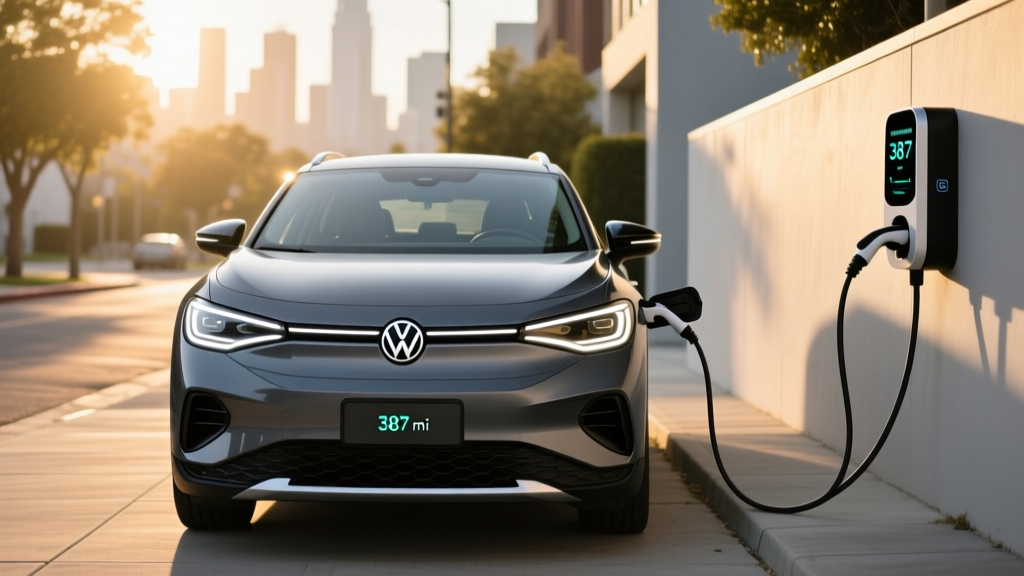
Quick Verdict: A Practical Family EV With European Roots
The 2025 VW ID.4 occupies a specific niche in the electric compact SUV segment: it's the sensible, comfort-oriented option that prioritizes ride quality and interior space over headline-grabbing performance numbers. With an EPA-estimated range of up to 291 miles on the rear-wheel-drive Pro S trim, a starting MSRP of $40,295 (before destination), and eligibility for the full $7,500 federal tax credit under current IRS §30D rules, it undercuts rivals like the Hyundai Ioniq 5 and Ford Mustang Mach-E on price while offering competitive daily usability.
But the ID.4 isn't without compromises. Its DC fast-charging speed peaks at 170 kW — adequate but noticeably behind the 240+ kW rates of Korean competitors. The infotainment system, while improved for 2025 with a larger 12.9-inch screen and updated software, still lags in responsiveness compared to Tesla or Hyundai. And real-world highway range drops meaningfully below the EPA sticker, especially in cold weather.
This review breaks down every number that matters: actual range you can count on, charging-curve behavior, trim-level pricing after credits, and whether the ID.4's 8-year/100,000-mile battery warranty provides genuine peace of mind.
Range and Efficiency: EPA Numbers vs. Reality
| Trim / Drivetrain | EPA Range | Real-World Highway (70 mph) | Cold Weather (20°F) |
|---|---|---|---|
| Pro / Pro S (RWD, 82 kWh) | 291 mi (Pro S) | ~240–260 mi | ~190–220 mi |
| AWD Pro / AWD Pro S (82 kWh) | 263 mi (AWD Pro S) | ~215–235 mi | ~170–200 mi |
| Standard (RWD, 62 kWh) | 206 mi | ~165–180 mi | ~135–155 mi |
Source: EPA / fueleconomy.gov. Real-world estimates based on highway driving at 70 mph with climate control active. Cold-weather estimates assume 20°F ambient with cabin heating.
The 2025 ID.4 uses an 82 kWh gross battery pack (77 kWh usable) with NMC (nickel manganese cobalt) chemistry on Pro, Pro S, and all AWD trims. The Standard trim uses a smaller 62 kWh pack (58 kWh usable). Volkswagen does not offer an LFP option — every ID.4 sold in the US uses NMC cells supplied primarily by SK On.
Efficiency on the RWD Pro S model is rated at 104 MPGe combined (city/highway), which translates to roughly 32 kWh per 100 miles. That's middling for the class. The Hyundai Ioniq 5 RWD achieves 114 MPGe combined, and the Tesla Model Y RWD hits 123 MPGe. The ID.4's heavier curb weight (around 4,680 lbs for the Pro S) and less aerodynamic profile explain the gap.
For daily commuting under 50 miles round-trip, the RWD trims require charging only once or twice a week on a Level 2 home charger. Road-trippers should plan stops every 200–220 miles on the RWD models to keep the battery in the optimal 20–80% state of charge window where charging speed is fastest.
Charging Speed: DC Fast Charging and Home Level 2
| Charging Method | Max Power (kW) | Speed / Time | Connector |
|---|---|---|---|
| DC Fast Charging (10–80%) | 170 kW peak | ~28 minutes (10–80%) | CCS1 (NACS adapter available) |
| DC Fast Charging (peak sustained) | ~135 kW avg (10–80%) | Adds ~190 mi in 30 min | CCS1 |
| Level 2 Home (240V, 48A) | 11.5 kW | ~33 mi/hr of charging | J1772 / NACS |
| Level 2 Home (240V, 32A) | 7.7 kW | ~22 mi/hr of charging | J1772 |
| Level 1 (120V, 12A) | 1.4 kW | ~4 mi/hr of charging | Standard outlet |
The ID.4's 170 kW peak DC fast-charge rate is the most contentious spec on the sheet. Here's why: peak rate is not sustained rate. The ID.4 hits 170 kW only briefly between roughly 15–30% state of charge, then tapers progressively. From 10–80%, the average charge rate is closer to 130–140 kW, which is why the full 10–80% session takes approximately 28 minutes.
Compare this to the Hyundai Ioniq 5, which peaks at 240 kW and sustains over 200 kW for a wider SoC window, completing 10–80% in roughly 18 minutes. On a long road trip, that 10-minute difference per stop adds up.
For 2025, Volkswagen includes a NACS adapter with new ID.4 purchases, enabling access to Tesla Supercharger stalls (V3 stalls limited to ~150 kW for non-Tesla vehicles via adapter, V4 stalls offer higher rates). This significantly expands the ID.4's usable public charging network beyond Electrify America's CCS-based infrastructure.
Home charging on a 48-amp Level 2 circuit (requiring a 60-amp breaker) delivers 11.5 kW and fully replenishes the 82 kWh pack in about 7.5 hours — easily overnight. The onboard charger maxes at 11.5 kW, so installing a higher-amperage wallbox won't speed things up. A standard 32-amp Level 2 unit (the most common home install) provides 7.7 kW and takes roughly 10.5 hours for a full charge.
Performance and Drivetrain
| Specification | RWD (Pro/Pro S) | AWD (Pro/Pro S) |
|---|---|---|
| Drivetrain | Rear-Wheel Drive (single motor) | Dual-Motor AWD |
| Horsepower | 282 hp | 335 hp |
| Torque | 339 lb-ft | 339 lb-ft (front) + 339 lb-ft (rear) |
| 0–60 mph | 7.7 seconds | 5.4 seconds |
| Top Speed | 99 mph (electronically limited) | 112 mph |
| Towing Capacity | 2,200 lbs | 2,700 lbs |
The RWD ID.4 with its 282-hp rear-mounted permanent-magnet motor delivers adequate acceleration for merging and passing but won't thrill anyone coming from a performance EV. The 7.7-second 0–60 time is roughly on par with a well-equipped Toyota RAV4 Hybrid. The AWD model's 5.4-second sprint is genuinely quick and transforms the car's character, but it costs you 28 miles of EPA range and roughly $3,800 in MSRP.
Where the ID.4 genuinely excels is ride quality. The MEB platform's low center of gravity and VW's tuning give it a compliant, quiet highway demeanor that outclasses the firmer-riding Ioniq 5 and the sometimes-harsh Model Y. The turning circle is tight at 31.5 feet (RWD), making it surprisingly maneuverable in urban settings.
Regenerative braking is adjustable via steering-wheel paddles (B mode for max regen, D mode for coasting), but VW does not offer true one-pedal driving to a full stop like Nissan's e-Pedal or Tesla's Hold mode. You'll still need the friction brake pedal at very low speeds. This is a deliberate engineering choice, but it frustrates EV veterans accustomed to single-pedal operation.
Interior, Cargo Space, and Technology
The 2025 ID.4's cabin is its strongest selling point for family buyers. Rear-seat legroom measures 37.6 inches — generous for the class and enough for rear-facing child seats without compromising front-passenger space. Headroom is excellent at 41.1 inches front and 38.5 inches rear, thanks to the flat floor and tall roofline.
Cargo volume behind the rear seats is 30.3 cubic feet, expanding to 64.2 cubic feet with the 60/40 split rear seats folded. That's competitive with the RAV4 and slightly behind the Model Y's 76.2 cu ft maximum. The ID.4 does not have a front trunk (frunk) — the space under the hood houses the power electronics and washer-fluid reservoir. For an EV at this price point, the missing frunk is a notable omission.
The 2025 model year brings a 12.9-inch center touchscreen (up from 12.0 inches in 2024) running VW's ID. Software 4.0. Response times are improved, wireless Apple CarPlay and Android Auto are standard, and the navigation system now includes better EV-specific route planning with charging-stop integration. However, the capacitive-touch climate controls below the screen remain a frustration — they lack backlighting at night and offer no tactile feedback. Many owners apply aftermarket tactile stickers to the slider bars.
Driver assistance comes via VW's IQ.DRIVE suite, which includes adaptive cruise control with stop-and-go, lane-centering assist, automatic emergency braking, and blind-spot monitoring. This is an SAE Level 2 system — the driver must keep hands on the wheel and eyes on the road at all times. It is not autonomous driving. The system works well on highways but is not as confident in construction zones or faded lane markings as Ford's BlueCruise or GM's Super Cruise on compatible roads.
Pricing, Trim Levels, and Federal Tax Credit
| Trim | Drivetrain | MSRP | Est. §30D Credit | Effective Price |
|---|---|---|---|---|
| Standard | RWD | $40,295 | Up to $7,500 | ~$32,795 |
| Pro | RWD | $43,795 | Up to $7,500 | ~$36,295 |
| Pro S | RWD | $47,095 | Up to $7,500 | ~$39,595 |
| AWD Pro | AWD | $47,595 | Up to $7,500 | ~$40,095 |
| AWD Pro S | AWD | $50,895 | Up to $7,500 | ~$43,395 |
| AWD Pro S Plus | AWD | $55,295 | Up to $7,500 | ~$47,795 |
Destination charge: ~$1,395 additional. Prices per VW's US configurator. Tax credit eligibility is subject to IRS §30D rules and individual circumstances.
The 2025 ID.4 qualifies for the full $7,500 federal EV tax credit under IRS §30D, provided the buyer meets all eligibility requirements. This credit can be transferred to the dealer at the point of sale as an immediate price reduction — you don't need to wait until tax filing to benefit. However, eligibility is not automatic. Here's what you need to know:
- MSRP Cap: SUVs must have an MSRP at or below $80,000. All ID.4 trims qualify.
- Buyer Income Cap: Modified AGI must not exceed $150,000 (single), $225,000 (head of household), or $300,000 (married filing jointly).
- Battery Sourcing: The ID.4's battery cells (SK On) and critical minerals must meet phased-in sourcing requirements. VW has confirmed US-market ID.4s meet 2025 thresholds, but verify with your dealer at purchase.
- Assembly: The ID.4 for the US market is assembled in Chattanooga, Tennessee, satisfying the North American final assembly requirement.
- Point-of-Sale Transfer: You may elect to transfer the credit to the dealer for an immediate price reduction, or claim it on your tax return using IRS Form 8936.
Source: IRS.gov — Clean Vehicle Provisions. Rules are subject to change. Consult a tax professional for your specific situation.
With the full $7,500 credit applied, a Pro S RWD model effectively costs around $39,595 before destination — placing it in direct competition with a base Hyundai Ioniq 5 SEL ($45,500 MSRP, less after credit) and undercutting the Tesla Model Y Long Range ($47,990). The value proposition is strong, especially on the lower trims.
Battery Warranty and Long-Term Ownership
Volkswagen provides an 8-year/100,000-mile battery warranty on the ID.4, guaranteeing that the high-voltage pack will retain at least 70% of its original usable capacity during that period. If the battery degrades below 70% capacity (roughly 54 kWh usable on the 77 kWh pack), VW will repair or replace it at no cost.
The 70% threshold is industry-standard, matching Hyundai, Ford, and Tesla. However, it's worth noting that NMC chemistry typically degrades more predictably than early LFP cells, and real-world data from European ID.4 owners (the model launched there in 2021) shows approximately 5–8% degradation after 60,000 miles — well within the warranty buffer.
Beyond the battery, the ID.4 carries a 4-year/50,000-mile bumper-to-bumper warranty and 4-year/40,000-mile scheduled maintenance coverage (VW includes two years of complimentary maintenance). Insurance costs are moderate — expect annual premiums 10–15% higher than a comparable gas-powered compact SUV, based on industry averages for EVs in this price range.
Long-term ownership economics favor the ID.4 if you charge primarily at home. At a national average residential electricity rate of $0.16/kWh, fully charging the 77 kWh usable pack costs about $12.32 — providing roughly 240 real-world highway miles. That equates to approximately $0.051 per mile. A gas-powered RAV4 at 30 MPG combined and $3.40/gallon costs $0.113 per mile. Over 15,000 miles annually, the ID.4 saves roughly $930 per year in fuel costs alone.
How the ID.4 Stacks Up Against Competitors
| Spec | VW ID.4 Pro S (RWD) | Hyundai Ioniq 5 SEL (RWD LR) | Tesla Model Y (RWD) |
|---|---|---|---|
| EPA Range | 291 mi | 303 mi | 320 mi |
| Battery (usable) | 77 kWh (NMC) | 77.4 kWh (NMC) | ~60 kWh (LFP) |
| Peak DC Charge | 170 kW | 240 kW | 170 kW |
| 10–80% DC Time | ~28 min | ~18 min | ~25 min |
| 0–60 mph | 7.7 sec | 7.0 sec | 6.6 sec |
| MPGe (combined) | 104 | 114 | 123 |
| Cargo (rear seats up) | 30.3 cu ft | 27.2 cu ft | 30.2 cu ft |
| Base MSRP | $47,095 | $49,850 | $44,990 |
| After $7,500 Credit | ~$39,595 | ~$42,350 | ~$37,490 |
Source: fueleconomy.gov, manufacturer specifications. Prices as of early 2025. Tax credit eligibility varies by buyer.
The ID.4's advantage is its combination of price (after credit), ride comfort, and interior space. The Ioniq 5 wins on charging speed and efficiency. The Model Y wins on range, efficiency, and Supercharger network access (though the ID.4's NACS adapter now partially bridges that gap). None of these choices is wrong — it depends on your priorities.
- You prioritize ride comfort and cabin quietness over sporty handling
- You want the lowest effective price after the federal credit in this segment
- You charge at home 90%+ of the time and rarely road-trip more than 300 miles
- You need generous rear-seat space for child seats or tall passengers
- You take frequent road trips and want the fastest possible DC charging (Ioniq 5)
- You want maximum range and efficiency per kWh (Model Y)
- You prefer one-pedal driving to a complete stop (neither ID.4 nor Ioniq 5 offer this fully)
- You need a frunk for charging-cable storage
Pros, Cons, and Who Should Buy the 2025 ID.4
- Competitive price after $7,500 federal tax credit — among the most affordable electric SUVs
- Comfortable, quiet ride quality that outclasses most competitors
- Spacious rear seat with 37.6 inches of legroom
- US-assembled (Chattanooga, TN) — supports domestic manufacturing
- NACS adapter included for Tesla Supercharger access
- Tight turning circle (31.5 ft) for easy urban maneuvering
- 8-year/100,000-mile battery warranty with 70% capacity retention guarantee
- 170 kW peak DC charging is slower than key rivals (Ioniq 5: 240 kW)
- No frunk — no dedicated front storage for charging cables
- Capacitive-touch climate sliders lack backlighting and tactile feedback
- Efficiency (104 MPGe) trails the segment leaders
- No true one-pedal driving mode to a full stop
- AWD model's 263-mile range is below average for dual-motor EVs
- Infotainment, while improved, still not as intuitive as Tesla or Hyundai systems
Who the 2025 ID.4 suits best: The ID.4 is ideal for a two-adult household with one or two children, primarily commuting 30–60 miles daily, with access to home Level 2 charging, and taking road trips no more than a few times per year. It's a comfort-first family hauler, not a tech showcase or a road-trip warrior. If that profile matches your needs, the ID.4 at its post-credit price is one of the most rational EV purchases available in 2025.
Frequently Asked Questions
What is the real-world range of the 2025 VW ID.4?
The EPA rates the RWD Pro S at 291 miles. In real-world highway driving at 70 mph with climate control active, expect approximately 240–260 miles. In cold weather (20°F), that drops to roughly 190–220 miles due to battery heating demands and cabin climate load. The AWD Pro S is rated at 263 miles EPA; plan for 215–235 miles highway.
How fast does the 2025 ID.4 charge at home and on DC fast chargers?
On a DC fast charger, the ID.4 peaks at 170 kW and charges from 10–80% in approximately 28 minutes, adding roughly 190 miles of range in 30 minutes. At home on a 48-amp Level 2 charger (240V), it charges at 11.5 kW, adding about 33 miles of range per hour and fully replenishing the 82 kWh pack overnight in roughly 7.5 hours.
Does the 2025 VW ID.4 qualify for the $7,500 federal tax credit?
Yes — the ID.4 qualifies for the full $7,500 federal EV tax credit under IRS §30D, provided the buyer meets income caps ($150K single / $300K married filing jointly), the vehicle MSRP is under $80,000 (all trims qualify), and battery-sourcing requirements are met. The credit can be transferred to the dealer at point of sale for an immediate price reduction. Always verify current eligibility with your dealer and consult a tax professional.
How much does the 2025 ID.4 cost after tax credits?
The base Standard trim starts at $40,295 MSRP, dropping to approximately $32,795 after the full $7,500 federal credit. The popular Pro S RWD trim is $47,095 before credit and approximately $39,595 after. Add $1,395 for destination. State and local incentives may reduce the price further — check your state's EV rebate programs.
Is the VW ID.4 worth buying vs. the Hyundai Ioniq 5 or Tesla Model Y?
The ID.4 wins on price (lowest effective cost after credit), ride comfort, and rear-seat space. The Ioniq 5 wins on DC charging speed (240 kW vs. 170 kW) and efficiency. The Model Y wins on range and Supercharger network convenience. If you charge at home and rarely road-trip, the ID.4's value proposition is compelling. If you drive long distances frequently, the Ioniq 5's faster charging is a meaningful advantage.
What is the ID.4's battery warranty?
Volkswagen covers the ID.4's high-voltage battery for 8 years or 100,000 miles (whichever comes first), guaranteeing at least 70% capacity retention. If the battery degrades below 70% of its original usable capacity within that period, VW will repair or replace it. The bumper-to-bumper warranty is 4 years/50,000 miles.
Does the ID.4 have a frunk (front trunk)?
No. The ID.4 does not have a front trunk. The space under the hood is occupied by power electronics, the 12V battery, and the washer-fluid reservoir. Cargo capacity is 30.3 cubic feet behind the rear seats and 64.2 cubic feet with the rear seats folded.
Can the ID.4 use Tesla Superchargers?
Yes. For 2025, Volkswagen includes a NACS adapter with new ID.4 purchases, allowing access to Tesla's V3 and V4 Supercharger stalls. On V3 stalls (250 kW max), the ID.4 will be limited by its own 170 kW onboard charging capability. The CCS1 port remains the native connector, and Electrify America remains VW's primary charging-network partner.