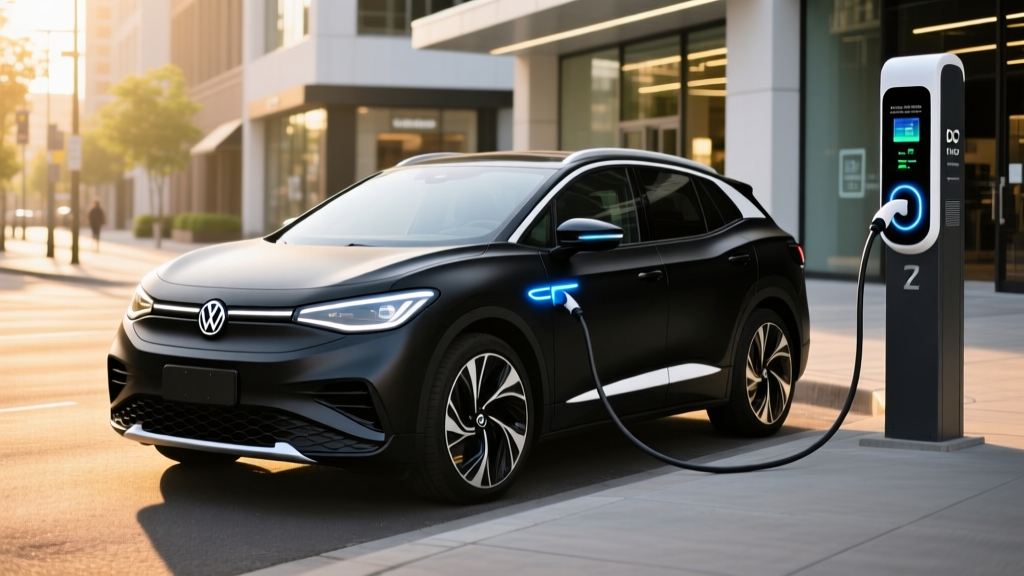
The Volkswagen ID.4 has quietly become one of the most practical electric SUVs on the market, and the 2025 Volkswagen ID.4 Black Package takes the proven formula and sharpens the styling. This appearance-focused trim adds blacked-out exterior accents, dark wheels, and a monochromatic aesthetic that appeals to buyers who want an EV that looks as modern as it drives. But beneath the stealthy exterior lies the same competent electric powertrain VW has refined over several model years. In this review, we break down exactly what the Black Package delivers — from real-world range and DC fast-charging behavior to pricing, tax-credit eligibility, and how it stacks up against the Hyundai Ioniq 5 and Tesla Model Y.
Quick Verdict: Who the 2025 Volkswagen ID.4 Black Package Is For
The Black Package is best understood as a style upgrade on an already solid compact electric SUV. It targets urban commuters and small families who want a no-drama EV with comfortable ride quality, reasonable range, and access to one of the best public charging networks. If you value understated design and everyday usability over sporty dynamics or maximum performance, this trim hits the mark. It is not a performance EV — it's a comfort-oriented daily driver with enough range for road trips when planned around DC fast-charging stops.
Range, Battery, and Real-World Efficiency
The 2025 ID.4 Black Package is built on the rear-wheel-drive (RWD) platform with Volkswagen's larger battery pack. Here are the core energy figures:
| Spec | Value |
|---|---|
| Battery (usable) | 82 kWh (NMC chemistry) |
| EPA range | 275 miles |
| EPA efficiency | 104 MPGe combined / 32 kWh/100 mi |
| Drivetrain | Rear-wheel drive, single motor |
| Horsepower | 282 hp |
| 0–60 mph | ~7.7 seconds |
| Max DC fast charge | 175 kW (peak) |
| 10–80% DC charge time | ~30 minutes |
| Level 2 home charging | 11 kW onboard charger |
| Base MSRP | ~$45,290 (incl. destination) |
The 82 kWh usable capacity uses NMC (nickel manganese cobalt) cell chemistry, which prioritizes energy density over the extended cycle life of LFP packs. For most owners driving 12,000–15,000 miles per year, NMC degradation remains modest — expect roughly 90–93% state of health after 5 years based on fleet data from earlier ID.4 model years. The pack is liquid-cooled with active thermal management, which is essential for sustaining charge speeds and longevity.
Charging Speeds: DC Fast Charging and Home Level 2
Charging is where the ID.4 earns its practical reputation, though it doesn't lead the segment in peak speed. Here's what to expect at each charging level:
| Charging Level | Power / Rate | Miles Added per Hour | Notes |
|---|---|---|---|
| Level 1 (120V) | ~1.2 kW | ~3–4 mi/hr | Emergency/trickle only |
| Level 2 (240V, 48A) | 11 kW (onboard max) | ~32–35 mi/hr | Full charge in ~8 hours |
| DC Fast Charge | 175 kW peak | ~180+ mi in 10 min (peak) | 10–80% in ~30 min; tapers above 80% |
On a DC fast charger, the ID.4 peaks at 175 kW — but only in a narrow state-of-charge window (roughly 15–35% SoC with a preconditioned battery). The charge curve tapers progressively: by 60% SoC, you're seeing roughly 120 kW, and above 80%, speeds drop below 50 kW as the battery management system protects cell health. This is normal behavior for NMC packs, but it means that sustained average charge rate on a 10–80% session is closer to 110–120 kW, not the 175 kW peak.
For home charging, the 11 kW onboard charger is a strong point. On a 48-amp Level 2 circuit (the most common home installation), you'll add about 32–35 miles of range per hour. A depleted battery reaches full in roughly 8 hours — easily overnight. If your home electrical panel only supports a 32-amp circuit (7.7 kW), plan on roughly 10–11 hours for a full charge. Always consult a licensed electrician to determine your panel's capacity before installing a Level 2 charger.
Volkswagen includes three years of complimentary 30-minute DC fast-charging sessions on the Electrify America network, which adds genuine value for road-trippers who haven't yet invested in home charging infrastructure.
Performance, Ride Quality, and Drivetrain
The RWD ID.4 Black Package produces 282 horsepower from its rear-mounted permanent-magnet synchronous motor. The 0–60 mph time of roughly 7.7 seconds places it squarely in "adequate for daily driving" territory — this is not a performance SUV. Acceleration from a stop is smooth and immediate (as with all EVs), and the rear-wheel-drive layout gives it a slightly more engaging feel than front-drive competitors, though steering feedback remains numb.
Ride quality is where the ID.4 shines. VW tuned the suspension for comfort over sportiness, and the result is a compliant, quiet cabin that absorbs potholes and highway seams with ease. Road noise is well-suppressed. The turning circle is tight for the class, making parking-lot maneuvers easy. Regenerative braking offers multiple levels adjustable via steering-wheel paddles, though VW does not offer true one-pedal driving with a complete stop — you'll still need the brake pedal at low speeds.
The available AWD Pro S variant (dual-motor, 335 hp, ~6.7 sec 0–60) sacrifices about 15–20 miles of range for all-weather traction. If you live in a snow-belt state, the AWD upgrade is worth considering, though it pushes the MSRP higher and may affect tax-credit calculations.
Interior, Cargo Space, and Technology
The Black Package's interior carries over the standard ID.4 cabin with its minimalist design, 12.9-inch infotainment touchscreen, and digital instrument cluster. The Black Package adds specific dark interior trim accents that complement the exterior theme.
Practical dimensions that matter for daily life:
- Cargo volume (rear seats up): 30.3 cu ft
- Cargo volume (rear seats folded): 64.2 cu ft
- Rear legroom: 37.6 inches
- Front headroom: 41.1 inches
These numbers make the ID.4 competitive with the Hyundai Ioniq 5 and slightly behind the Tesla Model Y in cargo capacity. The rear seat is genuinely comfortable for adults on longer trips — a notable advantage over some competitors with low-mounted cushions.
Technology highlights include wireless Apple CarPlay and Android Auto, a heated steering wheel, heated front seats, and VW's IQ.DRIVE suite of driver-assistance features. IQ.DRIVE includes adaptive cruise control with stop-and-go, lane-keeping assist, and Travel Assist (a Level 2 combined system). Per NHTSA, the ID.4 has earned a 5-star overall safety rating. Note: Travel Assist is a driver-assist system, not a self-driving feature — you must keep your hands on the wheel and eyes on the road at all times.
Notable drawbacks: The infotainment system, while improved for 2025, still lags behind Hyundai/Kia's interface in responsiveness. The capacitive-touch steering wheel controls and slider-style volume/temperature controls frustrate some owners who prefer physical buttons. There is no front trunk (frunk), which reduces small-item storage compared to rivals.
Pricing, Trim Levels, and Federal Tax Credit Eligibility
The 2025 Volkswagen ID.4 Black Package slots into the upper-middle of the ID.4 lineup. Pricing for the RWD configuration starts around $45,290 including destination charges. Adding AWD pushes the price above $49,000. An as-tested Black Package RWD with no additional options typically lands in the $46,000–$47,000 range.
| Item | Amount |
|---|---|
| Base MSRP (RWD, incl. destination) | ~$45,290 |
| Estimated out-the-door (before incentives) | ~$46,500 |
| Federal §30D tax credit (if eligible) | Up to $7,500 |
| Effective price after max credit | ~$39,000 |
Federal tax-credit eligibility under IRS §30D depends on several factors that change periodically:
- MSRP cap: SUVs must be at or below $80,000 — the ID.4 clears this easily.
- Buyer income cap: Modified AGI must not exceed $150,000 (single), $225,000 (head of household), or $300,000 (joint filers).
- Battery component and critical-mineral sourcing: The credit splits into two halves ($3,750 each) based on where battery components and critical minerals are sourced. VW has been working to localize supply chains, but the exact credit amount (full $7,500, partial $3,750, or $0) can shift as sourcing rules tighten. Always verify current eligibility on the IRS website or with a tax professional before purchasing.
- Point-of-sale transfer: As of 2024, buyers can transfer the credit to the dealer at purchase, reducing the upfront cost rather than waiting for a tax refund. This is available for the ID.4 if the dealer is registered with the IRS portal.
State and local incentives may further reduce cost, but these vary by jurisdiction. Check your state's energy office or DMV for current programs.
How It Compares: ID.4 Black Package vs. Key Rivals
The compact electric SUV segment is crowded. Here's how the ID.4 Black Package stacks up against its two most obvious competitors:
| Spec | VW ID.4 Black Pkg (RWD) | Hyundai Ioniq 5 SEL (RWD) | Tesla Model Y Long Range (AWD) |
|---|---|---|---|
| EPA Range | 275 mi | 303 mi | 320 mi |
| Battery (usable) | 82 kWh NMC | 77.4 kWh NMC | ~75 kWh NMC |
| Peak DC Charge | 175 kW | 235 kW | 250 kW |
| 10–80% DC Time | ~30 min | ~20 min | ~25 min |
| 0–60 mph | 7.7 sec | 7.2 sec | 4.8 sec |
| Starting MSRP | ~$45,290 | ~$46,650 | ~$44,990 |
| Cargo (seats up) | 30.3 cu ft | 27.2 cu ft | 30.2 cu ft |
The Ioniq 5 charges significantly faster and offers more range, but has slightly less cargo space. The Model Y leads in range, performance, and Supercharger network access, but its ride quality is firmer and the interior is spartan. The ID.4 Black Package occupies a middle ground: it's the most comfort-oriented of the three, with a ride quality advantage and a straightforward ownership experience backed by VW's dealer network.
Warranty Coverage and Long-Term Ownership
Volkswagen backs the 2025 ID.4 with competitive warranty terms:
- Battery warranty: 8 years / 100,000 miles (retains ≥70% capacity)
- Powertrain warranty: 8 years / 100,000 miles
- Bumper-to-bumper: 4 years / 50,000 miles
- Roadside assistance: 4 years / 50,000 miles
The 70% capacity retention threshold is industry-standard. Based on data from 2021–2024 ID.4 models in European and North American fleets, real-world degradation has been modest — most vehicles retain 92–95% capacity after 2–3 years. The liquid-cooled thermal management system is a key factor. For peace of mind, the ID.4's battery warranty is on par with Hyundai/Kia's coverage and competitive with Tesla's 8-year/120,000-mile term.
Pros
- Comfortable, quiet ride quality
- Strong 11 kW Level 2 onboard charger
- Spacious rear seat with adult-friendly legroom
- Black Package styling adds premium visual appeal
- 3 years free Electrify America charging
- 5-star NHTSA safety rating
Cons
- 175 kW peak DC charge trails Ioniq 5 and Model Y
- Real-world highway range closer to 220–240 mi
- Infotainment still less intuitive than Korean rivals
- No frunk for additional storage
- Capacitive-touch controls frustrate some drivers
- Tax credit amount varies by sourcing rules
Frequently Asked Questions
What is the real-world range of the 2025 Volkswagen ID.4 Black Package?
The EPA rates it at 275 miles, but real-world conditions tell a more nuanced story. Expect 250–270 miles in mixed city/suburban driving in moderate weather. Highway driving at sustained speeds drops this to 220–240 miles. In freezing temperatures, plan for 190–220 miles depending on cabin heating use and whether you precondition the battery.
How fast does the ID.4 Black Package charge?
On a DC fast charger, it peaks at 175 kW and reaches 10–80% in approximately 30 minutes, with tapering above 80%. At home on a 48-amp Level 2 charger (240V), the 11 kW onboard charger adds about 32–35 miles per hour, with a full charge taking roughly 8 hours.
Does the 2025 VW ID.4 qualify for the $7,500 federal tax credit?
It can, but eligibility under IRS §30D depends on your income (AGI caps apply), the vehicle's MSRP (well under the $80,000 SUV cap), and battery-sourcing requirements that determine whether you receive the full $7,500, a partial $3,750, or no credit. The credit can be transferred to the dealer at point of sale. Always verify current eligibility on irs.gov or consult a tax professional before purchasing.
Is the ID.4 Black Package worth buying over the Hyundai Ioniq 5 or Tesla Model Y?
It depends on your priorities. Choose the ID.4 Black Package if you value ride comfort, a quiet cabin, and a strong dealer network. Choose the Ioniq 5 if DC fast-charging speed and maximum range matter most. Choose the Model Y if you want the best range, performance, and Supercharger access — and can accept a firmer ride and minimalist interior.
Does the ID.4 have one-pedal driving?
Not fully. The ID.4 offers adjustable regenerative braking via steering-wheel paddles, and in the strongest mode it slows the car significantly, but it does not bring the vehicle to a complete stop without brake-pedal input. This is a deliberate VW engineering choice, though some EV drivers find it a drawback in stop-and-go traffic.
What battery chemistry does the 2025 ID.4 use?
The ID.4 uses NMC (nickel manganese cobalt) lithium-ion cells with an 82 kWh usable capacity. NMC offers higher energy density than LFP, which translates to more range in a smaller, lighter pack — but slightly faster long-term degradation compared to LFP. For typical ownership cycles of 5–8 years, the difference is marginal and covered by the 8-year/100,000-mile battery warranty.