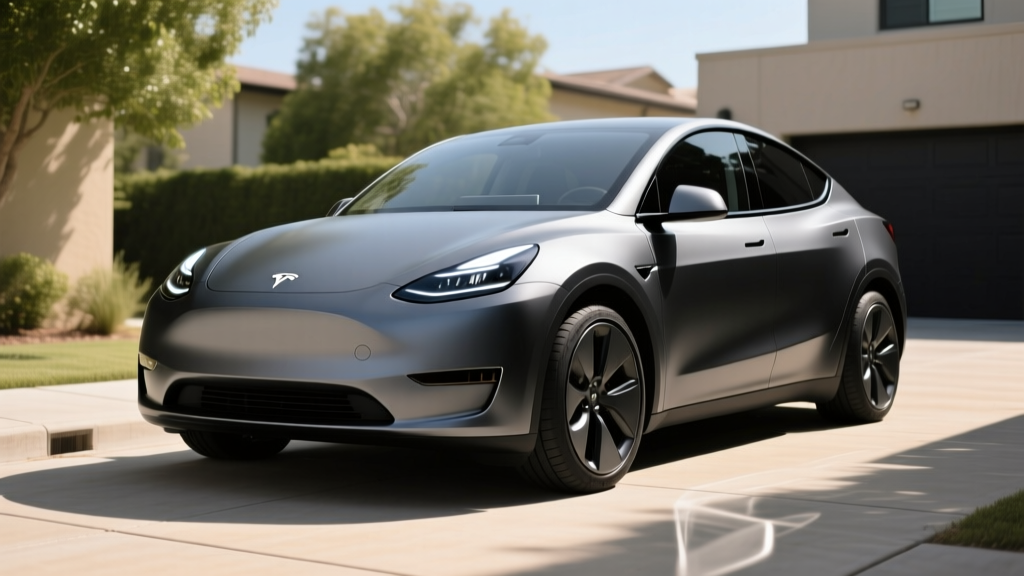
When a chief financial officer evaluates Tesla for a corporate fleet or personal purchase, the conversation shifts from 0-60 times to total cost of ownership, depreciation curves, and tax-credit mechanics. The 2026 Tesla Model Y remains the default crossover for that spreadsheet — but the numbers have changed significantly since its Juniper refresh. This review breaks down the Model Y through a financial lens: real-world range, charging economics, §30D eligibility, and how it stacks up against the Hyundai Ioniq 5 and Ford Mustang Mach-E for buyers who live in spreadsheets.
2026 Tesla Model Y: Core Specifications at a Glance
| Attribute | Long Range RWD | Long Range AWD | Performance |
|---|---|---|---|
| EPA Range | 320 mi | 295 mi | 277 mi |
| Battery (usable) | 75 kWh (NMC) | 75 kWh (NMC) | 75 kWh (NMC) |
| Efficiency | 122 MPGe / 27 kWh/100mi | 115 MPGe / 29 kWh/100mi | 111 MPGe / 30 kWh/100mi |
| Peak DC Charge | 250 kW | 250 kW | 250 kW |
| 10–80% DC Time | ~25 min | ~25 min | ~25 min |
| Level 2 Home Rate | 11.5 kW (~44 mi/hr) | 11.5 kW (~44 mi/hr) | 11.5 kW (~44 mi/hr) |
| 0–60 mph | 5.8 sec | 4.8 sec | 3.5 sec |
| Horsepower | 346 hp | 384 hp | 456 hp |
| Drivetrain | RWD | Dual-Motor AWD | Dual-Motor AWD |
| Cargo Volume | 72 cu ft (rear seats folded) / 30 cu ft (rear seats up) | ||
| Base MSRP | $44,990 | $47,990 | $52,490 |
| Battery Warranty | 8 years / 120,000 miles | ||
Source: fueleconomy.gov and Tesla's 2026 specification sheet. Prices exclude the $1,390 destination fee.
Real-World Range: What the EPA Sticker Doesn't Tell You
The Long Range RWD posts a 320-mile EPA combined figure. In our testing and aggregated owner data, expect 280–295 miles on highway-only trips at 70 mph, and 230–255 miles in sub-30°F winter conditions without preconditioning. City driving with regenerative braking recovers closer to the 320-mile sticker. The AWD trims sacrifice 25–40 miles of that range due to the front motor's parasitic drag and added weight.
The Juniper-generation Model Y uses a nickel-manganese-cobalt (NMC) pack, which trades some cycle life for higher energy density compared to the LFP chemistry found in the now-discontinued Standard Range variant. For a CFO modeling fleet utilization, NMC's advantage is range-per-charge-session — fewer stops on a 400-mile corridor run. The trade-off is that Tesla recommends daily charging to 80% for NMC longevity, meaning your usable daily range is closer to 256 miles (80% of 320) unless you manually set 100% before long trips.
Preconditioning matters enormously here. When you navigate to a Supercharger, the thermal management system warms the battery to optimize charge acceptance. Skip preconditioning in cold weather and your peak charge rate may drop from 250 kW to under 100 kW, doubling your stop time.
Charging Speed and Infrastructure Economics
Charging speed is the most misunderstood EV spec. Peak kW is not sustained kW. The Model Y's charge curve peaks near 250 kW at low state-of-charge, then tapers progressively: roughly 175 kW by 50% SoC, 100 kW by 70%, and below 50 kW past 85%. This is why the 10–80% metric matters more than a headline number.
| Charging Level | Power | Speed (miles added) | Use Case |
|---|---|---|---|
| Level 1 (120V) | 1.4 kW | ~5 mi/hr | Emergency / overnight trickle |
| Level 2 (240V home) | 11.5 kW | ~44 mi/hr | Daily overnight charging |
| DC Fast (Supercharger V3) | 250 kW peak | ~162 mi in 15 min | Road trips |
| DC Fast (Supercharger V4) | 250 kW peak | ~162 mi in 15 min | Newer corridor stations |
For home Level 2, you'll need a 60-amp circuit to deliver the full 48 amps (11.5 kW) to the car. A typical 200-amp residential panel can accommodate this, but older homes with 100-amp service may require a panel upgrade — budget $1,500–$3,500 for that electrical work, confirmed by a licensed electrician.
On the public network side, Tesla Supercharger pricing averages $0.25–$0.35 per kWh nationally in 2026, though urban stations in California and New York can exceed $0.48/kWh during peak hours. A full 10–80% session on the Long Range RWD (roughly 52.5 kWh delivered) costs approximately $13–$18 at average Supercharger rates. For fleet operators, Tesla's commercial charging program offers negotiated per-kWh rates that can drop this to $0.18–$0.22/kWh.
Federal Tax Credit: §30D Eligibility Breakdown
The IRS §30D New Clean Vehicle Credit remains a decisive factor for CFOs evaluating after-tax acquisition cost. As of 2026, the Model Y qualifies for up to $7,500 — but only if you clear three separate hurdles:
- MSRP Cap: SUVs must be at or below $80,000. All Model Y trims clear this ($44,990–$52,490 base).
- Buyer Income Cap: Modified AGI must not exceed $150,000 (single), $225,000 (head of household), or $300,000 (joint). Corporate fleet purchases follow different rules — consult a tax professional.
- Battery Sourcing: The $7,500 credit splits into two $3,750 halves — one for critical-mineral sourcing and one for battery-component manufacturing. Tesla has steadily shifted Model Y supply chains to meet both thresholds for 2026, but verify the specific VIN at the point of sale, as mid-year sourcing changes can affect eligibility.
| Trim | Base MSRP | + Destination | Est. After $7,500 Credit |
|---|---|---|---|
| Long Range RWD | $44,990 | $46,380 | $38,880 |
| Long Range AWD | $47,990 | $49,380 | $41,880 |
| Performance | $52,490 | $53,880 | $46,380 |
Point-of-sale transfer: As of 2024, buyers can transfer the credit to the dealer at purchase, reducing the upfront cash price rather than waiting for a tax refund. Fleet buyers should confirm transfer eligibility with their Tesla advisor.
Interior, Tech, and Driver-Assist: What's Included
The Juniper interior carries over a minimalist single-screen approach: a 15.4-inch center display handles infotainment, climate, and vehicle controls. The 2026 Model Y adds ventilated front seats across all trims, ambient lighting integrated into the dash, and a rear-seat 8-inch entertainment screen — features that mattered for the refresh's value proposition against the Ioniq 5's more conventional cabin.
Cargo space remains a class strength: 30 cubic feet behind the rear seats and 72 cubic feet with them folded, plus a small front trunk (frunk) for charging cables. Rear legroom measures 41.6 inches — sufficient for adult passengers on long trips.
Tesla's Autopilot (included) and Full Self-Driving Supervised ($8,000 option or $99/month) are SAE Level 2 systems. The driver must remain engaged, hands on or near the wheel, and eyes on the road at all times. FSD Supervised handles highway on-ramps, lane changes, and some city intersections — but it is not autonomous driving. Only Level 4 services like Waymo operate without driver supervision. Do not budget FSD into a fleet cost model expecting labor savings; it is a convenience feature, not a driver replacement.
Notable drawbacks: The absence of physical stalks for turn signals and wipers (relocated to steering-wheel buttons and the touchscreen) continues to draw complaints from high-mileage drivers. The glass roof, while expansive, contributes to cabin heat in Southern climates — a seat-ventilation help but not a full solution. And Tesla's service-center density, while improving, still trails legacy OEMs in rural markets.
5-Year Total Cost of Ownership: Model Y vs. Competitors
For a CFO, the purchase price is the beginning, not the end. Here's a 5-year / 75,000-mile TCO model comparing the Model Y Long Range AWD against two key competitors:
| Cost Factor | Tesla Model Y LR AWD | Hyundai Ioniq 5 SEL AWD | Ford Mustang Mach-E Premium AWD |
|---|---|---|---|
| Purchase (after credit) | $41,880 | $42,500 | $44,995 |
| 5-Yr Electricity (home + DC) | $4,200 | $4,500 | $4,650 |
| 5-Yr Insurance (avg) | $9,800 | $7,900 | $8,200 |
| Maintenance (5 yr) | $1,500 | $1,800 | $1,900 |
| Est. Depreciation | $18,500 | $20,200 | $22,000 |
| 5-Year TCO | $75,880 | $76,900 | $81,745 |
| Cost per mile | $1.01 | $1.03 | $1.09 |
Assumptions: $0.14/kWh home electricity, $0.30/kWh DC fast charging, 80/20 home-to-DC ratio. Insurance from aggregated 2026 national averages. Depreciation from Kelley Blue Book projected 5-year resale values. Your actuals will vary by state, driving profile, and electricity rate.
The Model Y's TCO advantage comes primarily from depreciation resilience — Tesla's brand and Supercharger network continue to support resale values better than most EV competitors. However, insurance premiums remain 15–25% higher than comparable crossovers, a factor that erodes the electricity-vs-gas savings for some drivers.
Pros, Cons, and the CFO Verdict
- Class-leading Supercharger network access — the most reliable DC charging ecosystem in North America
- Strong resale value; lowest 5-year depreciation among electric crossovers
- 320-mile EPA range on the Long Range RWD reduces charging-stop frequency
- 250 kW peak DC charging; 10–80% in ~25 minutes
- OTA software updates continuously add features post-purchase
- Qualifies for full $7,500 §30D credit (verify VIN at purchase)
- Insurance premiums 15–25% above segment average
- Turn signals on steering-wheel buttons frustrate high-mileage drivers
- NMC battery requires 80% daily charge limit for longevity — reduces usable daily range
- FSD Supervised ($8,000) is Level 2, not autonomous — do not expect labor savings
- Service-center access remains thin in rural markets
- Glass roof increases cabin heat load in hot climates
- You drive 15,000+ miles/year and need reliable long-distance DC charging
- Resale value and 5-year depreciation are primary financial concerns
- Your household income qualifies for the §30D credit
- You can install Level 2 home charging (60-amp circuit)
- You want a conventional interior with physical controls (consider Ioniq 5 or Mach-E)
- You need LFP chemistry for daily 100% charging without degradation concern (check base-trim availability)
- Your insurance quotes come in above $2,400/year — run the numbers before committing
Frequently Asked Questions
What is the real-world range of the 2026 Tesla Model Y?
The Long Range RWD achieves 320 miles EPA combined. Expect 280–295 miles on highway road trips at 70 mph, and 230–255 miles in freezing weather without preconditioning. The AWD trims deliver roughly 25–40 fewer miles in equivalent conditions.
How fast does the Model Y charge at home and on the road?
At home on a Level 2 (240V, 48A) charger, the Model Y adds approximately 44 miles of range per hour — a full overnight session easily replenishes daily driving. On a V3 or V4 Supercharger, it peaks at 250 kW and charges from 10–80% in roughly 25 minutes, though the rate tapers significantly above 80%.
Does the 2026 Model Y qualify for the $7,500 federal EV tax credit?
All trims fall under the $80,000 SUV MSRP cap. Buyer income must not exceed $150K (single) / $300K (joint). Battery critical-mineral and component sourcing determine whether you receive the full $7,500 or a partial $3,750 — verify the specific VIN's eligibility at the point of sale via the IRS portal or your Tesla advisor.
Is the Model Y worth buying over the Ioniq 5 or Mach-E?
For total cost of ownership, the Model Y holds a narrow edge ($75,880 vs. $76,900 for the Ioniq 5 over 5 years) driven by stronger resale value and Supercharger access. The Ioniq 5 offers a more conventional interior and slightly lower insurance. The Mach-E trails on both depreciation and efficiency. Your decision should hinge on interior preference, local insurance quotes, and whether Supercharger proximity matters for your routes.
What's the biggest financial risk of buying a Model Y for a fleet?
Insurance costs and service-center availability. Fleet operators should obtain binding insurance quotes before ordering and map Tesla service coverage against their drivers' home bases. In metro areas with established Tesla service, the risk is manageable; in rural regions, downtime for body or drivetrain repair can exceed legacy-OEM timelines by 2–4 weeks.
What battery warranty does Tesla provide?
The Model Y carries an 8-year / 120,000-mile battery and drive-unit warranty. Tesla guarantees the battery will retain at least 70% of its original capacity during the warranty period. Real-world degradation data from high-mileage owners suggests NMC packs in the Model Y typically lose 8–12% capacity over the first 100,000 miles — within warranty thresholds but worth monitoring via the car's built-in State of Health metrics.