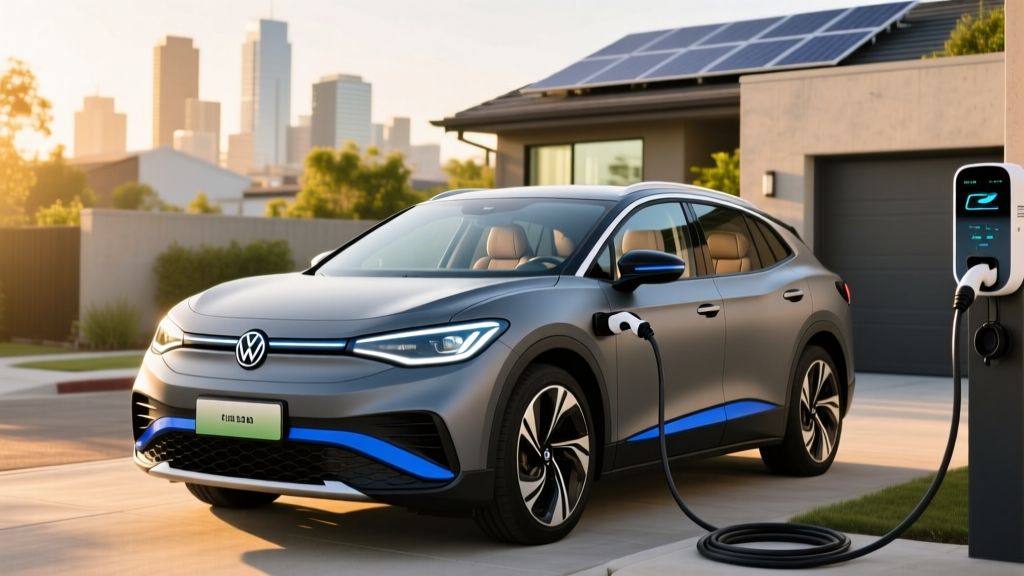
The Volkswagen ID.4 has been a volume player in the compact electric crossover segment since its launch, and the 2025 model year brings incremental but meaningful refinements. The 2025 ID.4 AWD Pro sits in the middle of the lineup as the entry point to dual-motor all-wheel drive, offering 295 horsepower, an EPA-estimated 263 miles of range, and access to the expanding Tesla Supercharger network via VW's recent charging partnerships. For buyers who need traction in snow and rain but don't want to step up to the loaded Pro S or Pro S Plus trims, this is the value play.
We've spent time with the ID.4 platform across multiple model years. Below, we break down what the 2025 AWD Pro actually delivers in range, charging speed, interior space, and ownership economics — with the real-world caveats that spec sheets leave out.
2025 ID.4 AWD Pro: Full Specifications at a Glance
| Specification | 2025 VW ID.4 AWD Pro |
|---|---|
| EPA Est. Range | 263 miles |
| Battery (Usable) | 77 kWh (82 kWh gross), NMC |
| Drivetrain | Dual-motor AWD |
| Horsepower | 295 hp (combined) |
| Torque | 339 lb-ft |
| 0-60 mph | 5.7 seconds |
| Max DC Fast Charge | 170 kW peak |
| 10-80% DC Charge Time | ~28 minutes (VW est.) |
| Level 2 Home Charge Rate | 11 kW (AC) |
| EPA Efficiency | 104 MPGe combined (32 kWh/100 mi) |
| Cargo Volume (rear seats up) | 30.3 cu ft |
| Cargo Volume (rear seats folded) | 64.2 cu ft |
| Base MSRP | $49,545 (incl. $1,395 dest.) |
| Battery/Powertrain Warranty | 8 years / 100,000 miles |
Real-World Range: What 263 EPA Miles Actually Means
EPA sticker: 263 miles
Realistic highway (70-75 mph, mild weather): 220–240 miles
City/suburban mixed driving: 245–260 miles
Cold weather (below 30°F, heater on): 185–210 miles
Source: EPA via fueleconomy.gov; real-world estimates based on owner reports and independent testing.
The 263-mile EPA estimate for the AWD Pro reflects the combined driving cycle. In practice, the ID.4 AWD's range behavior follows a familiar pattern for NMC-equipped crossovers: city and suburban driving with regenerative braking recovers energy effectively, often letting you approach or slightly exceed the sticker number on low-speed commutes. Highway driving at sustained 70+ mph is where the penalty shows — aerodynamic drag and the lack of a heat pump on some configurations (standard on Pro S and above, check your build sheet) eat into reserves.
Cold weather is the bigger concern for buyers in northern states. Below freezing, expect a 20–30% range reduction. That drops usable range to roughly 185–210 miles on a full charge. If your daily round-trip commute exceeds 150 miles and you live in a cold climate, the AWD Pro's 77 kWh usable battery will require mid-day charging or careful planning. The RWD Pro variant with 275 miles EPA gives you more buffer; the AWD trade-off is traction and acceleration for about 12 miles of range.
One practical note: the ID.4's navigation-based battery preconditioning for DC fast charging has improved with 2025's software updates, but preconditioning only activates when you navigate to a charger. Plug in without routing through the nav system and you may see slower initial charge rates until the battery warms up — especially in cold weather.
Charging Speed: DC Fast, Level 2, and the Supercharger Question
| Charging Level | Power | Speed / Time | Connector |
|---|---|---|---|
| Level 1 (120V household) | ~1.4 kW | ~3–4 mi/hr | J1772 / NACS adapter |
| Level 2 (240V home/public) | 11 kW max | ~25–28 mi/hr; full charge in ~7.5 hr | J1772 (CCS1 combo) |
| DC Fast Charge | 170 kW peak | 10–80% in ~28 min | CCS1 (NACS adapter included) |
The 2025 ID.4 AWD Pro peaks at 170 kW on DC fast chargers — adequate but not class-leading. Competitors like the Hyundai Ioniq 5 (240 kW peak) and Kia EV6 (239 kW) charge substantially faster at 800V-capable stations. In real-world DC charging, the ID.4 sustains roughly 130–150 kW through the 20–60% state of charge window, then tapers progressively. Expect a 10–80% session to take 28–32 minutes depending on battery temperature and charger capability.
For home Level 2 charging, the 11 kW onboard charger is a bright spot. On a 48-amp Level 2 circuit (the most common home installation), you'll add roughly 25–28 miles of range per hour, meaning a full overnight charge from 20% to 100% takes about 7.5 hours. This is plenty for daily use — plug in when you get home, wake up full.
The significant 2025 update is Tesla Supercharger network access. VW has partnered with Tesla to provide NACS adapters for ID.4 owners, giving access to over 17,000 Supercharger stalls nationwide. Note that Superchargers with NACS connectors deliver up to 150–250 kW depending on the stall generation (V2 vs V3/V4), so the ID.4's 170 kW peak will be the bottleneck only at V2 stalls (capped at 150 kW). At V3 and V4 stalls, the vehicle's own charge curve is the limiting factor. The Electrify America network remains included with complimentary charging for the first few years depending on current VW promotions — check your purchase agreement for exact terms.
Performance and Driving Dynamics
The dual-motor AWD setup produces 295 horsepower and 339 lb-ft of torque, good for a 0–60 mph time of 5.7 seconds. That's meaningfully quicker than the RWD variant (7.7 seconds) and puts the ID.4 AWD Pro in the same acceleration bracket as the Ford Mustang Mach-E Select AWD (5.8 sec) and slightly behind the Hyundai Ioniq 5 Dual Motor (5.1 sec).
On the road, the ID.4 drives like a Volkswagen should — composed, quiet, and slightly firm over broken pavement. The AWD system uses a rear-mounted permanent-magnet synchronous motor as the primary drive unit with a front induction motor that engages on demand for traction or hard acceleration. In normal driving, you'll feel mostly rear-drive character, which gives it a planted, confident feel through corners. The turning radius is reasonable at 31.5 feet, making it manageable in tight urban environments.
One limitation: the ID.4's regenerative braking is modest compared to competitors. There's no true one-pedal driving mode. You can select B-mode for stronger regen, but the vehicle will still creep and require brake pedal use to come to a full stop. If you're coming from a Tesla or a Nissan Leaf and expect aggressive regen, this takes adjustment.
Interior, Cargo, and Technology
The ID.4's cabin prioritizes space and minimalism, though VW's software execution has been a consistent criticism. The 2025 model continues with the 12.9-inch touchscreen (upgraded from the earlier 12-inch) running VW's ID. Software 4.0, which is a meaningful improvement in responsiveness and menu logic over 2022–2023 versions. Wireless Apple CarPlay and Android Auto are standard.
Passenger space is generous for the segment:
- Front headroom: 41.1 inches
- Front legroom: 41.1 inches
- Rear headroom: 38.8 inches
- Rear legroom: 37.6 inches
Cargo volume stands at 30.3 cubic feet behind the rear seats and 64.2 cubic feet with them folded — competitive with the Toyota RAV4 Hybrid and slightly less than the Hyundai Ioniq 5 (56.2 cu ft seats up, but its hatchback shape swallows long items differently). There is no frunk (front trunk); the space under the hood houses electronics.
The AWD Pro trim includes heated front seats, a heated steering wheel, a panoramic fixed glass roof, adaptive cruise control with stop-and-go, lane-keeping assist, and front/rear parking sensors. What it lacks compared to the Pro S: ventilated seats, a head-up display, the premium audio system, and the 360-degree camera. For most buyers, the Pro's equipment list covers daily needs well.
Regarding driver assistance: the ID.4's Travel Assist system is a SAE Level 2 driver-assist feature. It combines adaptive cruise control and lane centering for highway use but requires continuous driver engagement — hands on the wheel, eyes on the road. It is not a self-driving system and does not support hands-free operation like GM's Super Cruise or Ford's BlueCruise on mapped highways.
Pricing, Tax Credit Eligibility, and Ownership Cost
The 2025 ID.4 AWD Pro carries a base MSRP of $49,545 (including the $1,395 destination charge). VW offers the ID.4 in several trims, and the AWD lineup breaks down as follows:
| Trim | MSRP (incl. dest.) | Key Additions Over Pro |
|---|---|---|
| AWD Pro | $49,545 | Base AWD trim (this review) |
| AWD Pro S | $54,245 | Heat pump, ventilated seats, 360° camera, premium audio, HUD |
| AWD Pro S Plus | $57,145 | Panoramic roof shade, Park Assist Plus, gradient matrix LED headlights |
Federal Tax Credit (§30D) Eligibility
The 2025 ID.4 qualifies for up to $7,500 in federal EV tax credits under IRS §30D, but eligibility depends on multiple factors that buyers must verify:
- MSRP cap: The ID.4 is classified as an SUV, so the cap is $80,000. All trims qualify.
- Buyer income cap: Modified AGI must not exceed $150,000 (single), $225,000 (head of household), or $300,000 (joint filers).
- Battery sourcing requirements: The ID.4 is assembled in Chattanooga, Tennessee, and VW has worked to meet critical-mineral and battery-component sourcing thresholds for the full $7,500. However, sourcing requirements tighten annually — verify current eligibility on IRS.gov before purchasing.
- Point-of-sale transfer: As of 2024, buyers can transfer the credit to the dealer at purchase, reducing the out-of-pocket price directly rather than waiting to claim it on their tax return.
If you qualify for the full credit, the effective price of the AWD Pro drops to approximately $42,045 — a significant value proposition that positions it against the base RWD variants of competitors. Consult a tax professional to confirm your individual eligibility, as income limits and sourcing rules are subject to change.
Battery Longevity, Warranty, and Degradation
VW equips the ID.4 AWD Pro with a 82 kWh gross / 77 kWh usable NMC (nickel-manganese-cobalt) lithium-ion battery pack. The usable capacity is buffered — VW locks out roughly 5 kWh at the top and bottom of the charge range to protect long-term health. This means you'll rarely see a true 0% or 100% state of charge, which is standard practice and beneficial for battery longevity.
The battery and powertrain warranty covers 8 years or 100,000 miles, whichever comes first, against defects and capacity loss below 70% of original capacity. This matches the industry standard set by federal mandate and mirrored by Hyundai, Kia, Ford, and most competitors.
Real-world degradation data from 2021–2024 ID.4 owners (tracked via platforms like Recurrent and Geotab) shows typical capacity retention of 92–95% after 50,000 miles — well within the warranty threshold. NMC chemistry in VW's thermal management system has proven durable, though frequent DC fast charging in extreme heat without preconditioning can accelerate wear. Best practice: charge to 80% daily, use DC fast charging for road trips rather than daily fills, and precondition when possible.
If out-of-warranty replacement ever becomes necessary, current estimates for an ID.4 battery pack replacement run $15,000–$22,000 including labor — a figure that continues to decline as battery costs fall and the used/remanufactured market grows.
Pros, Cons, and Who Should Buy the ID.4 AWD Pro
- Competitive pricing after $7,500 tax credit (~$42K effective)
- Tesla Supercharger network access via NACS adapter
- Spacious rear seat and cargo area for the class
- Composed, quiet ride quality
- Strong 11 kW Level 2 home charging speed
- AWD confidence for snow/rain climates
- Standard heated seats and steering wheel on Pro
- 170 kW DC fast charging is slower than Ioniq 5/EV6
- No true one-pedal driving / modest regen
- Infotainment software still lags behind competitors in UX polish
- No frunk for additional storage
- Cold-weather range loss significant without heat pump (Pro trim)
- Travel Assist requires hands-on-wheel (no hands-free highway driving)
Who This EV Suits Best
Buy the 2025 ID.4 AWD Pro if: You live in a region with real winters, need AWD for safety, want Supercharger access for road trips, and value a comfortable, spacious cabin over sporty dynamics. It's an excellent family commuter and a strong value after the federal tax credit. The Pro trim gives you the essentials without paying for luxury features you may not need.
Consider the Pro S instead if: You live in a cold climate and want the heat pump (improves winter range and cabin heating efficiency), or you want the 360-degree camera and ventilated seats.
Look at competitors if: Maximum DC charging speed is your priority (Hyundai Ioniq 5, Kia EV6), you want hands-free highway driving (Ford Mustang Mach-E with BlueCruise), or you need more than 263 miles of range and can sacrifice AWD (ID.4 RWD Pro at 275 mi, Tesla Model Y Long Range at 308 mi).
Frequently Asked Questions
What is the real-world range of the 2025 ID.4 AWD Pro?
The EPA rates it at 263 miles combined. Expect 220–240 miles in real-world highway driving, 245–260 miles in city/suburban use, and 185–210 miles in freezing temperatures. These figures assume standard driving habits and tire pressure — aggressive acceleration and roof cargo boxes reduce range further.
How fast does the ID.4 AWD Pro charge at home and on the road?
At home on a 240V Level 2 charger, it charges at up to 11 kW, adding about 25–28 miles of range per hour (full charge in ~7.5 hours). On DC fast chargers, it peaks at 170 kW with a 10–80% charge time of approximately 28 minutes. Via the included NACS adapter, it can also charge at Tesla Supercharger V3 stalls.
How much does the 2025 ID.4 AWD Pro cost after tax credits?
The base MSRP is $49,545. If you meet all IRS §30D requirements (income caps, battery sourcing), you may qualify for up to $7,500 in federal tax credits, bringing the effective price to approximately $42,045. The credit can now be transferred to the dealer at point of sale, reducing your out-of-pocket cost immediately. State and local incentives may stack on top — check afdc.energy.gov for your area.
Does the 2025 ID.4 qualify for the full $7,500 federal EV tax credit?
As of the latest IRS guidance, the ID.4 assembled in Chattanooga, TN meets the battery component and critical mineral sourcing requirements for the full $7,500 credit. However, you must also meet personal income thresholds ($150K single / $300K joint). Always verify on IRS.gov before purchasing, as rules can change with model year and supply-chain adjustments.
Is the ID.4 AWD Pro worth buying over the Hyundai Ioniq 5 or Tesla Model Y?
It depends on your priorities. The Ioniq 5 charges faster (240 kW vs 170 kW) and has a slightly more refined infotainment system, but its AWD variant starts higher. The Model Y Long Range AWD offers 308 miles of range and access to the native Supercharger network without an adapter, but its ride quality is firmer and the interior is more spartan. The ID.4 AWD Pro wins on post-credit value, ride comfort, and cabin quietness. It's a strong choice if you don't prioritize maximum charging speed or hands-free driving features.
Does the ID.4 have a heat pump on the Pro trim?
No — the heat pump is standard on the Pro S and Pro S Plus trims but is not included on the base Pro. In cold climates, this means cabin heating draws directly from the battery, contributing to greater range loss in winter. If you live where temperatures regularly drop below freezing, the Pro S's heat pump is worth the upcharge for both comfort and range preservation.