Quick Verdict: The Electric Microbus Grows Up
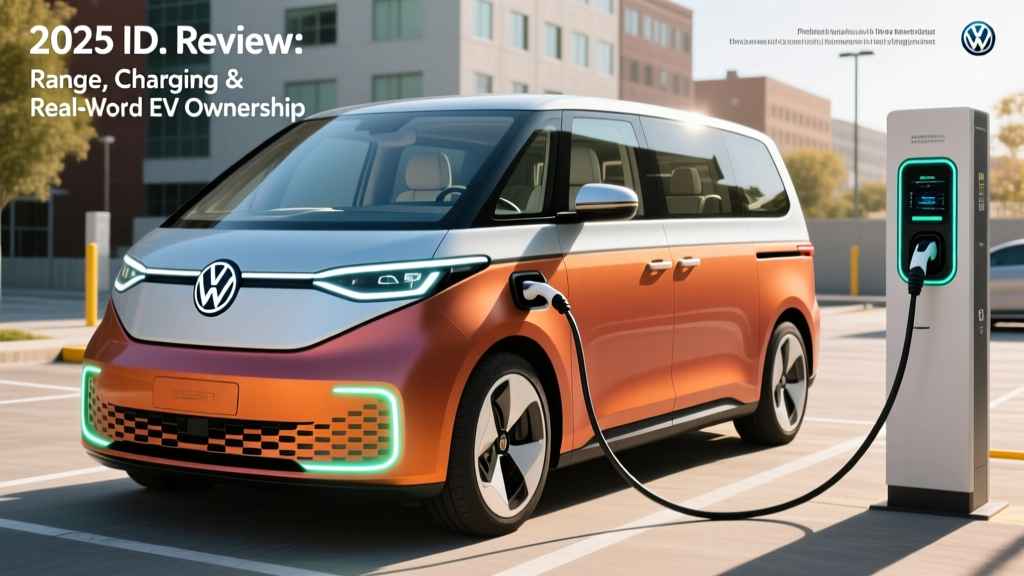
The 2025 Volkswagen ID. Buzz Pro S arrives in the U.S. as a three-row, retro-styled electric van built on VW's MEB platform — and it's the first electric minivan available stateside since the concept-car era. The Pro S trim sits in the middle of the lineup (above the base Pro, below the 1st Edition), offering a compelling mix of standard features, a long-wheelbase chassis, and rear-wheel-drive simplicity. With an EPA-estimated 234 miles of range, a 91 kWh usable battery, and seating for up to seven, it targets families who want an EV without sacrificing passenger and cargo versatility.
But the ID. Buzz Pro S isn't for everyone. Its range falls short of crossover rivals like the Hyundai Ioniq 5 or Tesla Model Y, DC fast-charging speeds are adequate rather than class-leading, and its starting price pushes past $60,000 before incentives. This review breaks down every number that matters — from real-world range to charging-curve behavior to total cost — so you can decide whether the Buzz earns a spot in your garage.
Range, Battery, and Efficiency: What the Numbers Actually Mean
| Spec | Value |
|---|---|
| EPA Range (RWD Pro S) | 234 miles |
| Battery (usable) | 91 kWh, NMC lithium-ion |
| Efficiency | 87 MPGe combined (29 kWh/100 mi) |
| Drivetrain | Rear-wheel drive (single motor) |
| Horsepower / Torque | 282 hp / 413 lb-ft |
| 0–60 mph | ~7.9 seconds |
| Max DC Fast Charge | 200 kW (peak) |
| 10–80% DC Charge Time | ~26 minutes |
| Level 2 Home Charge Rate | 11 kW AC (~30 mi/hr) |
| Seating | Up to 7 (2-3-2 config) |
| Cargo (behind 3rd row) | 18.2 cu ft |
| Cargo (all seats folded) | ~107 cu ft |
| Base MSRP (Pro S) | $61,545 (incl. destination) |
| Battery Warranty | 8 years / 100,000 miles (70% capacity) |
The 2025 VW ID. Buzz Pro S carries an EPA-estimated 234 miles of range. In mixed real-world driving, expect:
- City / suburban: 230–245 mi (regenerative braking recovers energy in stop-and-go traffic)
- Highway (70–75 mph sustained): ~190–210 mi (aerodynamic drag on the tall van body is significant)
- Cold weather (below 32°F): ~165–195 mi (NMC chemistry loses 15–25% range in freezing temps without preconditioning)
The ID. Buzz's boxy shape works against it at highway speeds. If your commute is mostly interstate, plan charging stops around 180 miles to keep a safety buffer. Preconditioning the battery via the VW app before a DC fast-charge session is essential — arriving at a charger with a cold pack can cut peak charge rates by 40% or more.
The 91 kWh usable battery uses NMC (nickel manganese cobalt) chemistry, which offers higher energy density than LFP but requires more careful state-of-charge management for long-term health. VW recommends keeping daily charge limits around 80% and only charging to 100% for longer trips. The battery sits low in the skateboard-style MEB chassis, contributing to a surprisingly planted ride for a vehicle with minivan proportions.
Efficiency lands at 87 MPGe combined (29 kWh per 100 miles), per fueleconomy.gov. That's below crossover competitors — the Hyundai Ioniq 5 achieves 114 MPGe combined — but expected given the Buzz's 5,800+ lb curb weight and van-class frontal area. At a national average electricity price of $0.16/kWh, you're paying roughly $4.64 per 100 miles, or about $0.046 per mile. A comparable gas minivan at 22 mpg and $3.40/gal costs $0.155 per mile — a substantial gap in the Buzz's favor.
Charging: DC Fast, Level 2, and the Curve Reality
| Charge Level | Power | Speed (approx.) | Notes |
|---|---|---|---|
| Level 1 (120V) | 1.4 kW | ~4 mi/hr | Emergency/trickle only; full charge ~65 hr |
| Level 2 (240V home) | 11 kW | ~30 mi/hr | Full 0–100% in ~9.5 hr; NACS connector |
| DC Fast Charge | 200 kW peak | ~140 mi in 26 min (10–80%) | Tapers significantly above 80% SoC |
The ID. Buzz Pro S ships with a NACS (North American Charging Standard) connector, meaning native access to Tesla Supercharger stalls — a major practical advantage as VW transitions away from CCS1. At a DC fast charger, the Buzz peaks at 200 kW, but like all EVs, that peak is not sustained across the entire session.
Here's what the charge curve actually looks like in practice: from a low state of charge (around 10%), the Buzz ramps quickly to ~175–200 kW and holds near peak through about 35–40% SoC. From 40–60%, power steps down to roughly 130–150 kW. Above 80%, charging slows dramatically to protect the NMC cells — expect 80–100% to take nearly as long as 10–80%. For road trips, the practical strategy is to charge from 10–80% (~26 minutes) and then drive on. Charging past 80% at a public DC station is rarely time-efficient.
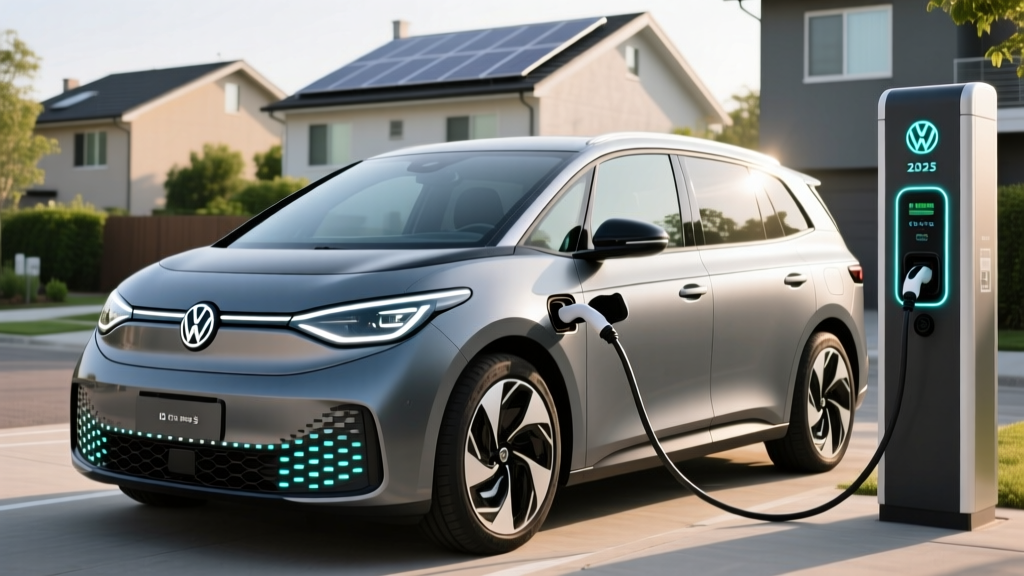
For home Level 2 charging, the 11 kW onboard charger is competitive. On a 48-amp home charger (hardwired, 240V), you'll add roughly 30 miles of range per hour of charging. An overnight session (8–10 hours) easily replenishes a full day's driving. Installation costs for a Level 2 home setup typically run $800–$2,500 depending on panel capacity, conduit length, and local permitting — budget toward the higher end if your electrical panel needs a 200-amp upgrade. Always have installation performed by a licensed electrician.
Performance and Driving Dynamics
The Pro S uses a single rear-mounted motor producing 282 horsepower and 413 lb-ft of torque. That's enough for a 0–60 mph time of approximately 7.9 seconds — leisurely by EV standards but more than adequate for merging and passing in a vehicle this size. The instant torque delivery makes the Buzz feel quicker around town than the stopwatch suggests.
Ride quality is a strength. The long wheelbase (127.5 inches) and MEB platform's low center of gravity give the Buzz a composed, car-like feel that defies its minivan silhouette. The turning circle is surprisingly tight at 38.4 feet, making it manageable in urban parking situations. Regenerative braking offers multiple levels adjustable via steering-wheel paddles, though the Buzz does not offer true one-pedal driving — it won't come to a complete stop on regen alone, unlike some competitors.
For buyers who need all-wheel drive, VW offers a dual-motor 4Motion variant on higher trims (1st Edition, and as a Pro S option), adding a front motor for a combined 335 hp. The AWD model sacrifices roughly 10–15 miles of EPA range and adds ~$3,000 to the price.
Interior, Cargo, and Technology
The ID. Buzz Pro S seats up to seven in a 2-3-2 configuration. Second-row captain's chairs (available in a six-passenger layout) offer generous legroom, while the third row accommodates adults on shorter trips. Key interior dimensions:
- Front headroom: 41.3 inches
- Second-row legroom: 39.6 inches
- Third-row legroom: 33.5 inches (tight for tall adults on long drives)
- Cargo behind 3rd row: 18.2 cu ft
- Cargo behind 2nd row (3rd row folded): 55.0 cu ft
- Max cargo (all rear seats folded): ~107 cu ft
The flat load floor and wide rear hatch opening make the Buzz genuinely practical for hauling furniture, bikes, or camping gear — a clear advantage over crossover SUVs with sloping rooflines.
Technology centers on a 12.9-inch infotainment touchscreen running VW's latest ID. Software 4.0. Wireless Apple CarPlay and Android Auto are standard, along with wireless phone charging and four USB-C ports. The digital instrument cluster is a compact 5.3-inch display behind the steering wheel. An augmented-reality head-up display is available on the Pro S with the optional Gradient Package.
Driver assistance comes via VW's IQ.DRIVE suite, which includes adaptive cruise control with stop-and-go, lane-keeping assist, front and rear automatic emergency braking, blind-spot monitoring, and rear cross-traffic alert. This is an SAE Level 2 driver-assist system — the driver must remain fully engaged with hands on the wheel and eyes on the road at all times. It is not autonomous or self-driving. VW has announced a future Travel Assist upgrade with lane-change assist, but it is not available at launch.
VW IQ.DRIVE is an SAE Level 2 system. It does NOT replace the driver. You must keep your hands on the steering wheel and monitor traffic at all times. The system may disengage in construction zones, faded lane markings, heavy rain, or sharp curves. Never treat it as self-driving.
Pricing, Trims, and Federal Tax Credit Eligibility
| Trim | MSRP | Drivetrain | Est. After §30D Credit* |
|---|---|---|---|
| Pro (base) | $59,995 | RWD | ~$52,495 |
| Pro S | $61,545 | RWD | ~$54,045 |
| Pro S Plus | $65,045 | RWD | ~$57,545 |
| 1st Edition | $69,995 | AWD | ~$62,495 |
*Tax credit estimates assume full eligibility under IRS §30D rules. Actual credit depends on individual tax liability, income, vehicle sourcing compliance, and point-of-sale transfer availability. Always verify with a tax professional and the IRS clean vehicle credit page.
The Pro S trim adds over the base Pro: a panoramic fixed glass roof, power-folding side mirrors, heated front seats with ventilation, a power liftgate, and upgraded interior ambient lighting. Our test vehicle, a Pro S with the Gradient Package (two-tone paint, 20-inch wheels, AR head-up display), came to $64,295 before any incentives.
Does the ID. Buzz Qualify for the $7,500 Federal Tax Credit?
- MSRP cap: Vans/minivans fall under the $80,000 MSRP cap for vans, SUVs, and pickups — the ID. Buzz qualifies on price.
- Buyer income caps: AGI must not exceed $300,000 (married filing jointly), $225,000 (head of household), or $150,000 (single).
- Battery sourcing: The §30D credit is split into two $3,750 halves — one for critical-minerals sourcing and one for battery-component manufacturing. As of the 2025 model year, VW sources the ID. Buzz battery from suppliers working toward North American compliance, but final credit eligibility depends on the specific VIN's supply-chain documentation. Check the fueleconomy.gov tax credit lookup for your exact vehicle.
- Point-of-sale transfer: Eligible buyers can transfer the credit to the dealer at purchase, reducing the out-of-pocket price immediately rather than waiting for a tax refund.
- Assembly: The U.S.-market ID. Buzz is assembled in Hannover, Germany — foreign assembly does not disqualify it under §30D for new vehicles (unlike the previous lease-credit loophole rules).
Critical caveat: battery-sourcing requirements tighten annually. A vehicle that qualifies in early 2025 may have different eligibility by late 2025 or 2026 as supply chains shift. Always confirm credit status at the time of purchase.
Pros, Cons, and Who Should Buy the ID. Buzz Pro S
Pros
- Genuine three-row seating with adult-usable second row and flat-load cargo versatility
- NACS connector — native Tesla Supercharger access without adapters
- Distinctive retro design with modern EV architecture — nothing else looks like it
- Smooth, quiet ride with a tight turning radius for its size
- Low per-mile fuel cost (~$0.046/mi vs. $0.155/mi for a gas minivan)
- IQ.DRIVE ADAS suite is comprehensive and standard
Cons
- 234-mi EPA range is below key crossover rivals; highway range drops further
- 200 kW peak DC charging is mid-pack — rivals like the Ioniq 5 charge at 240+ kW
- No one-pedal driving; regen doesn't bring the vehicle to a full stop
- Starting price above $60,000 before incentives — steep for a minivan
- Third-row legroom is tight for adults on long trips (33.5 in)
- Infotainment software, while improved, still lags behind Tesla and Hyundai in responsiveness
Who Should Buy the ID. Buzz Pro S?
Choose the ID. Buzz Pro S if: You need a three-row EV with real cargo-hauling capability, you value unique styling, your daily driving stays under 200 miles, and you have reliable home Level 2 charging.
Look elsewhere if: You regularly drive 300+ miles between charging stops (consider a Tesla Model Y or Rivian R1S), you need best-in-class fast-charging speed for road trips, or your budget is under $50,000 (consider a used EV or a PHEV minivan like the Chrysler Pacifica Hybrid).
Ownership Costs: 5-Year Outlook
Based on 15,000 miles per year and national average electricity/gas prices, the ID. Buzz Pro S offers meaningful fuel savings over a gas minivan:
- Annual electricity cost: ~$698 (15,000 mi × 29 kWh/100 mi × $0.16/kWh)
- Comparable gas minivan annual fuel cost: ~$2,318 (15,000 mi ÷ 22 mpg × $3.40/gal)
- Annual fuel savings: ~$1,620
- 5-year fuel savings: ~$8,100
Maintenance savings add another $500–$800 per year (no oil changes, fewer brake replacements thanks to regen, no transmission fluid). However, EV insurance premiums run 15–25% higher than comparable gas vehicles on average, partially offsetting savings. Battery replacement is unlikely under normal use — the 8-year/100,000-mile warranty guarantees at least 70% capacity retention, and NMC degradation data from VW's ID.4 (which shares the MEB platform) shows approximately 5–8% capacity loss over 100,000 miles in moderate climates.
Frequently Asked Questions
What is the real-world range of the 2025 VW ID. Buzz Pro S?
The EPA estimates 234 miles. In real-world mixed driving, expect 210–230 miles. Highway-only driving at 70+ mph drops this to roughly 190–210 miles, and cold weather (below freezing) can reduce range to 165–195 miles without battery preconditioning.
How fast does the ID. Buzz Pro S charge?
On a DC fast charger, it peaks at 200 kW and charges from 10–80% in approximately 26 minutes. On a Level 2 home charger (11 kW), a full charge takes about 9.5 hours, adding roughly 30 miles of range per hour. Level 1 (120V) trickle charging adds about 4 miles per hour.
How much does the ID. Buzz Pro S cost after tax credits?
The Pro S starts at $61,545 MSRP. If you qualify for the full $7,500 federal §30D credit (subject to income caps, battery-sourcing requirements, and tax liability), the effective price drops to approximately $54,045. State and local incentives may reduce the price further — check your jurisdiction's programs.
Does the 2025 VW ID. Buzz qualify for the federal EV tax credit?
The ID. Buzz falls under the $80,000 MSRP cap for vans and meets the vehicle-class requirement. Eligibility for the full $7,500 depends on your income (AGI caps apply), the specific VIN's battery-sourcing compliance, and your federal tax liability. Verify your vehicle's status on fueleconomy.gov and consult a tax professional.
Is the ID. Buzz Pro S worth buying vs. competitors?
If you need a three-row electric vehicle with minivan-level cargo space, the ID. Buzz Pro S has no direct rival at its price point. The Kia EV9 offers three rows and longer range (279 mi EPA) but is an SUV with less cargo flexibility. The Chrysler Pacifica Hybrid is a PHEV minivan with lower upfront cost but only 32 miles of electric range. The Buzz wins on versatility and uniqueness; it loses on range and fast-charging speed to crossover competitors.
What is the battery warranty on the ID. Buzz?
VW covers the high-voltage battery for 8 years or 100,000 miles (whichever comes first), guaranteeing at least 70% of original capacity. The powertrain (motor, power electronics) shares the same 8-year/100,000-mile coverage. The basic vehicle warranty is 4 years / 50,000 miles.
Can the ID. Buzz tow?
Yes. The RWD Pro S has a maximum towing capacity of 2,500 pounds (braked trailer). That's sufficient for a small utility trailer, a pair of dirt bikes, or a lightweight pop-up camper, but not a full-size travel trailer. AWD variants increase towing to 3,500 pounds.