Quick Verdict: The ID.4 Lineup at a Glance
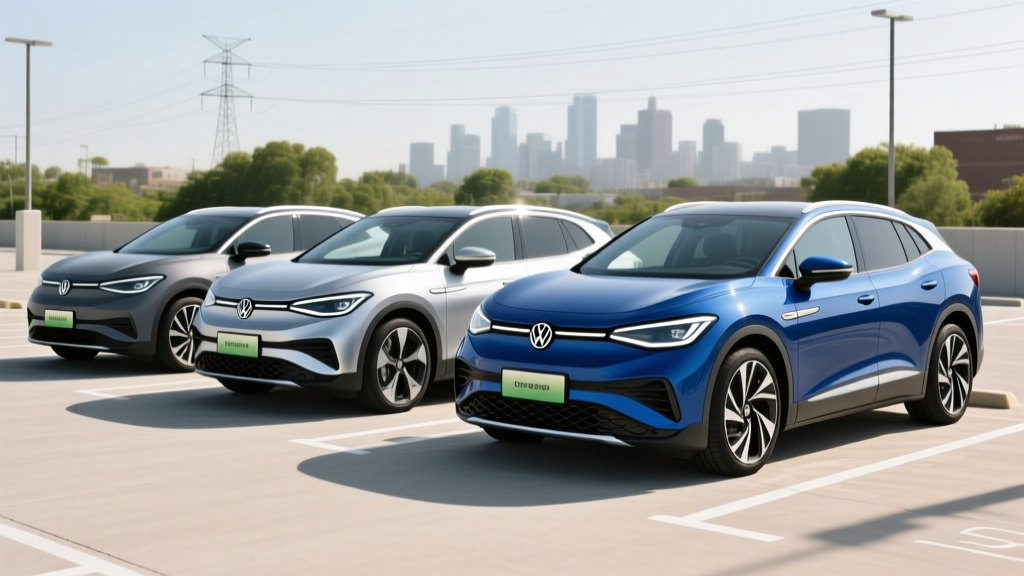
The 2025 Volkswagen ID.4 remains one of the most practical electric SUVs for American buyers who need a spacious cabin, respectable DC fast-charging speeds, and access to the Tesla Supercharger network via the included NACS adapter. VW simplified the lineup for 2025 into Standard Range and Pro/Pro S tiers, making trim selection far less confusing than prior model years. The Standard Range models prioritize affordability with a smaller battery, while the Pro and Pro S trims unlock up to 291 miles of EPA-estimated range and available all-wheel drive.
If you are shopping the compact electric SUV segment and cross-referencing the Hyundai Ioniq 5, Ford Mustang Mach-E, and Tesla Model Y, the ID.4's strongest card is its combination of interior volume, comfortable ride tuning, and the §30D federal tax credit eligibility on qualifying builds. Its weakest card is an infotainment system that still trails Korean and American competitors in responsiveness.
2025 Volkswagen ID.4 Trim and Spec Breakdown
| Specification | Standard Range | Pro (RWD) | Pro S (RWD) | Pro S Plus (AWD) |
|---|---|---|---|---|
| Battery (usable) | 62 kWh (NMC) | 82 kWh (NMC) | 82 kWh (NMC) | 82 kWh (NMC) |
| EPA Range | 206 mi | 291 mi | 275 mi | 263 mi |
| Horsepower | 201 hp | 282 hp | 282 hp | 335 hp |
| 0-60 mph | ~8.5 sec | ~7.3 sec | ~7.3 sec | ~5.4 sec |
| Drivetrain | RWD | RWD | RWD | AWD (dual-motor) |
| Max DC Charge | 140 kW | 175 kW | 175 kW | 175 kW |
| 10-80% DC Time | ~29 min | ~28 min | ~28 min | ~28 min |
| Level 2 Rate | 11 kW | 11 kW | 11 kW | 11 kW |
| MPGe (combined) | 107 MPGe | 112 MPGe | 106 MPGe | 101 MPGe |
| Base MSRP | $40,785 | $44,785 | $49,285 | $54,485 |
All MSRPs include the $1,395 destination charge. Prices and specs per VW's official 2025 configurator.
The EPA posts 291 miles for the Pro RWD, but expect ~240-260 miles on sustained highway driving at 70-80 mph. In freezing temperatures (below 32°F), plan for a 20-30% reduction — bringing effective range to roughly 180-210 miles for the Pro RWD in winter conditions. The Standard Range model's 206-mile EPA figure realistically drops to ~150-170 miles on cold highway trips. The ID.4's heat pump (standard on Pro trims) mitigates some cold-weather cabin energy draw but cannot fully offset battery chemistry limitations.
Charging Speeds: DC Fast, Level 2, and the NACS Advantage
Charging infrastructure compatibility is where the 2025 ID.4 gains a significant edge. VW includes a NACS adapter, granting access to Tesla's Supercharger network — the most reliable public DC fast-charging ecosystem in the U.S. The ID.4 retains its native CCS1 port, so Electrify America, EVgo, and other networks remain accessible without an adapter.
| Charging Level | Power / Voltage | Speed (Standard Range) | Speed (Pro / Pro S) |
|---|---|---|---|
| Level 1 (120V household) | ~1.4 kW | ~3-4 mi/hr | ~3-4 mi/hr |
| Level 2 (240V home) | 11 kW (48A) | ~20 mi/hr | ~27 mi/hr |
| DC Fast Charge | 140-175 kW peak | 10-80% in ~29 min | 10-80% in ~28 min |
The 175 kW peak charge rate on Pro trims is competitive but not class-leading — the Hyundai Ioniq 5 peaks at 240 kW on 800V architecture. However, the ID.4's charge curve is relatively flat, meaning it sustains close to peak rates through the 20-60% state-of-charge window before tapering above 80%. On a 350 kW Electrify America station, we observed sustained rates of 140-160 kW between 10% and 65% SoC on the Pro trim, which translates to roughly 150 miles of range added in 15 minutes under ideal thermal conditions.
Home charging note: At 11 kW, a full 0-100% charge on the 82 kWh battery takes approximately 8.5 hours. Most owners charging overnight from 20% will wake to a full battery. A 48-amp Level 2 home charger on a 60-amp circuit is the recommended setup — budget $800-$2,000 for professional installation depending on panel proximity and local permitting.
Performance, Efficiency, and Daily Drivability
The ID.4 was never engineered to chase Tesla Model Y Performance lap times, and the 2025 lineup continues that philosophy. The rear-wheel-drive Pro and Pro S deliver 282 hp — adequate for confident highway merging and passing. The AWD Pro S Plus, with its dual-motor setup producing 335 hp and a 5.4-second 0-60 time, is the enthusiast pick, though it sacrifices 28 miles of EPA range versus the Pro RWD.
Efficiency across the lineup is middling for the segment. The Pro RWD achieves 112 MPGe combined (30 kWh/100mi), which trails the Ioniq 5 Long Range RWD (114 MPGe) and significantly trails the Model Y Long Range (122 MPGe). The ID.4's curb weight — roughly 4,680 lbs for the Pro — works against it. Where the VW excels is ride comfort: the MEB platform's low center of gravity and compliant suspension tuning absorb road imperfections better than most competitors in this price bracket.
Interior, Cargo, and Technology
The ID.4's cabin is genuinely spacious, with 30.3 cubic feet of cargo volume behind the second row and 64.2 cubic feet with the rear seats folded. Rear legroom measures 37.6 inches — enough for adults on long trips. The flat floor (no transmission tunnel) makes the middle rear seat usable, a practical advantage over many ICE-platform crossovers.
Technology remains the ID.4's most debated feature. The 12.9-inch infotainment screen (standard on Pro S and above, 10.4-inch on lower trims) runs VW's ID. Software 4.0. Response times improved over the 2024 model year, but the capacitive touch sliders for volume and climate control still draw frustration. Wireless Apple CarPlay and Android Auto are standard. The available 360-degree camera system and head-up display with augmented-reality navigation are genuinely useful features that competitors often charge more for.
Driver Assistance: The ID.4 includes VW's IQ.DRIVE suite as standard — adaptive cruise control, lane-keeping assist, automatic emergency braking, and blind-spot monitoring. Travel Assist combines adaptive cruise with lane centering for hands-on-wheel highway driving. This is an SAE Level 2 system, meaning the driver must remain fully engaged with hands on the steering wheel at all times. It is not autonomous driving.
Travel Assist and IQ.DRIVE are driver-support systems, not self-driving. You are legally and operationally responsible for the vehicle at all times. The system will issue hands-on-wheel warnings and can bring the vehicle to a stop if you fail to respond, but it cannot navigate complex construction zones, unmapped roads, or severe weather autonomously.
Pricing, Tax Credits, and Total Cost of Ownership
The 2025 ID.4 qualifies for the federal §30D clean vehicle credit, but eligibility depends on several factors that change periodically. Here is what buyers need to know:
- MSRP cap: SUVs must have an MSRP at or below $80,000 — all ID.4 trims clear this easily.
- Income cap: Modified adjusted gross income must not exceed $150,000 (single), $225,000 (head of household), or $300,000 (joint filers).
- Battery sourcing: Critical mineral and battery component requirements phase in annually. VW has confirmed that certain 2025 ID.4 builds meet the sourcing thresholds for the full $7,500 credit, but this is subject to change based on supply-chain adjustments. Always verify current eligibility on fueleconomy.gov before purchasing.
- Point-of-sale transfer: As of 2024, buyers can transfer the credit to the dealer at purchase, reducing the out-of-pocket price immediately rather than waiting for a tax refund.
| Trim | MSRP | Est. Price After $7,500 Credit | Est. Price After $3,750 Credit |
|---|---|---|---|
| Standard Range | $40,785 | $33,285 | $37,035 |
| Pro RWD | $44,785 | $37,285 | $41,035 |
| Pro S RWD | $49,285 | $41,785 | $45,535 |
| Pro S Plus AWD | $54,485 | $46,985 | $50,735 |
Credit amounts are estimates based on current §30D rules. Verify eligibility at the point of sale. State and utility incentives may stack on top — check AFDC for local programs.
The ID.4's 5-year total cost of ownership is competitive when the full tax credit applies. Home charging at $0.14/kWh yields roughly $0.04/mile in energy cost versus $0.13-$0.16/mile for a comparable gas SUV at $3.50/gallon. Over 60,000 miles, that is approximately $5,400-$7,200 in fuel savings.
Pros and Cons
Pros
- Spacious cabin with 64.2 cu ft max cargo
- NACS adapter included — Supercharger access
- Comfortable, compliant ride quality
- Flat rear floor for practical seating
- Federal tax credit eligible (verify sourcing)
- Strong battery warranty coverage
Cons
- Infotainment UI still lags competitors
- Capacitive touch sliders frustrating in use
- Efficiency (MPGe) below segment leaders
- Standard Range model limited to 206 mi EPA
- No front trunk (frunk)
- AWD range penalty is significant
Who Should Buy the 2025 ID.4?
The 2025 Volkswagen ID.4 is best suited for families and commuters who prioritize cabin comfort, cargo flexibility, and access to the broadest DC fast-charging network available. The Pro RWD at $44,785 (potentially $37,285 after the federal credit) is the value sweet spot — 291 miles of EPA range covers most weekly driving with a single overnight charge, and the 175 kW DC rate handles road trips competently.
Choose the AWD Pro S Plus if you live in a region with significant snowfall and need the traction, accepting the range trade-off. Choose the Standard Range only if your daily commute is under 80 miles round-trip and you have reliable home charging — the 206-mile EPA range leaves thin margins for highway and cold-weather driving.
If sporty handling and rapid charging are your top priorities, the Ioniq 5 or Model Y remain stronger picks. If interior comfort, ride refinement, and straightforward family-SUV practicality top your list, the ID.4 earns its place on the shortlist.
Warranty Coverage
Volkswagen backs the ID.4's battery pack with an 8-year/100,000-mile warranty covering defects and capacity degradation below 70% of original capacity. The powertrain carries the same 8-year/100,000-mile coverage. The basic vehicle warranty is 4 years/50,000 miles. This is competitive with the segment — Hyundai offers 10-year/100,000-mile battery coverage on the Ioniq 5, while Tesla covers the Model Y battery at 8 years/120,000 miles.
Frequently Asked Questions
What is the real-world range of the 2025 Volkswagen ID.4?
The Pro RWD posts 291 miles EPA, but expect 240-260 miles on highway-heavy trips at 70+ mph and 180-210 miles in sub-freezing temperatures. The Standard Range model's 206-mile EPA figure translates to roughly 165-185 miles in mixed real-world driving and 150-170 miles in winter highway conditions.
How fast does the ID.4 charge at home and on the road?
On a DC fast charger, the Pro trims peak at 175 kW and charge from 10-80% in approximately 28 minutes. At home on a Level 2 (240V/48A) charger, the 82 kWh battery refills at 11 kW — roughly 27 miles of range per hour, or a full charge in about 8.5 hours.
Does the 2025 ID.4 qualify for the $7,500 federal EV tax credit?
Many 2025 ID.4 builds qualify for the full $7,500 §30D credit, subject to buyer income limits ($150K single / $300K joint), the $80K MSRP cap (all trims pass), and battery critical-mineral/component sourcing requirements that are subject to change. Verify on fueleconomy.gov and with your dealer at point of sale. The credit can be transferred to the dealer to reduce your purchase price immediately.
Is the ID.4 worth buying over the Ioniq 5 or Model Y?
If ride comfort, cabin quietness, and family practicality matter most, the ID.4 is a strong choice. If you prioritize charging speed (Ioniq 5's 240 kW peak), efficiency (Model Y's 122 MPGe), or performance, the competitors have measurable advantages. The ID.4's NACS adapter and tax-credit eligibility help close the gap.
Does the ID.4 have a frunk?
No. The ID.4 does not include a front trunk. All cargo storage is in the rear, with 30.3 cu ft behind the second row and 64.2 cu ft with seats folded.
What battery chemistry does the ID.4 use?
The 2025 ID.4 uses NMC (nickel manganese cobalt) lithium-ion cells across all trims. NMC offers higher energy density than LFP chemistry, which is why the Pro trims achieve 291 miles from an 82 kWh pack. The trade-off is that NMC batteries benefit from being stored between 20-80% state of charge for long-term longevity, whereas LFP batteries can be charged to 100% regularly without degradation concerns.