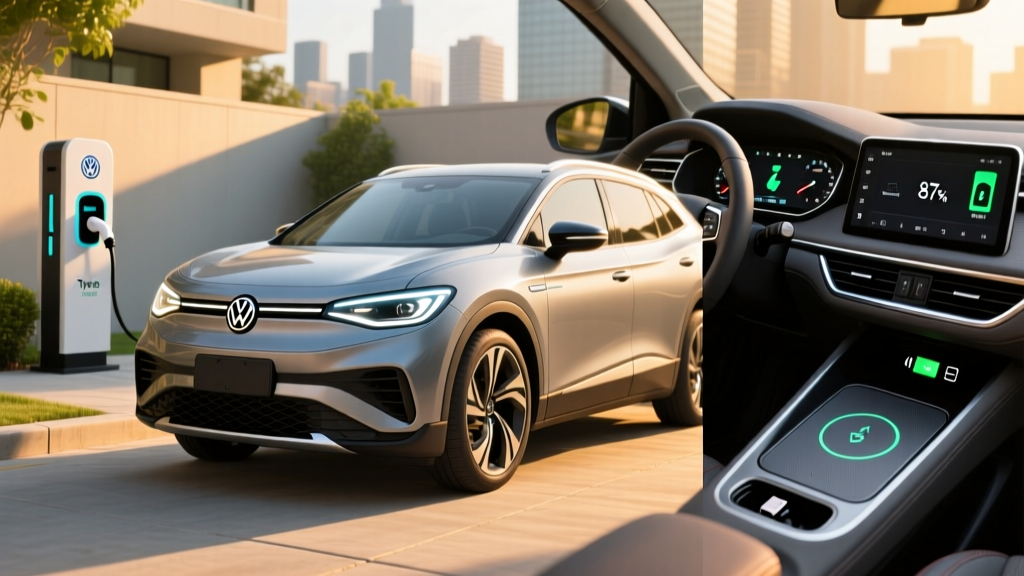
The compact electric SUV segment leaves little room for mediocrity, and the 2025 Volkswagen ID.4 arrives with meaningful updates to address past criticisms. A larger 12.9-inch infotainment screen, illuminated VW badges on Pro trims, and revised software aim to elevate what was already a practical, value-oriented electric crossover. But with rivals like the Hyundai Ioniq 5, Ford Mustang Mach-E, and Tesla Model Y pushing boundaries in charging speed and performance, where does the ID.4 land for buyers shopping in 2026?
After examining EPA data, real-world driving logs, and current pricing, the 2025 ID.4 positions itself as a sensible family hauler with competitive range and strong cargo utility — though its DC charging speeds and software refinement trail the segment leaders.
Range, Battery, and Efficiency: What to Expect
The 2025 Volkswagen ID.4 uses an 82 kWh gross battery pack (approximately 77 kWh usable) with NMC (nickel manganese cobalt) chemistry across all trims. This is a conventional lithium-ion formulation optimized for energy density and cold-weather performance, though it does not carry the 100% daily-charge tolerance of LFP packs found in some competitors.
| Spec | Pro / Pro S (RWD) | AWD Pro / Pro S |
|---|---|---|
| EPA Range | 291 miles | 263 miles |
| Battery (gross / usable) | 82 kWh / ~77 kWh | 82 kWh / ~77 kWh |
| Chemistry | NMC | NMC |
| Motor Config | Rear-Wheel Drive | Dual-Motor AWD |
| Horsepower | 282 hp | 335 hp |
| 0–60 mph | 7.3 sec | 5.4 sec |
| MPGe (city / hwy / combined) | 104 / 93 / 99 | 97 / 87 / 92 |
| Efficiency (kWh/100 mi) | 34 | 37 |
| Max DC Fast Charge | 170 kW | 170 kW |
| Level 2 Charge Rate | 11 kW (AC) | 11 kW (AC) |
| Cargo (behind 2nd row) | 30.3 cu ft | 30.3 cu ft |
| Cargo (seats folded) | 64.2 cu ft | 64.2 cu ft |
The EPA rates the RWD ID.4 Pro at 291 miles, but expect 240–265 miles in sustained highway driving at 70–75 mph. In cold weather (below 32°F), range drops further — testing shows 190–220 miles is realistic with cabin heating active. City and suburban driving with regenerative braking can return closer to the EPA sticker, around 275–290 miles. The AWD variant sacrifices roughly 10% of range for all-weather traction.
According to EPA data at fueleconomy.gov, the RWD ID.4 achieves 99 MPGe combined (34 kWh/100 mi). That's competitive with the Ford Mustang Mach-E Extended Range RWD (101 MPGe combined) but trails the Hyundai Ioniq 5 Long Range RWD (114 MPGe combined). If efficiency is a top priority, the ID.4 sits mid-pack — adequate, but not class-leading.
Charging Speeds: Home and DC Fast Charging
Charging is where the 2025 ID.4 shows its most notable compromise. The maximum DC fast-charge rate is 170 kW — adequate for road trips but noticeably behind the Hyundai Ioniq 5's 240 kW (via 800V architecture) and the Tesla Model Y's ~250 kW peak on V3 Superchargers.
| Charging Level | Power | Speed / Time | Typical Use Case |
|---|---|---|---|
| Level 1 (120V) | ~1.4 kW | ~4 miles per hour | Emergency / overnight top-off |
| Level 2 (240V, 48A) | 11 kW | ~33 miles per hour; 0–100% in ~8 hrs | Home / workplace daily charging |
| DC Fast Charge | Peak 170 kW | 10–80% in ~30 minutes | Road trips, public fast chargers |
At a 150+ kW DC fast charger, the ID.4 peaks near 170 kW between approximately 10–30% State of Charge (SoC), then tapers progressively. The 10–80% charge takes roughly 30 minutes under ideal thermal conditions. In cold weather without adequate preconditioning, expect 35–40 minutes. The ID.4 supports route-based battery preconditioning when a DC fast charger is set as your navigation destination — this warms the pack for faster charging upon arrival, though the system is less aggressive than Tesla's or Hyundai's implementations.
For home Level 2 charging, the onboard 11 kW AC charger is a strong point. On a 48-amp Level 2 circuit (the most common home install), you'll recover the full battery in about 7.5–8 hours — comfortably overnight. This requires a 60-amp dedicated circuit; budget $800–$2,000 for professional installation depending on your panel's proximity to the garage and whether a panel upgrade is needed.
Performance and Driving Dynamics
The rear-wheel-drive ID.4 Pro delivers 282 hp from its single rear-mounted permanent-magnet synchronous motor, achieving a 0–60 mph time of 7.3 seconds. That's perfectly adequate for merging and daily driving but won't thrill enthusiasts. The AWD Pro S adds a front induction motor for 335 hp combined and a 5.4-second 0–60 sprint — a meaningful improvement for those who want confident highway passing or live in snowy climates.
Ride quality is where the ID.4 earns praise. VW tuned the suspension for comfort over sportiness, and the result is a compliant, quiet cruiser that absorbs rough pavement well. Steering is light and predictable, body roll is controlled, and the turning circle is tight at 31.5 feet — helpful for urban parking. Regenerative braking offers two modes (D for coasting, B for stronger regen) but does not provide true one-pedal driving to a full stop, which some EV veterans may miss.
The AWD variant includes a towing capacity of 2,700 pounds — enough for a small utility trailer or a pair of dirt bikes, but well below the Ford Mach-E's 3,300-pound rating and the Rivian R1S's 7,700-pound capability.
Interior, Tech, and Practicality
The 2025 ID.4 cabin is spacious and functional. Rear legroom measures 37.6 inches — generous for the segment and comparable to the Toyota RAV4. The flat floor (no transmission tunnel) makes the middle seat usable for adults on shorter trips. Cargo volume behind the second row is 30.3 cubic feet, expanding to 64.2 cu ft with seats folded — competitive with the Hyundai Ioniq 5 (27.2 / 56.2 cu ft) and significantly more than the Kia EV6 (24.4 / 50.2 cu ft).
The updated 12.9-inch infotainment display runs VW's latest ID. Software 4.0, which brings larger touch targets, improved responsiveness, and backlit slider controls for volume and climate — a direct response to widespread complaints about the prior touch-capacitive sliders. Wireless Apple CarPlay and Android Auto are standard. However, some menu nesting remains, and the system occasionally lags on cold starts compared to the snappier interfaces in the Tesla Model Y or Hyundai Ioniq 5.
Standard driver-assistance features include:
- Adaptive cruise control with stop-and-go
- Lane-keeping assist with centering
- Automatic emergency braking with pedestrian detection
- Blind-spot monitoring with rear cross-traffic alert
- Travel Assist (SAE Level 2 hands-on highway driving assist)
Travel Assist works well on well-marked highways, maintaining lane position and following distance competently. This is a Level 2 driver-assistance system — the driver must remain engaged with hands on the wheel at all times. It is not autonomous or self-driving.
VW's Travel Assist and IQ.DRIVE suite are SAE Level 2 systems requiring continuous driver supervision. They do not handle construction zones, unmapped roads, or severe weather autonomously. Always keep hands on the steering wheel and eyes on the road.
Pricing, Trims, and Federal Tax Credit
The 2025 Volkswagen ID.4 is offered in five trims. Pricing below reflects MSRP before destination charges ($1,395) and before any incentives:
| Trim | Drivetrain | MSRP | Est. After §30D Credit* |
|---|---|---|---|
| Standard Range S | RWD | $39,735 | ~$32,235 |
| Pro | RWD | $43,735 | ~$36,235 |
| Pro S | RWD | $46,735 | ~$39,235 |
| AWD Pro | AWD | $47,735 | ~$40,235 |
| AWD Pro S Plus | AWD | $53,735 | ~$46,235 |
*Estimated prices assume full $7,500 federal tax credit under IRS §30D. Actual eligibility depends on multiple factors.
The ID.4 qualifies for the up-to-$7,500 federal EV tax credit (IRS §30D) for eligible buyers, and this credit can be transferred to the dealer as a point-of-sale discount under current rules. However, eligibility is not automatic. Key requirements include:
- MSRP cap: The vehicle must have an MSRP at or below $80,000 for SUVs (all ID.4 trims qualify).
- Buyer income cap: Modified adjusted gross income must not exceed $150,000 (single), $225,000 (head of household), or $300,000 (joint filing).
- Battery sourcing: Critical minerals and battery components must meet escalating domestic-sourcing thresholds that tighten annually. VW has confirmed that qualifying 2025 ID.4 vehicles assembled in Chattanooga, TN, meet current-year requirements — but always verify with your dealer and a tax professional before purchase.
- Point-of-sale transfer: You may elect to transfer the credit to the dealer for an immediate price reduction, subject to IRS registration requirements.
For the latest rules, consult the IRS clean vehicle credits page. State and local incentives may stack on top — check your state energy office or AFDC incentive database for details.
Pros and Cons: The Honest Scorecard
- Competitive 291-mile EPA range (RWD)
- Spacious cargo area (30.3 cu ft) and generous rear legroom
- Comfortable, compliant ride quality
- Strong 11 kW Level 2 onboard charger for fast home charging
- Federal tax credit eligible (up to $7,500)
- Comprehensive standard ADAS suite
- 8-year / 100,000-mile battery warranty
- 170 kW peak DC charging lags Ioniq 5 (240 kW) and Model Y (~250 kW)
- No true one-pedal driving to a full stop
- Infotainment still occasionally sluggish despite improvements
- AWD towing limited to 2,700 lbs
- No front trunk (frunk) — space is occupied by HVAC components
- Base Standard Range trim uses a smaller 62 kWh pack with only ~206 miles range
Who Should Buy the 2025 Volkswagen ID.4?
- You need a practical family SUV with strong cargo space and a comfortable ride
- You charge primarily at home overnight and rarely DC fast-charge
- You want a mainstream-brand EV with a strong dealer network and 8-year battery warranty
- You qualify for the full $7,500 federal credit, bringing effective pricing into the low-$30K range
- Road trips are frequent and you want the fastest possible DC charging (consider Ioniq 5 or Model Y)
- You want a sporty, engaging driving experience (consider Mach-E GT or Model Y Performance)
- You need more than 2,700 lbs of towing capacity
- You want a frunk for additional sealed storage
The ID.4 is a strong choice for suburban families and commuters who value space, comfort, and value over performance and cutting-edge charging tech. Its Chattanooga-built credentials and tax-credit eligibility make it one of the most affordable compact electric SUVs when incentives are applied.
2025 VW ID.4 vs. Key Competitors
| VW ID.4 Pro | Hyundai Ioniq 5 SEL | Ford Mach-E Premium | Tesla Model Y LR | |
|---|---|---|---|---|
| EPA Range | 291 mi | 303 mi | 290 mi | 320 mi |
| DC Fast Charge Peak | 170 kW | 240 kW | 150 kW | ~250 kW |
| 10–80% DC Time | ~30 min | ~18 min | ~37 min | ~22 min |
| 0–60 mph | 7.3 sec | 7.4 sec | 6.1 sec | 4.8 sec |
| Cargo (rear seats up) | 30.3 cu ft | 27.2 cu ft | 29.7 cu ft | 30.2 cu ft |
| Base MSRP | $43,735 | $46,650 | $43,495 | $46,630 |
The ID.4 holds its own on range and cargo volume, and undercuts most rivals on MSRP before incentives. Its weakness is DC charging speed — the Ioniq 5's 800V architecture delivers a decisive 12-minute advantage on road trips. The Model Y leads in range and performance but costs more and carries polarizing build-quality perceptions.
Frequently Asked Questions
What is the real-world range of the 2025 Volkswagen ID.4?
The EPA rates the RWD ID.4 Pro at 291 miles. In real-world highway driving at 70+ mph, expect 240–265 miles. In freezing temperatures with cabin heat, plan for 190–220 miles. The AWD variant delivers roughly 10% less range in all conditions.
How fast does the 2025 ID.4 charge?
On a DC fast charger, the ID.4 peaks at 170 kW and charges from 10–80% in approximately 30 minutes under ideal conditions. At home on a Level 2 (240V, 48A) charger, it adds about 33 miles per hour and fully recharges in roughly 8 hours.
Does the 2025 ID.4 qualify for the federal EV tax credit?
Yes, the 2025 ID.4 is eligible for up to $7,500 under IRS §30D for buyers who meet income caps (up to $300,000 joint) and purchase a qualifying vehicle with compliant battery sourcing. The credit can be applied at point of sale. Always verify current eligibility with your dealer and a tax professional, as sourcing requirements change annually.
How much does the 2025 ID.4 cost after incentives?
The base Standard Range S starts at $39,735 MSRP. With the full $7,500 federal credit, that drops to approximately $32,235. The well-equipped Pro S RWD at $46,735 falls to roughly $39,235 after the credit. State and utility incentives may reduce the cost further.
Is the 2025 ID.4 worth buying over the Ioniq 5 or Model Y?
The ID.4 is worth considering if you prioritize ride comfort, cargo space, and value after tax credits. If fast DC charging and tech-forward design matter more, the Ioniq 5 is the stronger pick. If range and performance top your list, the Model Y Long Range leads the segment. Test-drive all three before deciding.
What is the battery warranty on the 2025 ID.4?
Volkswagen covers the ID.4's high-voltage battery for 8 years or 100,000 miles (whichever comes first) against defects and capacity loss below 70% of original capacity. The limited vehicle warranty is 4 years / 50,000 miles.
Does the ID.4 have a frunk (front trunk)?
No. The space under the front hood is occupied by power electronics and HVAC components. All storage is in the rear cargo area (30.3 cu ft) and a small under-floor compartment.
Sources: EPA Fuel Economy, IRS Clean Vehicle Credits, Volkswagen of America specifications.