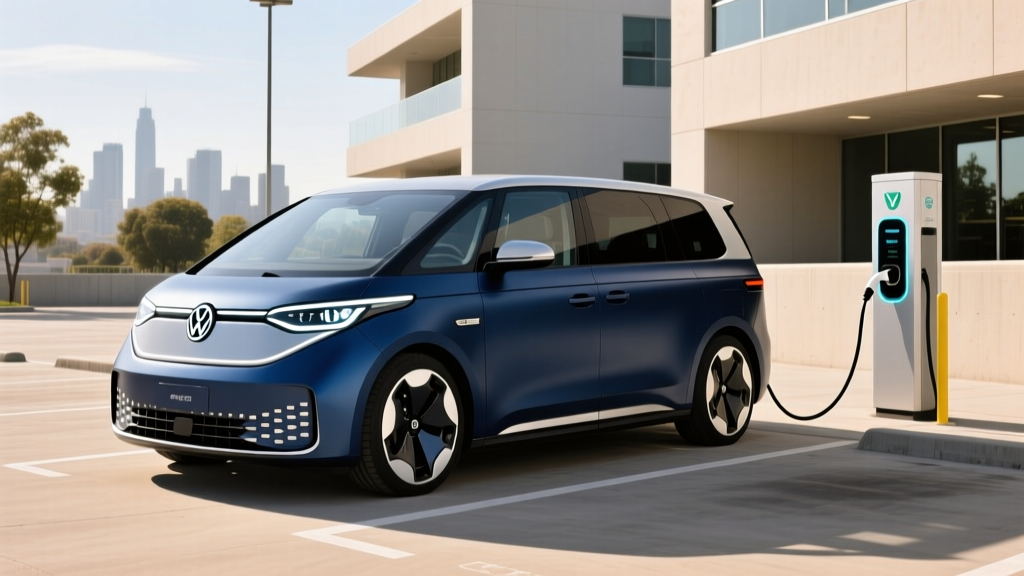
The 2025 Volkswagen ID. Buzz Pro S arrives in the U.S. as a retro-styled electric minivan that trades the utilitarian bones of the European original for a longer wheelbase, a larger battery, and the 800-volt-class architecture VW calls APP550. The Pro S is the mid-tier trim — one step above the base Pro — and it bundles the most sought-after comfort and driver-assist features while retaining the same 91 kWh usable battery and single-motor rear-wheel-drive layout. For families who want three rows, a usable frunk, and a van that actually looks fun in the school drop-off line, the ID. Buzz Pro S occupies a space that nothing else in the 2025 model year quite fills. But its 234-mile EPA range, 200 kW peak charge rate, and $59,995 starting price demand scrutiny. Here is the data-driven breakdown.
Range, Efficiency, and Real-World Expectations
The 2025 Volkswagen ID. Buzz Pro S carries an EPA-estimated range of 234 miles from its 91 kWh usable (NMC lithium-ion) battery pack. That figure applies to the RWD Pro and Pro S trims; the 4Motion all-wheel-drive variant drops to 231 miles. Efficiency is rated at 87 MPGe combined, which translates to roughly 39 kWh per 100 miles according to fueleconomy.gov.
EPA Sticker: 234 miles
Highway (70-75 mph, moderate weather): Expect 195–210 miles. The Buzz's boxy shape produces a 0.29 Cd drag coefficient — respectable for a van but still far higher than a sedan. Sustained highway speeds hit range hard.
Cold weather (below 32°F): Plan for 160–180 miles. The Buzz uses a resistive PTC heater on U.S. models rather than a heat pump, which increases energy draw significantly in winter. Preconditioning while plugged in helps but does not eliminate the loss.
City / mixed driving (mild weather): 220–234 miles is achievable with moderate regen use and speeds under 55 mph.
The absence of a heat pump on North American models is a meaningful omission for buyers in northern climates. Volkswagen has stated the decision was driven by packaging and cost, but it means winter range loss is steeper than competitors like the Hyundai Ioniq 9 or Kia EV9 that offer heat pump-equipped thermal management. If you live in a climate where temperatures regularly drop below freezing, budget for roughly 30% range reduction in deep winter.
Battery, Charging Speed, and Infrastructure Compatibility
The ID. Buzz Pro S uses a 91 kWh usable (approximately 96 kWh gross) NMC (nickel manganese cobalt) lithium-ion battery pack mounted in the floor. VW has not offered an LFP option for the U.S. market. The pack operates on an 800-volt-class architecture, which enables the headline charging spec: a peak DC fast-charge rate of 200 kW.
| Charging Level | Power / Rate | Speed / Time | Connector |
|---|---|---|---|
| Level 1 (120V) | ~1.3 kW | ~3 mi/hr | J1772 |
| Level 2 (240V, 48A) | 11 kW onboard | ~26 mi/hr (0–100% in ~9 hr) | J1772 / NACS adapter |
| DC Fast Charge | Peak 200 kW | 10–80% in ~26 min | CCS1 (NACS via adapter) |
A few things to note from real-world charging behavior. The 200 kW peak is just that — a peak. The Buzz's charge curve is strongest between roughly 10% and 45% state of charge, where it sustains 170–195 kW on a capable 350 kW charger. Above 60% SoC, the rate tapers to around 100 kW, and above 80% it drops further to roughly 50 kW. This is normal for NMC packs but worth understanding: if you regularly charge past 80% on road trips, that last 20% will take nearly as long as the first 70%.
Home Level 2 charging at 11 kW means a full overnight replenishment is practical. On a standard 48-amp Level 2 home charger (such as a ChargePoint Home Flex or Emporia V2), you will add roughly 26 miles of range per hour, or fully recharge the 91 kWh pack in about 9 hours. This is competitive with other three-row EVs in the class.
The ID. Buzz ships with a CCS1 port. Volkswagen has confirmed NACS adapter compatibility for Tesla Supercharger access, though the adapter is not always included at purchase — confirm with your dealer. This is essential for road-trip charging, as the Tesla Supercharger network remains the most reliable DC fast-charging infrastructure in the U.S.
Performance and Drivetrain
The Pro S trim uses a single rear-mounted APP550 electric motor producing 282 horsepower and 413 lb-ft of torque. Volkswagen quotes a 0–60 mph time of 7.9 seconds. That is adequate for merging and passing but noticeably unhurried for a vehicle in the $60,000 range. For context, the Kia EV9 GT-Line AWD hits 60 in about 5.0 seconds, and the Hyundai Ioniq 9 Performance AWD does it in roughly 5.5 seconds.
The 4Motion all-wheel-drive variant (available on Pro S Plus and as a standalone option) adds a front motor for a combined 335 hp and drops the 0–60 time to approximately 6.5 seconds. However, AWD costs an additional $3,840 and reduces EPA range to 231 miles.
Ride quality is a strength. The Buzz's long 127.5-inch wheelbase and VW's tuned suspension deliver a compliant, car-like feel that absorbs potholes and expansion joints with composure. Body roll is present in corners — this is a tall, heavy van — but it is well-controlled for the segment. Regenerative braking offers three levels selectable via steering-wheel paddles, but there is no true one-pedal driving mode. The lowest regen setting still requires brake-pedal use for complete stops, which frustrates drivers accustomed to Chevy's or Nissan's one-pedal implementations.
Interior Space, Cargo, and Practicality
The U.S.-spec ID. Buzz rides on the extended-wheelbase platform and offers three rows of seating for up to seven passengers. Second-row captain's chairs are standard on the Pro S (a bench is available on the base Pro). Here is how the space breaks down:
| Dimension | Measurement |
|---|---|
| Cargo behind 3rd row | 18.2 cu ft |
| Cargo behind 2nd row (3rd row folded) | 75.5 cu ft |
| Max cargo (2nd + 3rd folded) | 126.5 cu ft |
| Front headroom | 41.3 in |
| 2nd-row legroom | 39.6 in |
| 3rd-row legroom | 33.5 in |
| Towing capacity | 2,500 lbs (braked) |
The third row is genuinely usable for adults on shorter trips, which puts the Buzz ahead of many compact three-row crossovers. However, 18.2 cubic feet behind the third row is tight for a family road trip with all seats occupied — you will want a roof box or soft-sided bags. The second-row seats slide fore and aft, which lets you trade legroom for cargo flexibility. Both second and third rows fold flat, creating a van-like cargo floor that is ideal for hauling gear, bikes, or camping equipment.
There is no front trunk (frunk). The space under the hood houses HVAC components and the 12V battery, so all storage is in the rear. This is a missed opportunity for an EV-native platform and a practical drawback compared to the Ford F-150 Lightning or Rivian R1S.
Tech, Driver Assistance, and Standout Features
The Pro S trim includes a 12.9-inch central touchscreen running VW's ID. Software 4.0, a 5.3-inch digital instrument cluster, wireless Apple CarPlay and Android Auto, and a heated steering wheel. The panoramic fixed glass roof (standard on Pro S) floods the cabin with light and is a defining feature — passengers in all three rows get an open, airy experience that feels distinctly European.
Driver-assist technology falls under VW's IQ.DRIVE suite, which is a SAE Level 2 system. It includes adaptive cruise control with stop-and-go, lane-centering assist, automatic emergency braking with pedestrian detection, blind-spot monitoring, and rear cross-traffic alert. The system is competent on highways but requires continuous driver engagement — hands must remain on the wheel, and the lane-centering can hunt slightly on faded lane markings. This is not a hands-free system like GM's Super Cruise or Ford's BlueCruise.
One standout feature is the Buzz's vehicle-to-load (V2L) capability, available via an optional accessory that allows the vehicle's battery to power external devices — useful for camping, tailgating, or emergency backup power. The bidirectional charging feature is limited to 2.0 kW output, enough for lights, a laptop, or a small appliance, but not whole-home backup.
Notable tech drawbacks: the infotainment system's capacitive touch sliders for volume and temperature have drawn widespread criticism for being imprecise and unlit at night. Wireless charging pad placement is awkward, and rear-seat USB-C ports are limited to two for the entire second row. Software responsiveness has improved with ID. Software 4.0 but still lags behind Tesla's and Hyundai's interfaces in fluidity.
Pricing, Trims, and Federal Tax Credit Eligibility
The 2025 Volkswagen ID. Buzz is offered in three trims, all on the long-wheelbase platform:
| Trim | Drivetrain | Base MSRP | EPA Range |
|---|---|---|---|
| Pro | RWD | $59,995 | 234 mi |
| Pro S | RWD | $63,495 | 234 mi |
| Pro S Plus | RWD or AWD | $66,995 (RWD) / $69,840 (AWD) | 234 / 231 mi |
Destination charges add $1,395 across all trims. Our review unit — a Pro S RWD with the panoramic roof (standard), Harman Kardon audio upgrade ($695), and two-tone paint ($995) — came to an as-tested price of $66,580.
Federal EV Tax Credit (§30D) Eligibility
The ID. Buzz is assembled in Hannover, Germany, which creates a significant hurdle for the $7,500 federal EV tax credit under IRS §30D. Under current rules, vehicles must undergo final assembly in North America to qualify for the new-vehicle credit. The ID. Buzz does not meet this requirement and is therefore ineligible for the $7,500 §30D credit.
However, there are alternative pathways to savings:
- Lease loophole (§45W): If you lease the ID. Buzz through Volkswagen Financial Services, the lessor (VW) may receive a $7,500 commercial clean vehicle credit and pass some or all of that savings to you as a capitalized-cost reduction. Lease deals vary by month and region — check current offers.
- State incentives: Several states (California, Colorado, Massachusetts, New York, among others) offer rebates or tax credits for EVs regardless of assembly location. Check your state energy office or AFDC state incentive database for specifics.
- Utility rebates: Many electric utilities offer $500–$1,500 rebates for EV purchases and home charger installations.
For the most current federal incentive rules, consult the IRS clean vehicle credits page or speak with a tax professional. Income caps, MSRP limits, and battery-sourcing requirements apply to qualifying vehicles and change periodically.
Warranty and Ownership Costs
Volkswagen backs the ID. Buzz with the following warranty coverage:
- Battery: 8 years / 100,000 miles (whichever comes first), covering defects and capacity loss below 70% of original capacity
- Powertrain (e-motor, reduction gearbox): 8 years / 100,000 miles
- Bumper-to-bumper: 4 years / 50,000 miles
- Roadside assistance: 4 years / 50,000 miles
- Complimentary maintenance: 2 years / 20,000 miles (covers cabin air filter, brake fluid, and inspections)
The 70% capacity retention threshold at 8 years / 100,000 miles is industry-standard, matching Hyundai, Kia, and Ford. Tesla's threshold is slightly higher at 70% but with unlimited miles on some models. VW's bumper-to-bumper coverage of 4/50,000 is shorter than Hyundai's 5/60,000 but in line with most European brands.
Insurance costs for the ID. Buzz are higher than average for the class. Expect annual premiums in the $2,200–$2,800 range depending on your state, driving record, and coverage level. This reflects the vehicle's high MSRP, imported parts costs, and limited collision-repair data for the U.S. market.
How the ID. Buzz Pro S Stacks Up Against Competitors
The ID. Buzz does not have a direct one-to-one rival — it is the only retro-styled electric minivan on the market. But buyers cross-shopping three-row electric vehicles will encounter these alternatives:
| Spec | 2025 VW ID. Buzz Pro S | 2025 Kia EV9 GT-Line AWD | 2025 Hyundai Ioniq 9 Perf. AWD |
|---|---|---|---|
| Base MSRP | $63,495 | $73,900 | $72,350 |
| EPA Range | 234 mi | 270 mi | 290 mi |
| Battery (usable) | 91 kWh NMC | 99.8 kWh NMC | 110.3 kWh NMC |
| Peak DC Charge | 200 kW | 239 kW | 350 kW |
| 10–80% DC Time | ~26 min | ~24 min | ~18 min |
| 0–60 mph | 7.9 sec | 5.0 sec | 5.5 sec |
| Horsepower | 282 hp | 379 hp | 379 hp |
| Max Cargo | 126.5 cu ft | 81.7 cu ft | 90.0 cu ft |
| §30D Tax Credit | No (German-built) | Yes (GA-built)* | Yes (GA-built)* |
*Tax credit eligibility depends on buyer income, battery sourcing, and current IRS rules. Verify at irs.gov.
The comparison makes the Buzz's value proposition clear: it offers vastly more cargo space than either Korean rival and undercuts them on price, but it trails significantly on range, charging speed, and performance. The Kia and Hyundai also qualify for the federal tax credit when purchased (subject to sourcing and income rules), effectively narrowing the price gap by $7,500.
✓ Pros
- Class-leading max cargo volume (126.5 cu ft)
- Distinctive retro design with panoramic glass roof
- Comfortable, compliant ride quality
- Usable adult-sized third row
- V2L capability for camping/emergency power
- Competitive starting price for a three-row EV
✗ Cons
- Lowest EPA range in the three-row EV class (234 mi)
- No heat pump on U.S. models — poor winter range
- Ineligible for $7,500 federal purchase credit
- Sluggish 7.9-sec 0–60 time for the price
- Capacitive touch controls are frustrating to use
- No front trunk (frunk)
- No true one-pedal driving mode
Who Should Buy the 2025 Volkswagen ID. Buzz Pro S?
Buy the ID. Buzz Pro S if: You prioritize interior volume and style over maximum range. You primarily drive in moderate climates, charge at home nightly, and take road trips under 200 miles between stops. You want a distinctive family hauler that stands out and can double as a cargo van with the seats folded. You plan to lease (to capture the $7,500 commercial credit pass-through) or your state offers strong purchase incentives.
Look elsewhere if: You regularly drive more than 200 miles in a single day, live in a cold climate where winter range loss compounds the Buzz's already modest EPA figure, or you want the fastest-charging three-row EV for frequent road trips. The Hyundai Ioniq 9 and Kia EV9 both offer 270+ miles of range, faster DC charging, and federal tax credit eligibility on purchase — making them more practical choices for range-conscious buyers.
Frequently Asked Questions
What is the real-world range of the 2025 VW ID. Buzz Pro S?
The EPA rates the RWD Pro S at 234 miles. In real-world mixed driving at moderate temperatures, expect 210–225 miles. On sustained highway trips at 75 mph, plan for 195–210 miles. In cold weather below freezing, range can drop to 160–180 miles due to the lack of a heat pump on U.S. models.
How fast does the ID. Buzz charge at home and on the road?
On DC fast charging, the Buzz peaks at 200 kW and charges from 10–80% in approximately 26 minutes on a capable 350 kW station. At home on a 48-amp Level 2 charger (11 kW), it adds about 26 miles of range per hour and fully recharges in roughly 9 hours. A standard 120V outlet adds only about 3 miles per hour — not practical for daily use.
Does the 2025 ID. Buzz qualify for the $7,500 federal EV tax credit?
No — not for outright purchase. The ID. Buzz is assembled in Germany, and the §30D new clean vehicle credit requires North American final assembly. However, leasing may allow the lessor to claim a $7,500 commercial credit (§45W) and pass savings to you. State and utility incentives may also apply regardless of assembly location. Always verify current rules at irs.gov.
Is the ID. Buzz Pro S worth buying over the Kia EV9 or Hyundai Ioniq 9?
It depends on your priorities. The Buzz wins on cargo space (126.5 cu ft max vs. 81–90 cu ft), headroom, and character. The Kia EV9 and Hyundai Ioniq 9 win on range (270–290 mi), charging speed, performance, and federal tax credit eligibility. If maximum range and road-trip charging speed are critical, the Korean SUVs are the more practical pick. If you need van-like cargo capacity and love the design, the Buzz is unique.
What is the battery warranty on the ID. Buzz?
Volkswagen covers the high-voltage battery for 8 years or 100,000 miles, whichever comes first. The warranty covers defects and capacity degradation below 70% of original capacity. The e-motor and powertrain components carry the same 8-year/100,000-mile coverage.
Can the ID. Buzz tow?
Yes. The ID. Buzz is rated to tow up to 2,500 pounds (braked trailer). This is sufficient for a small utility trailer, a pair of jet skis, or a lightweight pop-up camper, but it is not rated for heavier boat or travel trailers. Keep in mind that towing will significantly reduce range — expect a 30–50% reduction depending on trailer weight and aerodynamics.