The Short Answer: Does the 2025 Volkswagen Beetle Electric Crossover Exist?
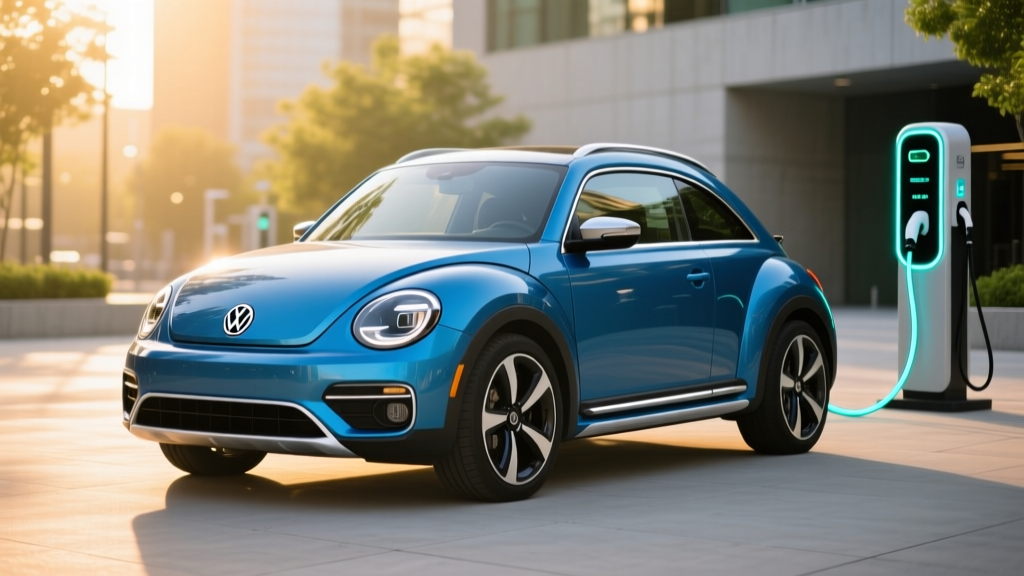
As of early 2026, Volkswagen has not officially announced or released a 2025 Volkswagen Beetle electric crossover for the U.S. market. No EPA certification, no MSRP, and no dealer allocation exists for this vehicle. Rumors and renderings have circulated since VW's ID.2all concept reveal in 2023 and subsequent trademark filings, but VW Group has not committed production resources to a retro-styled electric crossover wearing the Beetle nameplate.
If you're searching for this vehicle, you're likely reacting to speculative automotive media reports. What VW does offer on its MEB (Modular Electric Drive Matrix) platform are the ID.4 compact crossover (EPA range up to 291 miles, starting at $39,735 for 2025) and the ID. Buzz retro-styled electric minivan (EPA range 234 miles, starting at $59,995). Below, we analyze what a Beetle EV crossover would require, what it might cost, and what you should buy instead if you want a practical, retro-flavored electric vehicle today.
Why the Beetle EV Rumor Won't Die
Volkswagen retired the Beetle nameplate in 2019 after declining sales of the final A5-generation model. But the brand's design team, led by Klaus Zyciora, has publicly acknowledged that an electric Beetle is "a possibility" on the MEB platform — the same skateboard architecture underpinning the ID.4, ID.5, and ID.7. The MEB supports wheelbases from 101 to 115 inches, battery packs from 48 to 82 kWh (usable), and rear- or all-wheel-drive layouts, making it mechanically feasible to build a compact retro crossover with Beetle design cues.
Several factors keep speculation alive:
- Trademark filings: VW has renewed "Beetle" trademark registrations in multiple jurisdictions, a common practice to protect brand assets but often interpreted as signaling future product intent.
- Design concepts: Independent renderings and VW's own heritage-focused marketing (e.g., the ID. Buzz) prove the company sees value in retro EV design.
- Market gap: The sub-$40,000 compact crossover EV segment has few stylish, emotionally appealing options. A Beetle-badged MEB vehicle could fill that gap.
However, VW's current U.S. product roadmap through 2027 focuses on the ID.7 sedan, ID. GTI performance variant, and next-generation ID.4 refresh. A Beetle crossover, if it happens, would likely be a 2027 or 2028 model year vehicle at the earliest.
What a Beetle EV Crossover Would Look Like on Paper
If VW greenlights a Beetle electric crossover based on the MEB platform's entry-level configuration, here are the most probable specifications — extrapolated from the current ID.4 and European ID.3:
| Attribute | Estimated Spec | Basis |
|---|---|---|
| Platform | MEB (Modular Electric Drive Matrix) | ID.4, ID. Buzz |
| Battery (usable) | 62 kWh (LFP) or 77 kWh (NMC) | ID.4 Standard Range / Pro |
| EPA Range (est.) | 240–290 miles | ID.4 Pro (291 mi EPA) |
| Drivetrain | RWD (base) / AWD (optional) | ID.4 layout options |
| Horsepower | 201 hp (RWD) / 295 hp (AWD) | ID.4 output figures |
| 0–60 mph | 7.5 sec (RWD) / 5.4 sec (AWD) | ID.4 tested times |
| Peak DC Fast Charge | 135 kW (62 kWh) / 175 kW (77 kWh) | ID.4 charge curves |
| 10–80% DC Charge | ~28 min (62 kWh) / ~30 min (77 kWh) | ID.4 real-world testing |
| Level 2 AC Charge Rate | 11 kW (48A) | MEB standard onboard charger |
| Estimated Base MSRP | $35,000–$42,000 | Below ID.4 positioning |
| Federal Tax Credit (§30D) | Uncertain — depends on battery sourcing | IRS final assembly + critical minerals rules |
Key caveat: These are projected figures based on the closest existing VW MEB vehicles. Actual specs for any future Beetle EV would depend on final battery chemistry selection, aerodynamic tuning, and weight — all unknowns for an unconfirmed model.
EV vs. Gas Crossover: What the Numbers Actually Say
Let's compare what a Beetle EV crossover would cost to own against the closest gas-powered alternative VW currently sells: the 2025 Volkswagen Taos (1.5L turbo, FWD, EPA 28/36/31 MPG combined). This comparison helps frame whether waiting for a hypothetical Beetle EV makes financial sense.
| Metric | Beetle EV (Estimated) | VW Taos 1.5T FWD |
|---|---|---|
| MSRP (base) | ~$37,000 | $28,595 |
| Federal tax credit | Up to $7,500 (if eligible) | $0 |
| Effective purchase price | ~$29,500 | $28,595 |
| Fuel/energy cost per mile | $0.045 (home L2, $0.14/kWh) | $0.112 ($3.48/gal, 31 MPG) |
| Annual fuel/energy (12,000 mi) | $540 | $1,344 |
| Annual maintenance | ~$350 (no oil, fewer brakes) | ~$650 (oil, filters, brake wear) |
| 5-year fuel + maintenance | $4,450 | $9,970 |
| 5-year total cost (purchase + operating) | ~$33,950 | ~$38,565 |
| EPA range / tank range | ~270 mi (est.) | ~390 mi (12.4-gal tank) |
| Cold-weather range loss | ~20–30% (no heat pump penalty if equipped) | Minimal (cabin heat from engine waste heat) |
Sources: fueleconomy.gov (Taos EPA data), IRS §30D clean vehicle credit guidelines. Electricity rate based on U.S. average residential price of ~$0.14/kWh (EIA, 2025). Actual costs vary by state, utility rate, and driving conditions.
The EV wins on 5-year operating cost by roughly $5,500, effectively closing the MSRP gap. But this assumes home Level 2 charging access at residential electricity rates. If you rely exclusively on public DC fast charging at $0.35–$0.48/kWh, your per-mile cost jumps to $0.11–$0.15, eliminating most of the fuel savings.
Real-World Ownership Considerations Before You Wait
If you're holding out for a Beetle EV crossover, weigh these practical factors against buying an available EV today:
Home Charging Access
A Level 2 home charger (240V, 32–48A) is the single biggest quality-of-life factor in EV ownership. Installation typically costs $800–$2,500 depending on panel capacity and run length. If your home has a 200A electrical panel with spare capacity, expect the lower end. Homes with 100A panels may need a $1,500–$3,500 panel upgrade before adding a 40A EV circuit.
Without home charging, EV ownership becomes significantly less convenient and more expensive. Public DC fast charging adds 20–35 minutes to a typical charge stop and costs 2–3x more per kWh than home electricity.
Climate and Range Reality
EPA range estimates assume moderate temperatures (68°F) and mixed driving. In real-world conditions:
- Highway driving at 75 mph: Expect 85–90% of EPA range due to aerodynamic drag scaling with velocity squared.
- Cold weather (20°F): Lithium-ion batteries lose 20–35% of usable range. A heat pump (standard on most MEB vehicles) recovers ~10% of that loss by efficiently heating the cabin.
- Mountain driving: Regenerative braking recovers significant energy on descents, partially offsetting uphill consumption.
A Beetle EV with a projected 270-mile EPA range would realistically deliver 220–240 miles on the highway in mild weather and 175–210 miles in sub-freezing temperatures.
Charging Speed and the 80% Taper
DC fast charging doesn't maintain peak rate for the entire session. A vehicle rated for 175 kW peak will typically sustain that rate only between 10–40% State of Charge (SoC), then taper progressively. A realistic 10–80% session on a MEB-based Beetle EV would take 28–33 minutes at a 350 kW-capable station, but could stretch to 40+ minutes at a 50–150 kW charger.
What You Can Actually Buy Today Instead
If the Beetle EV concept appeals to you — retro styling, compact footprint, practical crossover utility — these available vehicles are the closest matches:
Decision Framework: What to Buy While You Wait
Choose the VW ID. Buzz if: You want retro VW design, three-row seating, and don't mind a 234-mile EPA range and $59,995 starting price. It's the closest VW comes to a heritage EV today.
Choose the VW ID.4 if: You want a practical compact EV crossover with up to 291 miles of range, available AWD, and a $39,735 entry point. It's the rational MEB choice.
Choose the Hyundai Ioniq 5 if: You prioritize 800V ultra-fast charging (10–80% in ~18 min at 350 kW chargers), retro-futuristic styling, and a starting MSRP of $42,600. EPA range reaches 303 miles with the Long Range RWD configuration.
Choose the Kia EV6 if: You want sporty dynamics, 800V charging architecture, and up to 310 miles EPA range. Starting MSRP is $42,900.
Wait for a Beetle EV only if: Retro Beetle design is a non-negotiable emotional priority, you don't need a vehicle within 12–18 months, and you're comfortable with VW's uncertain U.S. product timeline for this model.
Federal Tax Credit: What Would Apply to a Beetle EV?
If VW does produce a Beetle electric crossover, its eligibility for the §30D Clean Vehicle Credit (up to $7,500) would depend on meeting all current IRS requirements:
| Requirement | Threshold | Beetle EV Outlook |
|---|---|---|
| Final assembly | Must occur in North America | Uncertain — VW's U.S. plant in Chattanooga builds the ID.4; a Beetle EV could be assembled there or imported |
| MSRP cap | ≤ $55,000 (SUVs/crossovers) / ≤ $50,000 (sedans) | Likely passes if priced $35K–$42K |
| Buyer income cap (AGI) | ≤ $150K single / $225K HOH / $300K joint | Depends on buyer |
| Battery critical minerals | Increasing % from FTA countries or recycled (80% by 2027) | Depends on VW supply chain — currently limits ID.4 eligibility |
| Battery components | Increasing % manufactured in N. America (100% by 2029) | Depends on VW cell supplier (likely SK On or CATL) |
| Point-of-sale transfer | Buyer may transfer credit to dealer for instant discount | Available if vehicle qualifies |
Source: IRS.gov — Credits for New Clean Vehicles. Rules are subject to legislative change. Consult a tax professional before making purchase decisions based on credit eligibility.
The critical-minerals and battery-component sourcing requirements are the biggest wildcard. As of 2025, the ID.4 qualifies for only $3,750 of the $7,500 credit because it meets one of two sourcing thresholds. A future Beetle EV built on the same supply chain would face the same limitation unless VW restructures its battery sourcing.
Common Misconceptions About the Beetle EV
| Myth | Fact |
|---|---|
| "The 2025 Beetle EV is available to order." | VW has not announced, priced, or opened orders for any Beetle EV. No VIN exists for this vehicle. |
| "It will be a direct replica of the original Beetle." | Any production model would be a modern crossover with Beetle design cues, not a two-door rear-engine replica. Think ID. Buzz, not 1967 Beetle. |
| "It will cost under $25,000." | With current MEB platform costs and U.S. compliance requirements, a $35K–$42K MSRP is realistic. Sub-$30K EVs require dedicated low-cost platforms VW hasn't confirmed for the U.S. |
| "EV batteries need replacing every 5 years." | MEB batteries carry an 8-year/100,000-mile warranty against degradation below 70% capacity. Real-world data shows average degradation of ~1.8% per year across fleet data, meaning most packs retain 85–90% capacity at 8 years. |
| "You'll get the full $7,500 tax credit." | Credit eligibility depends on MSRP, buyer income, battery sourcing, and final assembly location. Most VW EVs currently qualify for $3,750, not $7,500. |
Bottom Line: Should You Wait or Buy Now?
The 2025 Volkswagen Beetle electric crossover is, as of this writing, not a real, orderable, or officially announced vehicle. It exists only in speculative renderings, trademark databases, and wish lists. VW's MEB platform could absolutely support such a vehicle, and the market would likely welcome it — but production timelines, pricing, and tax-credit eligibility remain entirely unknown.
If you need an electric vehicle in 2026, the ID.4, ID. Buzz, Ioniq 5, or EV6 are proven, warrantied, and available alternatives with known specs and real EPA range data. If the Beetle EV is a dream purchase and you have a reliable current vehicle, monitoring VW's annual product announcements (typically at CES in January and the New York Auto Show in April) is your best strategy.
Frequently Asked Questions
Has Volkswagen officially confirmed a Beetle electric crossover?
No. VW has not announced any production Beetle EV for the U.S. or global market. The company has acknowledged the concept is technically feasible on the MEB platform but has not committed to production.
What VW electric vehicles are actually available in 2025?
The 2025 VW ID.4 (compact crossover, up to 291 mi EPA range, $39,735 MSRP) and the 2025 VW ID. Buzz (retro minivan, 234 mi EPA range, $59,995 MSRP) are currently on sale. The ID.7 sedan is expected for the 2026 model year.
Would a Beetle EV qualify for the $7,500 federal tax credit?
Uncertain. Eligibility depends on final assembly location, battery mineral sourcing, MSRP caps, and buyer income. Based on VW's current supply chain, partial credit ($3,750) is more likely than the full $7,500. Check IRS.gov for current rules.
What is the closest alternative to a Beetle electric crossover?
The VW ID. Buzz offers retro VW styling in an electric package. For a compact crossover form factor, the ID.4, Hyundai Ioniq 5, or Kia EV6 offer similar size, range, and pricing to what a Beetle EV would likely target.
How much does home Level 2 charger installation cost?
Expect $800–$2,500 for a standard 240V/48A installation with an existing 200A panel. Homes requiring a panel upgrade (100A to 200A) should budget an additional $1,500–$3,500. Always get a quote from a licensed electrician before purchasing equipment.