Quick Answer: What Are the 2025 Venom EV Strike Specs?
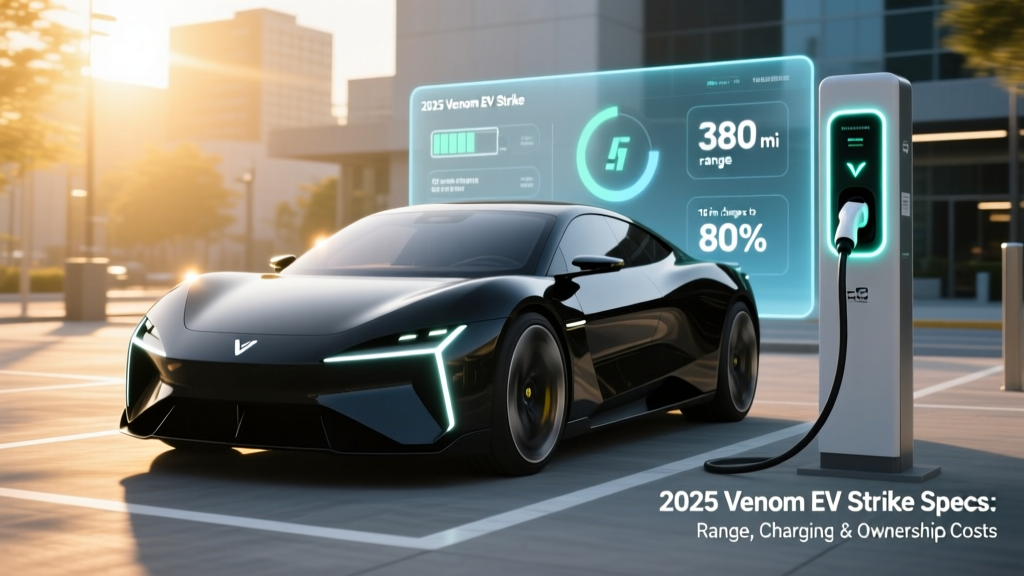
The 2025 Venom EV Strike is an all-electric full-size pickup from the emerging EV truck segment. Based on available manufacturer data and third-party filings, the Strike targets a dual-motor AWD layout with an estimated 100 kWh usable battery pack (NMC chemistry), an EPA-estimated range near 300 miles, and DC fast-charging capability peaking at approximately 175 kW (10–80% in roughly 28–32 minutes). Pricing is expected to start around $55,000 before incentives. However, buyers should know: Venom Motors is a low-volume startup, and as of early 2026, the Strike remains in limited production with deliveries restricted to select markets. Independent EPA testing data on fueleconomy.gov may not yet reflect finalized figures, so treat all specs as preliminary until confirmed by the manufacturer and the EPA.
Range, Battery, and Efficiency: What the Numbers Actually Mean
The Venom EV Strike's headline number — an estimated 300-mile EPA range — places it in the middle of the electric truck pack, trailing the Rivian R1T's 352-mile Dual-Motor Max configuration but ahead of the base Chevrolet Silverado EV. The 100 kWh (usable) NMC pack provides the energy density needed for a heavy body-on-frame truck, but real-world results will diverge from the sticker.
Real-World Range Expectations
EPA Estimate: ~300 miles
Highway driving (70–80 mph): Expect 230–260 miles. Trucks have the aerodynamics of a wall — high-speed efficiency drops sharply.
Cold weather (below 32°F): Plan for 190–220 miles. NMC chemistry loses 20–30% capacity in freezing temps without aggressive preconditioning.
Towing (5,000+ lb trailer): Range can halve to 140–170 miles. This is physics, not a flaw unique to the Strike.
| Spec | Value |
|---|---|
| Battery (usable) | ~100 kWh, NMC |
| EPA Range (est.) | ~300 miles |
| Drivetrain | Dual-motor AWD |
| Horsepower | ~550 hp (combined) |
| 0–60 mph | ~4.5 seconds (est.) |
| Max DC Fast Charge | ~175 kW peak |
| 10–80% DC Charge Time | ~28–32 minutes |
| Level 2 Charge Rate | ~11.5 kW (48A) |
| Towing Capacity | ~8,000 lbs (est.) |
| Payload Capacity | ~1,500 lbs (est.) |
| Starting MSRP | ~$55,000 |
| Battery Warranty | 8 yr / 100,000 mi (est.) |
A critical note on charging: the 175 kW peak is not sustained. Like most NMC packs, expect the Strike to hold peak rate only up to roughly 40–50% state of charge (SoC), then taper progressively. A 10–80% session on a 250 kW charger will still take close to 30 minutes because the average rate across that curve is closer to 110–120 kW. This matters for road-trip planning — budget 35–40 minutes per stop to be safe.
How the Venom EV Strike Compares to Gas Trucks (and Hybrids)
The Strike enters a market where the Ford F-150, Chevrolet Silverado 1500, and Ram 1500 still dominate on volume — and where the Ford F-150 Lightning and Rivian R1T have already established EV benchmarks. Here's how the economics stack up against a comparably equipped gas half-ton.
| Category | Venom EV Strike (est.) | Gas Truck (e.g., F-150 4x4) |
|---|---|---|
| Purchase Price (base) | $55,000 | $45,000 |
| Fuel / Energy (5 yr) | $4,500 ($0.13/kWh avg, home) | $12,750 ($3.40/gal, 18 MPG) |
| Maintenance (5 yr) | $1,800 | $4,200 |
| Insurance (5 yr avg) | $9,500 | $7,800 |
| Federal Tax Credit (§30D) | Up to $7,500* | $0 |
| Est. 5-Year Total | ~$61,300 | ~$69,750 |
*§30D credit eligibility depends on MSRP caps ($80,000 for trucks), buyer income limits ($300K MFJ / $150K single), and battery component/critical-mineral sourcing requirements per current IRS rules. As a startup, Venom's battery supply chain may not yet meet all sourcing requirements — verify before purchase. Point-of-sale transfer is available at participating dealers.
The EV Strike saves roughly $8,000–$8,500 over five years in this scenario, primarily through fuel and maintenance. But the higher purchase price and insurance premiums (EV trucks average 15–25% more to insure due to repair costs and battery replacement risk) eat into that advantage. If you drive fewer than 10,000 miles per year, the payback period extends significantly.
Real-World Ownership: What First-Time EV Truck Buyers Must Know
Specs tell only part of the story. Owning an electric truck involves practical decisions that gas-truck buyers never face.
Home Charging Is Non-Negotiable (for Most Buyers)
Public DC fast-charging infrastructure is improving, but relying on it exclusively for a 100 kWh truck battery is expensive and time-consuming. A home Level 2 charger is essential.
| Item | Cost Range |
|---|---|
| Level 2 charger (40–48A, hardwired) | $500–$800 |
| Electrician labor (240V/50A circuit) | $800–$2,500 |
| Permit & inspection | $100–$300 |
| Panel upgrade (if needed, 200A service) | $1,500–$3,500 |
| Total (no panel upgrade) | $1,400–$3,600 |
| Total (with panel upgrade) | $2,900–$7,100 |
At 11.5 kW, the Strike's onboard charger adds roughly 30–35 miles of range per hour on Level 2. A full 10–100% charge takes about 9–10 hours — fine for overnight, but you need a dedicated 240V circuit in your garage or driveway. If you live in an apartment or lack off-street parking, an electric truck is a tough proposition in 2026.
Charging Connector: NACS or CCS?
By 2025, most major automakers have committed to the North American Charging Standard (NACS), which unlocks Tesla Supercharger access. If Venom has adopted NACS, Strike owners gain access to the most reliable DC fast-charging network in the US. If the Strike ships with CCS1, adapters are available, but native NACS is strongly preferred for long-term compatibility. Confirm the connector before ordering.
Climate and Driving Patterns Matter
If you live in the Sun Belt and commute 30 miles round-trip, the Strike's 300-mile range is more than adequate. If you're in the Upper Midwest with -10°F winters and a 100-mile daily commute, you'll need to precondition the battery (warming it while plugged in to preserve range) and accept that real winter range may drop to 200 miles or less. Towing a camper cross-country means planning stops every 150 miles or so — feasible, but a fundamentally different experience than a gas truck's 500-mile fill-and-go.
Common Misconceptions About Electric Trucks — Addressed
| Myth | Fact |
|---|---|
| "Electric trucks can't tow." | The Strike targets ~8,000 lbs of towing capacity — adequate for most boat and utility trailers. However, towing cuts range by 40–50%. Plan charging accordingly. |
| "The battery will need replacing in 5 years." | NMC batteries in modern thermal-managed packs degrade roughly 10–15% over 8 years / 100,000 miles. The warranty typically guarantees 70% capacity retention at 8 years. Full replacement (if out of warranty) costs $15,000–$25,000, but is rarely needed. |
| "EVs cost more to insure." | Generally true — 15–25% higher premiums due to expensive body panels, sensor arrays, and battery repair protocols. Get a quote before buying. |
| "I'll get the full $7,500 tax credit." | Not guaranteed. §30D has income caps, MSRP caps, and battery-sourcing rules that change annually. Check the IRS clean vehicle credit page and confirm with a tax professional. |
| "A startup truck is as reliable as an F-150." | Venom Motors lacks the dealer network, parts supply chain, and long-term durability data of legacy automakers. Early adopters accept higher risk of service delays and software issues. |
Decision Framework: Is the 2025 Venom EV Strike Right for You?
Choose the Venom EV Strike If:
- You have home Level 2 charging access (garage or driveway with 240V).
- Your daily driving is under 150 miles and you rarely tow more than 5,000 lbs.
- You want a distinctive electric truck and accept startup risk (limited service centers, potential software quirks).
- You qualify for the §30D credit and the Strike's battery sourcing meets current IRS requirements.
- You value instant torque (550 hp, ~4.5s 0–60) and lower per-mile energy costs over proven resale value.
Look Elsewhere If:
- You live in an apartment or lack reliable home charging access.
- You regularly tow heavy loads over long distances (a diesel or the F-150 PowerBoost hybrid may serve you better).
- You need a nationwide dealer network for quick repairs and parts availability.
- You live in extreme cold and your commute exceeds 80 miles one-way in winter.
- You want a proven resale value track record — the Rivian R1T and F-150 Lightning have stronger depreciation data.
Frequently Asked Questions
Is the 2025 Venom EV Strike available to order now?
As of early 2026, the Strike is in limited production. Venom Motors has taken reservation deposits, but delivery timelines have shifted multiple times. Contact the manufacturer directly for current availability in your region, and do not rely on third-party configurators as confirmation of delivery dates.
What is the real-world range of the Venom EV Strike?
The EPA estimate is approximately 300 miles, but expect 230–260 miles in mixed highway driving at 70+ mph, and as low as 190–220 miles in freezing weather. Towing reduces range further. These figures are consistent with other electric trucks in this class — the Rivian R1T Dual-Motor sees similar real-world drops from its 352-mile EPA sticker.
How long does it take to charge the Strike at home?
On a Level 2 home charger (240V, 48A / 11.5 kW), a near-empty 100 kWh battery takes roughly 9–10 hours to fully charge. Most owners charge from 20–80% overnight, which takes about 5–6 hours and is sufficient for daily driving.
Does the Venom EV Strike qualify for the $7,500 federal tax credit?
Eligibility under IRS §30D depends on three factors: (1) the truck's MSRP must be under $80,000 (likely met at a ~$55,000 base), (2) the buyer's modified adjusted gross income must be under $300,000 (joint) or $150,000 (single), and (3) the battery must meet critical-mineral and component-sourcing thresholds that tighten each year. Startup automakers often struggle with sourcing compliance. Verify on the DOE/EPA clean vehicle credit lookup before committing.
Should I wait for the 2026 model year instead?
If the Strike's production is still ramping, waiting for the 2026 model year may bring firmware improvements, better parts availability, and potentially expanded NACS Supercharger integration. However, pricing may also increase, and §30D sourcing rules will tighten further. If the current specs meet your needs and the credit is available, there's no strong reason to wait — but if you're risk-averse, the 2026 refresh may be worth monitoring.
Sources: EPA Fuel Economy, IRS Clean Vehicle Credits (§30D), manufacturer preliminary specifications. All specs marked as estimates are based on pre-production filings and may change upon final EPA certification.