Quick Verdict: The Sensible Electric Crossover
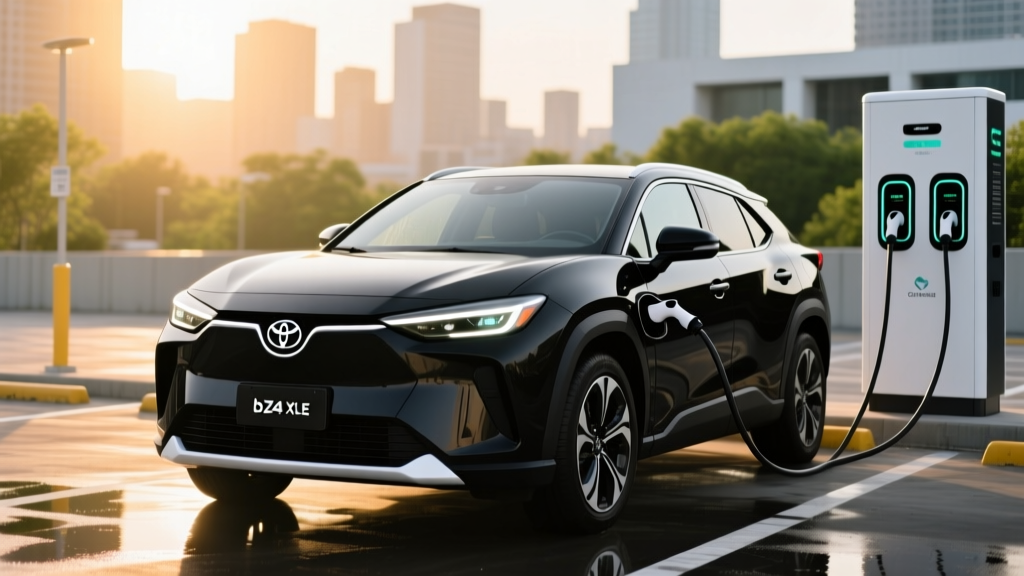
The 2025 Toyota bZ4X XLE occupies a specific lane in the EV market: the pragmatic, no-drama electric crossover for buyers who value Toyota's reliability reputation over headline-grabbing performance. With an EPA-estimated 252 miles of range (FWD), a comfortable ride, and a starting MSRP around $37,070, the XLE trim represents the volume seller in Toyota's battery-electric lineup. It's not the fastest-charging or longest-range SUV in its class, but for daily commuting and moderate road trips, it delivers predictable, stress-free electrification.
Where the bZ4X XLE earns points is in its straightforward ownership experience. Toyota Safety Sense 3.0 comes standard, the cabin materials hold up well, and the 8-year/100,000-mile battery warranty provides long-term peace of mind. Where it falls short: DC fast-charging speeds trail rivals like the Hyundai Ioniq 5 and Kia EV6, and real-world highway range drops noticeably below the EPA sticker. This review breaks down every number that matters.
Range, Battery & Real-World Efficiency
| Spec | FWD | AWD |
|---|---|---|
| EPA Range | 252 mi | 228 mi |
| Battery (usable) | 65.6 kWh | 65.6 kWh |
| Chemistry | NMC (nickel manganese cobalt) | NMC |
| MPGe (combined) | 119 MPGe | 104 MPGe |
| kWh/100 mi | 28 | 32 |
| Horsepower | 201 hp | 214 hp |
| 0–60 mph | 7.1 sec | 5.8 sec |
| Drivetrain | Single motor, FWD | Dual motor, AWD |
The EPA rates the bZ4X XLE FWD at 252 miles. In mixed real-world driving at 70 mph highway speeds with mild temperatures (60–75°F), expect roughly 210–230 miles before needing a charge. In cold weather (below 32°F), highway range can drop to 170–195 miles due to battery resistance and cabin heating demands. City driving with regenerative braking recovers closer to the EPA figure — around 240–250 miles is achievable in stop-and-go traffic.
The 65.6 kWh usable battery uses NMC (nickel manganese cobalt) chemistry, which offers higher energy density than LFP but requires more careful state-of-charge management for long-term longevity. Toyota recommends keeping charge between 20% and 80% for daily use and only charging to 100% before longer trips. The battery is liquid-cooled, which helps maintain consistent performance during repeated fast-charging sessions and in extreme temperatures.
According to fueleconomy.gov, the FWD bZ4X achieves 119 MPGe combined (28 kWh/100 mi), placing it mid-pack among electric crossovers. The AWD variant drops to 104 MPGe combined (32 kWh/100 mi) due to the additional motor and weight. For comparison, the Hyundai Ioniq 5 RWD achieves 117 MPGe combined with a larger battery, while the Tesla Model Y Long Range hits 122 MPGe — so the bZ4X is competitive on efficiency per mile, just with a smaller total energy reserve.
Charging Speed: DC Fast, Level 2 & Home Setup
Charging performance is where the bZ4X draws the most criticism relative to rivals, and understanding the charge curve is critical for trip planning.
| Charge Level | Rate | Speed / Time |
|---|---|---|
| Level 1 (120V household) | ~1.4 kW | ~4 mi/hr added |
| Level 2 (240V home/public) | 7.2 kW (onboard charger) | ~23 mi/hr; full charge in ~9.5 hr |
| DC Fast Charge (peak) | Up to 150 kW (FWD) | 10–80% in ~30 min (see curve note) |
DC Fast-Charging Curve Reality: The bZ4X FWD peaks at approximately 150 kW, while the AWD version peaks closer to 100 kW. However, peak kW is not sustained kW. In real-world DC fast-charging on a 150 kW+ station, the bZ4X FWD holds roughly 120–140 kW from 10% to about 40% state of charge, then tapers progressively. From 50% to 80%, speeds drop to 50–70 kW. The result is a 10–80% session taking approximately 30 minutes under ideal thermal conditions. Cold-soak the battery (starting below 50°F without preconditioning), and that session can stretch to 40+ minutes.
The bZ4X does support battery preconditioning: when you navigate to a DC fast charger via the built-in navigation, the system warms the battery to optimize charge acceptance. Use this feature — skipping preconditioning in cold weather significantly slows your charge.
Home Level 2 Charging: The onboard charger maxes out at 7.2 kW. On a 48-amp home Level 2 station (such as a ChargePoint Home Flex or Wallbox Pulsar Plus), you'll add roughly 23 miles of range per hour. A full overnight charge from 20% to 80% takes about 5.5 hours — more than enough for daily replenishment. Installation of a 240V/50A circuit typically costs $800–$2,000 depending on your electrical panel capacity and run distance, according to industry estimates.
Performance, Ride & Drivetrain
The FWD bZ4X XLE uses a single front-mounted motor producing 201 horsepower and 196 lb-ft of torque. The 0–60 mph time of 7.1 seconds is adequate for merging and passing but won't win any drag races. The AWD variant pairs front and rear motors for a combined 214 hp and 248 lb-ft, dropping the sprint to 5.8 seconds — noticeably more responsive, especially in wet or snowy conditions.
Ride quality is where the bZ4X genuinely impresses. Toyota tuned the suspension for comfort over sportiness, and the result is a compliant, quiet cruiser that absorbs road imperfections well. The steering is light and predictable, though it lacks the precision feel of a Tesla Model Y or Ford Mustang Mach-E. Regenerative braking offers multiple levels adjustable via paddle shifters, but the bZ4X does not offer true one-pedal driving (full stop via regen alone) — you'll still need the brake pedal at low speeds, which some EV veterans find annoying.
Ground clearance sits at 7.0 inches, competitive for the segment. Towing capacity is limited to not rated for towing — this is a passenger-focused crossover, not a hauler.
Interior, Cargo & Technology
The bZ4X XLE cabin strikes a clean, modern aesthetic with a 12.3-inch touchscreen running Toyota's latest Audio Multimedia system. Wireless Apple CarPlay and Android Auto are standard. The instrument cluster sits high on the dash (inspired by a head-up display concept), though some drivers find the steering wheel rim blocks the upper portion of the display — an ergonomic quirk worth testing during a test drive.
Passenger Space:
- Front headroom: 39.9 in | Front legroom: 42.1 in
- Rear headroom: 38.5 in | Rear legroom: 35.3 in
Rear-seat legroom is adequate for adults on shorter trips but tighter than a Hyundai Ioniq 5 (39.4 in rear legroom) or Volkswagen ID.4 (37.6 in). The floor is relatively flat, which helps the middle passenger.
Cargo Volume:
- Behind rear seats: 27.7 cu ft
- Seats folded: 56.9 cu ft
There is no front trunk (frunk) — the space under the hood houses electronics and the HVAC system. The 27.7 cu ft behind the rear seats is competitive with a Mazda CX-5 but trails the Ioniq 5 (27.2 cu ft, nearly identical) and ID.4 (30.3 cu ft). For a family of four on a weekend trip, the bZ4X accommodates luggage without issue, but larger hauls require seat-folding.
Toyota Safety Sense 3.0 (Standard):
- Pre-Collision System with Pedestrian Detection
- Lane Departure Alert with Steering Assist
- Lane Tracing Assist (centering)
- Dynamic Radar Cruise Control (full-speed adaptive)
- Road Sign Assist
- Automatic High Beams
- Proactive Driving Assist (gentle braking/steering in certain scenarios)
These are SAE Level 2 driver-assistance features — the driver must remain fully engaged with hands on the wheel and eyes on the road at all times. This is not autonomous driving.
Toyota Safety Sense 3.0 provides combined steering and speed assistance. It is not self-driving. The driver is responsible for all vehicle control at all times. For context, SAE Level 4 (no driver needed in defined conditions) is currently limited to commercial robotaxi services like Waymo, not consumer vehicles.
Pricing, Trims & Federal Tax Credit
The 2025 Toyota bZ4X is offered in two trims: XLE and Limited. The XLE is the volume model and the focus of this review.
| Trim | MSRP (incl. destination) | Est. After §30D Credit* |
|---|---|---|
| XLE FWD | $37,070 | ~$29,570 |
| XLE AWD | $39,130 | ~$31,630 |
| Limited FWD | $43,070 | ~$35,570 |
| Limited AWD | $45,130 | ~$37,630 |
*Federal §30D credit amounts shown are estimates assuming the buyer and vehicle meet all current-year eligibility requirements. Actual credit varies based on battery sourcing, income, and MSRP caps. Verify with a tax professional and IRS.gov.
- MSRP cap: SUVs/crossovers must have an MSRP at or below $80,000 (bZ4X qualifies on price).
- Buyer income cap: Adjusted gross income must not exceed $150,000 (single), $225,000 (head of household), or $300,000 (joint filing).
- Battery sourcing: The vehicle must meet critical-mineral and battery-component sourcing requirements that tighten annually. Toyota's supply chain has generally qualified, but confirm the specific VIN with the dealer and the IRS portal before purchase.
- Point-of-sale transfer: Eligible buyers can transfer the credit to the dealer at purchase for an immediate price reduction rather than waiting for a tax refund.
- Assembly: Final assembly must occur in North America. The bZ4X is assembled in Japan, which disqualifies it from the new-vehicle §30D credit as of current rules.
Critical note on the bZ4X and the federal tax credit: The 2025 bZ4X is assembled at Toyota's Motomachi plant in Japan. Under current IRS §30D rules, new vehicles must undergo final assembly in North America to qualify for the new clean vehicle credit. This means the bZ4X does not qualify for the $7,500 federal tax credit on new purchases. However, it may qualify for the used EV tax credit (up to $4,000 or 30% of the sale price, whichever is lower) if purchased from a dealer as a qualifying pre-owned vehicle — check IRS used vehicle credit rules for details. Some state and local incentives may still apply regardless of assembly location; consult your state's energy office.
Ownership Costs, Warranty & Reliability
Toyota backs the bZ4X with competitive warranty coverage:
- Basic vehicle warranty: 3 years / 36,000 miles
- Powertrain warranty: 5 years / 60,000 miles
- EV battery warranty: 8 years / 100,000 miles (retains ≥70% capacity)
- Corrosion perforation: 5 years / unlimited miles
- Roadside assistance: 2 years / 25,000 miles
The 8-year/100,000-mile battery warranty guarantees the pack will retain at least 70% of its original capacity. If degradation exceeds 30% within that period, Toyota will repair or replace the battery. Based on industry data from similar NMC packs, typical degradation at 100,000 miles is 8–12%, meaning most owners will never approach the warranty threshold — but the coverage is there as a safety net.
Estimated 5-Year Cost of Ownership (FWD, 15,000 mi/yr):
- Electricity (home charging at $0.14/kWh national avg): ~$3,530
- Maintenance (no oil changes, brake wear reduced by regen): ~$1,200
- Insurance (EV premium avg): ~$9,500 (varies significantly by driver/location)
- Estimated depreciation: ~$14,000–$17,000 (EVs continue to see higher-than-average depreciation)
Compared to a similarly priced gas crossover like the Toyota RAV4, the bZ4X saves roughly $4,000–$5,500 on fuel over five years but may lose more to depreciation. The break-even point depends heavily on local electricity rates, gas prices, and how long you hold the vehicle.
How It Compares: bZ4X XLE vs. Key Rivals
| Spec | Toyota bZ4X XLE FWD | Hyundai Ioniq 5 SE RWD | Kia EV6 Light RWD | VW ID.4 Pro |
|---|---|---|---|---|
| MSRP | $37,070 | $42,600 | $42,900 | $40,290 |
| EPA Range | 252 mi | 303 mi | 232 mi (std) / 310 mi (LR) | 291 mi |
| Battery (usable) | 65.6 kWh | 77.4 kWh | 58.0 / 77.4 kWh | 82.0 kWh |
| Peak DC Charge | 150 kW | 240 kW (w/ 800V) | 240 kW (w/ 800V) | 170 kW |
| 10–80% DC Time | ~30 min | ~18 min | ~18 min | ~29 min |
| 0–60 mph | 7.1 sec | 7.4 sec | 7.2 / 5.1 sec | 7.5 sec |
| N. American Assembly | No (Japan) | Yes (GA) | Yes (GA) | Yes (TN) |
| Federal §30D Credit | Not eligible (new) | Up to $7,500 | Up to $7,500 | Up to $7,500 |
The bZ4X's most significant competitive disadvantage is its ineligibility for the federal new-vehicle tax credit due to Japanese assembly. A $42,600 Ioniq 5 with a $7,500 credit nets to roughly $35,100 — undercutting the $37,070 bZ4X on effective price while offering 51 more miles of range and significantly faster DC charging. This math is the single biggest hurdle Toyota faces with this model.
Where the bZ4X wins: Toyota's brand loyalty and perceived long-term reliability, a slightly lower base MSRP for buyers who don't qualify for the credit (e.g., income above caps), and strong standard safety equipment. If you're a Toyota loyalist who plans to hold the vehicle 10+ years and values the dealer network, the bZ4X still makes a rational case.
- Competitive base MSRP before incentives
- Standard Toyota Safety Sense 3.0 (comprehensive ADAS)
- Comfortable, quiet ride quality
- Strong battery warranty (8 yr / 100,000 mi)
- Toyota dealer network for service and support
- Wireless Apple CarPlay / Android Auto standard
- Does not qualify for $7,500 federal new-vehicle tax credit (Japan assembly)
- DC fast-charging speed trails 800V rivals (Ioniq 5, EV6)
- Real-world highway range ~210–230 mi (below EPA 252)
- No front trunk (frunk)
- No true one-pedal driving mode
- Rear legroom tighter than some competitors
Who Should Buy the 2025 Toyota bZ4X XLE?
- You're a Toyota loyalist who values brand reliability and an extensive dealer network
- Your daily commute is under 80 miles round-trip and you charge at home
- You don't qualify for the federal tax credit (income above caps) and want a lower base MSRP
- You prioritize ride comfort and safety tech over performance and fast-charging speed
- You plan to keep the vehicle 8+ years and value the long battery warranty
- You qualify for the $7,500 federal credit — the Ioniq 5, EV6, and ID.4 become significantly cheaper after incentives
- You take regular road trips of 250+ miles and need faster DC charging (the Ioniq 5's 18-minute 10–80% is a major time-saver)
- You need maximum cargo space or rear-seat legroom for family use
- You want one-pedal driving or a sportier driving experience
Frequently Asked Questions
What is the real-world range of the 2025 Toyota bZ4X XLE?
The EPA rates the bZ4X XLE FWD at 252 miles. In real-world highway driving at 70 mph in moderate temperatures, expect 210–230 miles. In cold weather (below freezing), highway range can drop to 170–195 miles. City driving with regenerative braking yields closer to 240–250 miles. The AWD variant's real-world range is approximately 190–210 miles highway, 160–180 in cold weather.
How fast does the bZ4X charge at home and on the road?
At home on a 240V Level 2 charger (7.2 kW max), the bZ4X adds about 23 miles per hour, with a full 20–80% charge in roughly 5.5 hours. On DC fast chargers, the FWD model peaks at 150 kW and charges from 10–80% in approximately 30 minutes under ideal conditions. The AWD model peaks lower (~100 kW), stretching that session to roughly 40 minutes. Always use battery preconditioning (via navigation routing) to optimize charge speed.
Does the 2025 Toyota bZ4X qualify for the federal EV tax credit?
No — for new vehicle purchases, the bZ4X does not qualify for the $7,500 §30D federal tax credit because it is assembled in Japan, not North America. However, it may qualify for the used EV credit (up to $4,000) when purchased pre-owned from a dealer, subject to income and price caps. State and local incentives may still apply; check your jurisdiction.
Is the bZ4X worth buying over the Hyundai Ioniq 5 or Kia EV6?
On paper, the Ioniq 5 and EV6 are stronger value propositions if you qualify for the federal tax credit — they offer more range, dramatically faster charging, and a lower effective price after incentives. The bZ4X makes sense for Toyota-loyal buyers who prioritize brand trust, a lower sticker price (if you don't qualify for credits), and don't need frequent long-distance fast charging. Test-drive both before deciding.
What is the biggest drawback of the bZ4X?
The combination of DC fast-charging speed and tax-credit ineligibility. At 30 minutes for 10–80% (FWD), the bZ4X takes 10–12 minutes longer than 800V rivals on road trips. Combined with no federal credit on new purchases, the total value proposition requires careful comparison shopping.
How long will the bZ4X battery last?
Toyota warranties the battery for 8 years or 100,000 miles against degradation below 70% capacity. Based on NMC chemistry data from similar EVs, most owners experience 8–12% degradation at 100,000 miles, meaning the battery should remain functional and useful well beyond the warranty period. Keeping charge between 20–80% for daily use and avoiding repeated 100% charges extends longevity.
Does the bZ4X have one-pedal driving?
No. The bZ4X offers adjustable regenerative braking levels via paddle shifters, but it does not bring the vehicle to a complete stop using regenerative braking alone. You must use the brake pedal for final stopping, which differs from competitors like the Nissan Ariya, Hyundai Ioniq 5 (i-PEDAL mode), and most Tesla models.