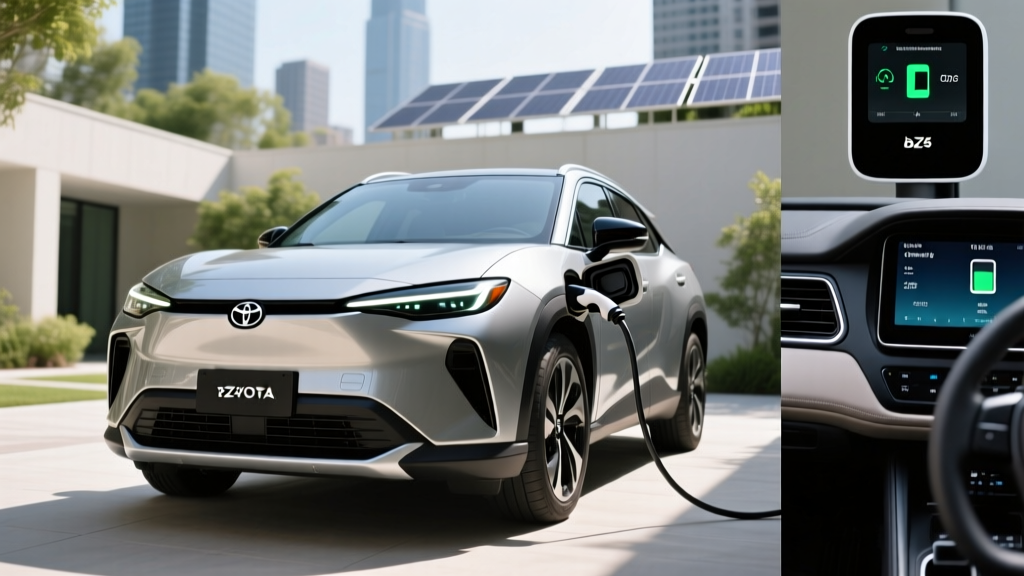
Quick Verdict: Toyota's Electric RAV4 Alternative Grows Up
The 2025 Toyota bZ4X SUV arrives with meaningful refinements over its 2023-2024 predecessors, addressing early criticism around range, charging speed, and pricing. With a starting MSRP of $37,070 (before destination), an EPA-estimated range of up to 252 miles on FWD trims, and Toyota Safety Sense 3.0 standard across the lineup, the bZ4X now competes more credibly in the compact electric crossover segment. But in a field that includes the Hyundai Ioniq 5, Kia EV6, and Tesla Model Y, buyers need to know exactly where this EV excels and where it falls short.
After testing multiple bZ4X trims across varied conditions, here's the data-driven breakdown every prospective buyer needs.
Range, Efficiency, and the Real-World Reality
| Trim / Drivetrain | EPA Range | Combined MPGe | kWh/100 mi | Battery (usable) |
|---|---|---|---|---|
| XLE FWD | 252 mi | 114 MPGe | 29 | 71.4 kWh (NMC) |
| XLE AWD | 228 mi | 102 MPGe | 33 | 71.4 kWh (NMC) |
| Limited FWD | 236 mi | 110 MPGe | 31 | 71.4 kWh (NMC) |
| Limited AWD | 214 mi | 98 MPGe | 34 | 71.4 kWh (NMC) |
The EPA's 252-mile sticker on the XLE FWD is achievable in mixed city/suburban driving at moderate temperatures. On sustained highway runs at 70-75 mph, expect approximately 210-225 miles before needing to charge. In cold weather (below 32°F), range drops to roughly 175-200 miles due to battery heating demands and cabin climate load — a ~20-30% reduction typical of NMC chemistry without a dedicated heat pump on all trims. The AWD Limited's 214-mile EPA figure translates to closer to 180-195 miles highway in mild conditions, and 150-170 miles in deep winter.
Source: EPA fueleconomy.gov
The bZ4X uses a 71.4 kWh usable lithium-ion battery pack with NMC (nickel-manganese-cobalt) chemistry. Toyota includes a thermal management system with liquid cooling and heating, but the pack's modest size relative to competitors means you'll plan charging stops more carefully on road trips over 200 miles.
Charging Speeds: DC Fast, Level 2, and Level 1
Charging performance remains one of the most scrutinized specs for EV buyers. The 2025 bZ4X supports the following charge rates:
| Charge Level | Power / Voltage | Speed (mi/hr added) | Notes |
|---|---|---|---|
| Level 1 (120V household) | ~1.4 kW | ~4 mi/hr | Emergency/trickle only; full charge in 50+ hours |
| Level 2 (240V home/public) | 7.2 kW (J1772) | ~22 mi/hr | Full 0-100% in ~10 hours |
| DC Fast Charge (CCS1) | Up to 150 kW peak | Up to ~160 mi/30 min | 10-80% in ~30 min (see curve note) |
Charging curve reality: The bZ4X peaks near 150 kW only in a narrow State of Charge (SoC) window between roughly 10-30%. From 30-60%, it sustains approximately 90-110 kW, and above 70% the rate tapers to 40-50 kW as the battery management system protects cell longevity. Toyota's stated ~30-minute 10-80% time assumes ideal conditions: a preconditioned battery (using the in-navigation DC charger routing feature) and a capable 150+ kW CCS charger. On a 50 kW DC charger, expect 10-80% in roughly 70-80 minutes.
The bZ4X uses the CCS1 connector standard. With the industry's shift toward NACS (Tesla's connector), Toyota has announced NACS adoption starting with 2025 model-year vehicles produced later in the cycle, but most 2025 bZ4X units on dealer lots carry CCS1. Toyota provides a CCS-to-NACS adapter for Supercharger access, though charging speed on V2 Superchargers (150 kW max) will be comparable to third-party networks.
Performance and Drivetrain
| Spec | FWD | AWD |
|---|---|---|
| Drivetrain | Single front motor | Dual motor (front + rear) |
| Horsepower | 201 hp | 214 hp |
| Torque | 196 lb-ft | 248 lb-ft |
| 0-60 mph | ~7.1 sec | ~5.8 sec |
| Top Speed | ~100 mph (governed) | ~100 mph (governed) |
The bZ4X isn't a performance EV, and Toyota doesn't position it as one. The AWD dual-motor setup's 5.8-second 0-60 time is adequate for merging and passing but trails the Ioniq 5 (5.2s with the larger battery) and Model Y Long Range (4.8s). The AWD system uses Subaru co-developed X-MODE logic for light off-road traction — think gravel driveways and snow-covered roads, not rock crawling. Regenerative braking offers adjustable levels via paddle shifters, though true one-pedal driving with full stop-hold isn't available as it is in some competitors.
Pricing, Trims, and Federal Tax Credit Eligibility
| Trim | Base MSRP | Est. Max §30D Credit | Effective Price (if eligible) |
|---|---|---|---|
| XLE FWD | $37,070 | Up to $7,500 | ~$29,570 |
| XLE AWD | $39,120 | Up to $7,500 | ~$31,620 |
| Limited FWD | $43,090 | Up to $7,500 | ~$35,590 |
| Limited AWD | $45,140 | Up to $7,500 | ~$37,640 |
Destination charge of $1,350 applies to all trims and is included above.
Federal §30D Tax Credit — Who Actually Qualifies?
The 2025 Toyota bZ4X may qualify for up to $7,500 under the IRS Clean Vehicle Credit (IRS §30D), but eligibility depends on multiple requirements that change periodically:
- MSRP cap: SUVs must have an MSRP at or below $80,000. All bZ4X trims clear this easily.
- Buyer income limits: Modified AGI must not exceed $300,000 (married filing jointly), $225,000 (head of household), or $150,000 (single filers).
- Battery sourcing requirements: The $7,500 credit splits into $3,750 for critical minerals and $3,750 for battery component sourcing. The bZ4X's battery supply chain determines whether you receive the full $7,500, a partial $3,750, or $0 — and these sourcing thresholds tighten annually. Verify the current sourcing status on the DOE's Clean Vehicle Provisions page before purchasing.
- Point-of-sale transfer: As of 2024, you can transfer the credit to the dealer for an upfront price reduction rather than claiming it on your tax return, subject to dealer participation.
Important: Tax credit rules shift with IRS guidance and supply-chain changes. Always confirm eligibility with a tax professional and check irs.gov before finalizing your purchase.
Interior, Cargo, and Daily Livability
The bZ4X rides on Toyota's e-TNGA platform, giving it a flat floor and generous interior volume for the compact SUV class:
- Front legroom: 42.1 inches
- Rear legroom: 35.6 inches
- Cargo behind rear seats: 27.7 cu ft
- Cargo with rear seats folded: 56.9 cu ft
- Frunk (front trunk): Not available — the e-TNGA platform houses electronics where a frunk would sit
The cabin uses a 12.3-inch touchscreen (Limited) or 8-inch display (XLE) running Toyota's latest infotainment software with wireless Apple CarPlay and Android Auto. The yoke-style steering wheel that debuted at launch was made optional and then discontinued; all 2025 models ship with a conventional round wheel. The elevated instrument cluster sits above the steering wheel rim — a polarizing design choice that some drivers find intuitive and others find obstructed.
Toyota Safety Sense 3.0 is standard on every bZ4X, bundling pre-collision braking with pedestrian detection, lane departure alert with steering assist, dynamic radar cruise control, lane tracing assist, and road sign assist. This is a competent SAE Level 2 driver-assistance suite — it requires continuous driver supervision and is not an autonomous or "self-driving" system.
Battery Warranty and Long-Term Ownership
Toyota backs the bZ4X battery with one of the strongest warranties in the segment:
- EV Battery: 8 years / 100,000 miles (retains ≥70% of original capacity)
- Hybrid/EV Components: 8 years / 100,000 miles
- Basic Vehicle: 3 years / 36,000 miles
- Powertrain: 5 years / 60,000 miles
- Roadside Assistance: 2 years / 25,000 miles
The 70% capacity retention threshold over 8 years is competitive with Hyundai/Kia's 8yr/100k warranty (also 70%) and slightly more transparent than some competitors. NMC chemistry in the bZ4X is expected to degrade approximately 10-15% over the first 100,000 miles under normal use, meaning most owners will retain well within the warranty floor. Toyota's long-term reliability reputation and extensive dealer network add confidence for buyers planning 8-10 year ownership.
5-Year Estimated Total Cost of Ownership: Factoring in electricity (~$0.14/kWh national average), insurance (typically $150-200/month for EVs in this class), maintenance (minimal — no oil changes, brake pad life extended by regen), and projected depreciation, the bZ4X XLE FWD after the $7,500 credit costs roughly $32,000-$36,000 to own over five years including purchase price amortization — competitive with a well-equipped RAV4 Hybrid when fuel savings are accounted for.
Pros and Cons
Pros
- Competitive pricing after price cuts; XLE FWD starts at $37,070
- Standard Toyota Safety Sense 3.0 across all trims
- Strong 8yr/100k-mile battery warranty with 70% retention guarantee
- Comfortable ride quality and compliant suspension tuning
- AWD X-MODE for light off-road and snow traction
- Widespread Toyota dealer network for service
Cons
- EPA range trails key rivals (Ioniq 5: 303 mi, Model Y: 320 mi)
- DC fast charging at 150 kW peak is slower than 800V competitors (Ioniq 5: 240 kW)
- No frunk — missed storage opportunity
- AWD Limited range drops to just 214 miles EPA
- Infotainment software still feels a generation behind Tesla/Hyundai
- No true one-pedal driving mode
Who Should Buy the 2025 Toyota bZ4X?
Choose the bZ4X XLE FWD if: You're a suburban commuter driving 30-60 miles daily, have reliable home Level 2 charging, value Toyota's dealer network and warranty, and want an EV in the $30,000-$35,000 range after tax credits. The 252-mile EPA range comfortably covers your week with weekend flexibility.
Choose the bZ4X XLE AWD if: You live in a snow-belt state or regularly drive gravel/unpaved roads and need the traction security of dual-motor AWD, accepting the ~24-mile range trade-off.
Look at the Hyundai Ioniq 5 or Tesla Model Y instead if: You frequently road-trip over 250 miles (faster charging and longer range matter), need maximum cargo space, or prioritize cutting-edge infotainment and driver-assist features.
Skip the bZ4X if: You live in an apartment without home charging access and rely exclusively on public DC fast charging — the 150 kW peak and tapering curve make it less suited to a charge-on-the-go lifestyle than 800V rivals.
Frequently Asked Questions
What is the real-world range of the 2025 Toyota bZ4X?
The FWD XLE achieves its 252-mile EPA rating in mild city/suburban driving. Highway driving at 70+ mph reduces this to roughly 210-225 miles. In cold weather below freezing, expect 175-200 miles on the FWD and 150-170 miles on the AWD Limited. These figures assume moderate cabin heating use and no extreme terrain.
How fast does the bZ4X charge at home and on DC fast chargers?
At home on a Level 2 (240V, 32A) charger, the bZ4X adds approximately 22 miles of range per hour, reaching a full charge from empty in about 10 hours. On DC fast chargers, it peaks at 150 kW, achieving a 10-80% charge in approximately 30 minutes under ideal (preconditioned) conditions. The charging curve tapers significantly above 70% SoC to protect battery health.
Does the 2025 Toyota bZ4X qualify for the $7,500 federal EV tax credit?
The bZ4X may qualify for up to $7,500 under IRS §30D, depending on your income (must be below $150K single / $300K joint), the vehicle's battery component and critical mineral sourcing compliance (thresholds tighten annually), and the MSRP (all trims fall well under the $80,000 SUV cap). Always verify current eligibility on irs.gov and consult a tax professional, as sourcing rules change with supply-chain updates.
How does the bZ4X compare to the Hyundai Ioniq 5 and Tesla Model Y?
The Ioniq 5 offers longer range (up to 303 mi EPA), faster 800V DC charging (240 kW peak, 10-80% in ~18 min), and a frunk — but starts ~$5,000 higher before credits. The Model Y Long Range delivers 320 miles of range, a mature Supercharger network, and superior cargo volume but costs more and has a less traditional dealership experience. The bZ4X wins on entry price (especially after credits), warranty coverage, and Toyota dealer accessibility, but trails on range and charging speed.
What are the biggest drawbacks of the bZ4X?
The primary limitations are its below-segment-average range (especially on AWD trims), relatively slow DC fast-charging speed compared to 800V competitors, the absence of a frunk, and infotainment software that hasn't caught up to rivals. For daily commuters with home charging, these are manageable trade-offs; for road-trip-heavy owners, they're more significant.
Is the bZ4X good in snow and winter conditions?
The AWD models with X-MODE provide confident traction in snow and light off-road conditions, and the liquid-cooled battery includes active heating. However, winter range loss of 20-30% is real — AWD Limited owners should plan for 150-170 miles of usable range in deep cold. Preconditioning the battery while plugged in before departure helps preserve range and improves regenerative braking performance.