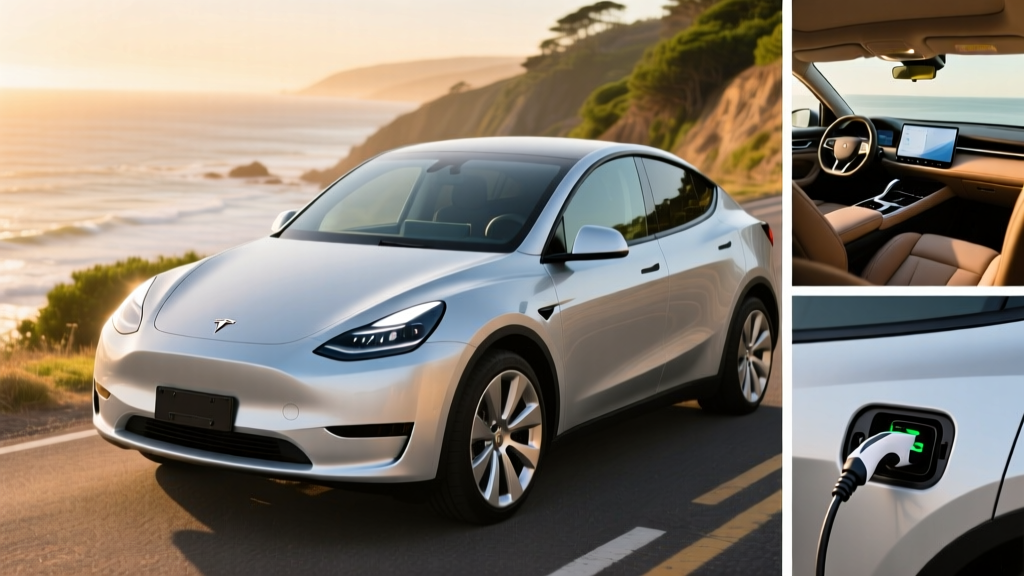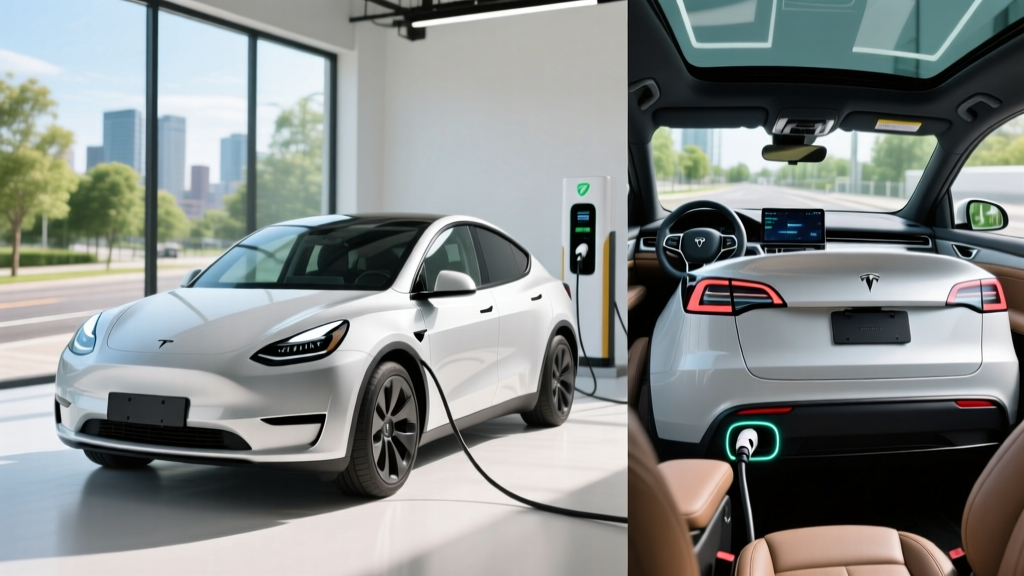
The Tesla Model Y remains one of the best-selling electric vehicles in the United States, and the 2025 refresh — internally called the "Juniper" update — brings revised styling, a quieter cabin, and updated suspension tuning. But for buyers researching cargo capacity, garage fit, and practical usability, the numbers matter more than the marketing. This guide breaks down every critical 2025 Tesla Model Y dimension alongside the range, charging, pricing, and ownership data you need before signing a purchase agreement.
Exterior and Interior Dimensions: Will It Fit Your Life?
The 2025 Model Y is a compact crossover built on Tesla's shared platform with the Model 3. Despite the Juniper refresh, the core dimensions remain closely aligned with the outgoing generation, preserving cargo and passenger space while introducing minor aerodynamic refinements.
| Measurement | Specification |
|---|---|
| Overall Length | 188.0 in (4,775 mm) |
| Overall Width (mirrors folded) | 75.6 in (1,921 mm) |
| Overall Width (mirrors out) | 83.8 in (2,129 mm) |
| Overall Height | 63.9 in (1,624 mm) |
| Wheelbase | 113.8 in (2,890 mm) |
| Ground Clearance | 6.6 in (167 mm) |
| Curb Weight (Long Range AWD) | 4,398 lbs (1,995 kg) |
| Front Headroom | 41.0 in |
| Rear Headroom | 37.7 in |
| Front Legroom | 41.8 in |
| Rear Legroom | 40.5 in |
| Cargo Volume (rear seats up) | 30.2 cu ft |
| Cargo Volume (rear seats folded) | 72.1 cu ft |
| Frunk (front trunk) | 4.1 cu ft |
| Turning Circle | 39.0 ft |
Compared to the Hyundai Ioniq 5 (182.7 in length, 56.2 cu ft max cargo) or the Ford Mustang Mach-E (186.7 in length, 59.7 cu ft max cargo), the Model Y offers class-leading cargo volume. The 72.1 cu ft maximum with seats folded approaches midsize SUV territory, making it a practical choice for families hauling strollers, camping gear, or Costco runs. The 4.1 cu ft frunk adds useful space for charging cables or a small bag, though it's shallower than the Model 3's front trunk due to the heat pump and HVAC components housed there.
Garage fit is rarely an issue. At just under 188 inches long and roughly 76 inches wide with mirrors folded, the Model Y fits standard US single-car garages (typically 120 in wide × 240 in deep). However, if you're installing a wall-mounted Level 2 charger, plan for at least 18 inches of clearance ahead of the vehicle for the charge cable bend radius.
Range, Battery, and Efficiency
The 2025 Model Y is offered in three trims in the US market: Long Range RWD, Long Range AWD, and Performance. Each uses a different battery and drivetrain configuration that directly affects range and efficiency.
| Trim | EPA Range | Battery (usable) | Chemistry | MPGe (combined) | kWh/100 mi |
|---|---|---|---|---|---|
| Long Range RWD | 320 mi | ~78 kWh | NMC (2170 cells) | 123 MPGe | 27 |
| Long Range AWD | 307 mi | ~78 kWh | NMC (2170 cells) | 117 MPGe | 29 |
| Performance AWD | 285 mi | ~78 kWh | NMC (2170 cells) | 110 MPGe | 31 |
All 2025 Model Y trims sold in the US use nickel-manganese-cobalt (NMC) chemistry in Tesla's 2170 cell format, supplied primarily by Panasonic and LG Energy Solution. Unlike the Standard Range variants sold in some international markets — which use lithium iron phosphate (LFP) batteries — the US Long Range and Performance models prioritize energy density for maximum range. NMC cells offer roughly 15-20% higher energy density than LFP but are more sensitive to sustained 100% state-of-charge storage; Tesla recommends daily charging to 80-90% for NMC packs and reserving 100% for road trips.
The EPA sticker says 320 miles for the Long Range RWD, but real-world results depend heavily on conditions:
- Highway driving (70-75 mph, moderate temps): Expect 260-280 miles before needing to charge. Aerodynamic drag rises with the square of speed, and the Model Y's crossover profile generates more drag than a sedan.
- City/suburban mixed driving: 290-315 miles is achievable, thanks to regenerative braking recapturing energy in stop-and-go traffic.
- Cold weather (below 32°F): Range drops 20-30%, bringing real-world highway range to 190-220 miles. Battery chemistry slows ion transfer in the cold, and cabin heating draws significant power. The 2025 Model Y's heat pump (standard on all trims) mitigates this compared to resistive heaters, but physics still applies.
- Towing (with optional tow package, 3,500-lb max): Expect a 35-45% range reduction, dropping effective range to roughly 170-190 miles on the Long Range AWD.
Source: EPA Fuel Economy
Efficiency at 27-31 kWh/100 mi places the Model Y among the most efficient electric crossovers available. For context, the Ford Mustang Mach-E Extended Range AWD achieves roughly 34 kWh/100 mi, and the Hyundai Ioniq 5 AWD sits at about 30 kWh/100 mi. Tesla's advantage comes from its integrated drivetrain design, low rolling-resistance tires, and aggressive thermal management.
Charging Speeds: DC Fast, Level 2, and Level 1
Charging speed is where the Model Y's 400-volt architecture shows its age compared to 800-volt rivals like the Hyundai Ioniq 5 and Kia EV6. Still, Tesla's Supercharger network integration delivers consistent real-world results.
| Charging Level | Max Power | Rate / Time | Notes |
|---|---|---|---|
| DC Fast Charge (Supercharger / CCS) | 250 kW peak | 10-80% in ~27 min | Peak rate sustained only up to ~35% SoC; tapers significantly above 60% |
| Level 2 (Tesla Wall Connector, 48A) | 11.5 kW | ~44 mi/hr of charge | Full charge (0-100%) in ~7 hours |
| Level 2 (Generic J1772 via adapter, 32A) | 7.7 kW | ~30 mi/hr of charge | Common at public Level 2 stations |
| Level 1 (120V household outlet) | ~1.4 kW | ~3-4 mi/hr of charge | Emergency/trickle only; not practical for daily use |
The 250 kW peak DC charge rate is a maximum, not an average. On a V3 Supercharger (or a third-party 350 kW CCS station with adapter), the Model Y will pull 250 kW from roughly 10-35% state of charge, then taper progressively. The 10-80% time of approximately 27 minutes is competitive but trails the Ioniq 5's 18-minute 10-80% time on 800V chargers. For road trips, plan charging stops around 20-25 minutes, which aligns well with a restroom break and snack run.
At home, the Tesla Wall Connector at 48 amps on a 60-amp circuit delivers 11.5 kW, adding roughly 44 miles of range per hour. Most owners who plug in overnight (8-10 hours) will wake to a full battery regardless of starting state of charge. Home installation typically costs $500-$2,000 depending on panel capacity and run distance — a 200-amp panel upgrade may be needed in older homes, adding $1,500-$3,000.
The 2025 Model Y ships with a NACS (North American Charging Standard) port natively. It can access the full Tesla Supercharger network without adapters. For CCS-equipped public chargers (Electrify America, EVgo, some ChargePoint stations), Tesla sells a CCS adapter (~$175) that enables compatibility.
Performance and Drivetrain
| Trim | Drivetrain | Horsepower | 0-60 mph | Top Speed |
|---|---|---|---|---|
| Long Range RWD | Rear-Wheel Drive (single motor) | 346 hp | 5.8 sec | 135 mph |
| Long Range AWD | Dual Motor AWD | 384 hp | 4.8 sec | 135 mph |
| Performance AWD | Dual Motor AWD | 456 hp | 3.5 sec | 155 mph |
The Performance trim's 3.5-second 0-60 time makes it one of the quickest crossovers under $60,000. But the more relevant metric for most buyers is the Long Range AWD's 4.8-second sprint, which provides confident highway merging and passing without the stiffer ride and larger wheels that reduce the Performance trim's range.
All 2025 Model Y trims feature regenerative braking with adjustable intensity (though Tesla has reduced the customization compared to earlier model years). One-pedal driving is possible in most city scenarios. The dual-motor AWD system provides torque vectoring and traction in rain and light snow, though ground clearance of 6.6 inches limits serious off-road capability.
Pricing, Tax Credits, and Total Cost
| Trim | Base MSRP | Destination | Typical As-Tested |
|---|---|---|---|
| Long Range RWD | $44,990 | $1,390 | $46,380 |
| Long Range AWD | $47,990 | $1,390 | $49,380 |
| Performance AWD | $51,490 | $1,390 | $52,880+ |
Popular options include the $2,000 Enhanced Autopilot package, $1,000-$2,500 paint colors (Pearl White is standard/free), and the $1,000 tow package. Fully loaded Performance models can approach $58,000.
The 2025 Tesla Model Y may qualify for up to $7,500 under the IRS §30D Clean Vehicle Credit, but eligibility depends on several conditions that change frequently:
- MSRP Cap: The Model Y qualifies as an SUV/van, so the MSRP cap is $80,000 (vs. $55,000 for sedans). All trims clear this threshold.
- Buyer Income Cap: Modified AGI must not exceed $150,000 (single), $225,000 (head of household), or $300,000 (married filing jointly).
- Battery Sourcing: A portion of the credit ($3,750) requires critical minerals sourced from the US or FTA partners; another $3,750 requires battery components manufactured in North America. Tesla's US-built packs with Panasonic cells have historically met these requirements, but supply-chain changes can affect eligibility month to month.
- Point-of-Sale Transfer: As of 2024, buyers can transfer the credit to the dealer at purchase, reducing the out-of-pocket price immediately rather than waiting for a tax refund.
Bottom line: Check the current eligibility on fueleconomy.gov and the IRS Clean Vehicle Credit page at the time of purchase. Consult a tax professional — credit rules are subject to change and individual circumstances vary.
With the full $7,500 credit applied at point of sale, the Long Range RWD drops to approximately $38,880 — a compelling price for a 320-mile electric crossover. Even without the full credit, many states offer additional incentives (check AFDC state incentive database for your jurisdiction).
Warranty, Reliability, and Ownership Costs
| Component | Coverage |
|---|---|
| Basic Vehicle | 4 years / 50,000 miles |
| Battery & Drive Unit | 8 years / 120,000 miles (Long Range); 8 years / 100,000 miles (RWD) |
| Battery Degradation Threshold | 70% capacity retention minimum during warranty period |
Tesla's battery warranty guarantees that the pack will retain at least 70% of its original capacity over 8 years or 120,000 miles (Long Range trims). Real-world degradation data from Tesla's fleet suggests most Model Y packs lose approximately 5-8% capacity over the first 50,000 miles, then degrade more slowly. A full battery replacement outside warranty currently costs approximately $12,000-$16,000, though prices continue to decline as cell costs fall.
Insurance costs for the Model Y run 15-30% higher than comparable gas crossovers, driven by repair costs for aluminum body panels and the integrated battery structure. Expect annual premiums of $1,800-$2,800 depending on location, driving record, and coverage level. Tesla offers its own insurance product in many states, which uses real-time driving data and can be competitive for safe drivers.
Maintenance is minimal: no oil changes, no spark plugs, no transmission fluid. Cabin air filter replacement ($60-$100 every 2 years), tire rotation, and wiper fluid are the primary recurring costs. Brake pads last significantly longer than on gas vehicles due to regenerative braking handling most deceleration.
Tech, Driver Assistance, and Notable Drawbacks
The 2025 Juniper refresh introduces a redesigned interior with ambient lighting, ventilated front seats, a rear-seat touchscreen, and improved sound insulation. The 15.4-inch center touchscreen runs Tesla's proprietary infotainment OS, which integrates navigation with real-time Supercharger routing, streaming media, and vehicle controls.
Standard Autopilot includes adaptive cruise control, lane centering, and automatic emergency braking — classified as SAE Level 2 driver assistance. The driver must maintain hands on the wheel and eyes on the road at all times. Enhanced Autopilot ($2,000) adds auto lane change, autosteer on highways, and smart summon. Full Self-Driving (Supervised) ($8,000 or $99/month) adds traffic light/stop sign recognition and city street autosteer, but remains a Level 2 system requiring full driver supervision — it is not autonomous driving.
Notable drawbacks:
- No Apple CarPlay or Android Auto. Tesla's closed ecosystem means you use Tesla's native navigation and media apps exclusively.
- Minimalist controls. Almost all vehicle functions (glovebox, mirror adjustment, vent direction) are buried in touchscreen menus, which can distract while driving.
- Ride quality. The Performance trim's 21-inch wheels and sport-tuned suspension transmit more road imperfections than comfort-oriented rivals like the Ioniq 5 or Mach-E.
- No physical instrument cluster. Speed and navigation info appear only on the center screen, requiring a glance to the right rather than straight ahead.
- Panel gaps and build quality have improved with Juniper but still draw more complaints than legacy automaker competitors at this price point.
Who Should Buy the 2025 Tesla Model Y?
- Families needing max cargo space in a compact electric crossover — 72.1 cu ft with seats folded leads the segment.
- Road-trippers who value the Supercharger network's reliability and coverage across the US highway system.
- Tech-forward buyers who want over-the-air updates, integrated navigation with charge routing, and a strong app ecosystem.
- Commuters with home charging — plugging in overnight at 11.5 kW means starting every day with 300+ miles of range.
- You need Apple CarPlay/Android Auto — look at the Hyundai Ioniq 5, Ford Mach-E, or Kia EV6.
- Fastest DC charging matters — the Ioniq 5/EV6 on 800V chargers add 10-80% in ~18 minutes vs. the Model Y's ~27 minutes.
- You prefer physical buttons and a traditional instrument cluster — the Mach-E or Volkswagen ID.4 offer more conventional layouts.
- You frequently tow heavy loads — the Rivian R1S or Ford F-150 Lightning offer higher tow ratings and longer range under load.
Pros and Cons at a Glance
- Class-leading cargo volume (72.1 cu ft max)
- Strong EPA range (up to 320 mi) with excellent efficiency
- Access to Tesla Supercharger network (most reliable US DC network)
- Competitive pricing after federal tax credit
- Over-the-air updates continuously add features
- Spacious rear legroom (40.5 in) for the segment
- DC fast charging slower than 800V rivals (27 min vs. 18 min, 10-80%)
- No Apple CarPlay or Android Auto
- Touchscreen-dependent controls can distract
- Performance trim ride quality is firm
- Insurance costs above segment average
- No physical instrument cluster or head-up display
Frequently Asked Questions
What is the real-world range of the 2025 Tesla Model Y?
The EPA rates the Long Range RWD at 320 miles, the Long Range AWD at 307 miles, and the Performance at 285 miles. In real-world highway driving at 70-75 mph in moderate temperatures, expect 260-280 miles on the Long Range RWD and 250-270 on the AWD. Cold weather (below 32°F) reduces range by 20-30%, and towing reduces it by 35-45%.
How fast does the 2025 Model Y charge at home and on the road?
On a DC fast charger, it peaks at 250 kW and charges from 10-80% in approximately 27 minutes. At home on a Level 2 Tesla Wall Connector (48A/11.5 kW), it adds about 44 miles of range per hour, with a full charge taking roughly 7 hours. A standard 120V outlet adds only 3-4 miles per hour and is not practical for regular use.
Does the 2025 Tesla Model Y qualify for the $7,500 federal EV tax credit?
It may qualify for up to $7,500 under IRS §30D, provided the buyer meets income limits ($150K single / $300K joint), the vehicle meets battery-sourcing requirements, and the MSRP is under $80,000 (it is). Eligibility can change as supply chains shift. Always verify on fueleconomy.gov and consult a tax professional before purchasing. The credit can be transferred at point of sale to reduce your purchase price immediately.
Is the 2025 Model Y worth buying vs. the Hyundai Ioniq 5 or Ford Mach-E?
The Model Y wins on cargo space (72.1 vs. 56.2 cu ft), Supercharger network access, and efficiency. The Ioniq 5 wins on DC charging speed (18 vs. 27 min, 10-80%), Apple CarPlay support, and ride comfort. The Mach-E offers a more traditional interior layout and competitive pricing. If cargo capacity and road-trip charging reliability are your priorities, the Model Y leads. If fast charging and smartphone integration matter more, test-drive the Ioniq 5.
What are the biggest dimensions to consider for garage and parking fit?
At 188.0 inches long and 75.6 inches wide (mirrors folded), the Model Y fits standard US garages. Allow at least 19 feet of depth including clearance for a wall-mounted charger. The 39.0-foot turning circle is average for the segment — tight urban parking lots may require multi-point turns. Height of 63.9 inches clears standard 7-foot garage doors with room to spare.
How much does it cost to charge a Model Y at home vs. gas?
At the US average electricity rate of ~$0.16/kWh, charging the Model Y's 78 kWh battery from 0-100% costs approximately $12.50, yielding a cost per mile of roughly $0.04. An equivalent gas crossover getting 28 MPG at $3.50/gallon costs about $0.125 per mile — roughly three times more. Over 15,000 miles annually, that's a fuel savings of approximately $1,275 per year with home charging.