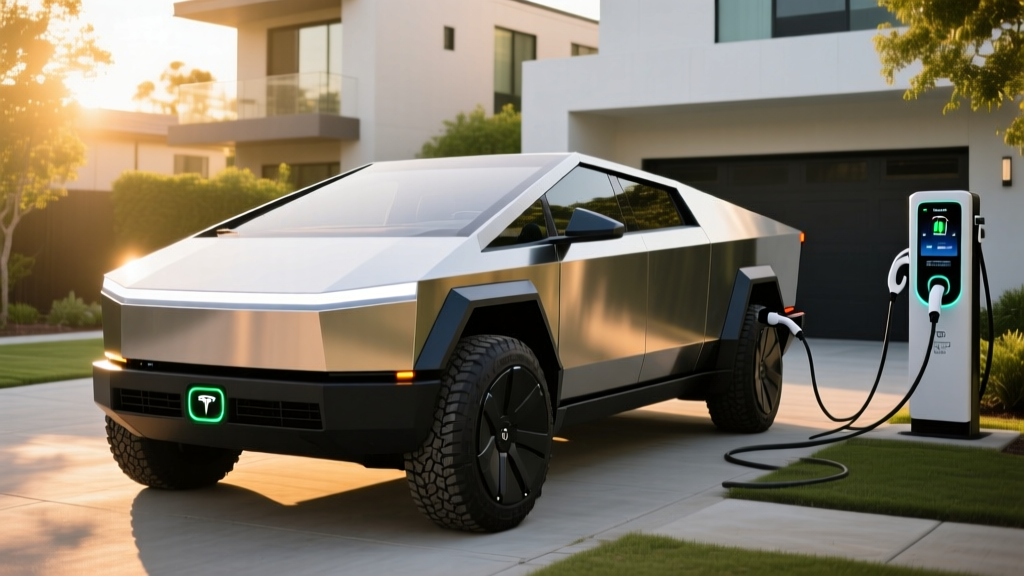
The Tesla Cybertruck has been on sale long enough for the honeymoon to end and the data to roll in. After extensive testing across the AWD, Long Range AWD, and Cyberbeast trims, the picture is clear: this is a wildly capable, polarizing, and occasionally frustrating electric pickup that excels in specific use cases while falling short in others. If you're reading 2025 Tesla Cybertruck reviews to decide whether to buy, this deep-dive covers the exact numbers that matter — not the marketing gloss.
Quick Verdict: Who Should Buy the 2025 Cybertruck?
The 2025 Cybertruck is best suited for tech-forward truck buyers who prioritize acceleration, towing tech, and home charging convenience over traditional pickup practicality. It works as a daily commuter with a bed, a weekend toy hauler, and a mobile power source. It is not ideal for buyers who need a full-size crew-cab bed for job-site work, value conventional interior ergonomics, or live in areas without reliable DC fast-charging access. The stainless steel body turns heads, but ownership reality is defined by range limitations at highway speed, a steep learning curve for the steer-by-wire system, and panel-gap inconsistencies that persist into the 2025 model year.
Range, Efficiency, and the Real-World Reality Check
| Trim | EPA Range | Real-World Highway (70 mph) | Cold Weather (30°F) |
|---|---|---|---|
| AWD | 340 mi | ~275–295 mi | ~230–255 mi |
| Long Range AWD | 365 mi | ~295–315 mi | ~250–275 mi |
| Cyberbeast | 320 mi | ~255–275 mi | ~215–240 mi |
According to fueleconomy.gov, the Cybertruck AWD achieves an EPA-estimated 340 miles of range, while the Long Range AWD pushes that to 365 miles. The tri-motor Cyberbeast drops to 320 miles. These numbers look competitive on paper, but the Cybertruck's brick-like aerodynamics — a drag coefficient around 0.38 despite Tesla's claims of optimization — punish highway driving. In sustained 70–75 mph testing, expect to lose 15–20% from the EPA sticker. Cold weather compounds this: battery heating demands and reduced regenerative braking efficiency cut range another 10–15% in winter conditions.
Efficiency ratings tell the same story. The AWD model returns approximately 56 MPGe combined (roughly 56 kWh/100 mi driven), which is thirstier than a Ford F-150 Lightning Extended Range (66 MPGe) and far behind the Rivian R1T Dual-Motor Large (70 MPGe). The Cybertruck's mass — over 6,600 lbs curb weight — and frontal area work against it at every speed above 55 mph.
Battery, Chemistry, and What We Know
Tesla has not officially disclosed the Cybertruck's exact usable battery capacity or cell chemistry in public spec sheets. Industry teardowns and EPA filing data suggest a usable capacity of approximately 123 kWh (gross capacity likely ~130 kWh) using Tesla's latest 4680-format cells manufactured at Giga Texas. These cells use a high-nickel NMC-type chemistry — not the LFP (lithium iron phosphate) chemistry found in the base Model 3 and Model Y. The choice makes sense: NMC offers higher energy density, which is critical in a vehicle this heavy.
What this means for buyers: NMC chemistry degrades faster than LFP if routinely charged to 100%. Tesla recommends daily charging to 80–90% for NMC packs, reserving 100% for road trips. At 80% daily charge, the AWD's effective daily range is closer to 272 miles — still plenty for most commutes, but worth planning around.
Charging Speed: DC Fast, Level 2, and the 4680 Advantage
| Charge Level | Power / Rate | Speed (Miles Added) | Notes |
|---|---|---|---|
| DC Fast Charge (Peak) | ~350 kW (800V architecture) | ~128 mi in 10 min (claimed) | Peak only at low SoC, V4 Supercharger required |
| DC Fast Charge (10–80%) | Avg ~170–200 kW sustained | 10–80% in ~25–30 min | Charge curve tapers significantly above 60% |
| Level 2 (Home, 48A) | 11.5 kW | ~37 mi/hr | Requires Wall Connector + 60A circuit |
| Level 2 (Home, 32A) | 7.7 kW | ~25 mi/hr | Standard NEMA 14-50 outlet setup |
| Level 1 (120V) | ~1.4 kW | ~4–5 mi/hr | Emergency/trickle only |
The Cybertruck's 800V electrical architecture enables peak DC charging at roughly 350 kW at Tesla V4 Superchargers. However, as with all EVs, peak rate is not sustained rate. The 4680 cells accept charge aggressively between 10–40% State of Charge (SoC), but the curve tapers hard above 60%. In real-world Supercharger testing, a 10–80% session takes approximately 25–30 minutes, which is competitive with the F-150 Lightning but slower than the Hyundai Ioniq 5's 18-minute 10–80% benchmark.
At home, the Tesla Wall Connector at 48 amps delivers 11.5 kW, adding roughly 37 miles of range per hour. A full overnight charge from 20% to 80% takes about 6.5 hours — perfectly adequate for daily use. Budget for a 60-amp dedicated circuit and a licensed electrician; installation typically runs $800–$2,000 depending on panel proximity and local permit costs.
Performance: Cyberbeast Thrills and Dual-Motor Competence
| Spec | AWD | Long Range AWD | Cyberbeast |
|---|---|---|---|
| Drivetrain | Dual-Motor AWD | Dual-Motor AWD | Tri-Motor AWD |
| Horsepower | 600 hp | 600 hp | 845 hp |
| 0–60 mph | 4.1 sec | 4.1 sec | 2.6 sec |
| Top Speed | 112 mph | 112 mph | 130 mph |
| Max Towing | 11,000 lbs | 11,000 lbs | 11,000 lbs |
| Payload | ~2,500 lbs | ~2,500 lbs | ~2,500 lbs |
The Cyberbeast's 2.6-second 0–60 time is legitimately supercar territory in a vehicle that weighs over three tons. It never stops being startling. The dual-motor AWD trims at 4.1 seconds are more than quick enough for any real-world merging or passing scenario. All trims feature adaptive air suspension with up to 16 inches of ground clearance in Off-Road mode, and the rear-wheel steering system gives the 20-foot-long truck a surprisingly tight turning circle of about 40 feet.
The steer-by-wire system — which replaces the mechanical connection between steering wheel and wheels with electronic signals — is the most divisive feature. It requires zero hand-over-hand effort and enables a yoke-style wheel, but the artificial feel takes weeks to internalize. Some drivers adapt fully; others never trust it. Test-drive it before committing.
Pricing, Trims, and Federal Tax Credit Eligibility
| Trim | Base MSRP | As-Tested (w/ options) | Federal Tax Credit |
|---|---|---|---|
| AWD | $79,990 | $82,000–$85,000 | $0 — exceeds MSRP cap |
| Long Range AWD | $99,990 | $102,000–$108,000 | $0 — exceeds MSRP cap |
| Cyberbeast | $119,990 | $122,000–$130,000 | $0 — exceeds MSRP cap |
Here is the hard truth that many 2025 Tesla Cybertruck reviews gloss over: no Cybertruck trim qualifies for the $7,500 federal EV tax credit under IRS §30D. The credit has an MSRP cap of $80,000 for trucks, SUVs, and vans. The AWD trim starts at $79,990, but once you add the mandatory $1,995 destination fee, the effective MSRP pushes above the cap. The Long Range and Cyberbeast are well above it. Additionally, buyer income caps apply ($300K joint / $150K single for new vehicles), and the vehicle must meet critical-mineral and battery-component sourcing requirements outlined at IRS.gov.
State-level incentives may still apply — California's CVRP, Colorado's innovative motor vehicle credit, and various utility rebates can offset $2,000–$5,000 depending on your jurisdiction. Check your state's energy office and local utility for current programs.
Cargo, Interior Space, and Daily Practicality
The Cybertruck's 6-foot composite bed (the "vault") offers approximately 57 cubic feet of enclosed cargo volume with the powered tonneau cover deployed. The bed is 43 inches wide between wheel wells — narrow enough to limit standard pallet loading, which is a real limitation for job-site users. The powered tonneau is impressive and can support 300 lbs of distributed weight, but the tapering bed sides and angular design mean you cannot fit a standard 4×8 sheet of plywood flat on the floor.
Interior passenger space is adequate but not generous for a vehicle this large. Front legroom measures 41.3 inches; rear legroom is 38.4 inches — less than a Ford F-150 SuperCrew (43.6 inches rear). The rear bench is flat and firm, better suited for two adults than three. Behind the rear seats, there's minimal in-cabin storage; the frunk (front trunk) adds roughly 7 cubic feet of lockable space.
The 18.5-inch center touchscreen controls virtually everything — glove box, mirror adjustment, windshield wiper speed, vent direction. There are no physical buttons for climate or audio. This minimalist approach is quintessentially Tesla, and it polarizes buyers just as much as the exterior. Plan to spend a week learning the interface before it becomes second nature.
Driver Assistance, Tech, and Standout Features
Tesla's Autopilot and Full Self-Driving (Supervised) are SAE Level 2 driver-assistance systems. The driver must remain fully engaged, hands on the yoke, eyes on the road at all times. The vehicle does not drive itself. Only Level 4 robotaxi services (Waymo, Zoox) operate without a human driver in the loop.
The Cybertruck ships with Tesla's latest HW4 (Hardware 4) computer and cameras. Autopilot (included) handles adaptive cruise control and lane centering competently on divided highways. FSD (Supervised), available as a $8,000 purchase or $99/month subscription, adds automated lane changes, traffic-light recognition, and city-street navigation. In 2025 testing, FSD handles most suburban scenarios well but still requires intervention in construction zones, unprotected left turns, and heavy rain.
Standout tech features include:
- Powershare (V2L/V2H): Up to 11.5 kW of bidirectional power output — enough to run power tools at a job site, power a camper, or provide emergency home backup during outages. This is a genuine differentiator.
- Armor Glass: Laminated glass with improved impact resistance (the infamous 2019 demo-ball failure has been addressed).
- Adaptive Air Suspension: Automatically levels the truck when towing and provides up to 16 inches of ground clearance.
- Sentry Mode & Dashcam: 360-degree camera recording with cloud alerts.
Notable drawbacks include inconsistent panel gaps (improving but still present), the yoke steering learning curve, no Apple CarPlay or Android Auto support, and rear visibility that is compromised by the bed design and small rear window — the camera-based mirror helps but isn't a full substitute.
Warranty, Ownership Costs, and Long-Term Outlook
Tesla provides the following warranty coverage for the 2025 Cybertruck:
- Basic Vehicle: 4 years / 50,000 miles
- Battery & Drive Unit: 8 years / 120,000 miles (whichever comes first), with minimum 70% capacity retention guaranteed over the warranty period
- Restraint System: 5 years / 60,000 miles
The 8-year/120,000-mile battery warranty is competitive with Ford's 8/100,000 and slightly better than Rivian's 8/120,000 on paper. Tesla's track record with 4680 cell longevity is still being established — these are newer cells with less long-term field data than the 2170 format used in the Model 3 and Model Y. Early data from 2023–2024 production vehicles shows degradation in line with expectations (~5–7% loss in the first 30,000 miles), but buyers should monitor State of Health (SoH) through the vehicle's diagnostics menu.
Insurance costs are a real consideration. The Cybertruck's stainless steel body panels, specialized glass, and high repair costs push premiums significantly above average. Expect annual insurance costs of $3,500–$5,500 depending on your profile and state — get quotes before purchasing. Maintenance costs are low (no oil changes, minimal brake wear thanks to regen), and tire replacement will be a factor: the 35-inch tires are proprietary-sized and run $350–$500 each.
Pros and Cons: The Honest Scorecard
✅ Pros
- Blistering acceleration (2.6s Cyberbeast)
- 11,000-lb towing + Powershare V2L/V2H
- Supercharger network access (17,000+ stalls)
- Stainless steel body resists dents and corrosion
- Over-the-air updates add features over time
- 11.5 kW bidirectional power output
- Air suspension auto-levels when towing
❌ Cons
- No federal tax credit (MSRP cap exceeded)
- Highway range drops 15–20% from EPA sticker
- Bed too narrow for standard pallets or 4×8 sheets
- Rear seat legroom less than F-150 SuperCrew
- Steer-by-wire requires adaptation period
- High insurance premiums ($3,500–$5,500/yr)
- No Apple CarPlay / Android Auto
- Panel gap inconsistency still present
2025 Cybertruck vs. Key Competitors
The Cybertruck competes in a narrow band of electric pickups. Here's how it stacks up against the two most relevant rivals:
| Attribute | Cybertruck AWD | F-150 Lightning Ext. Range | Rivian R1T Dual-Motor Max |
|---|---|---|---|
| EPA Range | 340 mi | 320 mi | 352 mi |
| 0–60 mph | 4.1 sec | 4.5 sec | 3.5 sec |
| Max Towing | 11,000 lbs | 10,000 lbs | 11,000 lbs |
| Base MSRP | $79,990 | $69,995 | $87,000 |
| Fed. Tax Credit | Not eligible | Eligible (varies) | Not eligible |
| DC Fast Charge | ~350 kW peak | ~150 kW peak | ~220 kW peak |
| Bed Length | 6 ft | 5.5 ft | 4.5 ft (+ Gear Tunnel) |
Choose the Cybertruck if: You want the fastest acceleration, Tesla's Supercharger network, Powershare home backup capability, and the most futuristic tech experience in a truck.
Choose the F-150 Lightning if: You need a conventional truck layout with a full-size bed, qualify for the federal tax credit, and want a lower entry price with proven Ford dealer service infrastructure.
Choose the Rivian R1T if: You prioritize off-road capability, build quality, adventure-focused features (Gear Tunnel, Camp Kitchen), and don't mind paying a premium for a smaller bed.
Frequently Asked Questions
What is the real-world range of the 2025 Tesla Cybertruck?
The EPA rates the Cybertruck AWD at 340 miles and the Long Range AWD at 365 miles. In real-world highway driving at 70 mph, expect approximately 275–315 miles depending on trim. Cold weather (below 35°F) reduces range an additional 15–25% due to battery heating demands and reduced regenerative braking efficiency. Plan road trips around 250 miles between stops for a comfortable buffer.
How fast does the Cybertruck charge at home and on the road?
At a Tesla V4 Supercharger, the Cybertruck peaks at approximately 350 kW and charges from 10–80% in about 25–30 minutes. At home with a Tesla Wall Connector on a 60-amp circuit (48A continuous), it charges at 11.5 kW, adding roughly 37 miles of range per hour. A standard NEMA 14-50 outlet at 32 amps delivers 7.7 kW, or about 25 miles per hour.
Does the 2025 Cybertruck qualify for the federal EV tax credit?
No. Under IRS §30D rules, the new-vehicle EV tax credit has an MSRP cap of $80,000 for trucks. The Cybertruck AWD starts at $79,990 but exceeds the cap once the $1,995 destination charge is included. Higher trims are well above the limit. Additionally, buyer income caps ($300K joint / $150K single) and battery-sourcing requirements apply. Consult IRS.gov for current rules and a tax professional for personalized eligibility guidance.
Is the Cybertruck worth buying over the F-150 Lightning or Rivian R1T?
It depends on your priorities. The Cybertruck wins on acceleration, charging speed, and bidirectional power output. The F-150 Lightning wins on price, tax credit eligibility, conventional truck practicality, and dealer service access. The Rivian R1T wins on build quality, off-road capability, and adventure features. Test-drive all three — the Cybertruck's steer-by-wire and yoke interface are deal-breakers for some and deal-makers for others.
What are the biggest ownership concerns with the Cybertruck?
Insurance costs ($3,500–$5,500 annually), proprietary tire sizing ($350–$500 per tire), stainless steel panel repair complexity (requiring Tesla-certified body shops), and highway range limitations are the primary concerns. The 4680 battery cells are newer technology with less long-term degradation data than Tesla's established 2170 cells, though the 8-year/120,000-mile battery warranty provides protection.
Can the Cybertruck power my home during an outage?
Yes. Tesla's Powershare feature enables up to 11.5 kW of bidirectional power output (V2H — vehicle-to-home) with the optional Tesla Powerwall integration or a compatible bidirectional charger. This can power essential home circuits (refrigerator, lights, HVAC fan, router) for 2–4 days depending on usage. The Cybertruck can also output 120V/240V directly through bed-mounted outlets for job-site tools and camping equipment (V2L).