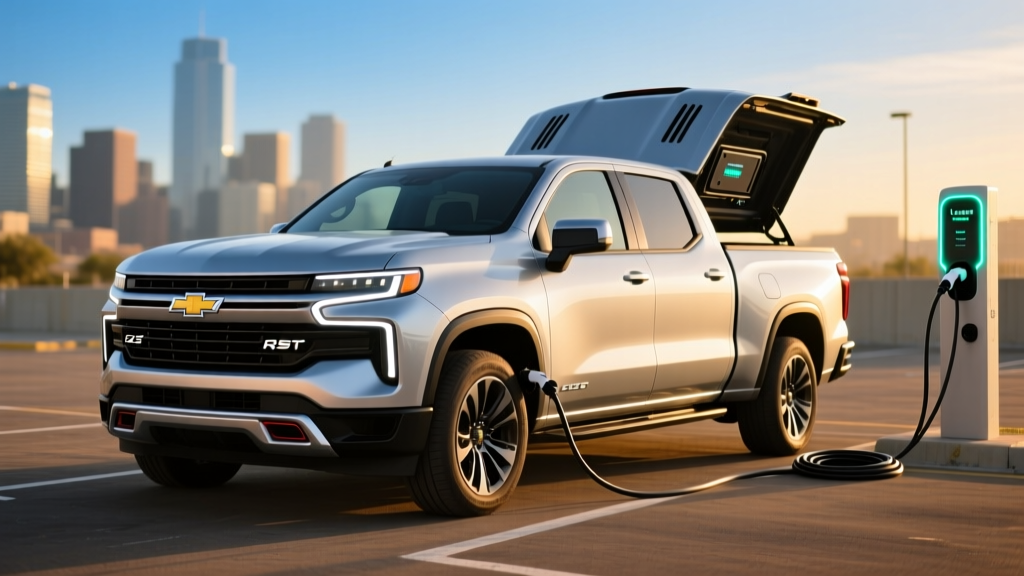
If you own or are considering a 2025 Chevy Silverado RST EV, adding a truck bed cap (tonneau cover or camper shell) can improve highway range by reducing aerodynamic drag — typically yielding a 3–7% efficiency gain at sustained speeds above 65 mph. For the Silverado EV RST's 24-module Ultium battery (roughly 200 kWh usable) and EPA-estimated 440 miles of range, that translates to an extra 13–30 miles of real-world highway driving per charge. However, not all caps are equal: hard folding and retractable covers offer the best aero benefit with cargo flexibility, while tall camper shells can actually increase frontal drag. Below, we break down the real numbers, cost implications, and ownership considerations for pairing a bed cap with Chevy's electric full-size truck.
Quick Answer: Does a Bed Cap Improve Silverado EV RST Range?
Yes — a low-profile, flush-mounted hard tonneau cover reduces the Silverado EV RST's open-bed turbulence, improving highway efficiency from ~2.0 kWh/mile to approximately 1.85–1.92 kWh/mile at 70 mph. Expect a real-world highway range bump of 15–30 miles depending on cover type, ambient temperature, and payload. Soft roll-up covers provide minimal aero benefit (1–2%). Tall camper shells may reduce range by 2–4% due to increased frontal area.
Silverado EV RST: Baseline Specs You Need First
Before evaluating any accessory's impact, let's establish the truck's factory numbers. The 2025 Silverado EV RST is the higher-output, longer-range trim in Chevy's electric truck lineup (alongside the fleet-oriented WT). These are the figures that matter when calculating aero-mod gains:
| Specification | 2025 Silverado EV RST |
|---|---|
| EPA Range | 440 miles (est.) |
| Battery (usable) | ~200 kWh, Ultium NMC |
| Powertrain | Dual-motor AWD, 664 hp / 780 lb-ft |
| 0–60 mph | ~4.5 seconds |
| Max DC Fast Charge | 350 kW (peak) |
| 10–80% DC Charge | ~35 minutes (at 350 kW station) |
| Level 2 Charge Rate | 19.2 kW (onboard charger) |
| Towing (max) | 10,000 lbs |
| Bed Length | 5' 11" (Multi-Flex tailgate) |
| Base MSRP | ~$87,300 (before incentives) |
| Battery/Powertrain Warranty | 8 years / 100,000 miles |
Real-world range caveat: The 440-mile EPA figure assumes a mix of city and highway driving at moderate temperatures. In sustained 70–75 mph highway use, expect 340–380 miles. In cold weather (below 32°F) at highway speeds, range can drop to 280–320 miles due to cabin heating demands and increased battery resistance. This is where a bed cap's aero benefit becomes most relevant — it helps close the gap between EPA sticker and real-world highway numbers.
How a Truck Bed Cap Affects EV Range: The Aerodynamics
Full-size pickups suffer from significant aerodynamic drag at the open bed. Air flowing over the cab creates a low-pressure zone in the bed, essentially acting as a parachute at highway speeds. This is well-documented in wind-tunnel testing by SAE International and by aftermarket manufacturers. For the Silverado EV RST, which has a relatively tall stance and a bed that cannot be eliminated (unlike the Ford F-150 Lightning's optional frunk-heavy configurations), managing bed turbulence is a practical efficiency lever.
Bed Cap Types and Estimated Range Impact
| Cover Type | Typical Cost | Aero Benefit | Est. Range Gain (Hwy) | Cargo Trade-Off |
|---|---|---|---|---|
| Hard Retractable | $1,800–$3,200 | High (flush seal) | +20–30 mi | Loses some vertical bed space |
| Hard Tri-Fold | $800–$1,500 | Moderate-High | +15–25 mi | Blocks rear window when folded |
| Soft Roll-Up | $200–$500 | Low (flex/billow) | +5–10 mi | Minimal, easy access |
| Fiberglass Camper Shell (low) | $1,500–$2,800 | Moderate | +10–15 mi | Enclosed, weatherproof |
| Tall Camper Shell / Cap | $2,000–$4,500 | Negative (more frontal area) | -10 to -15 mi | Maximum enclosed volume |
Key physics: The benefit comes from eliminating the bed's turbulent wake, not from weight savings (covers weigh 40–120 lbs — negligible against the Silverado EV's ~8,500 lb curb weight). A hard, flush-mounted cover essentially extends the cab's roofline, smoothing airflow separation. Retractable covers (like the RetraxPRO XR or BAK Revolver X4s) are popular among EV truck owners because they maintain the seal while allowing partial bed access.
Real-World Ownership Costs: Silverado EV RST With vs. Without a Bed Cap
Let's model the financial impact over a typical 5-year / 75,000-mile ownership period, assuming 60% highway driving (45,000 highway miles) where the aero benefit applies.
5-Year Charging Cost: Bed Cap vs. No Bed Cap
| Metric | No Bed Cap | Hard Retractable Cover |
|---|---|---|
| Highway Efficiency | 2.0 kWh/mile | 1.88 kWh/mile |
| Highway Miles (5 yr) | 45,000 | 45,000 |
| Highway kWh Consumed | 90,000 kWh | 84,600 kWh |
| Avg. Charging Cost ($0.14/kWh home) | $12,600 | $11,844 |
| 5-Year Charging Savings | — | $756 |
| Cover Cost (installed) | — | $2,500 (avg.) |
| Net 5-Year Cost | $12,600 | $14,344 |
The honest math: At typical residential electricity rates ($0.13–$0.16/kWh), the energy savings from a bed cap do not pay for a premium hard cover within 5 years. The break-even point for a $2,500 retractable cover is roughly 12–14 years of exclusive highway driving. However, if you frequently use DC fast charging (at $0.35–$0.50/kWh on networks like Electrify America or EVgo), savings accelerate — potentially $1,400–$1,900 over 5 years, making the cover cost-neutral or slightly positive. The real value proposition is cargo security, weather protection, and the incremental range buffer that reduces charging stops on long trips.
Silverado EV RST vs. Gas Silverado 1500: Cost and Capability Context
Many Silverado EV shoppers cross-shop the gas Silverado 1500 (particularly the 2.7L Turbo or 5.3L V8). Here's how the EV RST stacks up over 5 years with a bed cap factored in:
| Factor | 2025 Silverado EV RST (w/ cover) | 2025 Silverado 1500 RST (5.3L V8, gas) |
|---|---|---|
| MSRP (base) | ~$87,300 | ~$57,000 |
| Federal Tax Credit (§30D) | Up to $7,500 (if eligible) | $0 |
| Effective Purchase Price | ~$79,800 | $57,000 |
| 5-Yr Fuel/Energy Cost | $14,000–$17,000 | $22,000–$28,000 |
| Maintenance (5 yr) | $1,200–$2,000 | $3,500–$5,500 |
| Insurance (avg. annual) | $2,800–$3,400 | $1,900–$2,500 |
| 5-Year Total Cost | ~$105,000–$115,000 | ~$95,000–$105,000 |
| Towing (max rated) | 10,000 lbs | 11,200 lbs |
| Real-World Hwy Range | 350–380 mi (410 w/ cover) | ~440 mi (26 gal × 17 mpg) |
The EV RST closes the gap primarily through fuel and maintenance savings, but the higher purchase price and insurance premiums keep the 5-year total cost comparable. The bed cap helps the EV's case by reducing charging frequency on road trips — potentially eliminating one 35-minute DC fast-charge stop on a 700-mile journey.
Common Misconceptions About EV Truck Bed Caps
| Myth | Fact |
|---|---|
| "A bed cap adds 50+ miles of range" | Realistic gain is 15–30 highway miles (3–7%). Claims above 10% are exaggerated unless comparing to extreme open-bed turbulence at 80+ mph. |
| "Any tonneau cover helps equally" | Soft covers flex and billow at speed, providing minimal aero benefit. Only hard, flush-sealed covers deliver meaningful drag reduction. |
| "Bed caps void the EV warranty" | GM's 8-year/100,000-mile battery warranty is not voided by aftermarket bed covers. Only modifications that alter the electrical system or battery cooling could trigger warranty disputes. |
| "You need a special 'EV-rated' cover" | There is no EV-specific certification for tonneau covers. Fitment is based on bed dimensions (5'11" for the Silverado EV), which differ from the gas Silverado's 5'8" or 6'6" beds. Verify compatibility with the Multi-Flex tailgate. |
| "The weight of a cover kills range" | A 100-lb cover on an 8,500-lb truck increases energy consumption by less than 1% — far outweighed by the aero gain. |
First-Time EV Truck Buyer: What You Should Know Before Adding a Bed Cap
If the Silverado EV RST is your first electric vehicle, here are practical considerations that affect how much value you'll get from a bed cover:
- Home charging is essential. The 200 kWh battery requires a 240V Level 2 charger (ideally a 48-amp / 11.5 kW circuit) for overnight replenishment. At 19.2 kW (the RST's max onboard rate), a full charge takes ~10.5 hours. Without home charging, relying on public DC fast chargers at $0.35–$0.50/kWh makes the bed cap's energy savings more financially meaningful.
- Cold climate owners benefit most. If you regularly drive in sub-40°F temperatures, you're already losing 15–25% of EPA range to battery resistance and cabin heating. A bed cap's 5–7% aero recovery helps offset this penalty on highway trips.
- Towing negates the cap benefit. When towing a trailer (even a modest 5,000-lb camper), aerodynamic drag from the trailer dominates. The bed cap's contribution becomes negligible. Expect towing range of 150–200 miles regardless of cover.
- Verify Multi-Flex tailgate compatibility. The Silverado EV's bed uses a unique midgate and Multi-Flex tailgate system. Not all aftermarket covers designed for the gas Silverado 1500 will fit. Confirm with the cover manufacturer that the product is listed for the 2025 Silverado EV specifically.
- Insurance implications are minimal. Adding a $2,500 tonneau cover typically does not change your premium. However, notify your insurer to ensure it's covered under comprehensive/collision in case of damage.
Federal Tax Credit & Purchase Considerations (2025–2026 Rules)
The Silverado EV RST's MSRP (~$87,300) falls under the IRS §30D truck MSRP cap of $80,000 for the base WT trim, but the RST trim may exceed it depending on options. Key eligibility points per IRS guidelines:
- MSRP cap: $80,000 for trucks/vans/SUVs (the RST's starting price may disqualify it — verify with your dealer's point-of-sale credit transfer).
- Buyer income limits: AGI ≤ $150,000 (single) / $300,000 (joint) for the tax year of delivery or prior year.
- Battery sourcing: Critical minerals and battery component requirements tighten annually. For 2025–2026 vehicles, a significant percentage must be sourced from the U.S. or free-trade-agreement partners. GM's Ultium cells (U.S.-assembled) generally qualify, but confirm current-year compliance on the IRS eligible vehicle list.
- Point-of-sale transfer: You can transfer the credit to the dealer at purchase for an immediate price reduction rather than claiming it on your tax return.
A bed cap purchase is not eligible for any separate EV tax credit or deduction — it's treated as an aftermarket accessory.
Decision Framework: Should You Add a Bed Cap to Your Silverado EV RST?
If X, Then Y
| If you drive 10,000+ highway miles/year | → A hard retractable cover is worth the $2,000–$3,000 investment. You'll gain 20–30 miles of highway range per charge and recoup $150–$300/year in energy savings. |
| If you primarily drive in-city / suburban | → Skip the cover for range purposes. Below 45 mph, aero drag from the bed is minimal. A soft cover for cargo security ($200–$400) is sufficient. |
| If you tow frequently (>5,000 lbs) | → Don't buy a cover for range gains. Towing drag overwhelms any bed aero improvement. Buy one only for cargo protection when not towing. |
| If you live in a cold climate (sub-32°F winters) | → A hard cover helps recover 15–25 miles of range lost to cold-weather inefficiency on highway trips. Worth the investment. |
| If you rely on DC fast charging (no home charger) | → The cover pays for itself faster at $0.35–$0.50/kWh public rates. Fewer charging stops on road trips also saves time (35+ minutes per stop). |
| If you need full bed height for gear (bikes, motorcycles) | → Consider a low-profile camper shell rather than a tonneau. Expect a slight range penalty (-5 to -10 mi) from increased frontal area, but you gain weatherproof enclosed storage. |
Frequently Asked Questions
Will a bed cap fit the 2025 Silverado EV's unique bed?
The Silverado EV has a 5'11" bed with a Multi-Flex tailgate and available midgate. Most aftermarket covers designed for the gas Silverado 1500's 5'8" short bed will not fit correctly. Look for covers specifically listed for the "2024–2025 Silverado EV" from manufacturers like BAK, Retrax, Read Hard Covers, or Leer. Always confirm midgate clearance if you plan to use the pass-through feature.
Does a tonneau cover affect the Silverado EV's regenerative braking or range estimation?
No. The truck's range estimator (GOM — guess-o-meter) calculates based on recent driving efficiency. Once you install a cover and drive a few hundred highway miles, the displayed range estimate will naturally adjust upward to reflect the improved efficiency. The cover does not interact with any powertrain, battery, or regen system.
How much does a hard retractable bed cover cost, installed?
Expect $1,800–$3,200 for the cover itself plus $200–$500 for professional installation (2–3 hours of labor). Premium models with integrated T-slot channels for rack accessories (like the RetraxPRO XR) run toward the higher end. DIY installation is feasible but requires careful alignment for a flush seal.
Is the range improvement from a bed cap measurable on the Silverado EV's dashboard?
Yes — but gradually. The truck's energy display tracks kWh/mile over trip, lifetime, and resettable intervals. After installing a hard cover, you should see highway trip efficiency drop from approximately 2.0 kWh/mile to 1.85–1.92 kWh/mile over several hundred miles of consistent highway driving. Short trips and city driving won't show meaningful change.
Do I need to report a bed cap modification to GM or my insurance?
No reporting to GM is required — aftermarket tonneau covers do not affect the powertrain warranty. For insurance, a quick call to your agent to add the accessory to your policy (typically no premium increase) ensures it's covered if damaged in a collision or by weather.
Sources: EPA Fuel Economy for range/efficiency baselines; Chevrolet Silverado EV specifications; IRS §30D Clean Vehicle Credit guidelines.