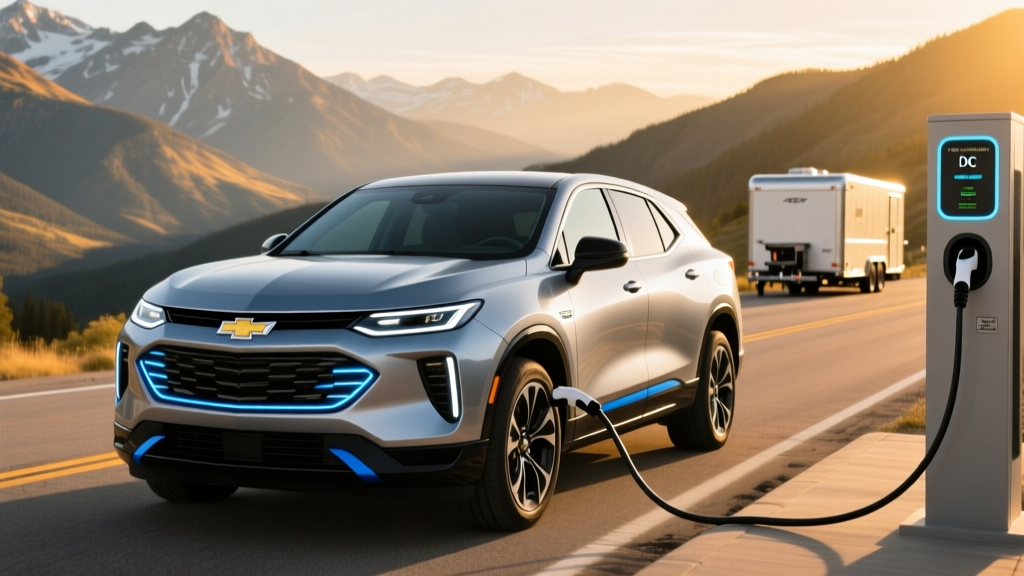
The 2025 Chevrolet Silverado EV slots into a narrow but growing segment: full-size electric pickups that can actually tow, haul, and road-trip without constant range compromises. Built on GM's Ultium platform (shared with the GMC Sierra EV and Cadillac Escalade IQ), the Silverado EV is not a converted gas truck — it's a ground-up battery-electric vehicle with a mid-floor battery pack, available four-wheel steering, and a multi-pro tailgate system that opens into the bed. For 2025, Chevrolet offers the truck in Work Truck (WT), LT, and RST trims, with the range-topping RST boasting one of the longest EPA range estimates of any production pickup on the market.
But sticker-range numbers only tell part of the story. Below, we break down the 2025 Silverado EV with exact figures — battery chemistry, real-world range expectations, sustained DC charging curves, towing efficiency penalties, and whether the federal tax credit actually applies to your purchase.
Range, Battery, and Real-World Efficiency
The 2025 Silverado EV uses GM's Ultium battery platform with nickel-cobalt-manganese-aluminum (NCMA) pouch cells — a variant of NMC chemistry optimized for energy density and cycle life. The available battery pack holds approximately 200 kWh of usable capacity (gross capacity is slightly higher to account for the top/bottom buffer that protects long-term health). The smaller WT fleet battery comes in around 120 kWh usable.
EPA Estimate: Up to 460 miles (RST Max Range) / 380 miles (LT Extended Range) / 310 miles (WT Standard Range)
Real-World Highway (70-75 mph): Expect roughly 370–400 miles from the 460-mi RST. Aerodynamic drag at highway speed hits full-size pickups harder than sedans — the Silverado EV's boxy profile and ~8,500 lb curb weight work against efficiency.
Cold Weather (below 32°F): Plan for 20–30% range loss depending on cabin heating demand and whether you precondition. That 460-mile sticker can shrink to ~320–350 miles in sub-freezing conditions without preconditioning.
Towing: Expect range to drop 40–55% when towing near max capacity. A 460-mile truck towing 8,000 lbs may deliver 200–250 miles between charges.
Efficiency on the EPA cycle lands the RST around 56 MPGe combined (approximately 60 kWh/100 mi). That's typical for a full-size electric truck — the Rivian R1T and Ford F-150 Lightning cluster in a similar band. The WT fleet version, with its smaller battery and lower power output, edges slightly higher in efficiency per mile.
| Spec | WT (Fleet) | LT Extended Range | RST Max Range |
|---|---|---|---|
| Battery Chemistry | NCMA (Ultium) | NCMA (Ultium) | NCMA (Ultium) |
| Usable Capacity | ~120 kWh | ~200 kWh | ~200 kWh |
| EPA Range | ~310 mi | ~380 mi | 460 mi |
| Efficiency (MPGe) | ~60 MPGe | ~57 MPGe | ~56 MPGe |
Charging Speed: DC Fast Charge and Home Level 2
The Silverado EV supports a peak DC fast-charge rate of 200 kW on the RST and LT trims (the WT is capped lower, around 150 kW). GM quotes a 10–80% charge time of approximately 45 minutes on the 200 kWh pack at a capable 350 kW CCS or NACS station. That peak rate is sustained through roughly 30–40% state of charge before tapering — a common charge-curve behavior for large NMC packs managing thermal load.
At home on a Level 2 charger (19.2 kW / 80A circuit), the Silverado EV adds roughly 34–37 miles of range per hour. A full 10–100% charge on the 200 kWh pack takes about 11–12 hours on Level 2 — practical for overnight charging but worth noting if you need a midday top-up on a road-trip turnaround.
Chevrolet equips the Silverado EV with a NACS (Tesla-style) charge port for 2025, granting native access to the Tesla Supercharger network without an adapter. CCS compatibility requires an adapter (included with some trims or available as an accessory).
| Charge Level | Power | Miles Added/Hour | 10–80% Time |
|---|---|---|---|
| Level 1 (120V) | ~1.4 kW | ~2–3 mi/hr | Not practical |
| Level 2 (240V, 80A) | 19.2 kW | ~34–37 mi/hr | ~7–8 hours |
| DC Fast Charge | Peak 200 kW | — | ~45 min (200 kWh pack) |
Preconditioning note: The Silverado EV supports battery preconditioning when you navigate to a DC fast charger in the infotainment system. This warms the pack to optimal temperature before arrival, enabling faster charge acceptance. Skipping preconditioning in cold weather can add 10–15 minutes to your 10–80% session.
Performance, Towing, and Drivetrain
The RST trim pairs dual motors for standard all-wheel drive, producing up to 754 horsepower and 785 lb-ft of torque in Wide Open Watts mode. That translates to a 0–60 mph time of approximately 4.5 seconds — startling for a truck that weighs over four tons. The LT uses a detuned dual-motor setup closer to 600 hp, while the WT fleet version offers a single rear-motor configuration (RWD) at around 510 hp to prioritize efficiency and cost.
Towing is where the Silverado EV makes its utility case. The RST and LT are rated for up to 10,000 pounds (with the available max trailering package), and the WT fleet version edges slightly higher at 12,000 pounds thanks to a lower curb weight and commercial-duty suspension tuning. The available Super Cruise (GM's Level 2 hands-free driver-assist system) works while towing on mapped divided highways — a genuine convenience feature for long hauls.
Super Cruise is an SAE Level 2 driver-assistance system. It provides hands-free steering, acceleration, and braking on pre-mapped divided highways (over 750,000 miles of compatible roads in North America). However, the driver must remain attentive at all times. A camera-based driver-monitoring system will issue alerts and eventually disengage the feature if you look away or close your eyes. This is not autonomous driving — it is supervised cruise and lane-centering.
| Spec | WT (RWD) | LT (AWD) | RST (AWD) |
|---|---|---|---|
| Horsepower | ~510 hp | ~600 hp | 754 hp (WOW mode) |
| 0–60 mph | ~6.5 sec | ~5.5 sec | ~4.5 sec |
| Drivetrain | Rear-Wheel Drive | Dual-Motor AWD | Dual-Motor AWD |
| Max Towing | 12,000 lbs | 10,000 lbs | 10,000 lbs |
| Payload | ~1,800 lbs | ~1,600 lbs | ~1,400 lbs |
Cargo, Interior, and Utility Features
The Silverado EV's skateboard architecture — battery beneath the floor with no transmission tunnel — creates interior volume that a body-on-frame gas truck can't match. The crew cab seats five with 44.5 inches of rear legroom, competitive with the largest gas-powered crew cabs.
The bed measures 5 feet 11 inches in length (shorter than a standard 6.5-foot gas truck bed), but GM's Multi-Flex Midgate folds down the rear cabin wall to extend load length to over 10 feet with the tailgate down. The Multi-Flex Tailgate offers six configurations including a load-stop, step, and full-width desk surface.
Cargo volume with the midgate up provides approximately 55 cu ft in the bed. The available front trunk (frunk) adds 10.7 cu ft of lockable, weatherproof storage — useful for tools, charging cables, or groceries you want separated from the bed.
Inside, the RST features a 17.7-inch diagonal infotainment touchscreen running Google Built-In (Google Maps, Assistant, and Play Store). A 11-inch digital instrument cluster sits behind the steering wheel. Wireless Apple CarPlay and Android Auto are standard across trims. Available features include a head-up display, 12-camera surround-view system, and a trailer-camera integration for monitoring your load while towing.
Pricing, Trims, and Federal Tax Credit Eligibility
The 2025 Silverado EV lineup starts at $55,900 MSRP for the WT fleet trim and climbs to approximately $89,300 for a fully loaded RST Max Range. Destination charges add approximately $1,995.
| Trim | Base MSRP | Est. After §30D Credit | Credit Eligible? |
|---|---|---|---|
| WT (Fleet, RWD) | $55,900 | ~$48,400 (if eligible) | Yes (under $80K cap) |
| LT Extended Range (AWD) | $74,900 | ~$67,400 (if eligible) | Yes (under $80K cap) |
| RST Max Range (AWD) | $87,300 | $87,300 (no credit) | No — exceeds $80K MSRP cap |
The Silverado EV qualifies as a pickup truck, so the MSRP cap is $80,000 (not $55,000 as it is for sedans/SUVs). However, eligibility depends on multiple factors:
- MSRP Cap: Vehicle must be at or below $80,000 MSRP (truck/van/SUV classification). The RST Max Range at $87,300 does NOT qualify.
- Buyer Income Cap: Modified adjusted gross income must not exceed $300,000 (joint filers), $225,000 (head of household), or $150,000 (individual).
- Battery Sourcing: Critical minerals and battery components must meet phased-in domestic-sourcing thresholds. GM has indicated Ultium cells meet current requirements, but confirm with your dealer and a tax professional.
- Point-of-Sale Transfer: As of 2024, you can transfer the credit to the dealer at purchase, reducing your out-of-pocket cost immediately rather than waiting for a tax refund.
- Verify: Check the latest rules at IRS.gov clean vehicle credits and consult a tax professional before relying on credit eligibility.
Warranty and Long-Term Battery Outlook
Chevrolet backs the 2025 Silverado EV with a 3-year/36,000-mile bumper-to-bumper warranty and a 5-year/60,000-mile powertrain warranty. The critical coverage for EV buyers is the battery warranty: 8 years/100,000 miles, guaranteeing that the Ultium pack will retain at least 70% of its original capacity. If degradation falls below that threshold within the warranty period, GM will repair or replace the battery.
For context, GM's NCMA chemistry has shown promising degradation data in earlier Ultium-based vehicles (Lyriq, Blazer EV), with most owners reporting 2–4% capacity loss after the first year and a flattening curve thereafter. The 200 kWh pack's large size also provides a natural buffer — even at 70% retention after 100,000 miles, the RST would still hold ~140 kWh, enough for approximately 320 miles of range.
Competitor Comparison: Silverado EV vs. F-150 Lightning vs. Rivian R1T
The Silverado EV doesn't exist in a vacuum. Here's how it stacks against the two most direct competitors in the electric full-size/mid-size pickup space:
| Spec | Silverado EV RST | F-150 Lightning (Ext. Range) | Rivian R1T (Dual Max) |
|---|---|---|---|
| EPA Range | 460 mi | 320 mi | 410 mi |
| Battery (usable) | ~200 kWh | ~131 kWh | ~149 kWh |
| Peak DC Charge | 200 kW | 150 kW | 220 kW |
| Max Towing | 10,000 lbs | 10,000 lbs | 11,000 lbs |
| 0–60 mph | ~4.5 sec | ~4.5 sec | ~3.5 sec |
| Starting MSRP | $87,300 | ~$79,990 | ~$89,900 |
| §30D Credit | No (over $80K) | Yes (under $80K) | No (over $80K) |
The Silverado EV RST wins on raw range — 460 miles is a class-leading figure that meaningfully reduces charging stops on long road trips. The F-150 Lightning Extended Range is the value play, qualifying for the tax credit and offering a proven platform with widespread dealer support. The Rivian R1T trades some utility (smaller bed, unibody) for superior off-road capability, faster charging, and a more refined interior at a similar price point.
- Class-leading 460-mile EPA range (RST Max Range)
- Native NACS port — direct Tesla Supercharger access
- Super Cruise hands-free driving while towing
- Multi-Flex Midgate extends load floor to 10+ feet
- 754 hp / 4.5-sec 0–60 in RST trim
- WT and LT trims qualify for $7,500 §30D credit
- RST Max Range at $87,300 — no tax credit, expensive entry
- 200 kW peak DC charge is slower than Rivian R1T (220 kW) and Hyundai Ioniq 5 (240 kW)
- 5'11" bed is shorter than standard gas-truck beds
- ~8,500 lb curb weight impacts efficiency and tire wear
- Real-world range drops 40–55% when towing near max
- No LFP option — NCMA chemistry requires more careful SoC management for longevity
Who Should Buy the 2025 Silverado EV?
- You need maximum range in a truck: The 460-mile RST is unmatched for long-distance driving without charging stops.
- You tow on mapped highways: Super Cruise while towing is a unique advantage for frequent trailer haulers on compatible routes.
- You want Supercharger access natively: NACS from day one means no adapter dependency.
- You're a fleet buyer: The WT at $55,900 with tax-credit eligibility is a strong commercial proposition.
Look Elsewhere If:
- Budget is the priority: The F-150 Lightning XLT or Lariat with the $7,500 credit comes in significantly cheaper out of pocket.
- You need a full 6.5-foot bed: The Silverado EV's 5'11" bed (even with midgate) may not suit all commercial or recreational hauling needs.
- You want the fastest DC charging: Rivian R1T and Hyundai/Kia 800V platforms charge faster at capable stations.
- You primarily drive off-road: The Rivian R1T's quad-motor torque vectoring and air suspension outperform the Silverado EV on technical terrain.
Frequently Asked Questions
What is the real-world range of the 2025 Silverado EV?
The EPA rates the RST Max Range at 460 miles. In real-world highway driving at 70–75 mph, expect 370–400 miles. In sub-freezing temperatures without preconditioning, plan for 320–350 miles. When towing near max capacity, range can drop to 200–250 miles.
How fast does the Silverado EV charge at home and on the road?
On a Level 2 home charger at 19.2 kW (80A), it adds roughly 34–37 miles per hour — a full charge takes about 11–12 hours. On a DC fast charger, it peaks at 200 kW and charges from 10–80% in approximately 45 minutes. Always precondition the battery via navigation for fastest charge acceptance.
Does the 2025 Silverado EV qualify for the $7,500 federal tax credit?
The WT ($55,900) and LT ($74,900) trims fall under the $80,000 MSRP cap for trucks and should qualify, assuming you meet the buyer income thresholds ($150K individual / $300K joint) and the battery meets current critical-mineral sourcing rules. The RST Max Range at $87,300 exceeds the cap and does NOT qualify. Always verify current rules at IRS.gov and consult a tax professional.
Is the Silverado EV worth buying over the F-150 Lightning?
It depends on your priorities. If maximum range is paramount and budget allows, the Silverado EV RST's 460 miles is a significant advantage over the Lightning's 320 miles. If value and tax-credit eligibility matter more, the Lightning's lower MSRP and broader dealer network make it compelling. Both trucks tow 10,000 lbs and offer strong tech suites.
Can the Silverado EV power my home during an outage?
Chevrolet has announced vehicle-to-home (V2H) capability for the Silverado EV through the GM Energy ecosystem, which requires the GM PowerShift Charger and a home energy management system. This feature allows the truck's battery to supply power to your home during outages. Confirm availability and equipment requirements with your dealer, as rollout timelines vary.
What is the battery warranty on the Silverado EV?
GM provides an 8-year/100,000-mile battery warranty guaranteeing at least 70% capacity retention. The bumper-to-bumper warranty is 3 years/36,000 miles, and the powertrain warranty is 5 years/60,000 miles.
Sources: EPA range and efficiency data via fueleconomy.gov; manufacturer specifications via Chevrolet's official press resources; IRS §30D tax credit rules via irs.gov. All pricing and specifications reflect 2025 model year information available at time of publication. Verify current pricing and credit eligibility with your dealer and tax advisor.