Quick Verdict: The R1T Gets Smarter and Goes Farther
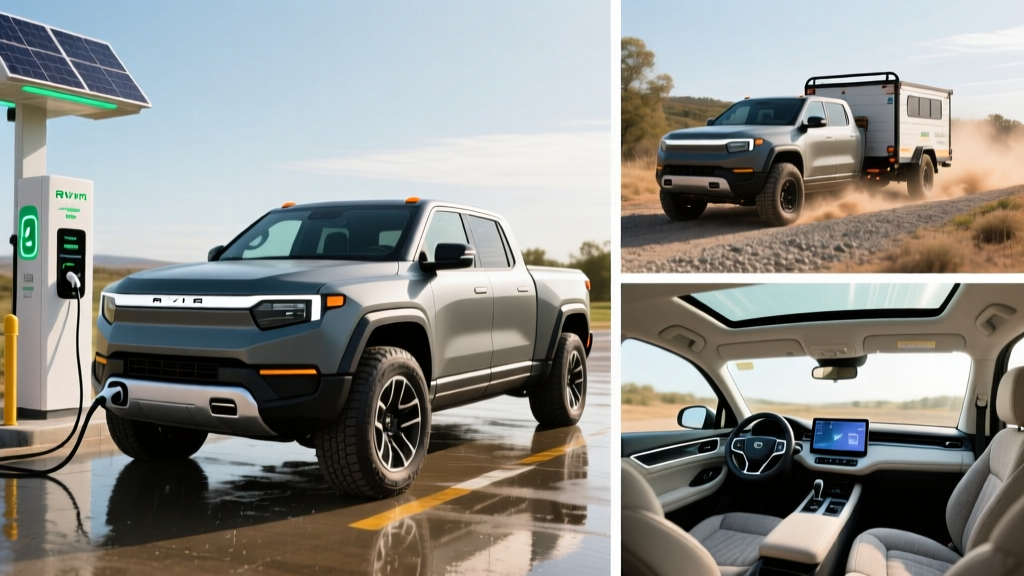
The 2025 Rivian R1T arrives as a thoroughly re-engineered second generation of the electric pickup that started the segment. Rivian has swapped in a new battery architecture, introduced a tri-motor configuration, overhauled the electrical system to reduce wiring weight, and pushed the top-end EPA range past 400 miles. It remains the most capable all-electric pickup for owners who need a true truck — not just an SUV with a bed — and who want rapid DC charging for road trips.
But with a starting MSRP near $70,000 and a complex tax-credit landscape, the 2025 R1T demands careful spec-by-spec evaluation. Here's everything you need to know.
Range and Efficiency: EPA Numbers vs. Reality
EPA Estimated Range (Max Pack, Dual-Motor): 420 miles
Real-World Expectation: 330–370 miles at sustained highway speeds (70–75 mph); 260–310 miles in sub-30°F winter conditions with cabin heating.
Rivian offers three battery pack sizes for 2025: the Standard, Large, and Max packs. The Max Pack paired with the Dual-Motor configuration delivers the headline 420-mile EPA estimate — a substantial improvement over the first-generation R1T's 352-mile ceiling. The Large Pack Dual-Motor returns an EPA-estimated 342 miles, while the Standard Pack comes in at approximately 270 miles.
Efficiency varies by configuration. The Dual-Motor Large Pack achieves an EPA-rated 73 MPGe combined (approximately 46 kWh/100 mi), according to fueleconomy.gov. Quad-Motor models, with their additional weight and power, drop to roughly 70 MPGe combined. These figures are competitive with the GMC Hummer EV Pickup but trail lighter electric trucks like the Chevrolet Silverado EV.
What this means for owners: If your typical drive is a mix of city and suburban roads, expect to approach or even exceed the EPA sticker thanks to regenerative braking in stop-and-go traffic. Highway-heavy commuters should budget a 12–18% reduction from the EPA number. Towing a 5,000-lb trailer? Plan on cutting range roughly in half — electric pickups are no different from their gas counterparts in this regard.
Battery Chemistry, Capacity, and Longevity
The 2025 R1T's second-generation battery packs use a mix of chemistries depending on the configuration. The Standard Pack utilizes lithium iron phosphate (LFP) cells, which offer excellent cycle life, thermal stability, and the ability to regularly charge to 100% without accelerated degradation. The Large and Max Packs employ nickel-manganese-cobalt (NMC) chemistry for higher energy density, which is necessary to hit those 342- and 420-mile targets.
| Spec | Standard Pack | Large Pack | Max Pack |
|---|---|---|---|
| Usable Capacity | ~95 kWh (LFP) | ~129 kWh (NMC) | ~157 kWh (NMC) |
| Chemistry | LFP | NMC | NMC |
| EPA Range (Dual-Motor) | ~270 mi | ~342 mi | ~420 mi |
| Recommended Daily Charge Limit | 100% | 80–90% | 80–90% |
Rivian provides an 8-year/175,000-mile battery warranty that guarantees a minimum of 70% capacity retention — competitive with industry norms. The powertrain is covered for 8 years/150,000 miles, and the vehicle itself carries a 5-year/60,000-mile bumper-to-bumper warranty.
Charging Speed: DC Fast and Home Level 2
Rivian upgraded the R1T's charging architecture for 2025, moving to a 400V system capable of accepting up to 220 kW at a DC fast charger. This is a meaningful step up from the first generation's ~200 kW peak and translates to shorter pit stops on road trips.
| Charging Level | Power (kW) | Speed / Time | Connector |
|---|---|---|---|
| Level 1 (120V household) | ~1.4 kW | ~3–4 miles per hour | J1772 / NACS |
| Level 2 (240V home) | 11.5 kW | ~25 miles per hour | J1772 / NACS |
| DC Fast Charge | Up to 220 kW (peak) | 10–80% in ~27 min (Large Pack) | NACS (native) |
Charging curve reality check: The 220 kW figure is a peak, not a sustained rate. Expect the R1T to pull maximum power between roughly 10% and 40% State of Charge (SoC), then taper progressively. From 80% to 100%, charging slows dramatically to protect the battery — plan to unplug at 80% on road trips unless you genuinely need the final 20%. A 10–80% session on the Large Pack takes approximately 27 minutes at a capable 250+ kW charger. The Max Pack, with its larger battery, will take closer to 35–40 minutes for the same session.
Rivian ships the R1T with the North American Charging Standard (NACS) port, granting native access to Tesla Supercharger stations — a major advantage for road-tripping owners. The Rivian Adventure Network continues to expand at destination-oriented locations, though coverage remains limited compared to Tesla or Electrify America.
For home charging, the R1T's onboard charger accepts up to 11.5 kW on Level 2. With a 48-amp hardwired wall connector on a 60-amp circuit, you'll recover roughly 25 miles of range per hour — enough to fully replenish even the Max Pack overnight. Budget $800–$2,000 for a professional Level 2 installation, potentially more if your electrical panel requires a 200-amp upgrade.
Performance: Dual, Tri, and Quad-Motor Configurations
The 2025 R1T lineup offers three drivetrain configurations, each with distinct performance personalities:
| Configuration | Horsepower | Torque (lb-ft) | 0–60 mph | Drivetrain |
|---|---|---|---|---|
| Dual-Motor AWD | 533 hp | 610 | 4.5 sec | AWD |
| Performance Dual-Motor | 665 hp | 820 | 3.4 sec | AWD |
| Tri-Motor AWD | 850 hp | 1,100+ | ~2.9 sec | AWD |
The Tri-Motor, introduced for the second generation, places one motor on the front axle and two on the rear, enabling torque vectoring across the rear wheels. This isn't just a straight-line party trick — it meaningfully improves cornering grip and off-road traction. The result is a 5,000-lb truck that accelerates like a supercar and handles dirt trails with the precision of Rivian's quad-motor tank turns.
All configurations feature adaptive air suspension with up to 14.9 inches of ground clearance, a 48-degree approach angle, and a wading depth of over 3 feet. Maximum towing capacity is rated at 11,000 lbs, though real-world range while towing drops sharply — expect roughly 150–200 miles from the Max Pack with a loaded 7,000-lb trailer.
Cargo, Passenger Space, and the Gear Tunnel
The R1T's 4-foot-6-inch bed is shorter than a traditional full-size truck, but Rivian compensates with the signature Gear Tunnel — a 11.7-cubic-foot pass-through compartment behind the rear seats accessible from both sides of the truck. It's ideal for securing long items like skis, fishing rods, or camping gear out of sight and out of the elements.
Interior dimensions remain generous for a midsize truck:
- Front legroom: 41.3 inches
- Rear legroom: 38.2 inches
- Bed volume: ~27.2 cu ft (bed only, not including Gear Tunnel)
- Frunk (front trunk): 11.0 cu ft — drainable and lockable
- Total lockable storage: ~77 cu ft (bed + Gear Tunnel + frunk)
The R1T seats five adults comfortably, though the rear middle seat is best reserved for shorter trips. Compared to the Ford F-150 Lightning, the R1T offers less rear-seat space and a shorter bed, but significantly more creative and secure storage options.
Pricing, Trims, and Federal Tax Credit Eligibility
The 2025 R1T lineup spans a wide price band depending on battery, motor configuration, and trim level (Adventure, Ascend):
| Configuration | Base MSRP | Est. §30D Credit | Effective Price |
|---|---|---|---|
| Dual-Motor / Standard Pack / Adventure | $69,900 | Up to $7,500* | ~$62,400 |
| Dual-Motor / Large Pack / Adventure | $75,900 | Up to $7,500* | ~$68,400 |
| Performance Dual-Motor / Large Pack | $81,900 | Up to $7,500* | ~$74,400 |
| Tri-Motor / Max Pack / Ascend | $99,900+ | Up to $7,500* | ~$92,400+ |
*Federal tax credit caveats (IRS §30D): The R1T qualifies as a light truck, so it falls under the $80,000 MSRP cap for trucks/vans/SUVs. However, higher-spec configurations (Tri-Motor, Max Pack) exceed this cap and will not be eligible for the credit. Buyer income limits apply: modified AGI must not exceed $150,000 (single), $225,000 (head of household), or $300,000 (joint). The vehicle must also meet critical-mineral and battery-component sourcing requirements, which have tightened annually. The credit can be applied as a point-of-sale reduction at the dealer. Always verify current eligibility on IRS.gov and consult a tax professional before relying on the credit in your purchase decision.
Tech, Driver Assistance, and Software
The 2025 R1T runs Rivian's latest software platform on a 15.6-inch center touchscreen and a 12.3-inch digital driver display. The system is responsive, over-the-air updatable, and integrates navigation with charger-aware route planning that automatically preconditions the battery ahead of DC fast-charging stops.
Rivian's driver-assistance suite, branded Rivian Driver+, includes adaptive cruise control, lane-centering assist, automatic emergency braking, and hands-free highway driving on compatible divided roads. This is an SAE Level 2 system — you must remain attentive, keep your eyes on the road, and be ready to take over at any moment. It is not autonomous driving.
Important: Rivian Driver+ is a Level 2 driver-assistance system. It does not make the R1T self-driving. You are the driver at all times and are responsible for safe operation. NHTSA and IIHS data consistently show that Level 2 systems reduce — but do not eliminate — crash risk when used as directed.
Standout features include the Camp Kitchen accessory (a slide-out kitchen unit that integrates with the Gear Tunnel), a built-in air compressor accessible from the bed, and a camp mode that keeps climate control and entertainment running while parked. One drawback: the R1T still lacks Apple CarPlay and Android Auto, relying instead on Rivian's native apps for music and navigation — a choice that frustrates some buyers accustomed to phone projection.
Pros, Cons, and Who Should Buy the 2025 R1T
Pros
- Class-leading 420-mile Max Pack range (Dual-Motor)
- Tri-Motor performance: 0–60 in under 3 seconds
- NACS port = native Tesla Supercharger access
- Gear Tunnel and frunk offer unmatched secure storage
- 11,000-lb towing capacity with integrated trailer software
- Over-the-air updates continuously improve the vehicle
Cons
- Starting price near $70K; well-equipped models exceed $90K
- 4.5-foot bed is shorter than competitors
- Towing cuts range by 40–50%
- No Apple CarPlay or Android Auto
- Higher-spec trims exceed the $80K §30D MSRP cap
- Service center network still expanding in rural areas
Who Should Buy the 2025 Rivian R1T?
Choose the R1T if: You want an electric pickup with genuine off-road capability, creative storage, and road-trip range above 350 miles. It's ideal for outdoor enthusiasts, tech-forward commuters who tow occasionally, and buyers who value build quality and software sophistication.
Look elsewhere if: You need a full-size 6.5-foot bed for commercial work, want the lowest possible entry price (the Chevy Silverado EV starts lower), or require Apple CarPlay for your daily commute. The Ford F-150 Lightning remains a strong value alternative with a larger bed and broader dealer network.
Frequently Asked Questions
What is the real-world range of the 2025 Rivian R1T?
The EPA estimates up to 420 miles for the Dual-Motor Max Pack. In real-world highway driving at 70–75 mph, expect 330–370 miles. In cold weather (below 30°F), plan for 260–310 miles depending on cabin heating usage and whether you precondition the battery.
How fast does the 2025 R1T charge?
At a DC fast charger, the R1T peaks at 220 kW and can charge from 10–80% in approximately 27 minutes (Large Pack) or 35–40 minutes (Max Pack). At home on a Level 2 charger (11.5 kW), expect about 25 miles of range per hour — a full overnight charge for any pack size.
Does the 2025 R1T qualify for the federal EV tax credit?
Configurations with an MSRP at or below $80,000 may qualify for up to $7,500 under IRS §30D, provided the buyer meets income limits ($150K single / $300K joint) and the vehicle satisfies battery-sourcing requirements. Tri-Motor and Max Pack configurations typically exceed the MSRP cap and are ineligible. Verify current rules at IRS.gov.
Is the 2025 R1T worth buying over the Ford F-150 Lightning or Chevy Silverado EV?
The R1T wins on range (420 vs. ~320 miles for the Lightning), performance (Tri-Motor is vastly quicker), and off-road capability. The F-150 Lightning wins on bed length (5.5–6.5 ft), rear-seat space, dealer network breadth, and lower starting price. The Silverado EV offers the longest range and largest bed but lacks the R1T's agility and premium feel. Your priority — truck utility vs. adventure versatility — should drive the decision.
Can the R1T tow a travel trailer?
Yes — the R1T is rated to tow up to 11,000 lbs. However, towing a 5,000–7,000 lb trailer will reduce range by roughly 40–50%, bringing the Max Pack down to approximately 200–250 real-world miles per charge. Plan charging stops accordingly and use Rivian's integrated trailer routing software.
What is the battery warranty on the 2025 R1T?
Rivian covers the battery for 8 years or 175,000 miles, whichever comes first, guaranteeing at least 70% of original capacity. The powertrain is covered for 8 years/150,000 miles, and the bumper-to-bumper warranty is 5 years/60,000 miles.