The Quick Answer: Is the 2025 Ram ProMaster EV Cargo Van Right for Your Fleet?
The 2025 Ram ProMaster EV cargo van delivers an EPA-estimated 162 miles of range from a 110 kWh battery pack, making it purpose-built for last-mile delivery and urban commercial routes under 120 miles per day. With a starting MSRP around $58,000 (before potential $7,500 federal commercial clean vehicle credit), it costs significantly more upfront than the gas ProMaster but can recoup the premium in 3-5 years through fuel and maintenance savings for high-mileage fleet operators. If your daily routes stay under 130 miles and you can install depot Level 2 charging, the ProMaster EV is a strong operational fit. If you regularly exceed 150 miles per day or operate in extreme cold without garage parking, the gas or upcoming EREV variants remain safer bets.
Range, Battery, and Real-World Efficiency
The 2025 Ram ProMaster EV is powered by a 110 kWh usable lithium-ion (NMC chemistry) battery pack mounted beneath the cargo floor, preserving the full 420 cubic feet of cargo volume that fleet buyers depend on. The electric motor produces 270 horsepower and 302 lb-ft of torque to the front wheels, which is more than adequate for a van with a 3,970-pound payload capacity.
The EPA rates the ProMaster EV at 162 miles of combined range in the standard low-roof, 12-foot wheelbase cargo configuration. Efficiency comes in at approximately 2.0 kWh per mile (or roughly 50 MPGe combined), which is competitive for a full-size commercial van of this weight class.
Real-World Range Reality Check
EPA Sticker: 162 miles
Expected highway (65-70 mph, unloaded): ~135-145 miles
Loaded to payload capacity, urban stop-and-go: ~140-155 miles (regen braking helps here)
Cold weather (below 30°F, cabin heat on): ~110-125 miles
Hot weather (95°F+, A/C running): ~145-155 miles
The ProMaster EV's boxy aerodynamic profile hurts most at sustained highway speeds above 65 mph. For urban delivery routes with frequent stops, regenerative braking recovers meaningful energy and real-world range often tracks close to the EPA estimate. But fleet managers should plan routes against a conservative 130-mile usable buffer to avoid range stress on hot or cold days.
| Specification | Value |
|---|---|
| Battery Capacity (usable) | 110 kWh (NMC) |
| EPA Range | 162 miles |
| Efficiency | ~2.0 kWh/mi (50 MPGe) |
| Motor Output | 270 hp / 302 lb-ft |
| Drivetrain | Front-wheel drive |
| Max Payload | 3,970 lbs |
| Cargo Volume | 420 cu ft (12-ft WB low roof) |
| Max DC Fast Charge Rate | 150 kW (peak) |
| Level 2 Charge Rate | 11.5 kW onboard charger |
| 10-80% DC Fast Charge Time | ~45 minutes |
| Level 2 Full Charge Time (0-100%) | ~10 hours |
| Base MSRP (Cargo Van) | ~$58,000 |
| Battery/Powertrain Warranty | 8 years / 100,000 miles |
Charging: Depot Level 2 Is the Fleet Standard
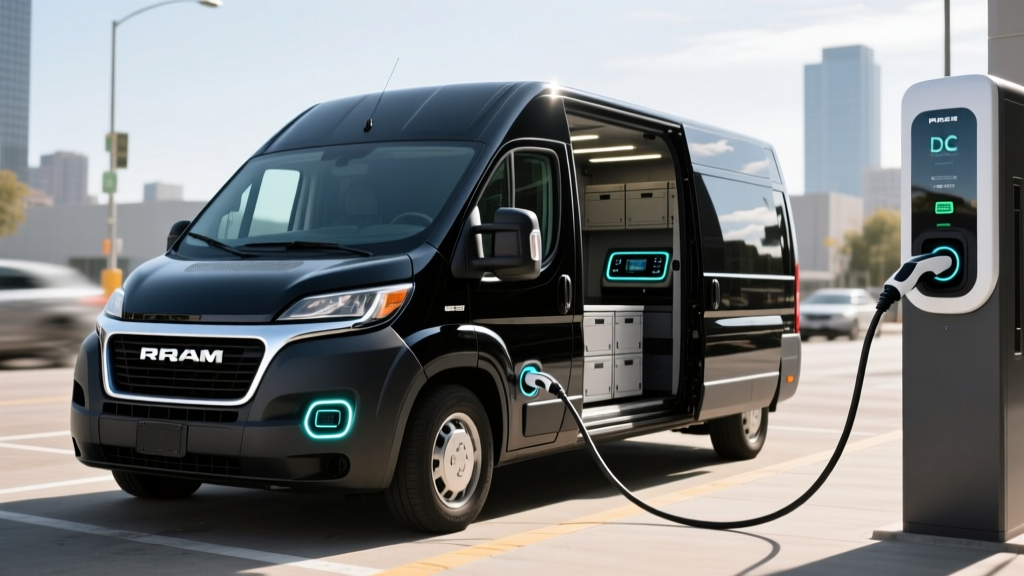
Commercial van operators rarely rely on public DC fast charging. The ProMaster EV's 11.5 kW onboard AC charger is designed for overnight depot charging — plug in at the end of a shift, and the van is fully replenished in roughly 10 hours on a Level 2 station. That's the exact window between end-of-shift and next-morning dispatch.
| Level | Power | Miles Added per Hour | Typical Use Case |
|---|---|---|---|
| Level 1 (120V) | 1.4 kW | ~4-5 mi/hr | Emergency top-off only |
| Level 2 (240V, 48A) | 11.5 kW | ~35-40 mi/hr | Overnight depot charging (primary) |
| DC Fast Charge | 150 kW peak | ~100+ mi in 30 min | Mid-day top-off on longer routes |
For DC fast charging, the ProMaster EV peaks at 150 kW on a CCS-equipped station, reaching 10-80% in approximately 45 minutes. The charge curve tapers noticeably above 80% state of charge — this is standard battery management behavior, not a flaw. Fleet managers should not plan routes around DC fast charging as a daily strategy; the 45-minute dwell time cuts into productivity and frequent DC sessions accelerate long-term battery degradation.
Depot charging infrastructure cost: Expect to budget $3,000-$7,000 per Level 2 station installed for commercial-grade equipment (e.g., ChargePoint CT4000 or Enel X JuiceBox Pro), plus potential electrical panel upgrades if your depot is adding multiple chargers simultaneously. A fleet of five vans on a shared 200-amp panel may require a $10,000-$25,000 panel upgrade. Consult a licensed commercial electrician for site-specific load calculations.
ProMaster EV vs. Gas ProMaster: 5-Year Fleet Cost Breakdown
The upfront price gap between the electric and gas ProMaster is substantial, but operational costs tell a different story over a typical 5-year/75,000-mile fleet ownership cycle.
| Cost Category | ProMaster EV | Gas ProMaster 2500 (3.6L V6) |
|---|---|---|
| Base MSRP | ~$58,000 | ~$47,000 |
| Federal Tax Credit (§45W Commercial) | -$7,500 | $0 |
| Net Purchase Price | ~$50,500 | ~$47,000 |
| Fuel/Energy (75,000 mi) | ~$3,750 ($0.13/kWh avg) | ~$11,250 ($3.50/gal, 15 MPG) |
| Maintenance (5 yrs) | ~$1,800 | ~$5,500 |
| Insurance (est. annual avg) | ~$9,500 | ~$8,000 |
| Total 5-Year Cost | ~$65,550 | ~$71,750 |
| Cost per Mile | ~$0.87 | ~$0.96 |
The ProMaster EV saves an estimated $6,200 over five years and $0.09 per mile in this scenario. The break-even point against the gas model typically arrives around year 3 to year 4, depending on local electricity rates, fuel prices, and annual mileage. Fleets running 20,000+ miles per year see the fastest payback. Fleets with lower annual miles may not recoup the premium within a standard ownership cycle.
Key assumptions: electricity at $0.13/kWh (national commercial average), gasoline at $3.50/gallon, and gas ProMaster fuel economy at 15 MPG combined (per fueleconomy.gov). Your local utility's commercial rate and state fuel prices will shift these numbers — always model against your actual operating costs.
Federal Tax Credits and Incentives: What Fleet Buyers Actually Qualify For
Commercial fleet buyers do not use the consumer §30D credit. Instead, the ProMaster EV qualifies under IRC §45W — the Commercial Clean Vehicle Credit, which offers up to $7,500 for vehicles under 14,000 pounds GVWR. Key eligibility points:
- Vehicle qualification: Must be a qualified plug-in electric vehicle with at least 7 kWh of battery capacity (ProMaster EV's 110 kWh easily clears this)
- Credit amount: Lesser of 15% of vehicle basis (30% if financed) or $7,500 for sub-14,000 lb GVWR
- No MSRP cap: Unlike the consumer §30D credit, §45W has no manufacturer's suggested retail price ceiling
- No buyer income cap: Business entities of any size qualify
- Battery sourcing: Critical minerals and battery component requirements apply — verify current-year compliance with the manufacturer and your tax professional per IRS guidelines
- Point-of-sale transfer: Available for commercial credit as of current rules; confirm with your dealer
Additionally, many states and utilities offer commercial EV rebates or depot charging incentives — California's HVIP (Hybrid and Zero-Emission Truck and Bus Voucher Incentive Project), for example, can stack significant voucher amounts on top of the federal credit. Always check your state's clean-fleet programs and consult a tax professional before finalizing purchase decisions.
Who Should Buy the ProMaster EV (and Who Shouldn't)
Not every fleet is ready for electrification. Here's a practical decision framework based on real operational patterns:
Decision Framework: Is the ProMaster EV Right for Your Operation?
Choose the ProMaster EV if:
- Your daily routes are consistently under 120-130 miles
- You operate primarily in urban or suburban delivery zones with stop-and-go driving
- You have (or can install) overnight depot Level 2 charging
- Your fleet runs 15,000-25,000+ miles per year per vehicle (faster payback)
- You operate in a city with emissions or low-emission zone requirements
- You want to lock in predictable energy costs and hedge against fuel price volatility
Stick with the gas ProMaster (or wait for EREV) if:
- Daily routes regularly exceed 150 miles with no mid-day charging opportunity
- You operate in extreme cold climates (Minnesota, Alaska) without heated garage parking — expect 25-30% range loss
- Your depot cannot support Level 2 charging installation (old wiring, leased property without landlord approval)
- Annual mileage is under 10,000 miles — the payback period stretches beyond practical ownership
- You need towing capability — the EV variant has limited tow ratings vs. the gas V6
Common Misconceptions About the ProMaster EV
| Myth | Fact |
|---|---|
| "162 miles isn't enough range for a work van." | The average last-mile delivery route covers 70-120 miles per day (BTS data). 162 EPA miles covers the vast majority of urban commercial routes with margin. |
| "The battery will need replacing and cost a fortune." | The battery is warranted for 8 years / 100,000 miles against defects and excessive degradation. NMC packs in commercial duty typically retain 80-85% capacity at 150,000 miles based on current fleet data. |
| "EV vans can't handle payload." | The ProMaster EV retains 3,970 lbs of payload capacity, comparable to the gas 2500 model. Cargo volume is unchanged at 420 cu ft. |
| "Charging takes too long for a commercial fleet." | Overnight depot Level 2 charging fully replenishes the battery in ~10 hours — aligned with standard shift-to-shift turnaround. No driver time is lost. |
| "The tax credit isn't worth the paperwork." | §45W can reduce effective purchase price by $7,500, and point-of-sale transfer options are now available. The paperwork is manageable with a qualified tax advisor. |
What First-Time Commercial EV Buyers Need to Know
If the ProMaster EV is your fleet's first electric vehicle, here are the operational realities that don't appear on spec sheets:
Route planning software is non-negotiable. Unlike gas vans where any route under 300 miles is trivially doable, EV fleet management requires daily awareness of remaining range, weather forecasts, and charging availability. Most fleet telematics platforms (Geotab, Samsara, Fleetio) now include EV-specific route optimization modules.
Driver behavior directly impacts range. Aggressive acceleration, excessive idling with cabin HVAC, and sustained 75+ mph speeds all reduce range by 15-25%. Fleet driver training on smooth acceleration and regen-braking utilization typically recovers 10-15% of real-world range versus untrained drivers.
Winter preconditioning matters. If your depot has shore power, preconditioning the battery and cabin while still plugged in preserves range that would otherwise be consumed by heating systems in the first 20 miles of a cold-weather route.
Insurance costs run 15-25% higher. Commercial EV insurance premiums reflect higher repair costs and specialized parts. Get quotes from your fleet insurer before committing to the purchase — some carriers now offer EV-specific fleet policies with competitive rates.
Resale value is still uncertain. The used commercial EV market is young. While battery warranties transfer to second owners, residual values for electric vans are less predictable than for established gas models. Factor conservative depreciation into your total cost model.
Frequently Asked Questions
Can the 2025 Ram ProMaster EV tow a trailer?
The ProMaster EV has a limited towing capacity compared to the gas V6 model. Ram has not published a maximum tow rating for the EV variant that matches the gas model's ~6,180-pound capacity. If regular towing is part of your operation, the gas ProMaster or a future EREV variant is the more practical choice. Confirm the specific tow rating with your Ram Commercial dealer for your configuration.
How long will the ProMaster EV battery last before needing replacement?
The battery is covered by an 8-year / 100,000-mile warranty that includes protection against excessive capacity loss (typically defined as falling below 70% state of health). Based on degradation data from similar NMC commercial packs, expect approximately 80-88% capacity retention at 150,000 miles with primarily Level 2 charging. Full battery replacement, if ever needed out of warranty, is estimated at $18,000-$25,000 based on current pack pricing for this capacity class.
Does the ProMaster EV qualify for the $7,500 federal tax credit?
Commercial buyers may qualify for up to $7,500 under IRC §45W (Commercial Clean Vehicle Credit), not the consumer §30D credit. Eligibility depends on battery sourcing compliance and your business tax situation. There is no MSRP cap or buyer income cap under §45W. Always verify current-year requirements with the IRS and a qualified tax professional before purchasing.
What happens if I need to charge on the road during a longer route?
The ProMaster EV supports CCS DC fast charging at up to 150 kW, reaching 10-80% in roughly 45 minutes. Electrify America and other networks have commercial-capable charging stations along major freight corridors. However, DC fast charging should be a contingency, not a daily strategy — the 45-minute dwell time reduces route efficiency, and frequent DC charging accelerates battery degradation over time.
Is the ProMaster EV available in all configurations (cargo, cutaway, chassis cab)?
For the 2025 model year, the ProMaster EV is offered primarily as a cargo van in the 12-foot wheelbase, low-roof configuration. Cutaway and chassis cab variants have been announced for future model years but are not yet available for order. Check with your Ram Commercial dealer for the latest configuration availability.