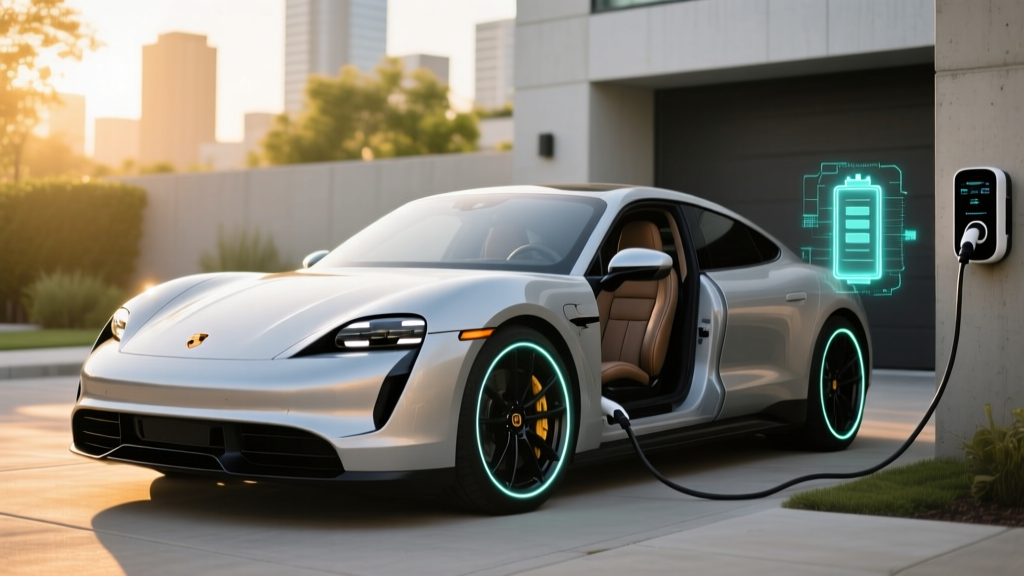
The 2025 Porsche Taycan 4S arrives with a comprehensive mid-cycle refresh that addresses the biggest criticism of the original 2020 model: range. With a larger 105 kWh battery pack (97.0 kWh usable), revised power electronics, and improved regenerative braking, Porsche has pushed the Taycan 4S into legitimate long-distance EV territory while preserving the driving dynamics that justify its premium positioning. But does the real-world efficiency match the spec sheet? We break down every number that matters.
2025 Porsche Taycan 4S at a Glance
| Spec | 2025 Taycan 4S (Sedan) |
|---|---|
| EPA Range | 283 miles (Performance Battery Plus) |
| Usable Battery | 97.0 kWh (105 kWh gross), NMC lithium-ion |
| Drivetrain | Dual-motor AWD |
| Horsepower | 512 hp (588 hp w/ Launch Control) |
| 0-60 mph | 3.5 seconds |
| Top Speed | 155 mph |
| DC Fast Charge (Peak) | 320 kW |
| 10-80% DC Charge Time | ~18 minutes |
| Level 2 Home Charge | 11 kW (AC) |
| EPA Efficiency | 84 MPGe combined / 40 kWh/100 mi |
| Cargo (Rear + Frunk) | 14.3 cu ft trunk + 2.9 cu ft frunk |
| Base MSRP | $105,395 (incl. destination) |
| Battery Warranty | 8 years / 100,000 miles |
Range and Real-World Efficiency
Real-World Expectation: Plan for 230-250 miles on highway road trips at 70-80 mph. In freezing temperatures (below 32°F), expect a further 15-25% reduction, bringing effective range to roughly 185-210 miles. City driving with regenerative braking recovers closer to the EPA sticker, often exceeding 260 miles in mild conditions.
Porsche offers the Taycan 4S with the larger Performance Battery Plus (105 kWh gross / 97.0 kWh usable) as the volume configuration in the US. The cell chemistry is NMC (nickel manganese cobalt), which prioritizes energy density and power delivery over the cycle-life advantages of LFP packs found in some competitors' base trims. For a performance sedan, NMC is the correct engineering choice.
The 283-mile EPA figure represents a substantial improvement over the pre-refresh Taycan 4S, which managed only 227 miles with its 93.4 kWh pack. The 24% range increase comes from a combination of higher energy capacity, a new rear-axle motor with improved efficiency, silicon carbide inverters on both axles, and more aggressive regenerative braking (up to 290 kW of recuperation). Porsche also revised the thermal management system to reduce energy spent on battery conditioning.
On the fueleconomy.gov listing, the Taycan 4S posts 84 MPGe combined (40 kWh per 100 miles). That efficiency figure trails the Tesla Model S Long Range (124 MPGe) and Lucid Air Pure (146 MPGe), which is the trade-off for the Taycan's 800-volt architecture and performance-oriented powertrain calibration. Porsche prioritizes sustained power delivery and charge speed over peak efficiency, and the numbers reflect that philosophy.
Charging Speed: 800-Volt Architecture Pays Off
| Charging Level | Max Rate | Speed / Notes |
|---|---|---|
| Level 1 (120V) | 1.2 kW | ~3-4 miles per hour — emergency use only |
| Level 2 (240V, 48A) | 11 kW (AC onboard charger) | ~30 miles per hour; full charge in ~10 hours |
| DC Fast Charge (CCS) | 320 kW peak | 10-80% in ~18 min on a 350 kW+ station |
| DC Fast Charge (NACS adapter) | 320 kW peak | Tesla Supercharger V4 compatible via included adapter |
The Taycan's 800-volt electrical architecture remains its most significant charging advantage. While most competitors operate on 400-volt systems (limiting sustained DC charge rates), the Taycan 4S can accept up to 320 kW at a compatible 350+ kW Electrify America or Ionity station. In practice, the charge curve is remarkably flat: Porsche's thermal preconditioning holds the battery in the optimal temperature window, sustaining above 250 kW through roughly 55% State of Charge before tapering gradually.
The 10-80% time of approximately 18 minutes is among the fastest in the segment. For context, the Tesla Model S Long Range (400V architecture) takes roughly 27 minutes for the same 10-80% window at a V3 Supercharger, despite Tesla's extensive Supercharger network advantage. The Taycan charges faster per stop; the Model S has more places to stop. That's the fundamental trade-off, though Porsche's inclusion of a NACS adapter for Tesla Supercharger V4 access significantly narrows the network gap for 2025.
Home charging on a Level 2 circuit (240V, 48 amps) delivers 11 kW to the battery, adding roughly 30 miles of range per hour of charging. A full 0-100% session takes approximately 10 hours. For most owners with a daily commute under 60 miles, overnight Level 2 charging means you'll rarely, if ever, visit a public charger outside of road trips.
Performance and Driving Dynamics
The dual-motor all-wheel-drive powertrain produces 512 horsepower in standard driving and 588 horsepower with Launch Control engaged. Porsche rates the 0-60 mph sprint at 3.5 seconds, and independent testing has recorded times as low as 3.3 seconds under optimal conditions. The instant torque delivery characteristic of EVs makes the Taycan 4S feel even quicker than its numbers suggest in rolling acceleration — highway passing maneuvers are effortless.
What separates the Taycan from faster-but-numb competitors is chassis tuning. The adaptive air suspension (standard on 4S), rear-axle steering (optional), and torque-vectoring differentials deliver a level of steering feedback and cornering composure that no Tesla or Lucid currently matches. This is a Porsche first, an EV second — and that's precisely what its target buyer wants.
The two-speed transmission on the rear axle (a unique feature among production EVs) gives the Taycan a short first gear for explosive launches and a tall second gear for efficient highway cruising. You won't feel the shift, but it contributes to both the sub-3.5-second 0-60 and the improved highway efficiency of the 2025 model.
Pricing, Trims, and Federal Tax Credit Eligibility
| Trim | Base MSRP | Typical As-Tested | §30D Federal Credit |
|---|---|---|---|
| Taycan 4S (Base) | $105,395 | $115,000-$130,000 | Not eligible (exceeds MSRP cap) |
| Taycan 4S w/ Premium Pkg | $111,095 | $125,000-$140,000 | Not eligible |
| Taycan GTS (AWD) | $124,895 | $135,000-$150,000 | Not eligible |
| Taycan Turbo S | $199,395 | $210,000+ | Not eligible |
The 2025 Taycan 4S starts at $105,395 including the $1,995 destination charge. Most buyers add the Premium Package (panoramic roof, ventilated seats, ambient lighting), 21-inch wheels, and the rear-axle steering system, pushing typical transaction prices into the $115,000-$130,000 range before any state incentives.
Regarding the IRS §30D federal tax credit: the Taycan 4S does not qualify. The federal credit imposes an MSRP cap of $55,000 for sedans, and at $105,395, the Taycan 4S exceeds that limit by nearly double. Additionally, the buyer income caps ($150,000 single / $300,000 joint modified AGI) would exclude many buyers in this price tier regardless. Do not factor a $7,500 credit into your purchase budget for this vehicle.
Some states offer their own EV incentives that are not bound by federal MSRP caps — check your state's energy or DMV website for current programs. However, these vary widely and change frequently, so confirm eligibility with your dealer and a tax professional before committing.
Interior, Technology, and Daily Practicality
The Taycan cabin features Porsche's curved 16.8-inch digital instrument cluster, a 10.9-inch central infotainment touchscreen, and an available 10.9-inch front passenger display. The infotainment system supports wireless Apple CarPlay and Android Auto, with native navigation that includes real-time charge-station routing and battery preconditioning for planned DC fast-charge stops.
Driver-assistance technology includes adaptive cruise control with stop-and-go, lane-keeping assist, and Porsche InnoDrive (predictive cruise that uses navigation data to adjust speed for upcoming curves and speed limits). These are SAE Level 2 systems — the driver must remain engaged with hands on the wheel at all times. Porsche does not currently offer a hands-free highway driving system comparable to GM's Super Cruise or Ford's BlueCruise.
Practicality is where the Taycan reveals its sports-sedan priorities. Rear-seat legroom is tight at 32.5 inches — adequate for adults on short trips but cramped for long highway hauls. The trunk offers 14.3 cubic feet (sedan), and the front trunk (frunk) adds 2.9 cubic feet for charging cables or a small bag. Compare this to the Tesla Model S (26.3 cu ft rear cargo) or Lucid Air (22.1 cu ft trunk), and the Taycan clearly sacrifices cargo volume for its low-slung, performance-oriented proportions. The Sport Turismo (wagon) variant adds approximately 5 cubic feet of rear cargo space and is worth considering if practicality matters.
Warranty and Battery Longevity
Porsche covers the Taycan's high-voltage battery for 8 years or 100,000 miles, whichever comes first, against defects and excessive capacity loss. Porsche defines excessive degradation as falling below 70% of original capacity within the warranty period — consistent with industry norms from Tesla, BMW, and Mercedes-Benz. The general vehicle limited warranty runs 4 years / 50,000 miles.
NMC battery chemistry in the Taycan benefits from the sophisticated liquid thermal management system, which keeps cells in the optimal 20-40°C range during both driving and charging. Early data from 2020-2023 Taycan models suggests degradation of approximately 5-8% over the first 60,000 miles, which is in line with premium EV benchmarks. The 2025's larger pack means even if 8% degradation occurs, you'd still retain roughly 260 miles of range from the original 283.
Pros
- Class-leading 320 kW DC fast charging with a flat charge curve
- Driving dynamics and steering feel unmatched in the electric sedan segment
- Significant range improvement (283 mi EPA) over the pre-2025 Taycan
- 800V architecture future-proofs for next-generation 400+ kW chargers
- NACS adapter included — access to Tesla Supercharger V4 network
- Two-speed rear transmission for both launch performance and highway efficiency
Cons
- No federal §30D tax credit — exceeds $55,000 sedan MSRP cap
- Rear-seat legroom and cargo space trail Model S and Lucid Air significantly
- Efficiency (84 MPGe) lags behind efficiency-focused competitors
- No hands-free Level 2+ driving system (Porsche InnoDrive requires hands on wheel)
- Options escalate price quickly — $130,000+ is typical transaction territory
- Public CCS charging infrastructure still inconsistent outside major corridors
Who Should Buy the 2025 Porsche Taycan 4S?
The Taycan 4S is the right EV for the driver who prioritizes engagement over efficiency and is willing to pay for chassis dynamics that no competitor replicates. If your daily routine includes a mix of spirited back-road driving and highway commuting, and you have reliable home Level 2 charging, the Taycan 4S delivers an ownership experience that justifies its premium.
It is not the right choice if maximum range-per-dollar, family cargo hauling, or hands-free highway driving are your top priorities. The Lucid Air Pure offers 419 miles of EPA range for roughly $30,000 less. The Tesla Model S Long Range delivers 402 miles, access to the most reliable charging network, and a more usable rear seat. The Mercedes EQS offers a more luxurious cabin and hands-free driving capability in certain conditions.
For road trips, the 320 kW charging speed makes the Taycan genuinely viable: 18-minute stops every 200-230 highway miles is manageable, and the NACS adapter opens Tesla Superchargers as a backup. But plan your routes carefully outside the Northeast, West Coast, and major interstate corridors — CCS infrastructure density still varies considerably by region.
Frequently Asked Questions
What is the real-world range of the 2025 Porsche Taycan 4S?
The EPA rates it at 283 miles with the Performance Battery Plus. In real-world highway driving at 70-80 mph, expect 230-250 miles. In freezing temperatures, that drops to approximately 185-210 miles due to battery heating demands and increased rolling resistance. City driving with regenerative braking often returns 260+ miles in mild weather.
How fast does the Taycan 4S charge at home and on the road?
At home on a 240V Level 2 charger (48 amps), the Taycan accepts 11 kW, adding roughly 30 miles of range per hour. A full overnight charge takes about 10 hours. On a 350+ kW DC fast charger, it peaks at 320 kW and charges from 10-80% in approximately 18 minutes — among the fastest production EVs available.
Does the 2025 Taycan 4S qualify for the $7,500 federal EV tax credit?
No. Under current IRS §30D rules, sedans must have an MSRP at or below $55,000 to qualify. The Taycan 4S starts at $105,395, making it ineligible regardless of buyer income or battery sourcing. Some state-level incentives may still apply — check your local program.
Is the Taycan 4S worth it over the Tesla Model S or Lucid Air?
If driving dynamics, build quality, and fast-charging speed are your priorities, yes. The Taycan's chassis, steering feel, and 320 kW charging are best-in-class. If you prioritize maximum range (Lucid Air: 419 mi EPA), cargo space, or hands-free driving tech (Model S), the competitors offer more for less money. Test-drive all three before deciding — the Taycan's advantage is felt from behind the wheel, not on a spec sheet.
What battery chemistry does the Taycan 4S use, and how long will it last?
The Taycan 4S uses an NMC (nickel manganese cobalt) lithium-ion pack with 97.0 kWh of usable capacity. NMC offers high energy density suited to performance applications. Porsche warranties the battery for 8 years / 100,000 miles against degradation below 70% capacity. Early Taycan models show approximately 5-8% degradation over 60,000 miles, suggesting strong long-term durability.
Can the Taycan 4S use Tesla Superchargers?
Yes. The 2025 Taycan ships with a NACS adapter, enabling access to Tesla Supercharger V4 stations equipped with CCS-compatible connectors. This significantly expands the Taycan's road-trip charging options beyond the Electrify America and independent CCS networks.