Quick Verdict: Who Is the 2025 Polestar 2 For?
The 2025 Polestar 2 occupies a narrow but compelling lane in the luxury EV sedan segment: Scandinavian design, a driver-focused chassis, and a pragmatic approach to range and charging that prioritizes real-world usability over headline-grabbing numbers. With the 2025 model year, Polestar standardized the larger 82 kWh battery pack across the lineup, bumped DC fast-charging to 200 kW, and refined the Google-based infotainment system — addressing the most common complaints from early adopters.
If you want a premium electric sedan that doesn't scream "tech bro" and rewards attentive driving without pretending to be autonomous, the Polestar 2 delivers. But buyers cross-shopping the Tesla Model 3, BMW i4, or Hyundai Ioniq 6 will find trade-offs in rear-seat space, charging speed, and federal tax credit eligibility that deserve careful consideration.
| Spec | Standard Range (RWD) | Long Range (RWD) | Long Range Dual Motor (AWD) | BST Edition 290 (AWD) |
|---|---|---|---|---|
| Base MSRP | $49,800 | $53,300 | $56,800 | $64,800 |
| EPA Range | 276 mi | 320 mi | 294 mi | 276 mi |
| Battery (usable) | 69 kWh (est.) | 82 kWh (NMC) | 82 kWh (NMC) | 82 kWh (NMC) |
| Drivetrain | Rear-Wheel Drive | Rear-Wheel Drive | Dual-Motor AWD | Dual-Motor AWD |
| Horsepower | 299 hp | 299 hp | 421 hp | 476 hp |
| 0–60 mph | 5.9 sec | 5.9 sec | 4.3 sec | 3.9 sec |
| Max DC Charge | 135 kW | 200 kW | 200 kW | 200 kW |
| 10–80% DC Time | ~34 min | ~27 min | ~27 min | ~27 min |
| Level 2 Rate | 11 kW | 11 kW | 11 kW | 11 kW |
| MPGe (combined) | 107 MPGe | 111 MPGe | 98 MPGe | 93 MPGe |
| Efficiency | 31 kWh/100mi | 30 kWh/100mi | 34 kWh/100mi | 36 kWh/100mi |
Range & Efficiency: EPA Sticker vs. Real-World Miles
The headline number for most buyers will be the Long Range Single Motor's 320-mile EPA estimate — a meaningful jump from the pre-2024 generation's 270-mile ceiling. That figure comes courtesy of the 82 kWh (gross) lithium-ion NMC pack, which Polestar sources from LG Energy Solution and CATL depending on production batch and market.
EPA: 320 mi (Long Range RWD) / 294 mi (Dual Motor AWD) / 276 mi (Standard Range & BST)
Expect in practice: ~270–290 mi mixed driving for the Long Range RWD. Highway-only at 75+ mph drops to ~245–265 mi due to the sedan's 0.278 Cd drag coefficient and relatively tall ride height. In freezing temperatures (below 32°F), plan for a 20–30% reduction — meaning a Long Range AWD could deliver ~200–235 mi on a cold winter highway run. The heat pump (standard on 2025 models) helps mitigate cabin-heating losses but cannot fully offset battery chemistry limitations in deep cold.
Efficiency is respectable but not class-leading. The Long Range RWD's 111 MPGe (30 kWh/100 mi) trails the Tesla Model 3 Long Range (131 MPGe) and Hyundai Ioniq 6 (140 MPGe). The Polestar 2's relatively heavy curb weight (~4,680 lbs for the dual-motor variant) and less aggressive aero tuning explain the gap. If maximizing miles per kWh matters to you — say, for solar-charging optimization or long road trips through sparse charging networks — competitors have an edge.
One practical note: the Standard Range model's estimated 69 kWh battery delivers 276 EPA miles, which is adequate for commuting but tight for road trips. If you plan to drive more than 200 miles regularly without reliable home charging, the Long Range variants are the safer pick.
Charging Speed: DC Fast, Level 2, and the Charge Curve Reality
The 2025 Polestar 2's charging story is one of meaningful improvement over earlier model years, but it still sits a tier below the fastest-charging competitors.
| Charging Level | Power / Rate | Miles of Range Added per Hour | Notes |
|---|---|---|---|
| Level 1 (120V household) | ~1.4 kW | ~3–4 mi/hr | Emergency/trickle only; ~80+ hours for full charge |
| Level 2 (240V home/public) | 11 kW (48A) | ~32–36 mi/hr | Full charge in ~8.5 hours (82 kWh pack); requires 48A+ circuit |
| DC Fast Charge (Long Range) | Peak 200 kW | ~170 mi in 10 min (peak) | 10–80% in ~27 min; curve tapers sharply above 80% |
| DC Fast Charge (Standard Range) | Peak 135 kW | ~120 mi in 10 min (peak) | 10–80% in ~34 min |
The charge curve matters more than peak kW. The Long Range models' 200 kW peak is only sustained between roughly 15–40% State of Charge. From 40–65%, the rate steps down to ~150 kW, and from 65–80% it drops further to ~100 kW. Above 80%, charging slows dramatically to protect the NMC cells — expect 80–100% to take an additional 25–30 minutes. This is standard NMC behavior, but it means your actual road-trip stops are best planned as 10–80% sessions (~27 minutes) rather than attempting full charges.
Compared to the Hyundai Ioniq 6 (peak 350 kW on 800V architecture, 10–80% in ~18 min) or Tesla Model 3 (peak 250 kW, 10–80% in ~20 min), the Polestar 2's charging speed is a generation behind. For most owners charging at home overnight, this is irrelevant. For road-trippers relying on Electrify America or EVgo networks, it adds ~7–10 minutes per stop versus the fastest rivals.
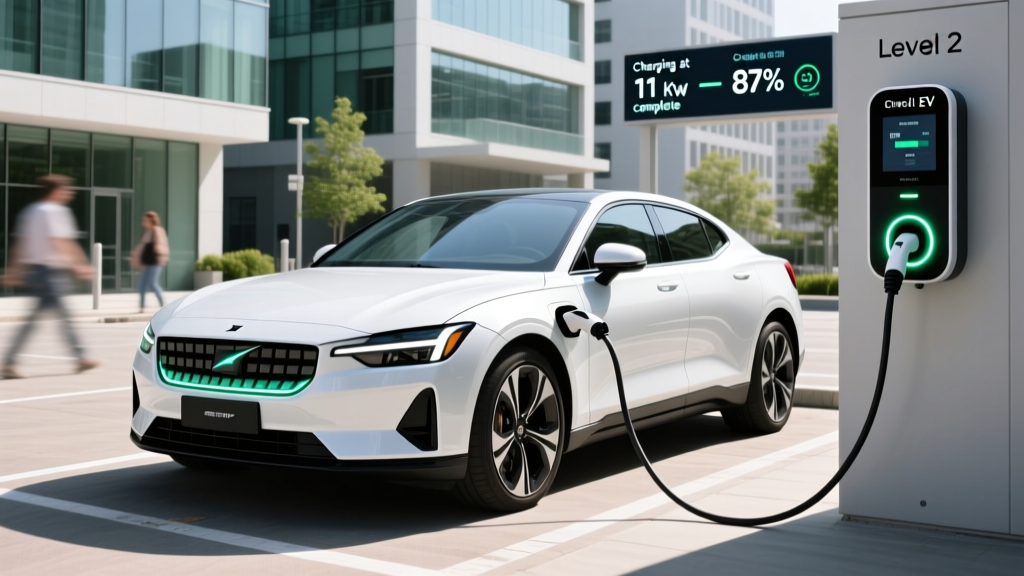
Home Level 2 charging at 11 kW is solid. A full overnight charge from 10% takes about 8.5 hours for the 82 kWh pack — plug in at 10 PM, wake up to a full battery at 6:30 AM. Note that you'll need a NACS adapter or CCS-to-NACS adapter depending on your home charger's connector; the 2025 Polestar 2 ships with a CCS1 port in the US market, though Polestar has announced NACS adoption for future model years. Check with a licensed electrician whether your panel can support a 60A circuit (required for a 48A continuous charger).
Performance & Driving Dynamics
The Polestar 2's chassis is where Volvo's CMA platform heritage shows its strengths. The steering is weighted and communicative — noticeably more engaging than the numb electric power steering in the Model 3 — and the ride quality strikes a firm-but-composed balance that absorbs highway imperfections without floating.
Powertrain breakdown:
- Single Motor (RWD): 299 hp, 361 lb-ft torque. 0–60 mph in 5.9 seconds. This is the volume seller and the efficiency champion of the lineup. Adequate for merging and passing, but not thrilling.
- Dual Motor (AWD): 421 hp, 546 lb-ft. 0–60 in 4.3 seconds. The additional front motor provides confident all-weather traction and genuinely quick acceleration. The Performance Pack ($5,000 option on Dual Motor) unlocks 476 hp via an OTA software update and adds Öhlins dampers with Brembo brakes.
- BST Edition 290: Track-oriented variant with 476 hp, lowered ride height, Öhlins dual-flow dampers, and unique 21-inch wheels. 0–60 in 3.9 seconds. Limited production; sacrifices some ride comfort for handling precision.
Regenerative braking offers two modes (low and high) via the center display, plus a "one-pedal driving" mode that brings the car to a complete stop. It's not as aggressively tuned as Nissan's e-Pedal, which some drivers prefer for smoother modulation in stop-and-go traffic.
Interior, Tech & Daily Livability
The Polestar 2's cabin is a study in Scandinavian restraint: vegan WeaveTech upholstery (standard), real wood or aluminum inlays, and a portrait-oriented 11.2-inch center touchscreen running Android Automotive OS with Google Maps, Google Assistant, and the Google Play Store built in. If you're already in the Google ecosystem, the integration is seamless — "Hey Google, navigate to the nearest DC fast charger" works reliably and routes through chargers with real-time availability data.
Standout tech features:
- Google Maps EV routing with automatic battery preconditioning for DC fast charging
- Polestar app with remote climate control, charge scheduling, and vehicle location
- Pilot Pack ($3,200): Pilot Assist (Level 2 adaptive cruise + lane centering), 360-degree camera, Park Assist Pilot
- Plus Pack ($4,000): Harman Kardon audio, panoramic glass roof, heated steering wheel and rear seats, wireless phone charging
- Over-the-air updates for powertrain tuning, infotainment, and driver-assist refinements
Polestar's Pilot Assist is a SAE Level 2 driver-assistance system. It provides adaptive cruise control with lane centering but requires continuous driver supervision — hands on the wheel, eyes on the road. It is NOT autonomous driving. The system handles highway cruising competently but does not manage stoplights, construction zones, or complex urban intersections. Polestar does not currently offer a hands-free system comparable to GM's Super Cruise or Ford's BlueCruise.
Cargo and passenger space is where the Polestar 2 reveals its compact-executive sizing:
- Rear cargo (behind rear seats): 14.4 cu ft (liftback design provides wide opening)
- Cargo with rear seats folded: 38.7 cu ft
- Front trunk (frunk): 1.4 cu ft (small — fits a charging cable bag, not a suitcase)
- Rear legroom: 33.6 inches — tight for adults over 6 feet on longer trips
- Front legroom: 42.2 inches
Compared to the Tesla Model 3 (23 cu ft rear cargo) or Hyundai Ioniq 6 (12.3 cu ft trunk but more rear legroom at 35.7 in), the Polestar 2's liftback versatility is a practical advantage, but overall interior volume is snug. Families with rear-facing child seats will find the back seat cramped.
Pricing, Trims & Federal Tax Credit Eligibility
| Trim | Base MSRP | As-Tested (Typical Options) | §30D Federal Credit Eligibility | Effective Price After Credit |
|---|---|---|---|---|
| Standard Range Single Motor | $49,800 | $52,000–$54,000 | Up to $7,500 (subject to sourcing/income rules) | ~$42,300–$44,500 |
| Long Range Single Motor | $53,300 | $57,000–$62,000 | Up to $7,500 (subject to sourcing/income rules) | ~$45,800–$54,500 |
| Long Range Dual Motor | $56,800 | $62,000–$68,000 | Up to $7,500 (subject to sourcing/income rules) | ~$49,300–$60,500 |
| BST Edition 290 | $64,800 | $66,000–$68,000 | Up to $7,500 (subject to sourcing/income rules) | ~$57,300–$60,500 |
- MSRP cap: Sedans must be ≤$55,000 MSRP. The Standard Range ($49,800) and Long Range Single Motor ($53,300) qualify on MSRP alone. The Dual Motor ($56,800) and BST Edition ($64,800) exceed the sedan cap and do NOT qualify unless reclassified — verify with your dealer and tax professional.
- Buyer income cap: AGI ≤$150,000 (single), ≤$225,000 (head of household), ≤$300,000 (married filing jointly).
- Battery sourcing: Critical minerals and battery component requirements phase in annually. Polestar's battery supply chain (LG/CATL) may or may not meet the full $7,500 threshold in 2025 — expect $3,750 (half credit) if only one of the two sourcing requirements is met. Check the latest IRS clean vehicle credit guidance before purchasing.
- Point-of-sale transfer: As of 2024, eligible buyers can transfer the credit to the dealer at purchase, reducing the out-of-pocket price immediately rather than waiting for a tax refund.
- Final assembly: Must occur in North America. The Polestar 2 is manufactured in Luqiao, China — this may disqualify it from the §30D credit entirely. Verify current status on fueleconomy.gov before committing.
This is the Polestar 2's single biggest competitive vulnerability. The Tesla Model 3 (assembled in Fremont, CA), Ford Mustang Mach-E (assembled in Mexico — some trims qualify), and many Hyundai/Kia models (assembled in Georgia) have clearer paths to the full $7,500 credit. If the credit matters to your purchase decision — and at this price point, it should — confirm the Polestar 2's eligibility status with your dealer before signing.
Warranty & Long-Term Ownership
Polestar backs the 2025 Polestar 2 with a warranty package that matches the European luxury baseline:
- Basic vehicle warranty: 4 years / 50,000 miles
- Battery & drive unit warranty: 8 years / 100,000 miles (whichever comes first)
- Battery capacity retention: Polestar warrants that the battery will retain at least 70% of its original capacity during the warranty period
- Corrosion warranty: 12 years (unlimited mileage)
- Roadside assistance: 4 years / unlimited mileage
The 70% capacity threshold is standard for the industry (Tesla uses the same benchmark). Real-world NMC degradation data from Polestar 2 owners on forums like Polestar Forum and InsideEVs suggests approximately 5–8% capacity loss in the first 50,000 miles, with the curve flattening significantly afterward. Expect 85–90% state of health at 100,000 miles under normal use — well within warranty.
Maintenance costs are minimal compared to ICE vehicles: no oil changes, no spark plugs, brake pad replacement is rare due to regenerative braking. Polestar's service network is growing but still limited compared to Tesla's mobile service infrastructure or BMW's dealer footprint. Check proximity to a Polestar service center before buying in rural or less-populated states.
How It Stacks Up: Polestar 2 vs. Key Competitors
| Spec | Polestar 2 LR RWD | Tesla Model 3 LR AWD | Hyundai Ioniq 6 LR RWD | BMW i4 eDrive40 |
|---|---|---|---|---|
| Base MSRP | $53,300 | $47,740 | $42,450 | $57,900 |
| EPA Range | 320 mi | 363 mi | 361 mi | 301 mi |
| Battery | 82 kWh NMC | ~79 kWh NMC | 77.4 kWh NMC | 83.9 kWh NMC |
| Peak DC Charge | 200 kW | 250 kW | 350 kW (800V) | 205 kW |
| 10–80% Time | ~27 min | ~20 min | ~18 min | ~31 min |
| 0–60 mph | 5.9 sec | 4.2 sec | 6.2 sec | 5.5 sec |
| MPGe (combined) | 111 | 131 | 140 | 105 |
| Cargo (rear) | 14.4 cu ft | 23 cu ft | 12.3 cu ft | 16.6 cu ft |
| §30D Credit Likely? | Unlikely (China assembly) | Yes (US assembly) | Yes (US assembly) | No (Germany assembly) |
- You value Scandinavian design, premium materials, and a driver-focused chassis over maximum range
- You want Google Automotive OS with native Google Maps EV routing
- You prefer a liftback sedan with a usable cargo opening over a traditional trunk
- The federal tax credit is not your deciding factor (or you confirm eligibility before purchase)
- Maximum range and efficiency are top priorities → Hyundai Ioniq 6 or Tesla Model 3
- Fastest possible DC charging matters for road trips → Hyundai Ioniq 6 (800V)
- You need the most reliable access to the $7,500 federal credit → Tesla Model 3 or Hyundai Ioniq 6
- Rear-seat space for adults is critical → BMW i4 or consider an SUV like the Model Y
Pros & Cons at a Glance
- Premium Scandinavian design inside and out — stands out in a sea of tech-forward EVs
- Composed, engaging driving dynamics with communicative steering
- Google Automotive OS is intuitive and well-integrated for navigation and charging
- Liftback cargo design (14.4 cu ft) is more versatile than traditional sedan trunks
- Standard heat pump improves cold-weather range retention
- Strong build quality and materials (vegan WeaveTech, real aluminum/wood options)
- DC fast charging (200 kW peak) trails Ioniq 6, Model 3, and other rivals
- Likely ineligible for $7,500 federal tax credit due to China assembly — verify before purchase
- Rear seat is tight for taller adults (33.6 in legroom)
- Efficiency (111 MPGe) lags behind the most aerodynamic competitors
- Pilot Assist (Level 2) lacks hands-free capability found in Super Cruise / BlueCruise
- Limited service center network compared to Tesla or legacy luxury brands
- CCS1 port (no native NACS) requires adapters for Tesla Supercharger access
Frequently Asked Questions
What is the real-world range of the 2025 Polestar 2?
The Long Range Single Motor is EPA-rated at 320 miles, but expect approximately 270–290 miles in mixed driving, 245–265 miles on sustained highway runs at 75+ mph, and 200–235 miles in freezing temperatures. The Dual Motor AWD (294 mi EPA) will deliver roughly 250–270 miles mixed and as low as 190 miles in cold highway conditions.
How fast does the 2025 Polestar 2 charge?
Long Range models peak at 200 kW on DC fast chargers, achieving a 10–80% charge in approximately 27 minutes. The Standard Range peaks at 135 kW (10–80% in ~34 min). At home on a Level 2 charger (11 kW / 48A), a full charge takes about 8.5 hours for the 82 kWh battery. Peak charge rate is only sustained between ~15–40% SoC; expect tapering above 65%.
How much does the 2025 Polestar 2 cost after tax credits?
Base MSRP starts at $49,800 (Standard Range) to $64,800 (BST Edition). If eligible for the full $7,500 federal §30D credit, the Standard Range drops to approximately $42,300. However, the Polestar 2's China assembly likely disqualifies it from the federal credit under current North American final-assembly requirements. Confirm eligibility on fueleconomy.gov and consult a tax professional before purchasing.
Does the 2025 Polestar 2 qualify for the federal EV tax credit?
Likely not in full. The §30D credit requires final assembly in North America, and the Polestar 2 is built in Luqiao, China. Additionally, sedans must have an MSRP ≤$55,000, meaning the Dual Motor ($56,800) and BST Edition ($64,800) exceed the cap regardless of assembly location. Battery sourcing requirements (critical minerals and component manufacturing) add further complexity. Always verify current eligibility on IRS.gov before committing to a purchase.
Is the Polestar 2 worth buying over a Tesla Model 3 or Hyundai Ioniq 6?
It depends on your priorities. The Polestar 2 wins on design distinctiveness, steering feel, and Google OS integration. The Model 3 wins on range (363 mi), charging speed (250 kW), Supercharger access, and tax credit eligibility. The Ioniq 6 wins on efficiency (140 MPGe), charging speed (350 kW), and price ($42,450 base). If you value premium materials and driving dynamics over spec-sheet dominance, the Polestar 2 is a compelling choice — but go in with eyes open about charging speed and credit eligibility.
What connector does the 2025 Polestar 2 use?
The US-market 2025 Polestar 2 uses a CCS1 (Combined Charging System) port. This is compatible with Electrify America, EVgo, ChargePoint, and most non-Tesla public DC fast chargers. To access Tesla Superchargers (which now use the NACS connector), you'll need a CCS-to-NACS adapter. Polestar has indicated future models will adopt NACS natively, but 2025 models ship with CCS1.
How long will the Polestar 2 battery last?
Polestar warranties the battery for 8 years / 100,000 miles with a minimum 70% capacity retention guarantee. Real-world owner data suggests approximately 5–8% degradation in the first 50,000 miles, with the rate slowing considerably afterward. Expect 85–90% state of health at 100,000 miles under normal charging habits (avoiding frequent 100% charges and deep discharges). Battery replacement cost, if needed out of warranty, is estimated at $12,000–$18,000 depending on pack size and labor.