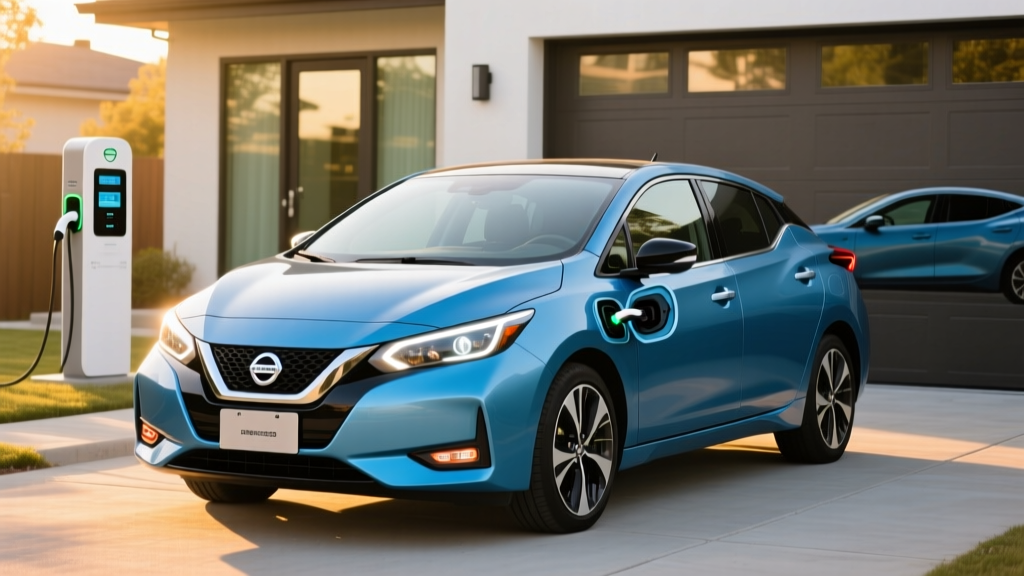
The 2025 Nissan Leaf S occupies a unique space in the new-EV market: it is one of the least expensive all-electric vehicles you can buy, but it carries legacy hardware that increasingly shows its age. With a starting MSRP of $28,140, a proven 40 kWh battery, and a compact hatchback footprint, the Leaf S remains a practical commuter for specific buyers. But its CHAdeMO charging connector and modest DC fast-charge rate place it at a growing disadvantage as the industry standardizes on NACS.
This review breaks down the exact numbers — range, charging speed, efficiency, pricing, and tax credit eligibility — so you can decide whether the 2025 Leaf S fits your driving life or whether a competitor makes more sense.
Specs at a Glance: 2025 Nissan Leaf S
| Specification | Value |
|---|---|
| EPA Range | 149 miles |
| Battery Capacity (usable) | 40 kWh (NMC lithium-ion) |
| Motor Output | 147 hp / 236 lb-ft torque |
| Drivetrain | Front-wheel drive (single motor) |
| 0–60 mph | ~7.4 seconds |
| EPA Efficiency | 123 MPGe combined (27 kWh/100 mi) |
| DC Fast Charge (peak) | ~46 kW (CHAdeMO) |
| 10–80% DC Charge Time | ~40 minutes |
| Level 2 Charge Rate | 6.6 kW onboard charger |
| Cargo Volume (rear seats up) | 23.6 cu ft |
| Cargo Volume (rear seats folded) | 50.0 cu ft |
| Base MSRP (Leaf S) | $28,140 |
| Battery/Powertrain Warranty | 8 years / 100,000 miles |
Range and Efficiency: EPA vs. Real World
The 2025 Nissan Leaf S carries an EPA-estimated range of 149 miles. That figure comes from the Leaf's 40 kWh usable battery pack and a combined efficiency rating of 123 MPGe, or about 27 kWh per 100 miles, according to fueleconomy.gov.
EPA estimate: 149 miles
Highway driving (70+ mph): Expect approximately 120–130 miles. The Leaf's aerodynamics and single-speed gearing reduce efficiency at sustained high speeds.
Cold weather (below 32°F): Range can drop to 100–115 miles. The Leaf uses resistive cabin heating rather than a heat pump, which draws heavily from the 40 kWh pack in winter conditions.
City/commuter driving (moderate temps): 145–155 miles is achievable thanks to regenerative braking and lower average speeds.
The Leaf S does not offer a heat pump — a feature increasingly common in rivals like the Hyundai Kona Electric and Chevrolet Equinox EV. This omission matters if you live in a climate with cold winters, as resistive heating can consume 3–5 kW continuously, cutting range by 20–30% on frigid days.
For context, the larger-battery Leaf SV Plus (60 kWh, 212 miles EPA) mitigates some of these losses simply by having more energy in reserve. If your commute exceeds 60 miles round-trip and you experience real winters, the SV Plus or a competing long-range EV is the safer choice.
Charging Speed and Connector Reality
Charging is where the 2025 Leaf S shows its most significant limitation relative to the broader EV market. Nissan has retained the CHAdeMO DC fast-charging connector, while virtually every other major automaker in North America has adopted or committed to the NACS (Tesla) standard.
| Charging Level | Power / Rate | Time / Miles Added |
|---|---|---|
| Level 1 (120V household) | ~1.4 kW | ~4 miles per hour of charging |
| Level 2 (240V home/public) | 6.6 kW (onboard charger max) | ~22 miles per hour; full charge in ~7 hours |
| DC Fast Charge (CHAdeMO) | Peak ~46 kW | 10–80% in approximately 40 minutes |
The 46 kW peak DC charge rate is modest by 2025 standards. Competing EVs routinely accept 150–250+ kW, enabling 10–80% charges in 18–25 minutes. The Leaf's CHAdeMO connector also limits public charging access: Electrify America stations typically offer only one CHAdeMO cable alongside multiple CCS or NACS connectors, and Tesla Superchargers are inaccessible without an adapter that Nissan does not officially support.
The charge curve is relatively flat, however. The Leaf S maintains close to its peak rate from 10% through roughly 70% state of charge before tapering, which means the 40-minute 10–80% estimate is reasonably consistent in practice — not a brief peak followed by a dramatic slowdown, as some higher-power EVs exhibit.
For home charging, the 6.6 kW onboard charger is adequate. A full Level 2 charge from empty takes about 7 hours, meaning overnight replenishment is straightforward if you install a 240V Level 2 station at home. Note that a professional Level 2 installation typically costs $500–$2,000 depending on your electrical panel's capacity and the distance from panel to charger location.
Performance and Driving Dynamics
The 2025 Leaf S is powered by a single front-mounted AC synchronous motor producing 147 horsepower and 236 lb-ft of torque. Nissan rates the 0–60 mph sprint at approximately 7.4 seconds — adequate for highway merging and city driving, though noticeably slower than rivals like the Hyundai Kona Electric (7.0 seconds with 201 hp) or the Chevrolet Equinox EV (around 8.0 seconds but with over 300 miles of range).
Instant electric torque gives the Leaf S strong off-the-line response at stoplights, and the low center of gravity (battery pack under the floor) keeps body roll reasonably controlled in corners. The steering is light and geared toward urban maneuverability rather than sporty feedback. Ride quality is compliant, with the suspension soaking up potholes and speed bumps effectively for a subcompact hatchback.
One-pedal driving is available via Nissan's e-Pedal mode, which increases regenerative braking aggressiveness to the point where the car can come to a complete stop without touching the brake pedal in most city driving scenarios. This is a genuine convenience feature for stop-and-go commuters.
Interior, Cargo, and Technology
The Leaf S seats five, though rear legroom (33.5 inches) is tight for taller adults on longer trips. Front legroom is generous at 42.1 inches. The cabin materials are hard-plastic-heavy at the S trim — an expected trade-off at this price point.
Cargo volume stands at 23.6 cubic feet behind the rear seats and 50.0 cubic feet with the 60/40 split rear seats folded. That's competitive with other subcompact EV hatchbacks and sufficient for weekly grocery runs, luggage for two, or a folded bicycle.
The S trim includes an 8-inch touchscreen infotainment system with wireless Apple CarPlay and wired Android Auto, a 4-speaker audio system, and a 7-inch digital driver display. Nissan's ProPILOT Assist is not included on the base S trim — it becomes available on the SV and SV Plus. The S trim does include Nissan Safety Shield 360, which bundles:
- Automatic emergency braking with pedestrian detection
- Lane departure warning and lane-keeping assist
- Blind-spot warning and rear cross-traffic alert
- Rear automatic braking
- High-beam assist
ProPILOT Assist, where equipped on higher trims, is a Level 2 driver-assistance system per SAE classification. It combines adaptive cruise control with lane-centering, but the driver must remain fully engaged at all times — it is not a self-driving system.
Pricing, Trims, and Federal Tax Credit Eligibility
| Trim | Base MSRP | Battery | EPA Range |
|---|---|---|---|
| S | $28,140 | 40 kWh | 149 miles |
| SV | $36,190 | 40 kWh | 149 miles |
| SV Plus | $36,190 | 60 kWh | 212 miles |
The 2025 Leaf S starts at $28,140 (including destination), making it one of the most affordable new EVs in the U.S. market. An as-tested Leaf S with no options typically lands near $29,000 before any incentives.
- Maximum credit: Up to $7,500, but eligibility depends on battery component and critical mineral sourcing requirements.
- MSRP cap: The vehicle must have an MSRP at or below $55,000 (sedans/hatchbacks). All Leaf trims qualify.
- Buyer income cap: Modified adjusted gross income must not exceed $150,000 (single), $225,000 (head of household), or $300,000 (married filing jointly).
- Battery sourcing: The Leaf's battery is manufactured by Envision AESC in Smyrna, Tennessee. However, critical mineral sourcing requirements under §30D are stringent and change annually. The credit amount may be $3,750 (partial) or $7,500 (full) depending on current-year mineral sourcing compliance.
- Point-of-sale transfer: As of 2024, the credit can be transferred to the dealer at purchase, reducing the purchase price directly — provided the buyer meets income requirements and files the appropriate IRS form.
Always verify current eligibility at irs.gov or with a qualified tax professional before purchase. Rules are subject to change.
If the Leaf S qualifies for the full $7,500 credit, the effective price drops to approximately $20,640 — an extraordinary value for a new electric vehicle. Even a partial $3,750 credit brings it under $24,500. This pricing positions the Leaf S well below nearly every competitor.
Who Should Buy the 2025 Nissan Leaf S?
- City commuters with round-trip drives under 80 miles who can charge at home overnight.
- Budget-conscious EV buyers who want the lowest possible new-EV purchase price after tax credits.
- Second-car households that already have a longer-range vehicle for road trips.
- Urban apartment dwellers with access to workplace or neighborhood Level 2 charging.
- Frequent road-trippers — the 149-mile range and CHAdeMO connector make long-distance travel inconvenient.
- Cold-climate drivers without garage parking — winter range loss is significant without a heat pump.
- Buyers who rely on public fast charging — CHAdeMO infrastructure is declining relative to CCS and NACS networks.
- Those needing advanced driver assists — ProPILOT is unavailable on the base S trim.
How the Leaf S Compares to Key Competitors
| Spec | Nissan Leaf S | Hyundai Kona Electric SE | Chevrolet Equinox EV LT |
|---|---|---|---|
| Base MSRP | $28,140 | $32,975 | $33,600 |
| EPA Range | 149 mi | 261 mi | 315 mi |
| Battery | 40 kWh NMC | 65 kWh NMC | 85 kWh NMC |
| DC Fast Charge Peak | ~46 kW (CHAdeMO) | ~100 kW (CCS/NACS) | ~150 kW (CCS/NACS) |
| 10–80% DC Time | ~40 min | ~43 min | ~35 min |
| Horsepower | 147 hp | 201 hp | 213 hp |
| Connector | CHAdeMO | NACS (2025+) | NACS (2025+) |
The Leaf S wins on upfront price — by a wide margin — but loses on range, charging speed, and future-proofing. The Kona Electric costs roughly $4,800 more but delivers 112 additional miles of range and access to the growing NACS Supercharger network. The Equinox EV is pricier still but offers 315 miles of EPA range, making it a genuinely road-trip-capable vehicle.
If your priority is the absolute lowest entry price into a new EV and your driving is predictable and local, the Leaf S makes a compelling financial case. If you need versatility, the extra $5,000–$6,000 for a Kona Electric or Equinox EV buys dramatically more range and charging convenience over a 5–8 year ownership period.
Pros, Cons, and Final Verdict
- Lowest base MSRP of any new EV in the U.S.
- Strong value after federal tax credit ($20,640 effective)
- Comfortable ride quality for a subcompact
- Generous cargo space (23.6 / 50.0 cu ft)
- Proven battery platform with 8-yr/100,000-mi warranty
- Nissan Safety Shield 360 standard on all trims
- Wireless Apple CarPlay on base trim
- CHAdeMO connector — declining public infrastructure
- Only 149 miles EPA range
- No heat pump — significant cold-weather range loss
- 46 kW DC fast charge peak is slow for 2025
- ProPILOT Assist unavailable on S trim
- Rear legroom is tight (33.5 inches)
- Liquid-cooled battery, but older pack architecture
The 2025 Nissan Leaf S is a purpose-built commuter EV at a bargain price. It excels when the use case is narrow: short daily drives, reliable home charging access, and a buyer who values low purchase price over long-distance capability. Its CHAdeMO connector and limited range are genuine liabilities in a market that has moved on. But at under $21,000 after incentives, it remains the most accessible on-ramp to new-EV ownership available today.
Frequently Asked Questions
What is the real-world range of the 2025 Nissan Leaf S?
Expect approximately 120–130 miles on the highway, 100–115 miles in cold weather (below freezing), and up to 155 miles in moderate-temperature city driving. The EPA sticker says 149 miles, but real-world conditions — especially highway speeds and winter cold — reduce that figure meaningfully.
How fast does the Leaf S charge at home and on DC fast chargers?
At home on a 240V Level 2 charger, the Leaf S charges at up to 6.6 kW, adding roughly 22 miles of range per hour and achieving a full charge in about 7 hours. On a CHAdeMO DC fast charger, it peaks at approximately 46 kW, reaching 10–80% in about 40 minutes.
Does the 2025 Nissan Leaf S qualify for the federal EV tax credit?
It may qualify for up to $7,500 under IRS §30D, depending on current-year battery sourcing requirements, your income (must be under $150K single / $300K married filing jointly), and the vehicle's MSRP (well under the $55,000 cap). The credit can be applied at the point of sale. Verify current eligibility at irs.gov before purchasing.
Is the Leaf S worth buying over the Hyundai Kona Electric or Chevy Equinox EV?
If your budget is strict and your commute is under 80 miles round-trip with home charging, the Leaf S offers unmatched value after tax credits. If you need 250+ miles of range, NACS Supercharger access, or a heat pump for cold winters, the Kona Electric or Equinox EV are better long-term investments despite higher upfront cost.
What is the battery warranty on the 2025 Leaf S?
Nissan covers the Leaf's lithium-ion battery pack for 8 years or 100,000 miles against capacity loss below 9 bars (of 12) on the capacity gauge — roughly equivalent to dropping below 66–70% of original capacity. The powertrain is also warranted for 8 years / 100,000 miles.
Can I use Tesla Superchargers with the 2025 Leaf S?
Not natively. The Leaf uses the CHAdeMO DC fast-charging standard, while Tesla Superchargers use NACS. Nissan has not announced an official adapter program for the Leaf. Third-party CHAdeMO-to-NACS adapters exist but are expensive ($300–$500+) and not endorsed by Nissan, which may affect warranty coverage.