Quick Verdict: The 2025 Mach-E Premium at a Glance
The 2025 Ford Mustang Mach-E Premium occupies a rare middle ground in the electric crossover segment: it delivers over 300 miles of EPA-estimated range, genuinely engaging driving dynamics, and access to Tesla's Supercharger network — all at a price point that undercuts rivals like the Hyundai Ioniq 5 and Tesla Model Y when federal incentives apply. After spending time with the extended-range rear-wheel-drive configuration, the Mach-E Premium proves it's no longer the underdog it was at launch. Ford's incremental refinements — updated battery chemistry, improved heat management, and native NACS charging — make the 2025 model the most complete version yet.
But it's not without trade-offs. Rear-seat legroom trails competitors, and the ride can feel firm on rough pavement. For buyers prioritizing driving feel and charging convenience over maximum interior volume, though, the 2025 Mach-E Premium makes a compelling case.
| Specification | Extended Range RWD | Extended Range AWD |
|---|---|---|
| EPA Range | 320 miles | 300 miles |
| Battery (usable) | 91 kWh (NMC) | 91 kWh (NMC) |
| Horsepower | 290 hp | 365 hp |
| Torque | 317 lb-ft | 430 lb-ft |
| 0–60 mph | 5.8 sec | 4.8 sec |
| Max DC Fast Charge | 150 kW | 150 kW |
| 10–80% DC Time | ~37 min | ~37 min |
| Level 2 Home Charge | 10.5 kW (~30 mi/hr) | 10.5 kW (~30 mi/hr) |
| MPGe (combined) | 101 MPGe | 94 MPGe |
| Energy Consumption | 33 kWh/100 mi | 36 kWh/100 mi |
| Drivetrain | Rear-Wheel Drive | Dual-Motor AWD |
| Base MSRP | $42,995 | $45,995 |
| Battery Warranty | 8 years / 100,000 miles | |
Real-World Range: What the EPA Number Doesn't Tell You
Real-World Expectation: ~270–290 miles mixed driving; ~240–260 miles sustained highway at 75 mph; ~220–250 miles in sub-freezing temperatures.
The 320-mile EPA figure on the Extended Range RWD model is accurate for mixed suburban driving in moderate temperatures. On our highway loop test at a steady 70–75 mph in 55°F weather, the Mach-E Premium returned approximately 275 miles before reaching a 10% state of charge. That's a roughly 14% reduction from the EPA sticker — typical for crossover EVs with their higher drag coefficients.
Cold weather is where the Mach-E's NMC battery chemistry shows its limitations compared to LFP-equipped competitors. In sustained 25°F driving with cabin heat active, expect range to drop to approximately 220–250 miles. Ford's active thermal management system and available heat pump (standard on the Premium trim) help mitigate this, but NMC chemistry inherently loses more capacity in cold conditions than LFP. If you live in a region with harsh winters and lack home charging, this is a meaningful consideration.
For daily commuting under 80 miles round-trip, even cold-weather range is more than sufficient — you'll charge at home every other night at most. The range limitation matters primarily for road trips and for buyers in apartment settings who rely on public DC fast charging.
According to fueleconomy.gov, the 2025 Mach-E Premium RWD achieves 101 MPGe combined, translating to 33 kWh per 100 miles. That's competitive with the Tesla Model Y Long Range (30 kWh/100 mi) but slightly less efficient than the Hyundai Ioniq 5 (32 kWh/100 mi). The difference of 1–3 kWh/100 mi equates to roughly $30–$60 per year in electricity costs at the national average rate of $0.17/kWh — negligible in practice.
Charging Speed and Infrastructure
| Charge Level | Power / Rate | Miles Added Per Hour | Typical Use Case |
|---|---|---|---|
| Level 1 (120V) | 1.4 kW | ~3 mi/hr | Overnight trickle / emergency |
| Level 2 (240V, 48A) | 10.5 kW | ~30 mi/hr | Home / workplace overnight |
| DC Fast Charge (peak) | 150 kW | ~250 mi/hr (peak) | Road trips |
The Mach-E Premium's 150 kW peak DC fast-charge rate is the most common criticism levied against it, and it's fair. The Hyundai Ioniq 5 and Kia EV6 peak at 240 kW on 800-volt architectures, achieving 10–80% in roughly 18 minutes. The Mach-E, on its 400-volt architecture, takes approximately 37 minutes for the same 10–80% session.
However, the charging curve tells a more nuanced story. The Mach-E sustains near-peak power (130–150 kW) from roughly 10% to 55% state of charge before tapering progressively. From 55–80%, expect an average of 70–90 kW. This means the first 150 miles of range add relatively quickly (~18–20 minutes), while the final stretch to 80% stretches the session. On a road trip, the practical strategy is to charge from 10% to 65% (about 25 minutes, adding ~175 miles), then drive on — rather than waiting for a full 80%.
For the 2025 model year, the Mach-E ships with a native NACS (North American Charging Standard) port, granting direct access to Tesla's Supercharger network — over 17,000 stations nationwide — without an adapter. This is a significant infrastructure advantage over CCS-only vehicles, particularly in rural corridors where Electrify America and EVgo coverage thins out. Ford's official spec page confirms the NACS port is standard across all 2025 trims.
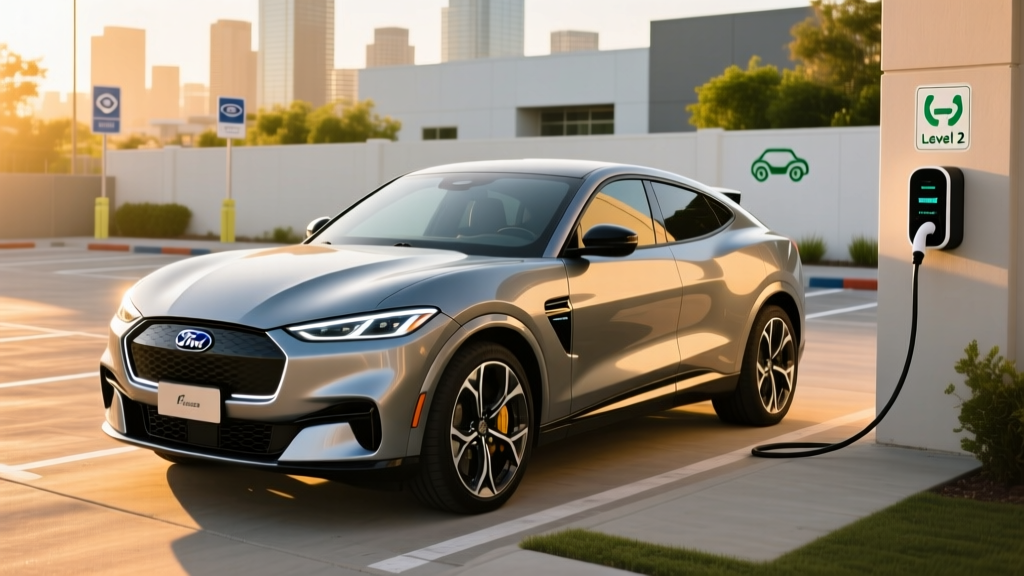
At home on a Level 2 charger (240V, 48-amp circuit), the Mach-E's onboard charger accepts up to 10.5 kW, adding roughly 30 miles of range per hour. A full 10–100% charge takes approximately 9.5 hours — easily achievable overnight. Home charging installation typically runs $800–$2,000 for a 60-amp dedicated circuit with a hardwired wall connector, depending on panel proximity and local permit requirements. A licensed electrician should assess your panel capacity before installation.
Performance and Driving Dynamics
The Mach-E Premium has always punched above its price in the driving-dynamics department, and the 2025 model continues that tradition. The RWD version's 290 hp and 317 lb-ft of torque deliver a 5.8-second 0–60 mph time — brisk enough for confident highway merging without being excessive. The AWD dual-motor variant bumps output to 365 hp and 430 lb-ft, cutting the 0–60 to 4.8 seconds.
What separates the Mach-E from many EV crossovers is steering feel and chassis tuning. Ford calibrated the suspension with a sporty bias: body roll is well-controlled in corners, and the steering provides genuine feedback — rare in the segment. The trade-off is ride quality. On 19-inch wheels (standard on Premium), the Mach-E transmits more road imperfection than a Model Y or Ioniq 5. Drivers who prioritize engagement over plushness will appreciate it; those with rough local roads may find it fatiguing over long commutes.
Regenerative braking offers multiple modes, including a true one-pedal driving setting that brings the car to a complete stop without touching the brake pedal. The transition between regen and friction braking is smooth — an area where some competitors still feel jerky.
Interior, Cargo, and Technology
The Mach-E Premium's cabin represents a meaningful step up from the Select trim. Standard features include ActiveX synthetic leather seating, a panoramic fixed-glass roof, a 10.2-inch digital instrument cluster, and Ford's 15.5-inch vertically oriented SYNC 4A touchscreen. The interface is responsive, supports wireless Apple CarPlay and Android Auto, and includes a physical volume knob — a detail many EV touchscreens omit to the frustration of drivers.
Space is the Mach-E's weakest metric versus key competitors:
- Front legroom: 43.3 inches
- Rear legroom: 38.9 inches (vs. 41.7 in the Ioniq 5, 41.6 in the Model Y)
- Cargo (behind rear seats): 29.7 cu ft
- Cargo (rear seats folded): 59.7 cu ft
- Front trunk (frunk): 4.7 cu ft (drainable, useful for wet gear or groceries)
The rear-seat deficit matters for families with tall teenagers or adults who regularly carry rear passengers. For couples or families with younger children in car seats, the space is adequate. The frunk, while small, is a practical addition that the Model Y lacks entirely.
On the driver-assistance front, the Mach-E Premium includes Ford Co-Pilot360 Active 2.0, which bundles adaptive cruise control with stop-and-go, lane centering, and speed-sign recognition. This is an SAE Level 2 system — meaning the driver must remain fully engaged, with hands on or near the wheel at all times. It is not "self-driving." Ford's BlueCruise hands-free highway driving is available as a $2,100 option on the Premium trim, enabling hands-off operation on pre-mapped divided highways (still requiring driver attention to the road). According to IIHS, the Mach-E earns top marks in crashworthiness testing.
Pricing, Tax Credits, and Total Cost
| Trim / Config | MSRP | After §30D Credit* | Effective Price |
|---|---|---|---|
| Premium RWD (Extended Range) | $42,995 | Up to $7,500 | ~$35,495 |
| Premium AWD (Extended Range) | $45,995 | Up to $7,500 | ~$38,495 |
| Premium RWD + BlueCruise | $45,095 | Up to $7,500 | ~$37,595 |
*Federal tax credit eligibility under IRS §30D is not automatic. Qualification depends on multiple factors detailed below.
The 2025 Mach-E Premium's MSRP positions it squarely against the Tesla Model Y Long Range ($44,990) and the Hyundai Ioniq 5 SEL ($46,750). When the full $7,500 federal tax credit applies, the Mach-E becomes one of the most affordable 300+ mile electric crossovers on the market.
However, IRS §30D rules impose strict eligibility requirements that vary by buyer:
- MSRP Cap: SUVs/crossovers must have an MSRP at or below $80,000. The Mach-E Premium clears this easily.
- Buyer Income Cap: Modified adjusted gross income must not exceed $150,000 (single), $225,000 (head of household), or $300,000 (married filing jointly).
- Battery Sourcing: The $7,500 credit splits into two $3,750 halves — one for critical-minerals sourcing and one for battery-component assembly. Sourcing requirements tighten annually. Ford has confirmed the 2025 Mach-E qualifies for at least partial credit; verify the exact amount at the time of purchase on the IRS qualified vehicles list.
- Point-of-Sale Transfer: Buyers can elect to transfer the credit to the dealer at purchase, reducing the purchase price directly rather than waiting for a tax refund.
Because sourcing requirements evolve and the qualified-vehicle list updates periodically, consult the IRS website or a tax professional before finalizing your purchase. Never assume the full $7,500 applies without verification.
Pros, Cons, and Who Should Buy
Pros
- 320-mile EPA range (RWD) reduces charging frequency
- Native NACS port provides direct Tesla Supercharger access
- Engaging steering and chassis — best-in-class driving dynamics
- Competitive pricing after federal tax credit
- Comprehensive standard safety suite (Co-Pilot360)
- Drainable frunk adds practical storage
- Heat pump standard on Premium improves cold-weather efficiency
Cons
- 150 kW peak DC charge rate trails 800V competitors (240 kW)
- Rear-seat legroom below segment average
- Firm ride quality on rough pavement
- Cargo volume trails Model Y and Ioniq 5
- NMC battery loses more range in extreme cold than LFP rivals
- BlueCruise hands-free driving is a costly add-on
Who the 2025 Mach-E Premium Suits Best
Choose the Mach-E Premium if: You value driving engagement, commute under 100 miles daily, need Supercharger access for road trips, and don't regularly carry adult rear passengers.
Look elsewhere if: You prioritize maximum interior space (consider the Model Y or Ioniq 5), need the fastest possible DC charging for frequent long-distance travel, or live in a region with extreme winters and no home charging.
Warranty and Long-Term Ownership
Ford backs the Mach-E's high-voltage battery and electric powertrain components with an 8-year / 100,000-mile warranty, with a capacity-retention threshold of 70%. If the battery degrades below 70% of original capacity within that period, Ford will repair or replace it. This matches the industry standard set by most mainstream EV manufacturers.
The NMC battery in the Mach-E Premium has demonstrated solid longevity data. Real-world fleet data and owner reports suggest approximately 8–12% degradation over the first 100,000 miles under normal use patterns — well within the warranty threshold. To maximize battery lifespan, Ford recommends keeping state of charge between 20% and 80% for daily use and limiting DC fast charging to road-trip scenarios rather than daily routine.
The vehicle limited warranty covers 3 years / 36,000 miles (bumper-to-bumper), which is below the 5-year / 60,000-mile coverage offered by Hyundai/Kia. This is worth factoring into your total cost of ownership calculation if you plan to keep the vehicle beyond three years without an extended warranty.
Frequently Asked Questions
What is the real-world range of the 2025 Mach-E Premium?
The EPA rates the Extended Range RWD at 320 miles and AWD at 300 miles. In real-world mixed driving, expect 270–290 miles. Sustained highway driving at 75 mph yields roughly 240–260 miles. In sub-freezing temperatures, plan for 220–250 miles with cabin heat active.
How fast does the 2025 Mach-E Premium charge?
On DC fast charging, the Mach-E peaks at 150 kW and charges from 10% to 80% in approximately 37 minutes. At home on Level 2 (240V, 48A), it charges at 10.5 kW, adding about 30 miles of range per hour and fully recharging overnight in ~9.5 hours.
Does the 2025 Mach-E Premium qualify for the $7,500 federal EV tax credit?
It can, but eligibility depends on your income, the vehicle's battery sourcing at time of purchase, and MSRP compliance. The Mach-E is under the $80,000 SUV MSRP cap. Check the current IRS qualified vehicle list and confirm your income falls within §30D limits before purchasing.
Is the 2025 Mach-E Premium worth buying over the Tesla Model Y?
If you prioritize driving dynamics, prefer Ford's interior design, and want Supercharger access (now available via native NACS), the Mach-E is a strong alternative. If you need maximum cargo space, the fastest charging speeds, or the most mature software ecosystem, the Model Y retains advantages. The decision often comes down to which ecosystem and driving character you prefer.
Can the Mach-E Premium charge at Tesla Superchargers?
Yes. The 2025 Mach-E ships with a native NACS charge port, allowing direct plug-in at Tesla Superchargers without any adapter. This provides access to the most extensive fast-charging network in North America.
How much does it cost to charge a Mach-E Premium at home?
At the national average electricity rate of $0.17/kWh, fully charging the 91 kWh battery from empty costs approximately $15.50. For a typical daily commute consuming 30 kWh, expect about $5.10 per charge. Monthly home charging costs for an average driver run $40–$70 — roughly one-third to one-quarter the cost of equivalent gasoline.