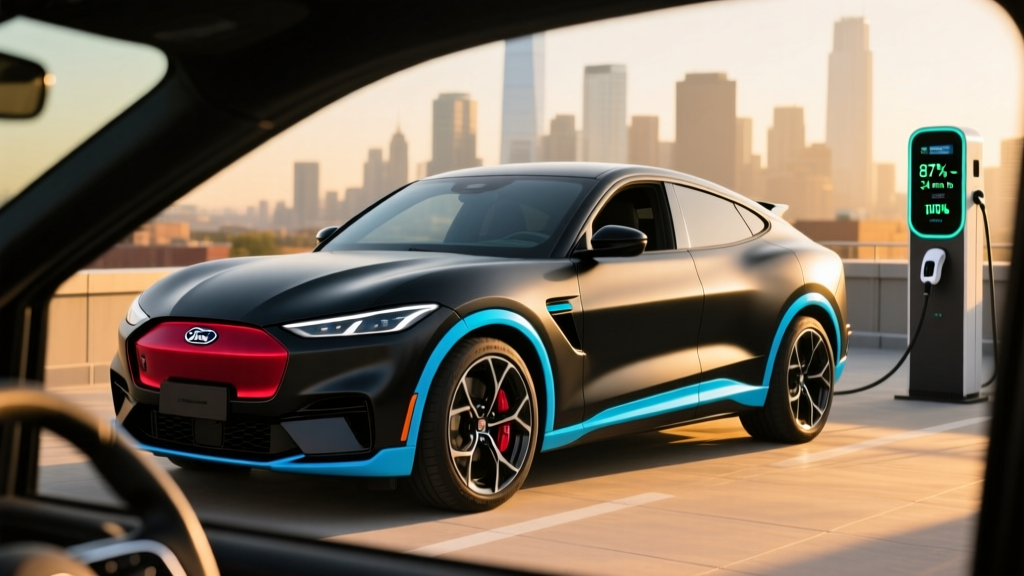
The 2025 Mustang Mach-E GT occupies a specific niche in the electric crossover market: it's the performance-oriented variant of Ford's electric Mustang lineup, trading some efficiency for a 3.3-second 0-60 time and standard all-wheel drive. But performance EVs live or die by their real-world usability — range on a road trip, charging speed at a public DC station, and whether the tax credit math actually works. Here's what the numbers say after examining EPA data, Ford's specifications, and the ownership realities that spec sheets don't always highlight.
Quick Verdict: Who the Mach-E GT Is For
The Mach-E GT targets drivers who want sports-sedan acceleration in a practical crossover body and who have reliable home charging access. It's best suited for performance-minded commuters and weekend road-trippers who can plan around its ~280-mile EPA range and 150 kW peak DC charging. If you prioritize maximum range over acceleration, the standard Mach-E Premium with the Extended Range battery (EPA 320 miles) is the smarter buy. If you want a true luxury performance EV with faster charging, the Porsche Macan Electric or BMW iX M60 are worth the premium.
Range and Efficiency: EPA vs. the Real World
| Metric | Value |
|---|---|
| EPA Estimated Range | 280 miles |
| Usable Battery Capacity | 91 kWh (NMC chemistry) |
| EPA Combined Efficiency | 84 MPGe (40 kWh/100 mi) |
| Drivetrain | Dual-motor AWD |
The EPA's 280-mile figure assumes a mix of city and highway driving at moderate temperatures. In real-world highway testing at 70-75 mph, expect approximately 240-260 miles before needing to charge. In cold weather (below 32°F), range can drop an additional 15-25%, bringing realistic winter highway range down to roughly 200-220 miles. The Mach-E GT's performance-tuned suspension and wider tires contribute to higher rolling resistance compared to the standard Mach-E, which is why its EPA rating trails the Extended Range RWD model by 40 miles.
The 91 kWh usable battery uses nickel-manganese-cobalt (NMC) chemistry, which offers higher energy density than lithium iron phosphate (LFP) but is more sensitive to sustained high state-of-charge storage. Ford recommends daily charging to 90% for battery longevity and reserving 100% charges for road trips. The GT comes with an active liquid thermal management system that preconditioning the battery for DC fast charging — a critical feature for maintaining charge speed in cold climates.
Charging Speed: DC Fast, Level 2, and the Curve
| Charge Level | Power / Rate | Time or Miles Added |
|---|---|---|
| DC Fast Charge (Peak) | 150 kW | 10-80% in ~38 minutes |
| DC Fast Charge (Sustained Avg.) | ~110 kW | ~180 miles in 30 minutes |
| Level 2 (Home, 48A) | 11.5 kW | ~30 miles per hour of charging |
| Level 2 (Home, 32A) | 7.7 kW | ~20 miles per hour of charging |
| Level 1 (120V Outlet) | ~1.4 kW | ~3-4 miles per hour |
The Mach-E GT's 150 kW peak DC fast-charge rate is the most misunderstood number on this spec sheet. Peak rate is what the car can accept at a low state of charge (typically 10-20%) under ideal thermal conditions. The charging curve tapers significantly above 60% SoC, and by 80% you're pulling closer to 50-60 kW. This is why Ford quotes the 10-80% time (~38 minutes) rather than a full 0-100% charge — charging above 80% at a DC fast charger is painfully slow and rarely worth the wait.
For home charging, the GT's onboard charger accepts up to 11.5 kW on a 48-amp Level 2 circuit (hardwired, requiring a 60-amp breaker). A full 0-100% home charge takes roughly 8.5 hours, making overnight charging practical. If your electrical panel only supports a 40-amp breaker (32-amp charge), expect about 10.5 hours for a full charge — still overnight-friendly but tighter for heavy daily drivers. Installation of a 48-amp hardwired Level 2 charger typically costs $800-$2,000 depending on panel capacity and conduit runs, according to industry estimates. Always have a licensed electrician evaluate your panel before committing to a specific amperage.
The Mach-E GT uses the CCS1 connector for DC fast charging. Ford has announced that future models will adopt NACS (Tesla's connector), but the 2025 Mach-E lineup retains CCS1. This means access to Electrify America, EVgo, ChargePoint, and other CCS networks — but not Tesla Superchargers without a CCS-to-NACS adapter (Ford has begun providing these to owners, but availability varies by model year).
Performance and Driving Dynamics
| Metric | Value |
|---|---|
| Horsepower | 480 hp (Performance Edition) |
| Torque | 634 lb-ft (Performance Edition) |
| 0-60 mph | 3.3 seconds |
| Top Speed | 124 mph (electronically limited) |
| Drivetrain | Dual-motor AWD |
| Curb Weight | ~4,900 lbs |
The GT trim comes in two configurations: the standard GT (480 hp, 600 lb-ft, 0-60 in 3.8 seconds) and the GT Performance Edition (480 hp, 634 lb-ft, 0-60 in 3.3 seconds). The Performance Edition adds a MagneRide adaptive suspension, performance brake calipers, and a sport-tuned torque distribution calibration that biases the rear motor under hard acceleration.
At nearly 4,900 pounds, the Mach-E GT is not a lightweight, but the instant torque delivery and low center of gravity (battery pack mounted under the floor) mask the mass effectively in daily driving. Where weight becomes apparent is in sustained high-speed cornering and braking distances — this is a straight-line performance car first. The regenerative braking system offers adjustable levels including a one-pedal driving mode that can bring the car to a complete stop without touching the friction brakes.
Pricing, Tax Credits, and Ownership Cost
| Trim | Base MSRP | Destination | Total Before Incentives |
|---|---|---|---|
| GT (Standard) | $54,495 | $1,895 | $56,390 |
| GT Performance Edition | $59,995 | $1,895 | $61,890 |
The Mach-E GT's eligibility for the full $7,500 federal tax credit depends on several factors that change frequently:
- MSRP Cap: SUVs/crossovers must be under $80,000 MSRP. Both GT trims qualify.
- Buyer Income Cap: Modified AGI must not exceed $150,000 (single), $225,000 (head of household), or $300,000 (joint). Check IRS §30D guidelines for current-year rules.
- Battery Sourcing: Critical minerals and battery component requirements phase in annually. As of 2025, vehicles must meet increasingly strict domestic-content thresholds. Ford assembles the Mach-E in Cuautitlán, Mexico, and battery sourcing has been adjusted to meet credit requirements — but confirm eligibility at the point of sale using the dealer's VIN-specific credit tool or the IRS clean vehicle report.
- Point-of-Sale Transfer: As of 2024, buyers can transfer the credit to the dealer at purchase, reducing the purchase price directly rather than waiting for a tax refund. This effectively lowers the GT's entry price to ~$48,890 (standard GT) if you qualify for the full $7,500.
Beyond the purchase price, the Mach-E GT carries higher insurance premiums than the standard Mach-E (performance trims typically add 15-25% to EV insurance costs) and will consume more electricity per mile than efficiency-focused rivals. At the national average electricity rate of ~$0.17/kWh, charging the GT's 91 kWh battery from 10-80% at home costs approximately $10.85 — roughly equivalent to $3.50 per gallon of gasoline in a 30 MPG vehicle. DC fast-charging at public stations ($0.35-$0.50/kWh) costs significantly more, typically $25-$35 for a 10-80% session.
Interior, Cargo, and Technology
| Measurement | Value |
|---|---|
| Cargo Volume (Behind Rear Seats) | 29.7 cu ft |
| Cargo Volume (Seats Folded) | 59.7 cu ft |
| Front Trunk (Frunk) | 4.7 cu ft |
| Rear Legroom | 38.9 inches |
| Front Headroom | 40.4 inches |
The Mach-E GT's cabin is built around a 15.5-inch portrait touchscreen running Ford's SYNC 4A infotainment system. Wireless Apple CarPlay and Android Auto are standard. The GT adds a Bang & Olufsen 10-speaker sound system, perforated ActiveX seating surfaces, and aluminum pedal covers. Build quality is solid but not luxury-tier — expect more hard plastics than you'd find in a similarly priced BMW iX or Audi Q8 e-tron.
On the driver-assistance front, the Mach-E GT comes with Ford Co-Pilot360 Assist 2.0, which includes adaptive cruise control with stop-and-go, lane centering, evasive steering assist, and intersection assist. BlueCruise (Ford's hands-on-wheel highway driving system) is available via subscription after a 90-day free trial. BlueCruise is an SAE Level 2 system — it does not make the car self-driving. The driver must remain attentive, and the system monitors eye gaze via an interior camera. It works well on divided highways but disengages in construction zones, on rural roads, and in heavy precipitation.
Warranty and Long-Term Ownership
| Coverage Area | Term |
|---|---|
| Basic Bumper-to-Bumper | 3 years / 36,000 miles |
| Powertrain | 5 years / 60,000 miles |
| High-Voltage Battery | 8 years / 100,000 miles (retains ≥70% capacity) |
| Roadside Assistance | 5 years / 60,000 miles |
The battery warranty guarantees that the pack will retain at least 70% of its original capacity over 8 years or 100,000 miles. NMC chemistry typically shows 8-12% degradation over the first 100,000 miles in real-world fleet data, meaning most owners will retain 88-92% capacity well within warranty terms. Ford's battery replacement cost is not publicly listed as a single figure (it depends on module-level vs. full-pack replacement), but industry estimates for a 91 kWh NMC pack replacement range from $12,000-$18,000 out of warranty.
How the Mach-E GT Compares to Key Rivals
| Spec | Mach-E GT Perf. Ed. | Tesla Model Y Perf. | Hyundai Ioniq 5 N |
|---|---|---|---|
| EPA Range | 280 mi | 285 mi | 221 mi |
| 0-60 mph | 3.3 sec | 3.5 sec | 3.25 sec |
| Peak DC Charge | 150 kW | 250 kW | 238 kW |
| 10-80% DC Time | ~38 min | ~20 min | ~18 min |
| Base MSRP | $59,995 | $53,490 | $67,495 |
| Supercharger Access | Adapter needed | Native | Adapter needed |
The Model Y Performance remains the benchmark for charging speed and Supercharger network access, which matters enormously for road trips. The Ioniq 5 N is a more focused track car with simulated gear shifts and an 800V architecture enabling faster charging, but its 221-mile range is a serious practicality limitation. The Mach-E GT splits the difference: better range than the Ioniq 5 N, more traditional driving feel than the Tesla, but slower charging than both. For daily commuting with occasional road trips, the Mach-E GT's trade-offs are livable. For frequent long-distance drivers, the Tesla's charging advantage is hard to overlook.
Pros and Cons at a Glance
- 3.3-second 0-60 with Performance Edition
- Comfortable ride quality for a performance crossover
- Spacious rear seat (38.9" legroom) and useful cargo area
- Strong regenerative braking with one-pedal mode
- BlueCruise hands-on highway assist available
- Qualifies for up to $7,500 federal tax credit (if sourcing/income rules met)
- 150 kW peak DC charging lags behind rivals (250 kW Tesla, 238 kW Ioniq 5 N)
- 38-minute 10-80% charge time is slow for road trips
- CCS1 connector — Supercharger access requires adapter
- Real-world highway range closer to 240-260 miles
- Interior materials don't match luxury competitors at this price
- Higher insurance costs vs. standard Mach-E trims
Frequently Asked Questions
What is the real-world range of the 2025 Mustang Mach-E GT?
The EPA rates the Mach-E GT at 280 miles. In real-world highway driving at 70-75 mph, expect 240-260 miles. In cold weather (below 32°F), plan for 200-220 miles before needing a charge. Preconditioning the battery before departure helps mitigate cold-weather losses.
How fast does the Mach-E GT charge at home and on the road?
At home on a 48-amp Level 2 charger, the GT adds about 30 miles of range per hour and fully charges in ~8.5 hours. On DC fast chargers, it peaks at 150 kW and takes approximately 38 minutes for a 10-80% charge. Charging slows significantly above 80% SoC.
Does the 2025 Mach-E GT qualify for the $7,500 federal EV tax credit?
It can, but eligibility depends on your income (AGI caps apply), the vehicle's battery sourcing compliance, and the MSRP being under $80,000 (both GT trims clear this). The credit can be transferred at the point of sale to reduce your purchase price directly. Verify with the dealer's VIN lookup tool and your tax professional, as IRS §30D rules evolve annually.
Is the Mach-E GT worth buying over the Tesla Model Y Performance?
If you value ride comfort, a traditional cockpit layout, and don't frequently road-trip, the Mach-E GT is compelling. If fast public charging and Supercharger access are priorities, the Model Y Performance is the stronger choice. The 18-minute charging advantage Tesla holds (20 min vs. 38 min, 10-80%) adds up significantly on long trips.
What is the biggest drawback of the Mach-E GT?
The 150 kW DC fast-charge ceiling is the GT's most significant limitation. On road trips where you're charging from 10-80%, spending 38 minutes at a station (versus 18-20 minutes in a Hyundai Ioniq 5 or Tesla Model Y) changes the experience noticeably. This is a daily-commuter EV that can road-trip, not a road-tripper that can daily commute.
What battery chemistry does the Mach-E GT use?
The 2025 Mach-E GT uses a 91 kWh (usable) nickel-manganese-cobalt (NMC) lithium-ion battery. NMC offers higher energy density than LFP, which helps keep weight manageable, but Ford recommends daily charging to 90% rather than 100% for long-term battery health. The battery is covered by an 8-year/100,000-mile warranty with a 70% capacity retention guarantee.