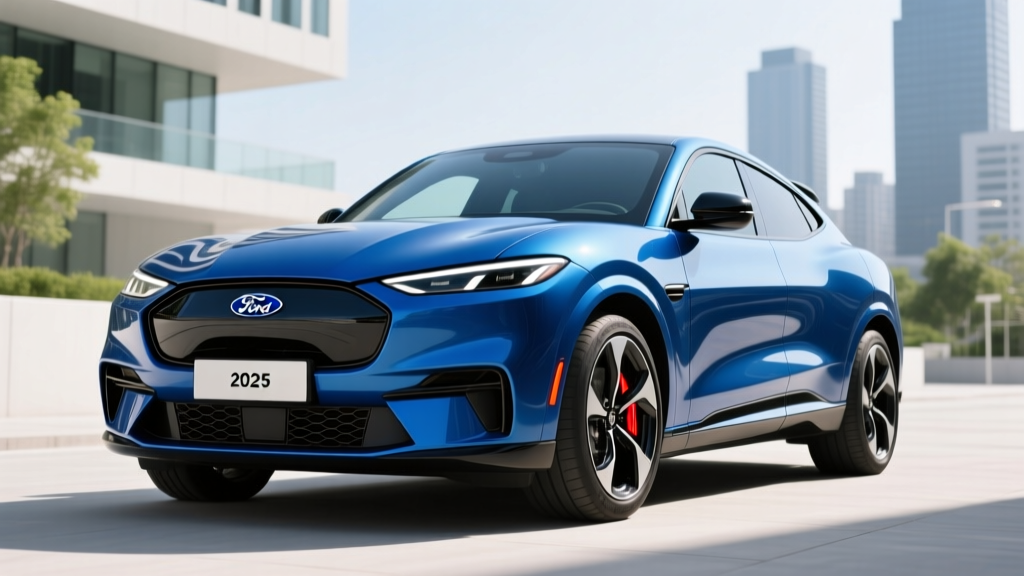
Quick Verdict: The 2025 Mach-E's Performance Sweet Spot
The 2025 Ford Mustang Mach-E enters its fifth model year with meaningful upgrades: a larger 91 kWh usable battery (up from 75.7 kWh on Extended Range trims in 2023), a new Rally trim, and revised software that sharpens throttle response. But for most buyers searching for 2025 Mach-E 0-60 data, the headline remains the GT Performance Edition's 3.3-second sprint to 60 mph — putting it in Porsche Cayenne Turbo territory at a fraction of the price.
Yet speed is only part of the ownership equation. The Mach-E's real strength lies in its balance: up to 320 miles of EPA-estimated range on Select RWD, a usable NACS charge port for Tesla Supercharger access, and a starting MSRP of $39,995 before incentives. This review breaks down every spec that matters — from real-world range and charge-curve behavior to tax-credit math — so you can decide if the Mach-E fits your garage.
| Spec | Select RWD | Premium AWD ER | GT Perf. Edition | Rally |
|---|---|---|---|---|
| EPA Range | ~250 mi | 320 mi | 280 mi | 275 mi |
| Battery (usable) | 75.7 kWh (LFP) | 91 kWh (NMC) | 91 kWh (NMC) | 91 kWh (NMC) |
| Horsepower | 266 hp | 365 hp | 480 hp | 480 hp |
| Torque | 387 lb-ft | 428 lb-ft | 700 lb-ft | 700 lb-ft |
| 0-60 mph | 5.8 sec | 5.1 sec | 3.3 sec | 3.4 sec |
| Drivetrain | RWD (single motor) | AWD (dual motor) | AWD (dual motor) | AWD (dual motor) |
| Max DC Charge | 115 kW | 150 kW | 150 kW | 150 kW |
| 10-80% DC Time | ~44 min | ~41 min | ~41 min | ~41 min |
| Base MSRP | $39,995 | $50,995 | $57,995 | $59,995 |
2025 Mach-E 0-60 Times by Trim: The Full Breakdown
Ford offers the 2025 Mach-E in four main configurations, and the 0-60 mph spread is dramatic — from a leisurely 5.8 seconds on the base RWD to a head-snapping 3.3 seconds on the GT Performance Edition. Here's what the numbers actually feel like on the road:
- Select RWD (5.8 sec): Adequate for merging and passing. The single rear motor delivers 266 hp and instant torque, so city acceleration feels punchier than the number suggests. Think Toyota Camry V6 territory.
- Premium AWD Extended Range (5.1 sec): Dual motors add all-weather traction and a noticeable step up. This is the daily-driver sweet spot — quick enough to be fun, efficient enough to maximize range.
- GT (3.5 sec) / GT Performance Edition (3.3 sec): The Performance Upgrade package (standard on Perf. Edition, optional on GT) unlocks 700 lb-ft of torque via a software calibration. The 0.2-second gap between GT and GT PE comes from revised launch control tuning. For context, a 2025 BMW M3 Competition clocks 3.4 seconds — the Mach-E GT PE is quicker.
- Rally (3.4 sec): Shares the GT's powertrain but adds rally-tuned MagneRide dampers, taller ride height (+0.8 in), and underbody protection. The 0.1-second penalty vs. the GT PE is negligible and likely within run-to-run variance.
All trims use Ford's fourth-generation electric powertrain. The GT's 3.3-second time requires the Performance Upgrade, preconditioned battery, and warm tires (below 40°F, expect 3.6–3.8 seconds on all-season rubber).
Real-World Range vs. EPA Estimates
EPA Estimate: Up to 320 miles (Premium AWD Extended Range)
Real-World Expectation: 270–290 miles on mixed highway/city driving at 70 mph; 230–250 miles in sustained cold weather (below 30°F) without preconditioning; 300+ miles possible in moderate temps with city-heavy driving and aggressive regen.
The 2025 Mach-E Extended Range trims carry a 91 kWh usable battery pack (NMC chemistry, up from 75.7 kWh in earlier model years), while the Select RWD uses a 75.7 kWh LFP (lithium iron phosphate) pack. LFP sacrifices energy density for longevity — it tolerates frequent 100% charges better than NMC, making it ideal for daily commuters who can charge at home every night.
Efficiency varies significantly by trim. The Premium AWD ER achieves roughly 99 MPGe combined (34 kWh/100 mi) per EPA data on fueleconomy.gov. The GT Performance Edition drops to approximately 84 MPGe combined (40 kWh/100 mi) due to wider 245/45R20 summer tires, higher curb weight (~4,900 lbs), and less aggressive coast-down regen tuning.
Cold-weather impact is real but manageable. In sub-freezing conditions, expect a 20–30% range reduction without battery preconditioning. The Mach-E's Active Thermal Management system warms the pack when you set a navigation destination to a charger, recovering some of that loss. Plan for 220–240 miles of usable range in January in the Midwest on the ER trims.
Charging Speed: DC Fast, Level 2, and NACS Access
| Charge Level | Connector | Peak Power | Speed (miles/hr added) | Notes |
|---|---|---|---|---|
| Level 1 (120V) | NACS (native) | ~1.4 kW | ~3–4 mi/hr | Emergency/trickle only |
| Level 2 (240V, 48A) | NACS (native) | 11.5 kW | ~30–34 mi/hr | Full charge overnight (~9–10 hrs for 91 kWh pack) |
| DC Fast Charge | NACS (native) | 150 kW (ER/GT) / 115 kW (Select) | ~250 mi/hr at peak | 10–80% in ~41 min (ER); ~44 min (Select) |
The biggest charging story for 2025: Ford transitioned the Mach-E to a native NACS (North American Charging Standard) charge port, eliminating the need for the CCS-to-NACS adapter that 2024 models required. This means plug-and-go access to Tesla Supercharger V3 and V4 stalls — a network that now exceeds 25,000 stalls in North America.
Peak DC charging on Extended Range and GT trims hits 150 kW, but like most EVs, the Mach-E doesn't sustain that rate. The charge curve peaks between 10–40% State of Charge (SoC), then tapers to ~100 kW by 60%, and drops below 50 kW above 80%. On a 350 kW Electrify America or Tesla V4 stall, you won't see faster speeds than on a 150 kW V3 — the vehicle is the bottleneck, not the station.
For home charging, the Mach-E's onboard charger accepts up to 11.5 kW (48 amps) on a 240V/60A circuit. A Ford Charge Station Pro (or any quality Level 2 EVSE like a ChargePoint Home Flex or Emporia V2) wired to a NEMA 14-60 or hardwired 60A circuit will deliver a full overnight charge. Expect roughly 9–10 hours from 10% to 100% on the 91 kWh pack — more than adequate for daily replenishment.
One practical note: the Select trim's LFP battery can (and should) be charged to 100% regularly without degradation concerns, unlike the NMC packs on ER/GT/Rally trims where daily charging to 80% is recommended for longevity.
Pricing, Trims, and Federal Tax Credit Eligibility
| Trim | Base MSRP | As-Tested (typical options) | §30D Credit Eligible? | Est. After Credit |
|---|---|---|---|---|
| Select RWD (LFP) | $39,995 | $41,500 | Yes (if sourcing rules met) | ~$32,495 |
| Premium RWD ER | $45,995 | $48,000 | Yes (if sourcing rules met) | ~$38,495 |
| Premium AWD ER | $50,995 | $53,500 | Yes (if sourcing rules met) | ~$43,495 |
| GT | $54,995 | $57,000 | Yes (if sourcing rules met) | ~$47,495 |
| GT Perf. Edition | $57,995 | $60,500 | Yes (if sourcing rules met) | ~$50,495 |
| Rally | $59,995 | $62,000 | Yes (if sourcing rules met) | ~$52,495 |
The 2025 Mach-E qualifies for the federal §30D clean vehicle credit — up to $7,500 — but eligibility depends on three moving targets that buyers must verify at purchase time:
- MSRP cap: The Mach-E is classified as an SUV (per IRS vehicle classification), so the cap is $80,000. All trims clear this comfortably.
- Buyer income cap: Modified AGI must not exceed $150,000 (single), $225,000 (head of household), or $300,000 (married filing jointly). Check IRS.gov §30D guidelines for current-year rules.
- Battery sourcing requirements: At least 60% of critical minerals and 75% of battery components must be sourced from the US or FTA partners (as of 2025). Ford sources NMC cells from SK On in Georgia and LFP cells from CATL — the LFP Select trim's eligibility can shift depending on FEOC (Foreign Entity of Concern) restrictions. Always confirm with your dealer at the time of purchase and consult a tax professional.
Since January 2024, the $7,500 credit can be transferred to the dealer as a point-of-sale rebate, reducing your out-of-pocket cost at signing rather than waiting for a tax refund. This is a significant cash-flow advantage for buyers who don't have $7,500 in tax liability to offset.
Interior, Cargo, and Daily Practicality
The Mach-E's cabin seats five with reasonable comfort, though rear-seat headroom (38.2 in) and legroom (38.9 in) trail the Hyundai Ioniq 5 slightly. The front seats are well-bolstered, with available ActiveX synthetic leather on Premium and above. The GT and Rally trims add heated and ventilated front seats with a heated steering wheel standard.
Cargo volume is a strong point:
- Behind rear seats: 29.7 cu ft
- Rear seats folded: 59.7 cu ft
- Front trunk (frunk): 4.7 cu ft (drainable, useful for wet gear or groceries)
The 15.5-inch vertical touchscreen running SYNC 4A dominates the dash. It supports wireless Apple CarPlay and Android Auto, over-the-air updates, and Ford's BlueCruise hands-free driving on pre-mapped divided highways (over 130,000 miles of Hands-Free Blue Zones as of 2025). A physical volume knob and climate shortcut bar sit below the screen — a practical layout that avoids the touchscreen-only frustration some competitors suffer.
Ford BlueCruise is an SAE Level 2 driver-assistance system. It controls steering, acceleration, and braking on qualified highways, but the driver must remain attentive and ready to take over at any time. A driver-facing camera monitors eye gaze. This is not autonomous driving (Level 4) — treat it as advanced cruise control with lane centering, not a chauffeur.
Pros, Cons, and Who Should Buy the 2025 Mach-E
Pros
- GT PE's 3.3-sec 0-60 rivals sports cars at half the price
- Native NACS port — no adapter needed at Superchargers
- 320-mi EPA range (ER) covers most road trips with one stop
- BlueCruise hands-free driving on 130,000+ mi of highways
- Drainable frunk adds practical cargo versatility
- LFP option (Select) allows worry-free 100% daily charging
- Qualifies for up to $7,500 federal tax credit (verify sourcing)
Cons
- 150 kW peak DC charge rate trails Hyundai/Kia's 240 kW (E-GMP)
- 10-80% in ~41 min is slower than Ioniq 5 (~18 min) or EV6
- Rear-seat space is tighter than Ioniq 5 and VW ID.4
- No third-row option — families needing 7 seats look elsewhere
- GT range drops to 280 mi; spirited driving reduces it further
- Ride quality on 20-inch GT wheels can be firm on rough roads
- LFP Select's 115 kW DC cap makes road trips noticeably slower
Who the 2025 Mach-E suits best:
- Performance-oriented commuters who want sports-car acceleration without the fuel bill. The GT PE delivers exotic-car thrust on 40 kWh/100 mi.
- Tesla-curious buyers who want Supercharger network access but prefer a traditional dealer experience, physical buttons, and Ford's build quality.
- Two-adult households who road-trip 2–4 times a year and value the 320-mi ER range with NACS Supercharger access.
- Daily commuters with home charging who will rarely DC fast charge and benefit from the LFP Select's durability.
Look elsewhere if: You regularly carry four adults long-distance (Ioniq 5 has more rear room), you need the fastest possible road-trip charging (Hyundai/Kia E-GMP platform wins), or you need three rows (Kia EV9, Rivian R1S).
How the Mach-E Stacks Up Against Key Rivals
| Vehicle | 0-60 mph | EPA Range (max) | Peak DC kW | 10-80% Time | Starting MSRP |
|---|---|---|---|---|---|
| Ford Mach-E GT PE | 3.3 sec | 280 mi | 150 kW | ~41 min | $57,995 |
| Hyundai Ioniq 5 N | 3.4 sec | 260 mi | 240 kW | ~18 min | $66,900 |
| Tesla Model Y Perf. | 3.5 sec | 303 mi | 250 kW | ~27 min | $52,490 |
| Kia EV6 GT | 3.4 sec | 252 mi | 240 kW | ~18 min | $61,600 |
| VW ID.4 AWD Pro S | 5.4 sec | 275 mi | 175 kW | ~30 min | $49,545 |
The Mach-E GT PE leads in raw 0-60 time (by a tenth over the Model Y Performance) and undercuts the Ioniq 5 N and EV6 GT on price by $8,000–$9,000. However, the Hyundai/Kia E-GMP platform's 800V architecture delivers dramatically faster DC charging — 18 minutes 10-80% vs. the Mach-E's 41 minutes. If you road-trip frequently, those extra 20+ minutes per stop add up. If you charge at home 90% of the time, the Mach-E's slower DC rate matters less.
Warranty, Ownership Costs, and Battery Longevity
Ford covers the 2025 Mach-E with:
- Bumper-to-bumper: 3 years / 36,000 miles
- Powertrain: 5 years / 60,000 miles
- EV battery: 8 years / 100,000 miles (capacity retention above 70%)
The 8-year/100,000-mile battery warranty is industry-standard and matches Tesla, Hyundai, and VW. Ford's threshold of 70% capacity retention means if your 91 kWh pack drops below ~63.7 kWh usable within the warranty period, Ford replaces or refurbishes it at no cost. Real-world degradation data from Mach-E owners (model years 2021–2023) shows approximately 5–8% capacity loss at 60,000 miles, well within the warranty buffer.
According to IIHS ratings, the Mach-E carries a Top Safety Pick+ designation (when equipped with specific headlights), and NHTSA awards it a 5-Star Overall Safety Rating. Insurance premiums run 10–20% higher than a comparable gas-powered Ford Edge, per industry averages — get quotes before committing.
Maintenance costs are minimal: no oil changes, no transmission fluid, no spark plugs. Expect cabin air filter replacement (~$50–80 annually), brake fluid checks every 2 years, and tire rotation every 7,500 miles. The regenerative braking system extends pad life significantly — many EV owners report original brake pads at 80,000+ miles.
Frequently Asked Questions
What is the real-world range of the 2025 Mach-E?
Expect 270–290 miles on the Extended Range AWD in mixed driving at moderate temperatures. Highway-only at 75+ mph reduces this to ~250 miles. Cold weather (below 30°F) without preconditioning can drop range to 220–240 miles. The LFP Select RWD delivers roughly 220–235 real-world miles.
How fast does the 2025 Mach-E charge at home and on the road?
On a 240V Level 2 home charger (48A), the Mach-E adds approximately 30–34 miles of range per hour, fully charging the 91 kWh pack overnight in 9–10 hours. On DC fast chargers, Extended Range and GT trims peak at 150 kW, reaching 10–80% in about 41 minutes. The Select RWD peaks at 115 kW (~44 minutes).
Does the 2025 Mach-E qualify for the $7,500 federal tax credit?
Most trims qualify under IRS §30D rules, but eligibility depends on battery component and critical-mineral sourcing requirements that change periodically. The buyer must also meet income caps ($150K single / $300K joint) and the MSRP must stay under $80,000 (all trims comply). The credit can be applied as a point-of-sale rebate. Always verify with your dealer and a tax professional at the time of purchase. See IRS clean vehicle credit guidelines.
Is the Mach-E GT Performance Edition worth the premium over the GT?
If 0-60 times matter to you, yes. The Performance Upgrade shaves 0.2 seconds (3.5 → 3.3 sec) and adds MagneRide adaptive dampers, a unique front fascia, and performance brake calipers. The $3,000 premium over the standard GT is reasonable for the hardware you receive. If you care more about range than acceleration, the Premium AWD ER at $50,995 with 320 miles is the smarter financial pick.
How does the Mach-E compare to the Tesla Model Y?
The Mach-E GT PE is quicker to 60 (3.3 vs. 3.5 sec) and starts at a comparable price, but the Model Y offers slightly more range (303 mi), faster DC charging (250 kW peak), and a more mature software ecosystem. The Mach-E wins on dealer service access, physical controls, BlueCruise availability, and a more traditional ownership experience. Both now use NACS — the charging-network gap has closed.
Can the Mach-E tow?
Yes, but modestly. AWD trims are rated for up to 2,300 lbs with the factory tow package — enough for a small utility trailer or a pair of dirt bikes, but not a boat or camper. Towing significantly reduces range (expect a 30–50% hit depending on weight and aerodynamics).