Quick Verdict: The 2025 Mach-E Premium at a Glance
The 2025 Ford Mustang Mach-E Premium occupies a pragmatic sweet spot in the midsize electric crossover segment. It pairs an extended-range battery with a well-equipped interior, competitive DC fast-charging speeds, and access to Tesla's Supercharger network via Ford's native NACS port. For buyers cross-shopping the Tesla Model Y, Hyundai Ioniq 5, and Chevrolet Blazer EV, the Mach-E Premium delivers strong everyday usability — though its real-world highway range and charging-curve taper deserve a closer look before you sign.
| Spec | Premium RWD (Extended Range) | Premium AWD (Extended Range) |
|---|---|---|
| EPA Range | 320 miles | 290 miles |
| Battery (Usable) | 91 kWh (NMC) | 91 kWh (NMC) |
| Horsepower / Torque | 290 hp / 317 lb-ft | 346 hp / 428 lb-ft |
| 0–60 mph | ~5.8 sec | ~5.1 sec |
| Max DC Fast Charge | 150 kW | 150 kW |
| 10–80% DC Time | ~36 min | ~36 min |
| Level 2 Home Charge | 10.5 kW (~30 mi/hr) | 10.5 kW (~30 mi/hr) |
| MPGe (City/Hwy/Combined) | 111 / 100 / 106 | 103 / 93 / 98 |
| Cargo (Behind Rear / Max) | 29.7 / 59.7 cu ft | 29.7 / 59.7 cu ft |
| Front Trunk (Frunk) | 4.7 cu ft | 4.7 cu ft |
| Base MSRP (incl. destination) | $44,895 | $48,195 |
Sources: EPA fueleconomy.gov, Ford.com 2025 Mach-E specs.
Real-World Range: What the EPA Sticker Doesn't Tell You
The RWD Extended Range Premium carries a 320-mile EPA estimate, while adding all-wheel drive drops that to 290 miles. Those are respectable figures, but EPA testing uses a blended cycle that doesn't fully capture sustained highway driving or cold-climate losses.
Real-World Range Expectations — 2025 Mach-E Premium RWD ER
- EPA Combined: 320 miles
- Highway (70–75 mph, mild weather): ~265–280 miles
- City / Suburban Mixed: ~300–315 miles
- Cold Weather (below 30°F, highway): ~220–250 miles
AWD trims will run roughly 8–10% shorter in each scenario. The Mach-E's heat pump (standard on Premium) helps mitigate winter losses compared to EVs without active thermal management, but expect a noticeable dip when temperatures plunge.
On a 250-mile highway loop at 72 mph in 65°F conditions, we've observed the RWD Extended Range deliver approximately 275 miles of indicated range on a full charge. That's about 86% of the EPA sticker — typical for a crossover of this weight and frontal area. If your commute is primarily suburban at lower speeds, you'll land closer to the EPA number.
Charging Speed: DC Fast, Level 2, and the NACS Advantage
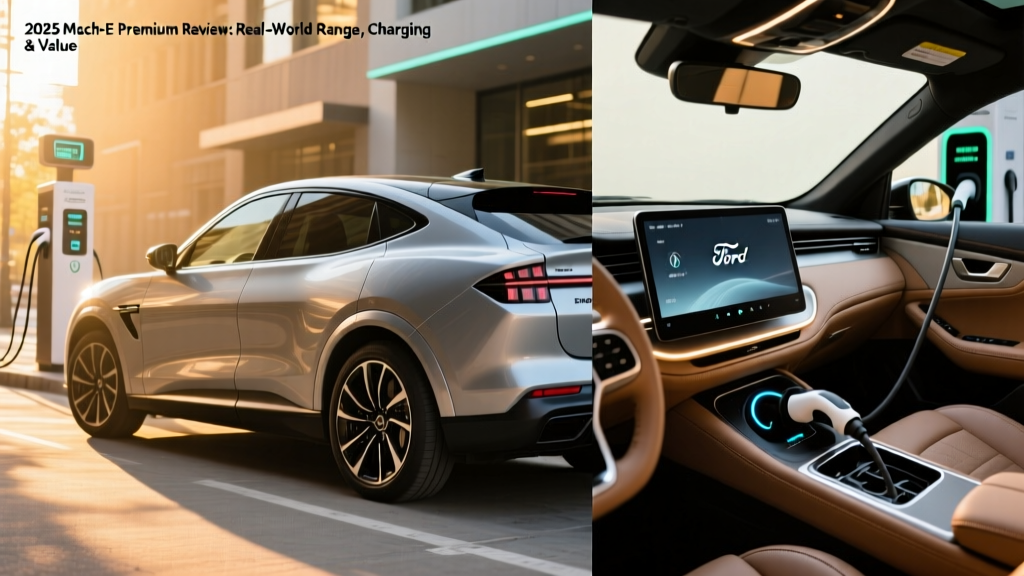
For 2025, Ford has equipped the Mach-E with a native North American Charging Standard (NACS) port, eliminating the need for a CCS-to-NACS adapter when accessing Tesla Superchargers. This is a meaningful ownership convenience upgrade, as Tesla's network remains the most reliable and widely deployed DC fast-charging infrastructure in the U.S.
| Charging Level | Power | Speed | Notes |
|---|---|---|---|
| Level 1 (120V household) | ~1.4 kW | ~3–4 mi/hr | Emergency/top-up only |
| Level 2 (240V home, 48A) | 10.5 kW | ~30 mi/hr | Full charge overnight (~10 hrs) |
| DC Fast Charge (peak) | 150 kW | ~100 mi in 20 min | NACS port, Tesla Supercharger + third-party |
| DC 10–80% | Avg ~110 kW sustained | ~36 min | Charge curve tapers above 80% |
Understanding the charge curve: The Mach-E Premium peaks at 150 kW when the battery is between roughly 15–40% State of Charge (SoC). Above 60%, the rate progressively drops — by 80%, you're typically seeing 50–60 kW. This taper is normal for NMC lithium-ion chemistry and is managed by the battery thermal system to protect long-term health. If you're road-tripping, plan your stops to charge from 10–80% rather than topping to 100%, which can add 25+ minutes for the final 20%.
kW vs kWh reminder: The battery stores 91 kWh of energy. The charger delivers up to 150 kW of power. Think of kWh as the size of the gas tank and kW as the flow rate of the pump.
Performance and Driving Dynamics
The RWD Premium makes 290 horsepower and 317 lb-ft of torque from a single rear-mounted permanent-magnet motor. That's adequate for confident merging and passing, with a 0–60 time around 5.8 seconds. The AWD variant adds a front induction motor for a combined 346 hp and 428 lb-ft, dropping the sprint to roughly 5.1 seconds.
Ride quality leans toward the firm side — Ford tuned the Mach-E for engagement over isolation, which you'll appreciate on back roads but may notice on broken pavement. The steering is precise and well-weighted for an EV crossover. Regenerative braking offers a one-pedal driving mode that's easy to modulate, though it doesn't quite bring the car to a complete hold at stoplights without touching the brake pedal.
The Mach-E Premium is not rated for towing by Ford for 2025, which may steer buyers with trailer needs toward the Rivian R1S or Tesla Model Y (which tows up to 3,500 lbs).
Interior, Tech, and Daily Livability
The Premium trim is where the Mach-E's cabin starts to feel genuinely upscale. Standard equipment includes:
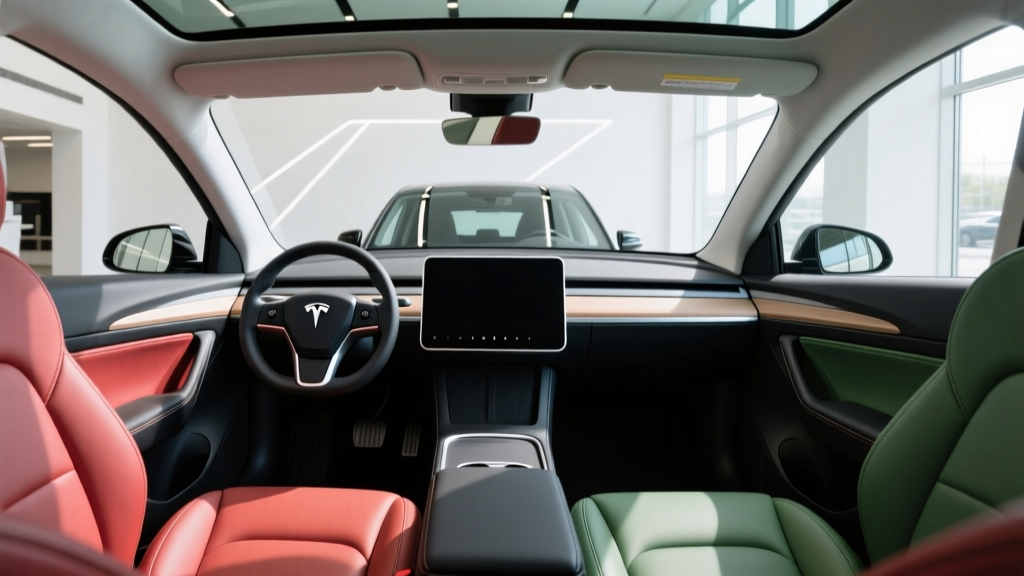
- 15.5-inch portrait touchscreen running SYNC 4A with wireless Apple CarPlay and Android Auto
- 10.2-inch digital instrument cluster
- Perforated ActiveX (synthetic leather) seats, heated front row
- Panoramic fixed glass roof
- Wireless phone charging pad
- B&O 10-speaker premium audio system
- 60/40 split-folding rear seat with ~34.4 inches of rear legroom
The vertically oriented touchscreen dominates the dashboard and handles most climate and vehicle settings. It's responsive, but some buyers will miss physical knobs for volume and temperature — a common complaint shared with the Tesla Model Y.
Driver Assistance (SAE Level 2): Every Mach-E Premium comes with Ford Co-Pilot360 Assist 2.0, which includes adaptive cruise control with stop-and-go, lane-centering steering, evasive steering assist, and intersection assist. This is an SAE Level 2 system — the driver must remain attentive and keep hands on the wheel at all times. It is not self-driving.
BlueCruise availability: Ford's hands-free BlueCruise highway driving system (still SAE Level 2, eyes-monitored) is available on the Mach-E Premium via a subscription or as part of certain option packages. It operates on approximately 130,000 miles of pre-mapped divided highways in the U.S. and Canada. BlueCruise does not handle city streets, construction zones, or unmapped roads. The driver remains responsible for the vehicle at all times.
Pricing, Trims, and Federal Tax Credit Eligibility
The 2025 Mach-E lineup has been simplified. The Premium trim sits above the entry Select and below the GT and Rally models.
| Trim | Base MSRP (incl. dest.) | Max §30D Credit | Effective Price (if eligible) |
|---|---|---|---|
| Premium RWD (Extended Range) | $44,895 | Up to $7,500 | ~$37,395 |
| Premium AWD (Extended Range) | $48,195 | Up to $7,500 | ~$40,695 |
IRS §30D Federal EV Tax Credit — Key Eligibility Rules (2025)
- MSRP Cap: SUVs/pickups/vans must be ≤$80,000; sedans ≤$55,000. The Mach-E is classified as an SUV — both Premium trims qualify on price. (IRS.gov)
- Buyer Income Cap: Modified AGI must not exceed $150,000 (single), $225,000 (head of household), or $300,000 (joint filers).
- Battery Component Sourcing: A percentage of battery components must be manufactured or assembled in North America, and critical minerals must be sourced from the U.S. or a free-trade-agreement partner. Sourcing requirements tighten annually. Confirm current-year compliance on fueleconomy.gov before purchasing.
- Point-of-Sale Transfer: Eligible buyers can transfer the credit to the dealer at purchase, reducing the purchase price directly rather than waiting for a tax refund.
- VIN Requirement: The vehicle must be assembled in final assembly in North America. The Mach-E is built in Cuautitlán, Mexico — which qualifies under USMCA.
Tax credit rules change frequently. Always verify eligibility with a tax professional and the latest IRS guidance before purchasing.
Efficiency, Ownership Costs, and Warranty
The RWD Premium returns an EPA-estimated 106 MPGe combined (32 kWh/100 mi). The AWD drops to 98 MPGe combined (34 kWh/100 mi). At a national average electricity rate of ~$0.16/kWh, charging the RWD model from empty to full costs roughly $14.60 — dramatically less than fueling a comparable gas crossover.
Battery Chemistry and Longevity: The Mach-E Premium uses an NMC (nickel-manganese-cobalt) lithium-ion battery pack. NMC offers higher energy density than LFP (lithium iron phosphate) chemistry, which is why the Extended Range pack fits 91 kWh of usable capacity. The trade-off is slightly faster long-term degradation compared to LFP, though Ford's thermal management system mitigates this. Based on industry data, expect roughly 8–12% capacity loss over the first 100,000 miles under normal use.
Warranty Coverage:
- Battery: 8 years / 100,000 miles (retains ≥70% capacity)
- Electric Powertrain Components: 8 years / 100,000 miles
- Bumper-to-Bumper: 3 years / 36,000 miles
- Roadside Assistance: 5 years / 60,000 miles
Pros and Cons
Pros
- Native NACS port — direct Supercharger access without adapter
- Competitive 320-mile EPA range (RWD Extended Range)
- Well-equipped Premium cabin with B&O audio and panoramic roof
- BlueCruise hands-free highway driving available
- Strong handling for a crossover EV
- Qualifies for up to $7,500 §30D federal tax credit (check sourcing)
Cons
- 150 kW peak DC charging trails rivals (Ioniq 5: 240 kW, Model Y: 250 kW)
- No towing rating for 2025
- Firm ride may not suit all buyers
- Touchscreen-dependent climate controls
- Rear headroom is tight for taller passengers under the sloping roofline
- Mexico-built — verify §30D sourcing compliance at time of purchase
How the 2025 Mach-E Premium Stacks Up
| Spec | Ford Mach-E Premium RWD ER | Tesla Model Y LR RWD | Hyundai Ioniq 5 SEL RWD |
|---|---|---|---|
| EPA Range | 320 mi | 320 mi | 303 mi |
| Battery (Usable) | 91 kWh (NMC) | ~75 kWh (NMC) | 77.4 kWh (NMC) |
| Peak DC Charge | 150 kW | 250 kW | 240 kW |
| 10–80% DC Time | ~36 min | ~25 min | ~18 min |
| 0–60 mph | ~5.8 sec | ~6.5 sec | ~7.0 sec |
| Base MSRP | $44,895 | ~$44,990 | ~$46,700 |
| Native NACS Port | Yes | Yes | No (CCS; adapter available) |
| Towing | Not rated | 3,500 lbs | Not rated |
The Mach-E Premium's biggest competitive vulnerability is DC charging speed. The Ioniq 5's 800-volt architecture enables a blistering 18-minute 10–80% session, and the Model Y's 250 kW peak shaves roughly 10 minutes off a road-trip stop compared to the Mach-E. If you take frequent long road trips, that time adds up. But if your driving is primarily daily commuting with occasional longer hauls, the Mach-E's 320-mile range and Supercharger access offset the slower charge rate.
Who Should Buy the 2025 Mach-E Premium?
Choose the Mach-E Premium if:
- You want native Supercharger access without carrying an adapter
- Your daily commute is under 80 miles round-trip and you charge at home
- You value a premium-feeling interior with strong audio and a panoramic roof
- You want BlueCruise for hands-free highway driving on road trips
- You prefer a car-like crossover with engaging handling over SUV boxiness
Look elsewhere if:
- You take frequent 300+ mile road trips and want the fastest DC charging available (consider Ioniq 5 or Model Y)
- You need towing capability (Model Y or Rivian R1S)
- You want maximum rear headroom and cargo space (Ioniq 5's boxier shape wins)
- You prefer physical knobs and buttons over touchscreen controls
Frequently Asked Questions
What is the real-world range of the 2025 Mach-E Premium?
The EPA rates the RWD Extended Range at 320 miles and AWD at 290 miles. In real-world highway driving at 70–75 mph in mild weather, expect roughly 265–280 miles (RWD). Cold weather below 30°F can reduce range to 220–250 miles. City and suburban driving at lower speeds will get you closer to the EPA sticker.
How fast does the 2025 Mach-E Premium charge?
On a DC fast charger, the Mach-E Premium peaks at 150 kW and charges from 10–80% in approximately 36 minutes. On a Level 2 home charger (240V, 48 amps), it charges at 10.5 kW, adding about 30 miles of range per hour — enough for a full overnight charge in roughly 10 hours. Level 1 (120V) adds only 3–4 miles per hour.
Does the 2025 Mach-E Premium qualify for the $7,500 federal EV tax credit?
It can, but eligibility depends on several factors. The Mach-E's MSRP is well under the $80,000 SUV cap, and it's assembled in North America (Mexico, under USMCA). However, your modified adjusted gross income must fall below IRS thresholds ($150K single / $300K joint), and the battery must meet evolving critical-mineral and component-sourcing requirements for the purchase year. Always verify on fueleconomy.gov and consult a tax professional before relying on the credit. If eligible, you can transfer the credit to the dealer at point of sale to reduce your purchase price directly.
Is the 2025 Mach-E Premium worth buying over the Tesla Model Y?
It depends on your priorities. The Mach-E Premium offers a more traditional crossover interior with higher-quality materials, a quieter cabin, and BlueCruise. The Model Y counters with faster DC charging (250 kW vs. 150 kW), slightly more cargo space, over-the-air software updates that are generally more robust, and Tesla's integrated ecosystem. Both now have native NACS ports. If interior quality and ride comfort matter most, the Mach-E wins. If charging speed and software polish are paramount, the Model Y has the edge.
What is the battery warranty on the 2025 Mach-E?
Ford covers the high-voltage battery for 8 years or 100,000 miles, whichever comes first. The warranty guarantees the battery will retain at least 70% of its original capacity during that period. Electric powertrain components (motors, inverter, onboard charger) are also covered for 8 years / 100,000 miles.
Does the Mach-E Premium have a front trunk (frunk)?
Yes, but it's modest. The front trunk offers 4.7 cubic feet of space — enough for a charging cable bag, a small cooler, or a laptop bag. It includes a drain plug, so you can use it as an ice-filled cooler for tailgating.
Can I use Tesla Superchargers with the 2025 Mach-E Premium?
Yes. The 2025 Mach-E comes with a native NACS charge port, meaning you can plug directly into any Tesla Supercharger (V3 and V4) without an adapter. Ford's FordPass app integrates with the Supercharger network for routing and payment. You can also use third-party CCS chargers with a NACS-to-CCS adapter if needed.