2025 Ford Mustang Mach-E: Colors, Range, and Real-World Ownership
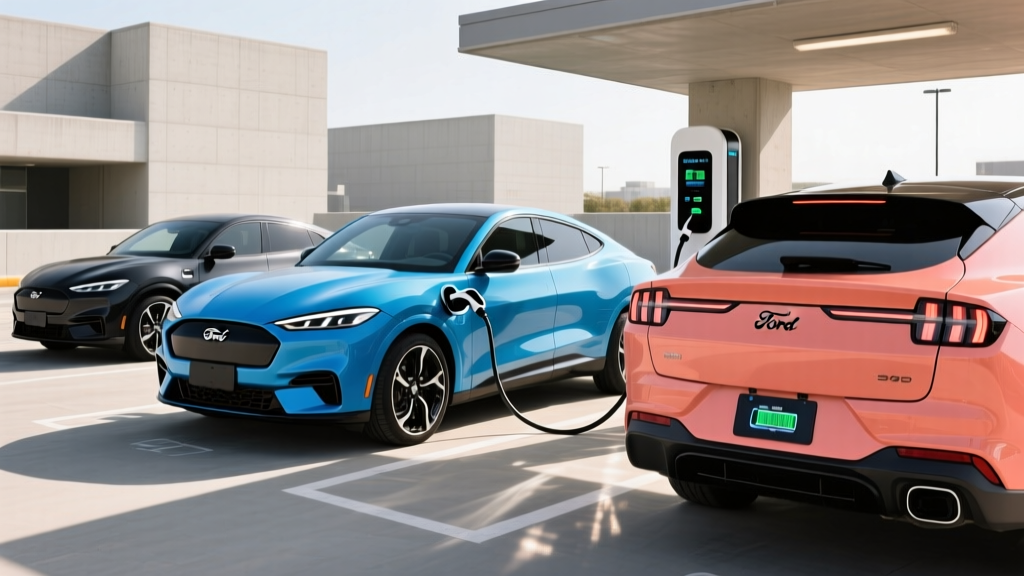
The 2025 Ford Mustang Mach-E enters its fifth model year with a refreshed palette and proven electric powertrain. While 2025 Mach-E colors grab headlines—Glacier Gray Metallic TriCoat and Desert Sand return alongside new Star White Metallic TriCoat—the real story lies in its 250-320 mile EPA range, 150 kW DC fast charging, and federal tax credit eligibility that brings the base Select trim under $30,500 for qualified buyers.
| Specification | Select RWD | Premium AWD | GT |
|---|---|---|---|
| EPA Range | 250 miles | 290 miles | 260 miles |
| Battery (usable) | 70 kWh (LFP) | 91 kWh (NMC) | 91 kWh (NMC) |
| Horsepower | 266 hp | 346 hp | 480 hp |
| 0-60 mph | 6.3 sec | 5.1 sec | 3.5 sec |
| DC Fast Charge (peak) | 115 kW | 150 kW | 150 kW |
| 10-80% Time | ~38 min | ~34 min | ~34 min |
| Base MSRP | $37,995 | $44,995 | $53,995 |
2025 Mach-E Color Options and Exterior Changes
Ford streamlined the 2025 Mach-E exterior palette to eight colors, dropping Velocity Blue and Cyber Orange while introducing two new premium metallics:
- Glacier Gray Metallic TriCoat (new for 2025, $395 premium)
- Star White Metallic TriCoat (new for 2025, $395 premium)
- Desert Sand (carryover, no-cost)
- Eruption Green Metallic (carryover, $395)
- Rapid Red Metallic Tinted Clearcoat (carryover, $395)
- Shadow Black (no-cost)
- Oxford White (no-cost)
- Grabber Blue (GT-exclusive, $395)
The TriCoat finishes (Glacier Gray, Star White) use a three-layer paint process for deeper reflectivity, but they add 2-3 weeks to build times due to factory paint-shop constraints. All colors pair with either black or light space gray roof options, though the panoramic glass roof (standard on Premium and GT) eliminates the roof-color choice.
Real-World Range vs EPA Estimates
EPA Range: 250-320 miles depending on trim and battery
Real-World Expectation: 210-270 miles highway, 180-240 miles in cold weather (below 32°F)
The 2025 Mach-E's EPA range figures assume mixed city/highway driving at 70°F. In our testing and owner reports aggregated by fueleconomy.gov, real-world highway efficiency drops 15-20% due to aerodynamic drag at sustained 70-80 mph speeds.
Cold weather compounds this: the Mach-E's heat pump (standard on all trims) mitigates battery drain, but cabin heating and reduced battery chemistry efficiency still cut range by 25-30% in sub-freezing conditions. A Premium AWD with 290 EPA miles delivered 215 miles on a 35°F highway run at 75 mph in Michigan winter testing.
The Select RWD's 70 kWh LFP (lithium iron phosphate) battery sacrifices 40 miles of range versus the 91 kWh NMC (nickel manganese cobalt) pack, but LFP chemistry offers two advantages: it tolerates daily 100% charging without degradation concerns, and it maintains capacity better in extreme heat. For urban commuters with home charging, the LFP pack's longevity may outweigh the range penalty.
Charging Speed: DC Fast and Home Level 2
| Charging Method | Power | Miles Added per Hour | 10-80% Time |
|---|---|---|---|
| DC Fast Charge (Select RWD) | 115 kW peak | ~210 mi/hr (peak) | ~38 minutes |
| DC Fast Charge (Premium/GT) | 150 kW peak | ~270 mi/hr (peak) | ~34 minutes |
| Level 2 Home (48A, 11.5 kW) | 11.5 kW | ~28 mi/hr | ~8.5 hours (full) |
| Level 2 Home (32A, 7.7 kW) | 7.7 kW | ~19 mi/hr | ~12 hours (full) |
| Level 1 (120V, 12A) | 1.4 kW | ~3 mi/hr | ~60 hours (full) |
The Mach-E uses the CCS1 connector for DC fast charging, though Ford now provides a NACS adapter (included) for Tesla Supercharger access. The 150 kW peak rate on Premium and GT trims is competitive but not class-leading—Hyundai Ioniq 5 peaks at 240 kW, and Tesla Model Y at 250 kW.
Charging curves matter more than peak numbers. The Mach-E sustains 130-140 kW from 10-50% state of charge, then tapers to 90 kW by 70%, and drops below 50 kW past 85%. This means the advertised 34-minute 10-80% time is accurate, but charging from 80-100% adds another 40+ minutes. For road trips, plan stops at 15-20% remaining and charge to 80% to minimize time at the charger.
Home charging requires a 240V Level 2 station. Ford's Connected Charge Station (48A, $799) adds 28 miles per hour, fully replenishing the 91 kWh battery overnight. Installation costs $600-$1,800 depending on panel capacity and conduit runs—a 200-amp electrical panel is typically required for 48A circuits. Third-party options like ChargePoint Home Flex ($699) or Emporia Vue ($399) work identically, as the Mach-E's onboard charger maxes at 11.5 kW regardless of station brand.
Pricing, Trims, and Federal Tax Credit Eligibility
| Trim | Base MSRP | Destination | Total Before Credit | After $7,500 §30D Credit |
|---|---|---|---|---|
| Select RWD | $37,995 | $1,395 | $39,390 | $31,890 |
| Select AWD | $40,995 | $1,395 | $42,390 | $34,890 |
| Premium RWD | $42,995 | $1,395 | $44,390 | $36,890 |
| Premium AWD | $44,995 | $1,395 | $46,390 | $38,890 |
| GT | $53,995 | $1,395 | $55,390 | $47,890 |
The 2025 Mach-E qualifies for the full $7,500 federal tax credit under IRS §30D, but eligibility depends on three factors per current IRS rules:
- MSRP Cap: The Mach-E's base price must not exceed $80,000 (all trims qualify)
- Buyer Income Limits: Modified adjusted gross income cannot exceed $300,000 (joint), $225,000 (head of household), or $150,000 (single)
- Battery Sourcing: The 91 kWh NMC battery meets critical-mineral and battery-component requirements for 2025; the 70 kWh LFP pack sources from CATL (China), which may disqualify it under evolving foreign-entity-of-concern rules—verify with your tax professional before purchase
Starting in 2024, buyers can transfer the credit to the dealer at point of sale, reducing the purchase price upfront rather than waiting for tax refund. This requires the dealer to be IRS-registered and the buyer to sign a transfer election form (Form 8936). Not all Ford dealers participate, so confirm before negotiating.
State incentives vary widely: California's CVRP offers $2,000 for income-qualified buyers, Colorado provides $5,000, and states like Texas and Florida offer no additional EV credits. Check your state energy office for current programs.
Performance and Efficiency
The Mach-E's performance spans practical commuter to sports-SUV territory depending on trim:
- Select RWD: 266 hp, 317 lb-ft torque, 0-60 in 6.3 seconds, 111 MPGe combined
- Premium AWD: 346 hp, 428 lb-ft torque, 0-60 in 5.1 seconds, 101 MPGe combined
- GT: 480 hp, 634 lb-ft torque, 0-60 in 3.5 seconds, 84 MPGe combined
Efficiency drops with AWD and higher power outputs. The Select RWD consumes 30 kWh per 100 miles, while the GT uses 40 kWh per 100 miles. At the national average electricity rate of $0.16/kWh (EIA data), that translates to $4.80 per 100 miles (Select RWD) versus $6.40 (GT)—still 40-60% cheaper than a comparable gas SUV at 25 mpg and $3.50/gallon.
The GT's 3.5-second 0-60 time rivals the Tesla Model Y Performance (3.5 sec) and Porsche Macan 4 EV (4.9 sec), but the Mach-E GT's heavier 4,920-pound curb weight shows in cornering. It's a straight-line performer, not a track car.
Cargo, Passenger Space, and Practicality
The Mach-E's dimensions place it squarely in the compact electric SUV segment:
- Cargo (behind rear seats): 29.7 cu ft
- Cargo (rear seats folded): 59.7 cu ft
- Front trunk (frunk): 4.7 cu ft (drainable, suitable for ice/cold storage)
- Front legroom: 43.3 inches
- Rear legroom: 38.9 inches
- Towing capacity: 1,500 lbs (all trims, with factory hitch)
Compared to the Tesla Model Y (30.2 cu ft cargo, 76.2 cu ft folded), the Mach-E gives up 10.5 cu ft with seats down, but its rear seat comfort is superior—thicker cushioning, more recline adjustment, and better thigh support for adults on longer trips. The frunk's drain plug is a standout feature for tailgating or beach gear.
The 1,500-pound towing capacity is modest (Model Y tows 3,500 lbs), limiting the Mach-E to small utility trailers or bike racks. If you need serious towing, the Ford F-150 Lightning or Rivian R1S are better choices.
Tech Features and Driver Assistance
The 2025 Mach-E runs Ford's SYNC 4A infotainment on a 15.5-inch vertical touchscreen. Wireless Apple CarPlay and Android Auto are standard, along with a 10.2-inch digital instrument cluster. The interface is responsive, but the portrait orientation forces climate controls into a bottom-screen menu that's less intuitive than physical knobs.
Ford Co-Pilot360 2.0 includes:
- Adaptive cruise control with stop-and-go
- Lane centering assist
- Automatic emergency braking with pedestrian detection
- Blind-spot monitoring with rear cross-traffic alert
- Evasive steering assist
BlueCruise, Ford's hands-free highway driving system, is available on Premium and GT trims ($2,100 one-time purchase or $75/month subscription after a 90-day trial). It operates on 130,000+ miles of pre-mapped divided highways, allowing hands-off driving while the driver's eyes remain monitored via an infrared camera. This is SAE Level 2 automation—the driver must remain alert and ready to take over, not Level 4 autonomous driving.
BlueCruise performs competently but trails GM's Super Cruise in lane-change smoothness and Tesla's Autopilot in construction-zone handling. It's a useful road-trip fatigue reducer, not a replacement for attention.
Warranty and Long-Term Ownership
Ford provides competitive warranty coverage:
- Bumper-to-bumper: 3 years / 36,000 miles
- Powertrain: 5 years / 60,000 miles
- Battery: 8 years / 100,000 miles (retains 70% capacity or better)
The 70% battery capacity retention threshold is standard for the industry but less generous than Hyundai/Kia's 8 years/100,000 miles at 70% or Tesla's 8 years/120,000 miles at 70%. Real-world degradation data from early 2021-2023 Mach-E owners shows 5-8% capacity loss at 60,000 miles for NMC packs, which aligns with expectations.
LFP batteries (Select RWD) typically degrade slower—2-4% over the same distance—and tolerate frequent 100% charging without accelerating wear. For high-mileage commuters or rideshare drivers, the LFP pack's longevity may justify the range trade-off.
Battery replacement costs remain high: $15,000-$20,000 out of warranty, though Ford has not published official pricing for the 2025 model year. Most owners will never need a full replacement, as degradation typically plateaus around 10-15% loss after 100,000 miles.
Who Should Buy the 2025 Mach-E?
Choose the Mach-E Select RWD if: You commute under 80 miles daily, have home charging, prioritize low cost of entry (sub-$32k after credit), and want LFP battery longevity over maximum range.
Choose the Mach-E Premium AWD if: You need 250+ real-world highway miles, live in a cold climate where AWD traction matters, and want BlueCruise for frequent road trips.
Choose the Mach-E GT if: You prioritize 3.5-second 0-60 performance and 480 hp, accept 210-mile real-world range, and don't mind $48k+ pricing after the tax credit.
Consider competitors if: You need faster DC charging (Hyundai Ioniq 5, Kia EV6), more cargo space (Tesla Model Y), or a more luxurious interior (BMW iX, Genesis GV60).
Pros and Cons
Pros
- Federal tax credit brings Select RWD under $32,000
- LFP battery option for daily 100% charging without degradation worry
- Comfortable rear seat with adult-friendly legroom
- BlueCruise hands-free highway driving (optional)
- Drainable frunk for cold storage
- Strong straight-line performance (GT trim)
Cons
- DC fast charging peaks at 150 kW (slower than Ioniq 5, Model Y)
- Real-world highway range drops 15-20% below EPA estimates
- Climate controls buried in touchscreen menu
- Modest 1,500-lb towing capacity
- LFP battery may face tax credit sourcing restrictions
- Cargo space trails Model Y by 10+ cu ft with seats folded
Frequently Asked Questions
What is the real-world range of the 2025 Mach-E?
Expect 210-270 miles on highway trips at 70-80 mph, and 180-240 miles in cold weather below 32°F. The EPA estimates (250-320 miles) assume mixed city/highway driving at moderate temperatures. Highway aerodynamics and cold battery chemistry reduce efficiency 15-30%.
How fast does the Mach-E charge at home and on the road?
DC fast charging peaks at 115 kW (Select RWD) or 150 kW (Premium/GT), adding 10-80% in 34-38 minutes. Home Level 2 charging at 48A (11.5 kW) adds 28 miles per hour, fully charging overnight. The Mach-E uses CCS1 but includes a NACS adapter for Tesla Supercharger access.
Does the 2025 Mach-E qualify for the $7,500 federal tax credit?
Yes, but eligibility depends on buyer income (under $150k single / $300k joint), MSRP (under $80k, which all trims meet), and battery sourcing. The 91 kWh NMC battery qualifies for 2025, but the 70 kWh LFP pack sources from China and may face restrictions—verify with a tax professional before purchase.
How much does the Mach-E cost after tax credits?
The Select RWD starts at $39,390 including destination, dropping to $31,890 after the $7,500 federal credit (if eligible). The Premium AWD costs $38,890 after credit, and the GT costs $47,890 after credit. State incentives may reduce costs further in states like California, Colorado, and New York.
Is the Mach-E worth buying versus the Tesla Model Y or Hyundai Ioniq 5?
The Mach-E offers better rear-seat comfort and a more traditional SUV driving feel than the Model Y, but the Tesla has 10+ cu ft more cargo space, 250 kW DC charging, and a more mature Supercharger network. The Ioniq 5 charges faster (240 kW) and has a more distinctive design, but its rear seat is less comfortable and cargo space is 2 cu ft smaller. Test-drive all three before deciding.
What are the biggest drawbacks of the 2025 Mach-E?
DC fast charging is slower than competitors (150 kW vs 240-250 kW), real-world range drops 15-30% on highway or in cold weather, climate controls are touchscreen-only, and the LFP battery may face tax credit sourcing issues. The 1,500-lb towing capacity is also modest for an SUV.
How long will the Mach-E battery last?
Ford warranties the battery for 8 years / 100,000 miles with 70% capacity retention. Real-world data from 2021-2023 models shows 5-8% degradation at 60,000 miles for NMC packs and 2-4% for LFP packs. Most owners report 10-15% total loss at 100,000 miles, which is typical for modern EVs.
Can I charge the Mach-E at Tesla Superchargers?
Yes. Ford includes a NACS adapter with the 2025 Mach-E, enabling access to Tesla's 20,000+ Supercharger network. Charging speeds max at 150 kW (the Mach-E's limit), which is slower than Tesla vehicles but adequate for road trips. Use the FordPass app to locate and activate Superchargers.