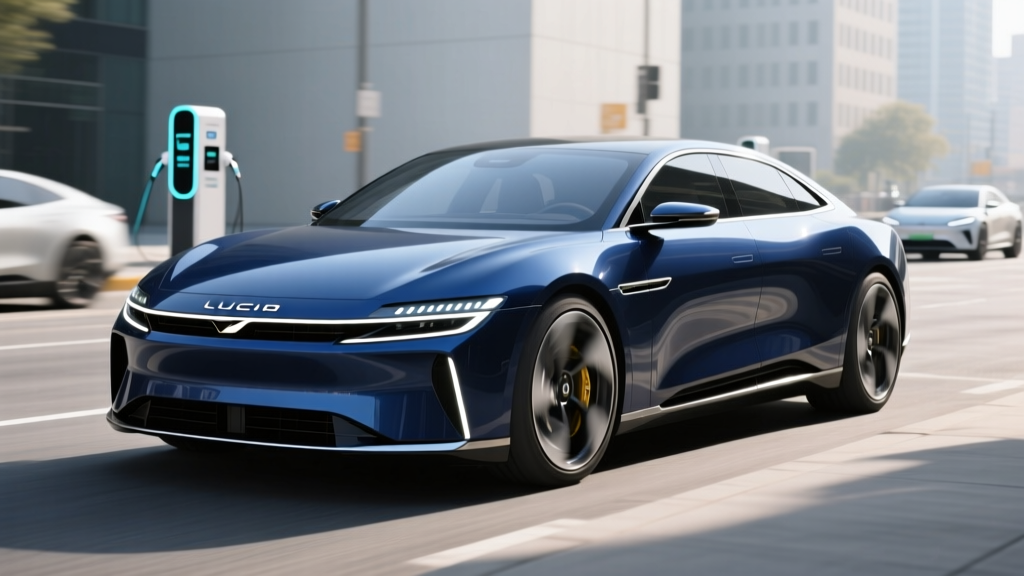
The Lucid Air occupies a rare position in the EV market: a luxury sedan that simultaneously holds the production-car range record and delivers supercar-rivaling acceleration. But all that battery capacity and aluminum-intensive construction raises a practical question for buyers comparing it against the Tesla Model S, Mercedes EQS, and BMW i7 — just how heavy is this thing, and what does that weight mean for efficiency, tire wear, and everyday usability?
We've compiled the full spec dossier on the 2025 Lucid Air lineup, from the entry-level Pure to the 1,234-hp Sapphire, with a particular focus on curb weight and how it intersects with range, charging speed, and real-world ownership.
2025 Lucid Air Curb Weight by Trim
The Air's curb weight varies significantly across the lineup — a spread of nearly 900 pounds between the lightest and heaviest variants. That delta comes down to battery pack size and motor count.
| Trim | Curb Weight (lbs) | Drivetrain | Battery Pack |
|---|---|---|---|
| Air Pure | ~4,575 | RWD (single motor) | 88 kWh usable |
| Air Touring | ~4,860 | AWD (dual motor) | 112 kWh usable |
| Air Grand Touring | ~5,000 | AWD (dual motor) | 112 kWh usable |
| Air Sapphire | ~5,236 | AWD (tri-motor) | 118 kWh usable |
For context, the Tesla Model S Long Range weighs approximately 4,561 lbs, while the Mercedes EQS 580 4MATIC tips the scales at roughly 5,600 lbs. The Air's Wunderbox battery architecture — which uses a structural pack with NMC (nickel manganese cobalt) lithium-ion cells — achieves impressive energy density that keeps weight competitive despite the class-leading capacity.
Why does curb weight matter? Heavier EVs consume more energy per mile, accelerate tire wear (plan on 20,000–30,000 miles from OEM rubber, not 50,000), and require longer braking distances. The Air's weight is well-managed for its battery size, but buyers should factor in tire replacement costs of $1,200–$1,800 per set for the staggered 19"–21" fitments.
Range, Efficiency, and Real-World Expectations
The Air's headline number is the Grand Touring's EPA-estimated 516 miles — still the highest of any production EV as of the 2025 model year. But EPA stickers are generated under controlled lab conditions. Here's what to expect on actual roads.
EPA Estimate (Grand Touring): 516 miles
Real-World Highway (70–75 mph): ~380–420 miles
Real-World Mixed Driving: ~400–450 miles
Cold Weather (below 32°F): Expect a 20–30% reduction, dropping highway range to ~280–340 miles
Why the gap? The Air's sleek 0.20 Cd drag coefficient helps at speed, but EVs lose efficiency at sustained highway velocities. Cold temperatures increase battery internal resistance and demand cabin heating energy. The Air's standard heat pump mitigates this better than resistive heaters, but physics still wins in deep winter.
| Trim | EPA Range (mi) | MPGe (Combined) | kWh/100 mi |
|---|---|---|---|
| Pure | 419 | 136 | 25 |
| Touring | 425 | 130 | 26 |
| Grand Touring | 516 | 131 | 26 |
| Sapphire | 427 | 111 | 30 |
The Pure's efficiency is remarkable: 25 kWh per 100 miles from a 4,575-lb luxury sedan is among the best in the segment. Lucid's miniaturized drive units — each motor weighs roughly 68 lbs and fits in a carry-on-sized housing — contribute heavily. The Sapphire trades efficiency for 1,234 hp, and its 30 kWh/100 mi figure reflects that performance tax.
According to fueleconomy.gov, the Grand Touring's combined efficiency of 131 MPGe translates to an annual electricity cost of approximately $650 (based on 15,000 miles/year and $0.17/kWh national average) — roughly one-third the fuel cost of a comparable BMW 5 Series.
Charging Speed: DC Fast and Home Level 2
The Air's Wunderbox electrical architecture supports up to 300 kW DC fast charging on the Grand Touring and Sapphire (the Pure and Touring peak at approximately 220 kW). But peak rate is only part of the story — the charge curve matters more.
| Charging Method | Rate | Speed | Notes |
|---|---|---|---|
| Level 1 (120V household) | ~1.4 kW | ~3–4 mi/hr | Emergency/trickle only |
| Level 2 (240V, 48A) | ~11.5 kW | ~30–35 mi/hr | Full charge overnight (~12–14 hrs for 112 kWh pack) |
| Level 2 (240V, 80A) | ~19.2 kW | ~50–55 mi/hr | Requires upgraded home circuit (100A breaker) |
| DC Fast Charge (GT/Sapphire) | Peak 300 kW | 10–80% in ~20 min | Adds ~200 mi in 12 min on 350 kW station |
| DC Fast Charge (Pure/Touring) | Peak 220 kW | 10–80% in ~25 min | Tapers above 80% SoC |
Charge curve reality check: The Air hits its 300 kW peak between roughly 10–40% state of charge, then steps down progressively. From 60–80%, expect ~150–180 kW. Above 80%, the rate drops sharply to protect the NMC cells — charging from 80–100% can take as long as 10–80%. For road trips, plan stops at 10–80% for the fastest turnaround.
The Air uses a CCS1 connector natively. With the industry's ongoing shift to NACS (Tesla's connector), Lucid has confirmed NACS adoption for future models, but 2025 Air owners will use CCS1 at non-Tesla networks and can access Tesla Superchargers via adapter (available through Lucid or third-party suppliers). Always verify adapter compatibility with your specific model year before relying on it.
For home charging, the onboard charger accepts up to 19.2 kW on a hardwired 80A Level 2 circuit. Most buyers install a 48A unit on a 60A breaker for ~$500–$1,200 in equipment plus $800–$2,500 in electrician labor (depending on panel proximity and local permit costs). A panel upgrade from 100A to 200A service adds $1,500–$3,000 if needed.
Performance: 0-60, Horsepower, and Drivetrain
The Air lineup spans from sensible luxury to hypercar territory. Every variant uses Lucid's proprietary permanent-magnet motors, and the dual-motor AWD system can fully disconnect the front motor for efficiency during light-load cruising.
| Trim | Horsepower | 0-60 mph | Drivetrain | Top Speed |
|---|---|---|---|---|
| Pure | 430 hp | 5.0 sec | RWD | 145 mph |
| Touring | 620 hp | 3.4 sec | AWD | 145 mph |
| Grand Touring | 819 hp (1,050 w/ Sprint) | 3.0 sec | AWD | 168 mph |
| Sapphire | 1,234 hp | 1.89 sec | AWD (tri-motor) | 205 mph |
The Sapphire's 1.89-second 0-60 time makes it one of the quickest production cars ever tested. It achieves this with a twin rear-motor setup (each rear wheel gets its own motor and torque-vectoring gearbox) plus a single front motor. Track use is viable thanks to an upgraded cooling system, carbon-ceramic brakes, and a dedicated Sapphire drive mode — but the 5,236-lb curb weight means you'll go through brake pads and tires quickly at the circuit.
For most buyers, the Grand Touring's 3.0-second sprint and 819 hp represent the sweet spot. The optional Sprint package unlocks 1,050 hp via a software calibration, bridging the gap toward the Sapphire at a fraction of the cost.
Pricing, Trims, and Federal Tax Credit Eligibility
The 2025 Air lineup starts just under $70,000 and climbs to nearly $250,000 for the Sapphire. Federal tax credit eligibility is constrained by IRS §30D rules, which impose MSRP caps, buyer income limits, and battery-sourcing requirements.
| Trim | Base MSRP | As-Tested (Typical) | §30D Eligible? |
|---|---|---|---|
| Pure | $69,900 | $72,000–$76,000 | Potentially (see rules below) |
| Touring | $87,400 | $92,000–$98,000 | No — exceeds sedan MSRP cap |
| Grand Touring | $125,600 | $130,000–$145,000 | No — exceeds sedan MSRP cap |
| Sapphire | $249,000 | $252,000+ | No — exceeds sedan MSRP cap |
- MSRP Cap: Sedans must be ≤$55,000 (vans/SUVs/pickups ≤$80,000). The Air Pure at $69,900 exceeds this cap — making it ineligible for the new-vehicle credit under current rules.
- Income Cap: Modified AGI must not exceed $300,000 (joint), $225,000 (head of household), or $150,000 (single).
- Battery Sourcing: Critical minerals and battery components must meet escalating domestic-sourcing thresholds (phased through 2032).
- Point-of-Sale: Eligible buyers can transfer the credit to the dealer for an upfront price reduction.
Interior Space, Cargo, and Technology
The Air is a full-size luxury sedan with a wheelbase of 116.5 inches, and Lucid's compact motor packaging frees up substantial interior volume. Rear legroom measures 37.6 inches — genuinely limousine-grade — and the cabin seats five adults comfortably.
Cargo space totals 32 cubic feet combined: 22.1 cu ft in the trunk and 10.1 cu ft in the front trunk (frunk). The frunk is deep enough for a carry-on bag and charging cables. The trunk features a wide opening and a flat load floor, though the sedan body style means no hatchback versatility for bulky items — a point where the Tesla Model S's liftback design retains an edge.
Standout Tech:
- Glass Canopy Display: A curved 34-inch 5K floating screen spans the dash, with a secondary lower touchscreen for climate and media controls.
- DreamDrive Pro ADAS: Lucid's Level 2 driver-assistance suite includes adaptive cruise, lane centering, and automated lane changes. It uses a combination of cameras, radar, and lidar (on Grand Touring and above) for impressive highway composure — but the driver must remain engaged at all times. This is not a self-driving system.
- Atmosphere & Surreal Audio: The optional 21-speaker Surreal Sound system by Dolby Atmos is among the best in any vehicle at any price.
- Over-the-Air Updates: Lucid regularly pushes feature additions and efficiency improvements remotely.
Notable Drawbacks:
- Touchscreen-dependent climate controls lack physical buttons — a common luxury-EV complaint.
- The Lucid mobile app lags behind Tesla's and BMW's in polish and remote-feature reliability.
- Service center density remains limited outside major metro areas. Plan for mobile service or potential travel for warranty work if you're in a smaller market.
- Panel gaps and interior material quality have improved since 2022–2023 builds but still trail Mercedes and BMW at this price point.
Warranty Coverage
Lucid backs the Air with competitive warranty terms for the luxury-EV segment:
| Coverage | Term |
|---|---|
| Basic Vehicle | 4 years / 50,000 miles |
| Battery & Powertrain | 8 years / 100,000 miles |
| Battery Capacity Retention | Maintains ≥70% of original capacity during warranty period |
| Roadside Assistance | 4 years / 50,000 miles |
The 70% capacity retention threshold is industry-standard (matching Tesla and most competitors). NMC batteries in the Air's configuration typically degrade 8–12% over the first 100,000 miles based on early owner data, well within warranty tolerance. For maximum longevity, avoid habitual 100% charges and DC fast charging in extreme heat without preconditioning — the Air's thermal management system handles this automatically when you navigate to a charger.
Pros, Cons, and Who Should Buy
- Class-leading 516-mi EPA range (Grand Touring)
- Best-in-segment efficiency (25 kWh/100 mi, Pure)
- Up to 300 kW DC fast charging
- Spacious rear seat with 37.6" legroom
- Standard lidar on upper trims
- Sapphire's hypercar performance (1.89s 0-60)
- Quiet, composed ride quality
- No trim qualifies for federal new-EV tax credit
- Limited service center network
- Touchscreen-only climate controls
- Sedan trunk (no hatchback/liftback)
- App experience trails competitors
- High tire replacement costs (weight + performance)
- Resale depreciation steeper than Tesla/Porsche
- The efficiency-obsessed road tripper: Grand Touring owners who regularly drive 300+ miles between stops and want to minimize charging time.
- The tech-forward luxury buyer: Someone who values lidar-equipped ADAS, Dolby Atmos audio, and OTA updates over traditional brand cachet.
- The performance sedan enthusiast: Sapphire buyers cross-shopping the Tesla Model S Plaid and Porsche Taycan Turbo GT.
- Not ideal for: Budget-conscious buyers (no tax credit), those in rural areas far from Lucid service, or families needing hatchback/SUV cargo flexibility.
2025 Lucid Air vs. Key Competitors
| Spec | Lucid Air GT | Tesla Model S LR | Mercedes EQS 580 | BMW i7 xDrive50 |
|---|---|---|---|---|
| EPA Range | 516 mi | 402 mi | 371 mi | 318 mi |
| Curb Weight | ~5,000 lbs | ~4,561 lbs | ~5,600 lbs | ~5,975 lbs |
| Battery (usable) | 112 kWh NMC | ~100 kWh | 108.4 kWh | 101.7 kWh |
| 0-60 mph | 3.0 sec | 3.1 sec | 4.1 sec | 4.5 sec |
| Peak DC Charge | 300 kW | 250 kW | 200 kW | 195 kW |
| Starting MSRP | $125,600 | $79,990 | $127,350 | $124,200 |
| §30D Eligible | No | No (sedan cap) | No | No |
The Air Grand Touring wins on range, charging speed, and straight-line performance. The Model S undercuts on price and benefits from the Supercharger network (though CCS adapters close that gap). The EQS and i7 offer more traditional luxury interiors and dealer service networks but can't match the Air's efficiency or range. Your priority ranking among these attributes will determine the right choice.
Frequently Asked Questions
What is the real-world range of the 2025 Lucid Air?
The Grand Touring's EPA estimate is 516 miles. In real-world highway driving at 70–75 mph, expect 380–420 miles. Mixed city/highway driving yields roughly 400–450 miles. In sub-freezing temperatures, plan for 280–340 highway miles. The Pure delivers a real-world 310–350 highway miles from its 419-mi EPA rating.
How fast does the Lucid Air charge at home and on the road?
On a 48A Level 2 home charger, the Air adds roughly 30–35 miles per hour, fully recharging the 112 kWh pack in 12–14 hours. On a 350 kW DC fast charger, the Grand Touring peaks at 300 kW and charges from 10–80% in approximately 20 minutes. The Pure and Touring peak at ~220 kW, taking about 25 minutes for 10–80%.
Does the 2025 Lucid Air qualify for the federal EV tax credit?
No. Under current IRS §30D rules, new sedans must have an MSRP at or below $55,000 to qualify. Every Air trim exceeds this cap. Always check IRS.gov for the latest rules, as legislation could change MSRP thresholds.
How much does it cost to own a Lucid Air vs. a gas luxury sedan?
At $0.17/kWh, the Grand Touring costs roughly $650/year in electricity (15,000 mi/yr). A comparable BMW 540i at 25 MPG and $3.50/gal costs about $2,100/year in fuel — a ~$1,450 annual savings for the Air. However, factor in higher insurance premiums (typically 15–25% above gas equivalents), tire replacement costs, and steeper depreciation when calculating total cost of ownership.
Is the Lucid Air worth buying over a Tesla Model S or Mercedes EQS?
Choose the Air if maximum range, charging speed, and efficiency are your top priorities and you accept limited service infrastructure. Choose the Model S for lower pricing and Supercharger access. Choose the EQS or i7 for traditional luxury dealer service and interior refinement. None of these sedans currently qualify for the federal tax credit.