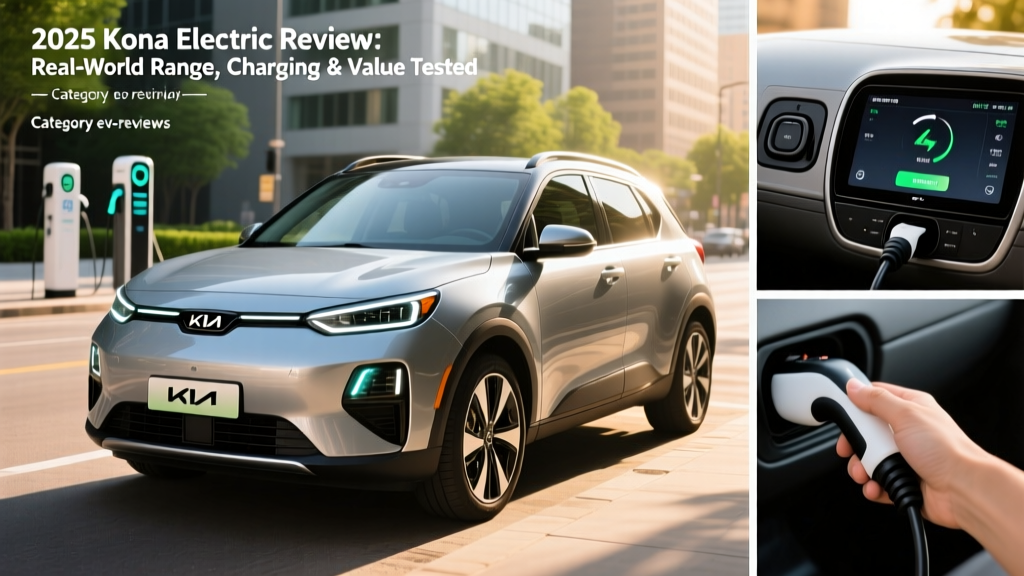
Quick Verdict: The Subcompact EV That Plays It Smart
The 2025 Hyundai Kona Electric doesn't chase headline-grabbing range or blistering acceleration. Instead, it delivers a pragmatic formula: 261 miles of EPA-estimated range, a usable 100 kW DC fast-charging peak, competitive pricing starting at $32,975, and Hyundai's industry-leading warranty. For urban commuters and suburban drivers who can charge at home, it remains one of the most rational subcompact EVs on the market — even as competition intensifies from the Chevrolet Equinox EV, Volvo EX30, and Hyundai's own Ioniq 5.
After spending time with the Kona Electric across mixed driving cycles, here's what the spec sheet doesn't tell you: real-world highway range drops noticeably, the charging curve tapers hard past 80%, and the NACS adapter situation matters more than you'd think. Let's break down exactly what you're getting.
Range, Battery, and Efficiency: The Real Numbers
The 2025 Kona Electric is powered by a 65.4 kWh (gross) lithium-ion battery pack using NMC (nickel-manganese-cobalt) cell chemistry, with approximately 62 kWh usable. This feeds a single front-mounted permanent-magnet synchronous motor producing 201 horsepower and 188 lb-ft of torque.
| Spec | Value |
|---|---|
| EPA Range (SEL and above) | 261 miles |
| EPA Range (SE trim, 17" wheels) | 261 miles |
| Battery Capacity (gross / usable) | 65.4 kWh / ~62 kWh |
| Battery Chemistry | NMC (Nickel-Manganese-Cobalt) |
| Motor Output | 201 hp / 188 lb-ft |
| Drivetrain | FWD (single motor) |
| 0-60 mph | ~7.3 seconds |
| EPA Combined MPGe | 116 MPGe |
| Efficiency | 29 kWh/100 mi |
| Top Speed | 108 mph (electronically limited) |
Real-World Range Expectations
EPA sticker: 261 miles. Here's what to actually plan for:
- City/suburban mixed driving (65°F): 250–270 miles. The Kona Electric's efficiency shines at lower speeds where regenerative braking recaptures energy effectively.
- Highway cruising (70-75 mph, 65°F): 210–230 miles. Aerodynamic drag hits all EVs hard at sustained speed, and the Kona's relatively compact battery shows the loss more than larger-pack rivals.
- Cold weather (below 32°F, mixed driving): 175–200 miles. NMC chemistry loses roughly 25-35% capacity in freezing temperatures without consistent preconditioning. The Kona Electric lacks a dedicated heat pump in the US market (it uses resistive PTC heating), which compounds cold-weather range loss compared to heat-pump-equipped rivals like the Ioniq 5.
Bottom line: Plan trips around 200 miles of usable range in moderate conditions and 170 in deep winter to avoid surprise.
The 116 MPGe combined rating translates to roughly 29 kWh consumed per 100 miles driven, according to fueleconomy.gov. That's competitive within the subcompact segment — slightly behind the Tesla Model Y (28 kWh/100 mi) but ahead of the Volvo XC40 Recharge (35 kWh/100 mi).
Charging Speed: DC Fast, Level 2, and the NACS Question
Charging is where the 2025 Kona Electric draws the most buyer scrutiny — and where expectations need calibration.
| Charging Level | Power / Rate | Time / Range Added |
|---|---|---|
| Level 1 (120V household) | ~1.4 kW | ~4-5 miles per hour of charging |
| Level 2 (240V, home/public) | Up to 10.9 kW (48A) | ~35 miles per hour; full charge in ~6.5 hours |
| DC Fast Charge (peak) | Up to 100 kW | 10-80% in approximately 43 minutes |
The 100 kW peak DC fast-charging rate is the Kona Electric's most debated spec. In a market where the Ioniq 5 peaks at 240 kW and the Tesla Model Y at 250 kW, 100 kW looks dated. Here's the real-world charging experience:
- 10-40% SoC: The Kona sustains close to its 100 kW peak, adding roughly 80-90 miles of range in about 15 minutes.
- 40-70% SoC: Power tapers to approximately 70-80 kW.
- 70-80% SoC: Further taper to ~50-60 kW.
- Above 80% SoC: Charging slows dramatically to protect battery health — expect 20-30 kW. This is normal charge-curve behavior, but it means 80-100% can take nearly as long as 10-80%.
For road trips, this means planning 40-45 minute stops at 150+ kW chargers to go from 10% to 80%. That's manageable for a subcompact crossover positioned primarily as a commuter vehicle, but it's noticeably slower than the 18-20 minute stops you'd experience in an Ioniq 5 or EV6 on the same charger.
The connector situation: The 2025 Kona Electric ships with a CCS1 (Combined Charging System) inlet. Hyundai provides a NACS-to-CCS adapter for Tesla Supercharger access in many markets, but verify adapter availability and Supercharger compatibility at your local stalls before relying on it. Hyundai has confirmed future models will adopt NACS natively, but the 2025 Kona Electric remains CCS1-equipped.
Performance and Driving Dynamics
The 201-horsepower single-motor FWD setup delivers adequate acceleration for daily driving. The 0-60 mph time of approximately 7.3 seconds won't thrill enthusiasts, but it's perfectly competent for highway merging and urban traffic. Torque delivery is instant and linear, as expected from an EV.
Where the Kona Electric impresses is ride quality. The second-generation platform (introduced for the 2024 model year) uses a multi-link rear suspension that absorbs road imperfections better than the torsion-beam setup of its predecessor. Steering is light and predictable — ideal for parking but lacking the feedback some drivers prefer on winding roads.
Regenerative braking offers four levels adjustable via steering-wheel paddles, from coast (level 0) to near one-pedal driving (level 3 with i-Pedal mode engaged). The transition between regen and friction braking is smooth, a common pain point in cheaper EVs that Hyundai has clearly addressed.
Notable omission: No all-wheel-drive option exists. If you need AWD for snow-belt winters or trailered cargo, you'll need to look at the Ioniq 5 (AWD available) or the Chevrolet Equinox EV AWD.
Interior, Cargo, and Technology
The 2025 Kona Electric's cabin is a significant step up from the first-generation model. Dual 12.3-inch displays (digital cluster and infotainment) sit behind a curved panoramic housing. Physical buttons for climate control and volume are retained — a practical choice that reviewers and owners consistently praise over touchscreen-only interfaces.
Interior dimensions:
| Measurement | Value |
|---|---|
| Front headroom | 39.9 inches |
| Front legroom | 41.7 inches |
| Rear headroom | 38.1 inches |
| Rear legroom | 38.2 inches |
| Cargo (behind rear seats) | 25.5 cu ft |
| Cargo (rear seats folded) | 63.7 cu ft |
| Frunk (front trunk) | None (no under-hood storage) |
The 25.5 cubic feet of rear cargo space is competitive with the Kia Niro EV (23.9 cu ft) and significantly larger than the Mazda MX-30 (21.0 cu ft). However, it trails the Chevrolet Equinox EV (26.4 cu ft) and lacks any frunk storage — a missed opportunity for stowing charging cables.
Infotainment and driver assists:
- Wireless Apple CarPlay and Android Auto (standard across all trims)
- Hyundai SmartSense suite: forward collision-avoidance assist, blind-spot collision-avoidance, rear cross-traffic collision-avoidance, lane-keeping assist, driver attention warning
- Highway Driving Assist (HDA) on SEL and above — a Level 2 SAE system combining adaptive cruise with lane centering. Driver must keep hands on wheel and eyes on road at all times.
- Digital Key 2 (NFC/BLE phone-as-key) on Limited trim
- Over-the-air (OTA) software updates supported
- Vehicle-to-load (V2L) capability with optional adapter — power devices up to 1.9 kW from the charge port
ADAS Level Clarification
Hyundai's Highway Driving Assist is an SAE Level 2 driver-assistance system. It is not autonomous or self-driving. You must remain fully engaged, monitor the road, and keep your hands on the steering wheel. The system will issue escalating warnings and eventually bring the vehicle to a stop if driver input is not detected.
Pricing, Trims, and Federal Tax Credit Eligibility
The 2025 Kona Electric is offered in three trims, all sharing the same 65.4 kWh battery and 201-hp FWD powertrain:
| Trim | Base MSRP | Key Additions Over Base |
|---|---|---|
| SE | $32,975 | 17" alloy wheels, heated front seats, SmartSense suite, 12.3" dual displays, wireless CarPlay/Android Auto |
| SEL | $34,475 | Highway Driving Assist, roof rails, wireless phone charging, power driver seat, LED interior lighting |
| Limited | $38,975 | 19" alloy wheels, ventilated front seats, heated steering wheel, Digital Key 2, Bose premium audio, sunroof, leather seats, HDA with lane change assist |
Destination charge: $1,395 (added to all trims).
Our as-tested Limited with Abyss Black Pearl paint and carpeted floor mats came to $41,015 out the door before incentives.
Does the 2025 Kona Electric Qualify for the Federal EV Tax Credit?
The 2025 Kona Electric is assembled in South Korea, which under current IRS §30D rules disqualifies it from the full $7,500 new clean vehicle credit because it does not meet the North American final assembly requirement. However, there are important nuances:
- Lease loophole (§45W): If you lease rather than buy, the lessor (dealership/finance company) may receive a $7,500 commercial clean vehicle credit and pass some or all of that savings to you as a lease incentive. Many Hyundai dealers advertise "$7,500 lease credit" — confirm the exact pass-through amount before signing.
- Used EV credit (§25E): If you purchase a qualifying pre-owned Kona Electric from a dealer for $25,000 or less, you may be eligible for a used clean vehicle credit of up to $4,000 (30% of sale price), subject to income caps.
- State incentives: Many states offer additional rebates or tax credits that do not carry the same assembly restrictions. Check your state's energy office or fueleconomy.gov's incentive finder for current programs.
§30D Federal Tax Credit Checklist (Purchase)
- ❌ Final assembly in North America — Kona Electric is built in South Korea (does NOT qualify for purchase credit)
- ✅ MSRP under $55,000 for SUVs — all trims qualify on price cap
- ⚠️ Buyer income caps apply if credit were available: $150K single / $225K HOH / $300K joint
- ⚠️ Battery critical mineral and component sourcing requirements apply for any qualifying vehicle
- ✅ Point-of-sale transfer available for vehicles that do qualify — reduces purchase price at dealer
Source: IRS.gov §30D guidelines. Tax rules change frequently — consult a tax professional and verify current eligibility before purchasing.
Warranty and Long-Term Ownership
Hyundai's warranty coverage is a genuine competitive advantage and a primary reason buyers cross-shop the Kona Electric against rivals with weaker coverage:
| Coverage | Term |
|---|---|
| New Vehicle Limited | 5 years / 60,000 miles |
| Powertrain | 10 years / 100,000 miles |
| EV Battery (capacity retention) | 10 years / 100,000 miles (replaces if capacity falls below 70%) |
| Corrosion Perforation | 7 years / unlimited miles |
| Roadside Assistance | 5 years / unlimited miles |
| Complimentary Maintenance | 3 years / 36,000 miles (oil changes irrelevant; covers tire rotation, multi-point inspection) |
The 70% capacity retention threshold on the battery warranty is industry-standard (matching Tesla, Kia, and Ford). Real-world data from first-generation Kona Electric owners suggests NMC packs in this application typically retain 90-93% capacity after 100,000 miles under normal use — well above the warranty threshold. Hyundai's 10-year/100,000-mile powertrain coverage exceeds most competitors; Toyota offers similar hybrid battery coverage, but few match it for full EVs.
How It Stacks Up Against Key Competitors
| Spec | 2025 Kona Electric | 2025 Chevy Equinox EV (3RS) | 2025 Volvo EX30 (Plus) | 2025 Hyundai Ioniq 5 (SEL) |
|---|---|---|---|---|
| EPA Range | 261 mi | 319 mi | 265 mi | 303 mi |
| Battery (usable) | ~62 kWh | ~85 kWh | ~66 kWh | ~77.4 kWh |
| DC Fast Charge Peak | 100 kW | 150 kW | 153 kW | 240 kW |
| 0-60 mph | 7.3 sec | ~7.8 sec | ~6.0 sec (RWD) | ~7.0 sec (RWD) |
| Starting MSRP | $32,975 | $34,900 | $40,150 | $42,600 |
| Federal Credit (Purchase) | No (Korea-built) | Yes (US-built, partial) | No (China-built battery) | No (Korea-built) |
| AWD Available? | No | Yes | Yes | Yes |
Pros
- Low starting price — undercuts most competitors at $32,975
- Best-in-class warranty (10yr/100K battery + powertrain)
- Comfortable ride quality with multi-link rear suspension
- Physical climate buttons alongside modern dual-screen setup
- Strong city efficiency and regenerative braking
- Compact dimensions ideal for urban parking
- Standard wireless CarPlay/Android Auto across all trims
- V2L capability for powering external devices
Cons
- 100 kW DC peak is slow vs. 150-240 kW rivals — 43 min for 10-80%
- No AWD option limits appeal in snow-belt states
- No frunk for charging cable storage
- No heat pump (US market) — cold-weather range loss is significant
- Does not qualify for $7,500 federal purchase credit (Korea assembly)
- Rear seats are tighter than Equinox EV or Ioniq 5 for tall passengers
- Limited trim pushes price into Ioniq 5 territory with less range and slower charging
Who Should Buy the 2025 Kona Electric?
Choose the Kona Electric if:
- You commute 30-60 miles daily and charge at home overnight
- You want the lowest entry price in a new EV with a full warranty
- You prioritize city and suburban driving over long road trips
- You value Hyundai's 10-year/100,000-mile battery and powertrain coverage
- You live in a mild-to-moderate climate where cold-weather range loss is minimal
- You want to lease and benefit from the $7,500 commercial credit pass-through
Look elsewhere if:
- You regularly drive 200+ miles between charging stops (consider Ioniq 5 or Equinox EV)
- You need AWD for winter traction (Equinox EV AWD, Ioniq 5 AWD, or Subaru Solterra)
- You rely primarily on DC fast charging without home access (100 kW peak means longer waits)
- You want to purchase and claim the full $7,500 federal credit (look at US-assembled models)
- You need maximum rear-seat room or cargo volume for family duty
Frequently Asked Questions
What is the real-world range of the 2025 Kona Electric?
Expect 250-270 miles in mixed city/suburban driving at moderate temperatures, 210-230 miles on sustained highway trips at 70-75 mph, and 175-200 miles in freezing weather. The EPA rates it at 261 miles, but real-world conditions — especially highway speed and cold temperatures — consistently reduce that figure by 10-30%.
How fast does the Kona Electric charge at home and on the road?
At home on a 240V Level 2 charger (10.9 kW), you'll add roughly 35 miles of range per hour, with a full 0-100% charge taking about 6.5 hours. On a DC fast charger, it peaks at 100 kW and charges from 10-80% in approximately 43 minutes. On a standard 120V household outlet (Level 1), expect about 4-5 miles per hour — sufficient only for overnight top-ups if your daily drive is under 30 miles.
Does the 2025 Kona Electric qualify for the $7,500 federal tax credit?
Not for purchase — it's assembled in South Korea, which fails the North American final assembly requirement under IRS §30D. However, leasing may unlock a $7,500 commercial credit (§45W) that the leasing company can pass to you as a capitalized cost reduction. Always confirm the exact lease incentive with your dealer and consult a tax professional. State incentives may also apply regardless of assembly location.
How much does the Kona Electric cost after incentives?
The SE starts at $32,975 plus $1,395 destination ($34,370 total). With a qualifying lease incentive of ~$7,500, effective monthly costs can be very competitive. For purchase, your out-of-pocket cost is the full MSRP minus any state rebates. A used Kona Electric purchased for $25,000 or less may qualify for the §25E used EV credit (up to $4,000).
Is the Kona Electric worth buying vs. the Ioniq 5 or Equinox EV?
It depends on your priorities. If budget is paramount and you drive mostly in the city with home charging, the Kona Electric's lower price and excellent warranty make it a strong choice. If you need more range (319 mi), faster DC charging (150-240 kW), AWD, or federal purchase credit eligibility, the Equinox EV or Ioniq 5 are worth the premium. The Kona Electric wins on value; its rivals win on capability.
Does the Kona Electric have a heat pump?
No — US-market Kona Electrics use resistive PTC heating rather than a heat pump. This means cabin heating in cold weather draws more energy from the battery, contributing to the 25-35% range loss observed in freezing temperatures. Hyundai offers heat pumps in some international markets, but not in the United States for this model.
Can I use Tesla Superchargers with the Kona Electric?
Hyundai provides or offers a NACS-to-CCS adapter for access to Tesla's Supercharger network (V3 stalls with Magic Dock or via adapter). Confirm adapter availability for your specific VIN and check Supercharger compatibility in the Tesla app before planning trips around Supercharger-only routes. Native NACS ports are expected on future Hyundai models, but the 2025 Kona Electric ships with CCS1.
What is the battery replacement cost?
Full battery pack replacement for the Kona Electric is estimated at $12,000-$18,000 out of warranty (parts and labor), based on current Hyundai parts pricing and industry data. However, battery failure before 100,000 miles is rare, and Hyundai's 10-year/100,000-mile battery warranty covers replacement if capacity drops below 70%. Most owners will never need an out-of-pocket battery replacement during typical ownership.
Sources: EPA Fuel Economy, IRS New Clean Vehicle Credit, Hyundai News.