Quick Verdict: The Three-Row EV Families Have Been Waiting For
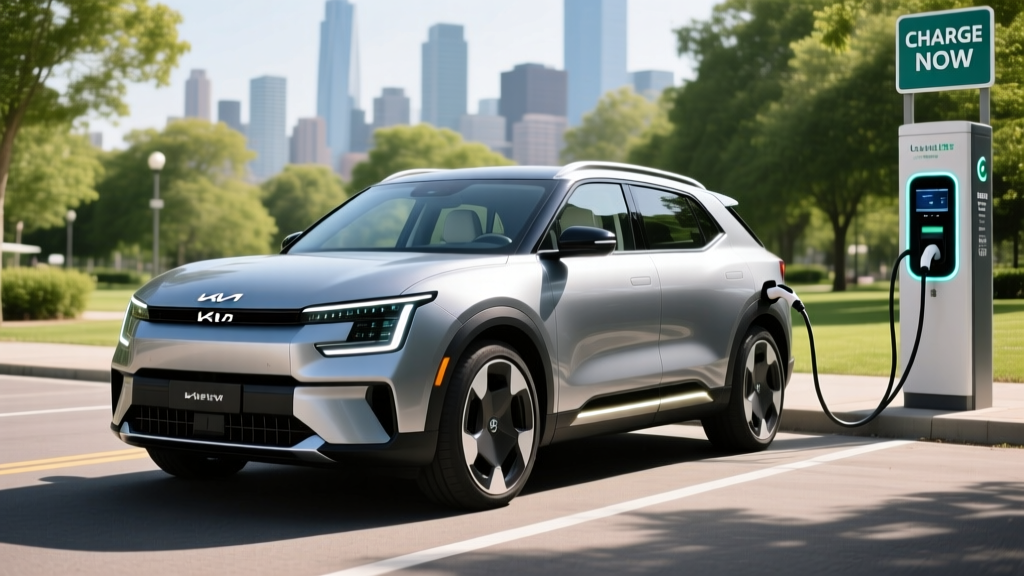
The 2025 Kia EV9 electric SUV occupies a space that was almost empty until recently: a genuinely usable three-row, battery-electric family hauler with mainstream pricing. With up to 304 miles of EPA-estimated range, 800-volt architecture enabling 10–80% DC fast charges in roughly 24 minutes, and seating for seven, the EV9 makes a compelling case for families ready to go electric without stepping into luxury-brand pricing.
But the EV9 isn't without compromises. Real-world highway range falls noticeably short of the EPA sticker, the third row is best suited for children on longer trips, and at over $54,000 starting, it demands careful tax-credit math to justify against hybrid alternatives like the Kia Sorento PHEV or Toyota Grand Highlander Hybrid. Here's everything you need to know before you buy.
Range, Battery & Efficiency: What the Numbers Actually Mean
EPA Estimated: 230 mi (Light RWD) / 304 mi (Wind RWD) / 270 mi (Land AWD)
Real-World Expectation: Plan for ~240–260 miles on the Wind RWD at highway speeds (70–75 mph). In cold weather (below 30°F), expect a 20–30% reduction, dropping effective range to roughly 185–210 miles on the AWD Land trim. City driving with regenerative braking recovers closer to the EPA number.
The EV9 uses a 99.8 kWh usable battery pack (gross capacity approximately 100.4 kWh) across the Wind, Land, and GT-Line trims. The base Light trim gets a smaller 76.1 kWh pack. Both use NMC (nickel manganese cobalt) chemistry, which offers higher energy density than LFP — important in a large SUV where weight and space are at a premium — but requires more careful long-term charging habits to minimize degradation.
On the efficiency front, the Wind RWD returns an EPA-rated 89 MPGe combined, which translates to roughly 38 kWh per 100 miles. That's competitive for a 5,000+ lb three-row SUV, though it trails the smaller Hyundai Ioniq 5's efficiency. The AWD Land trim drops to 83 MPGe combined. For context, charging at home at $0.14/kWh, that's about $0.053 per mile — roughly a third of what a comparable gas SUV costs at $3.50/gallon and 22 MPG.
| Spec | Light RWD | Wind RWD | Land AWD | GT-Line AWD |
|---|---|---|---|---|
| Battery (usable) | 76.1 kWh (NMC) | 99.8 kWh (NMC) | 99.8 kWh (NMC) | 99.8 kWh (NMC) |
| EPA Range | 230 mi | 304 mi | 270 mi | 270 mi |
| MPGe (combined) | 84 MPGe | 89 MPGe | 83 MPGe | 83 MPGe |
| Efficiency (kWh/100mi) | 40 | 38 | 41 | 41 |
Source: fueleconomy.gov
Charging Speed: 800-Volt Architecture Pays Off
Kia's E-GMP platform — shared with the Hyundai Ioniq 5 and Genesis Electrified GV70 — uses an 800-volt electrical architecture, which translates to genuinely fast DC charging when you find a compatible station. Here's what that looks like across charging levels:
| Level | Power | Time / Rate | Notes |
|---|---|---|---|
| Level 1 (120V) | ~1.4 kW | ~3–4 mi/hr | Emergency top-up only; full charge takes 3+ days |
| Level 2 (240V, 48A) | 10.9 kW (onboard charger max) | ~30 mi/hr; 0–100% in ~9 hrs (99.8 kWh) | Requires 60A dedicated circuit; overnight home charging |
| DC Fast Charge | Peak 210 kW (99.8 kWh pack) | 10–80% in ~24 min | Requires 350 kW-class charger; charge curve tapers significantly above 80% |
Understanding the charge curve: The EV9's peak 210 kW draw occurs between roughly 10–55% State of Charge. Above 60%, the rate begins tapering, and above 80% it drops steeply to protect battery health — often falling below 60 kW. This is normal for NMC chemistry, but it means charging from 80–100% at a DC fast charger is painfully slow. Plan your road-trip stops to charge from 10–80% and move on.
For home charging, the EV9's 10.9 kW onboard charger is one of the faster Level 2 acceptance rates in its class. A full overnight charge from 10% takes about 9 hours on the large battery — perfectly manageable with a typical overnight plug-in schedule. Installation of a 48A Level 2 home charger (requiring a 60A breaker) typically costs $800–$2,000 including equipment and electrician labor, depending on your panel's proximity to the garage.
The EV9 uses a CCS1 connector for DC fast charging. Through Kia's partnership with Tesla, EV9 owners have access to Tesla Supercharger stations using an adapter (included or available depending on trim and model year). This significantly expands the available fast-charging network for road trips.
Performance & Drivetrain
The EV9 offers two distinct powertrain configurations:
- RWD (Light & Wind): Single rear motor producing 215 hp and 258 lb-ft of torque. 0–60 mph in approximately 8.2 seconds. Adequate for merging and daily driving, but not quick by EV standards.
- AWD (Land & GT-Line): Dual-motor setup producing 379 hp and 516 lb-ft of torque (with boost mode engaged). 0–60 mph in approximately 5.0 seconds. Noticeably more confident on highway on-ramps and in passing situations.
Towing capacity is rated at 5,000 lbs for AWD trims and 2,000 lbs for RWD — competitive with midsize gas SUVs and a genuine advantage over many EV competitors. If you're pulling a small boat or a light travel trailer, the AWD EV9 handles it.
Ride quality leans comfort-oriented, with well-damped suspension tuning that absorbs highway imperfections. The steering is light and vague — this is a family cruiser, not a sport SUV — but body roll is controlled for a vehicle of this height and weight.
Interior Space, Cargo & Family Practicality
The EV9's defining feature is its three-row layout in a fully electric package. Here's how the dimensions stack up:
- First-row legroom: 41.4 inches
- Second-row legroom: 42.8 inches (captain's chairs) — genuinely spacious, even for tall adults
- Third-row legroom: 32.0 inches — suitable for children or short trips; tight for adults beyond 5'6"
- Cargo (behind 3rd row): 20.2 cu ft — enough for a few grocery bags or a compact stroller
- Cargo (behind 2nd row): 43.5 cu ft — competitive with midsize SUVs
- Cargo (behind 1st row, max): 81.7 cu ft — nearly flat load floor
- Frunk (front trunk): 1.8 cu ft (AWD) / 3.2 cu ft (RWD) — useful for charging cables or a small bag
The second row is where the EV9 shines. Available captain's chairs recline, slide fore/aft, and include a "relaxation mode" that reclines the seat for rest stops while charging. The cabin materials are convincing for the price point — soft-touch surfaces on the dashboard and door uppers, with hard plastics relegated to lower panels where they're less noticeable.
The 12.3-inch digital instrument cluster and 12.3-inch infotainment touchscreen are mounted in a single curved housing. The system supports wireless Apple CarPlay and Android Auto, OTA (over-the-air) updates, and Kia's Digital Key 2 (using your smartphone as a key). Physical climate controls remain — a welcome decision for a family vehicle where gloved hands and quick adjustments matter.
Pricing, Trims & Federal Tax Credit Eligibility
The 2025 EV9 lineup spans five trims with meaningful equipment differences:
| Trim | Drivetrain | MSRP | Est. After §30D Credit* | Key Equipment |
|---|---|---|---|---|
| Light | RWD | $54,900 | ~$47,400 | 76.1 kWh, basic ADAS, 19" wheels |
| Wind | RWD | $59,900 | ~$52,400 | 99.8 kWh (304 mi), heated/ventilated front seats |
| Land | AWD | $63,900 | ~$56,400 | Dual motor, captain's chairs, premium audio |
| GT-Line | AWD | $69,900 | ~$62,400 | Sport styling, boost mode, HDA2, 21" wheels |
| GT-Line Prestige | AWD | $73,900 | ~$66,400 | All GT-Line + Nappa leather, massaging seats, head-up display |
*Tax credit estimate assumes full $7,500 §30D eligibility. Actual credit depends on buyer income, battery sourcing, and MSRP caps. Consult a tax professional.
- MSRP Cap: SUVs/vans must have an MSRP at or below $80,000. All EV9 trims qualify.
- Income Cap: Modified AGI must not exceed $300,000 (joint), $225,000 (head of household), or $150,000 (single).
- Battery Sourcing: The $7,500 credit splits into two halves — $3,750 for critical-minerals sourcing and $3,750 for battery-component sourcing. The EV9's eligibility for each half depends on supply-chain compliance, which has tightened under current IRS rules.
- Point-of-Sale Transfer: You can transfer the credit to the dealer at purchase, reducing your out-of-pocket cost immediately rather than waiting for tax filing.
Verify current eligibility on the IRS qualified vehicles list before purchasing — sourcing requirements have disqualified some previously eligible models mid-year.
Warranty & Long-Term Ownership
Kia backs the EV9 with one of the strongest warranty packages in the segment:
- Battery & Drive Unit: 10 years / 100,000 miles
- Limited (bumper-to-bumper): 5 years / 60,000 miles
- Powertrain: 10 years / 100,000 miles
- Roadside Assistance: 5 years / 60,000 miles
The battery warranty guarantees that the pack will retain at least 70% of its original capacity over the 10-year/100,000-mile period. Given that NMC batteries in Hyundai/Kia's E-GMP platform have shown roughly 8–12% degradation over the first 100,000 miles in real-world fleet data (based on Ioniq 5 tracking), the 70% threshold provides a comfortable buffer.
For ownership costs, insurance premiums on the EV9 run approximately 15–25% higher than a comparably priced gas SUV, consistent with EV industry averages. Expect annual premiums in the $1,800–$2,400 range depending on your state, driving record, and coverage level.
Driver Assistance & Safety Technology
The EV9 comes equipped with Kia's Highway Driving Assist 2 (HDA2) on Land and GT-Line trims. This is a SAE Level 2 driver-assistance system — it provides adaptive cruise control with stop-and-go, lane-centering steering, and lane-change assist, but requires continuous driver supervision. You must keep your hands on the wheel and eyes on the road at all times.
HDA2 assists with steering, acceleration, and braking on highways. It does NOT drive the vehicle autonomously. The driver is legally and operationally responsible at all times.
Standard safety features across all trims include forward collision-avoidance assist with pedestrian/cyclist detection, blind-spot monitoring with rear cross-traffic alert, rear occupant alert, and safe exit assist. The EV9 earned an IIHS Top Safety Pick designation and a 5-star overall NHTSA safety rating.
A standout feature: the EV9 offers Vehicle-to-Load (V2L) capability via an available outlet, allowing you to power appliances, tools, or even a home during an outage (up to 3.6 kW output). For camping or emergency preparedness, this is a genuine differentiator.
Pros & Cons: The Honest Summary
✅ Pros
- Genuine three-row seating with usable second-row space for adults
- 800V architecture enables ~24-minute 10–80% DC fast charges
- 304-mile EPA range (Wind RWD) covers most road-trip legs comfortably
- 10-year/100,000-mile battery warranty is among the best in class
- V2L capability adds utility beyond transportation
- 5,000-lb towing capacity (AWD) is competitive with gas midsize SUVs
- Tesla Supercharger access via adapter expands charging network
❌ Cons
- Third row is tight for adults — 32" legroom limits long-trip comfort
- Real-world highway range drops to ~240–260 mi (Wind RWD); cold weather cuts further
- RWD Light trim's 230-mile range is underwhelming at this price point
- Base MSRP of $54,900 is steep before incentives; tax credit eligibility is not guaranteed
- CCS1 connector requires adapter for Tesla Supercharger access
- No frunk on AWD models (1.8 cu ft is barely functional)
- Insurance premiums run 15–25% higher than comparable gas SUVs
Who Should Buy the 2025 Kia EV9?
Choose the EV9 if:
- You need three rows of seating and want a fully electric powertrain
- You have reliable home Level 2 charging access
- You take road trips within a 250-mile radius (or are willing to plan DC fast-charge stops)
- You value the 10-year battery warranty and Kia's improving reliability record
- You qualify for the full $7,500 federal tax credit, bringing the effective price below $50K–$55K
Look elsewhere if:
- You regularly need adult-sized third-row seating (consider a minivan or the Rivian R1S)
- You lack home charging access and your area has sparse public DC infrastructure
- Your budget is firm below $50K even after incentives (consider the Hyundai Ioniq 5 or a PHEV like the Sorento Plug-In Hybrid)
- You frequently drive in extreme cold and need consistent 300+ mile range (the Rivian R1S Dual-Motor Max Pack offers 410 mi EPA)
Frequently Asked Questions
What is the real-world range of the 2025 Kia EV9?
The EPA rates the Wind RWD at 304 miles and the Land AWD at 270 miles. In real-world highway driving at 70–75 mph, expect roughly 240–260 miles from the Wind RWD and 215–235 miles from the Land AWD. In cold weather (below 30°F), reduce those figures by an additional 20–30%. City driving with regenerative braking will get you closer to the EPA sticker.
How fast does the EV9 charge at home and on the road?
At home on a Level 2 charger (240V, 48A), the EV9 accepts up to 10.9 kW, adding roughly 30 miles of range per hour and fully charging the 99.8 kWh pack overnight in about 9 hours. On a 350 kW-class DC fast charger, it peaks at 210 kW and charges from 10–80% in approximately 24 minutes, though the charge curve tapers significantly above 80%.
Does the 2025 Kia EV9 qualify for the $7,500 federal EV tax credit?
The EV9 meets the MSRP cap (all trims are under $80,000). However, full $7,500 eligibility depends on (1) the buyer's income falling under IRS thresholds ($300K joint, $150K single), and (2) battery component and critical-mineral sourcing requirements that change periodically. Check the IRS qualified vehicles list before purchasing, and consult a tax professional for your specific situation.
Is the Kia EV9 worth buying over the Rivian R1S or Tesla Model X?
The EV9 offers the best value proposition among three-row EVs when the tax credit is applied, starting effectively around $47,000–$52,000 depending on trim. The Rivian R1S ($75,900+) offers more off-road capability, a larger battery option (410 mi EPA), and a more premium feel, but at a significant price premium. The Tesla Model X ($79,990+) offers more range and Supercharger-native access but at nearly double the EV9's effective price. For budget-conscious families who don't need extreme range or off-road chops, the EV9 is the pragmatic choice.
How does the EV9 handle cold weather?
Like all EVs, the EV9 experiences reduced range in cold temperatures — typically 20–30% below the EPA estimate when temperatures drop below 30°F. The EV9 is equipped with a heat pump (standard on all trims), which significantly reduces the cabin-heating energy draw compared to resistive heaters. Preconditioning the battery while plugged in before a DC fast-charge stop also helps maintain charging speed in cold conditions.
Can the EV9 tow, and how does towing affect range?
AWD trims are rated to tow up to 5,000 lbs; RWD trims are rated at 2,000 lbs. When towing near the maximum capacity, expect range to drop by 30–50% depending on trailer aerodynamics and terrain. A 270-mile AWD EV9 towing a 4,000-lb travel trailer may see effective range drop to 140–180 miles, requiring more frequent charging stops.