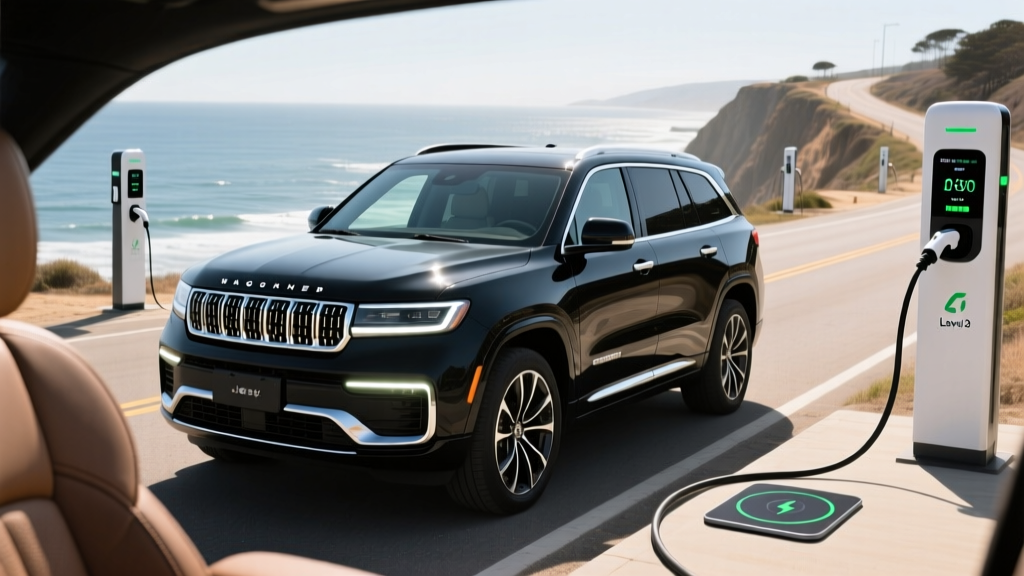
The 2025 Jeep Wagoneer S Limited is the brand's first fully electric SUV built on the STLA Large platform, and it arrives with a clear mandate: blend Jeep's off-road heritage with serious electric performance. With 600 horsepower, all-wheel drive, and a claimed 300 miles of EPA-estimated range, the Wagoneer S Limited targets buyers who want luxury-EV acceleration without abandoning the Jeep badge. But how does it stack up in real-world driving, at the charger, and on the balance sheet? We break down every number that matters.
2025 Jeep Wagoneer S Limited: Key Specs at a Glance
| Specification | Value |
|---|---|
| EPA Estimated Range | 300 miles |
| Battery Capacity (Usable) | ~100 kWh (NMC lithium-ion) |
| Drivetrain | Dual-motor AWD |
| Horsepower | 600 hp |
| Torque | 617 lb-ft |
| 0–60 mph | ~3.4 seconds |
| Max DC Fast Charge Rate | ~100 kW (peak) |
| 10–80% DC Charge Time | ~38 minutes (estimated) |
| Level 2 Home Charging | 11.5 kW onboard charger |
| EPA Efficiency | ~88 MPGe combined / ~38 kWh/100 mi |
| Cargo Volume (Behind 2nd Row) | ~30 cu ft |
| Cargo Volume (Max, Seats Folded) | ~60 cu ft |
| Battery/Powertrain Warranty | 8 years / 100,000 miles |
| Base MSRP (Limited Trim) | $65,995 (before destination) |
| Destination Charge | $1,995 |
Range and Efficiency: EPA vs. the Real World
Real-World Expectation: Expect approximately 250–275 miles on mixed highway driving at 70–75 mph. In cold weather (below 32°F), plan for a 15–25% reduction, bringing usable range to roughly 225–255 miles depending on cabin heating demand and terrain.
The Wagoneer S Limited's 300-mile EPA figure places it in the middle of the luxury electric SUV segment — behind the BMW iX xDrive50 (324 miles EPA) but ahead of the base Jaguar I-PACE (246 miles). The ~100 kWh usable battery uses NMC (nickel manganese cobalt) chemistry, which offers higher energy density than LFP but requires more careful thermal management for long-term health.
Efficiency lands at roughly 88 MPGe combined (about 38 kWh per 100 miles), which is typical for a 5,500+ lb dual-motor AWD SUV. Highway efficiency drops noticeably — expect closer to 80–82 MPGe at sustained 75 mph speeds due to the Wagoneer S's boxy aerodynamic profile. City driving with frequent regenerative braking opportunities will push that figure closer to 92–95 MPGe.
One practical note: the Wagoneer S does not include a heat pump as standard equipment on the Limited trim (confirmed via Jeep's 2025 spec sheet). In sub-freezing climates, resistive cabin heating will consume additional energy, compounding range loss beyond what a heat-pump-equipped competitor like the Hyundai Ioniq 5 or Tesla Model Y would experience.
Charging Performance: DC Fast Charging and Home Setup
| Charging Level | Power (kW) | Speed / Time | Connector |
|---|---|---|---|
| Level 1 (120V household) | ~1.4 kW | ~3–4 miles per hour | J1772 / NACS (with adapter) |
| Level 2 (240V home/public) | Up to 11.5 kW | ~28–32 miles per hour; full charge in ~9 hours | J1772 or NACS |
| DC Fast Charge | ~100 kW peak | 10–80% in ~38 min; ~150 mi in 20 min | CCS1 (NACS adapter available) |
The Wagoneer S Limited's ~100 kW peak DC fast-charging rate is the most debated spec on this vehicle. For context, competitors like the Hyundai Ioniq 5 (peak 240 kW), Kia EV9 (peak 210 kW), and the Tesla Model X (peak 250 kW) charge significantly faster at public DC stations. A 100 kW peak means that even under ideal conditions — battery preconditioned, SoC below 20%, moderate ambient temperature — you're looking at roughly 38 minutes from 10% to 80%.
The charge curve on the STLA Large platform tapers predictably above 80% SoC, dropping to roughly 40–50 kW to protect the NMC cells. Plan on 50–60 minutes for a 10–90% session if you need maximum range for a long highway stretch.
At home on a Level 2 charger (48-amp circuit, 11.5 kW), the math works well for daily ownership: a full overnight charge adds roughly 280+ miles in 9 hours, more than enough for any daily commute. Jeep provides a mobile charging cord with the vehicle, but buyers should budget for a professional Level 2 wall connector installation — typically $500–$1,500 for equipment and electrician labor depending on panel proximity and local permitting, per U.S. Department of Energy guidance.
Performance and Driving Dynamics
The dual-motor all-wheel-drive powertrain produces 600 horsepower and 617 lb-ft of torque, launching the Wagoneer S Limited to 60 mph in approximately 3.4 seconds. That puts it in the same acceleration bracket as the BMW iX M60 and well ahead of the Rivian R1S dual-motor (which hits 60 in roughly 4.5 seconds in its standard configuration).
The AWD system uses independent front and rear motors with torque vectoring capability. Jeep has programmed several drive modes including Snow, Sand, and a terrain-select mode that adjusts throttle response, regen aggressiveness, and torque distribution. While this is not a Wrangler Rubicon, the Wagoneer S can handle light off-road trails, gravel roads, and snowy mountain passes with confidence.
One-pedal driving is available with adjustable regen levels, though the maximum regen setting does not bring the vehicle to a complete stop — you'll still need the friction brakes at very low speeds. The air suspension (standard on Limited) provides up to 10.2 inches of ground clearance in its highest setting and automatically lowers at highway speeds for improved aerodynamics.
Interior, Cargo, and Technology
The cabin seats five passengers with generous space: rear legroom measures approximately 40.9 inches, and front legroom comes in at 41.2 inches. The flat floor (a benefit of the dedicated EV platform) makes the middle rear seat genuinely usable for adults on shorter trips.
Cargo capacity behind the second row sits at roughly 30 cubic feet — competitive with the BMW iX (35.5 cu ft) but less than the three-row Rivian R1S or Kia EV9. Folding the 60/40 split rear seats opens up approximately 60 cubic feet, adequate for camping gear, luggage for a family road trip, or a Costco run.
The infotainment system runs Stellantis' Uconnect 5 on a 12.3-inch center touchscreen plus a 10.25-inch passenger display. Wireless Apple CarPlay and Android Auto are standard, along with a Wi-Fi hotspot, over-the-air update capability, and a digital rearview mirror. The Limited trim includes a 19-speaker McIntosh audio system — a heritage-brand touch that differentiates the Wagoneer S from its tech-focused rivals.
Driver-assistance features include adaptive cruise control with stop-and-go, lane-centering assist, automatic emergency braking with pedestrian detection, and a surround-view camera. This is an SAE Level 2 system — the driver must remain attentive and keep hands on the wheel at all times. Jeep does not currently offer a hands-free highway driving system comparable to GM's Super Cruise or Ford's BlueCruise on the Wagoneer S.
Pricing, Trims, and Federal Tax Credit Eligibility
| Cost Element | Amount |
|---|---|
| Base MSRP (Wagoneer S Limited) | $65,995 |
| Destination Charge | $1,995 |
| Typical As-Tested Price (with options) | $68,000–$72,000 |
| Federal EV Tax Credit (§30D) — Max | Up to $7,500 |
| Effective Price After Max Credit | ~$58,495–$60,495 |
| Estimated 5-Year Fuel Savings vs. Gas SUV* | $4,000–$6,000 |
*Savings estimate based on 15,000 miles/year, $0.14/kWh home charging, and $3.50/gallon gasoline in a comparable 22 MPG gas SUV. Actual savings vary by local electricity and fuel prices.
The Wagoneer S Limited starts at $65,995 before destination, placing it squarely in the luxury electric SUV bracket. It sits below the $80,000 MSRP cap for SUVs under IRS §30D federal tax credit rules, meaning it can qualify for the full $7,500 credit — but only if the buyer meets all current eligibility requirements:
- Income cap: Modified adjusted gross income (MAGI) must not exceed $150,000 (single), $225,000 (head of household), or $300,000 (married filing jointly)
- MSRP cap: Vehicle MSRP must not exceed $80,000 for SUVs — the Wagoneer S Limited clears this threshold at $65,995 base
- Battery sourcing: A percentage of critical minerals and battery components must be sourced from the U.S. or free-trade-agreement countries; these thresholds increase annually. Verify current-year compliance with your dealer and the IRS qualifying vehicle list
- Point-of-sale transfer: Eligible buyers can transfer the credit to the dealer at purchase, reducing the upfront price rather than waiting for a tax return
Always confirm eligibility with a tax professional before relying on the credit in your purchase budget. Sourcing rules tighten each year, and a vehicle that qualifies in early 2025 may face different component thresholds by year's end.
How It Compares: Wagoneer S Limited vs. Key Rivals
| Spec | 2025 Jeep Wagoneer S Limited | 2025 BMW iX xDrive50 | 2025 Rivian R1S Dual-Motor | 2025 Hyundai Ioniq 5 Limited AWD |
|---|---|---|---|---|
| EPA Range | 300 mi | 324 mi | 352 mi (Max Pack) | 290 mi |
| Battery (Usable) | ~100 kWh (NMC) | 105.2 kWh (NMC) | 149 kWh (Max, NMC) | 77.4 kWh (NMC) |
| Horsepower | 600 hp | 516 hp | 665 hp | 320 hp |
| 0–60 mph | ~3.4 sec | ~4.4 sec | ~3.5 sec | ~4.5 sec |
| Peak DC Charge | ~100 kW | ~200 kW | ~200 kW | 240 kW |
| 10–80% DC Time | ~38 min | ~34 min | ~34 min | ~18 min |
| Base MSRP | $65,995 | $87,250 | $79,900 | $54,600 |
| Cargo (Behind 2nd Row) | ~30 cu ft | 35.5 cu ft | 46.7 cu ft | 27.2 cu ft |
Choose the BMW iX if: You need maximum range and faster charging, prioritize interior material quality, and budget is less of a constraint.
Choose the Rivian R1S if: You need three rows, serious off-road capability, and maximum cargo volume — and are willing to pay a premium.
Choose the Hyundai Ioniq 5 if: Ultra-fast 800V charging (18-minute 10–80%) and a lower starting price matter most, and you can accept less power and slightly less range.
Pros and Cons
Pros
- 600 hp and 3.4-second 0–60 make it one of the quickest SUVs under $70K
- 300-mile EPA range is practical for daily use and moderate road trips
- Qualifies for up to $7,500 federal tax credit (verify sourcing eligibility)
- Standard air suspension with adjustable ride height
- McIntosh 19-speaker audio and dual-screen Uconnect 5 infotainment
- Competitive base price vs. BMW iX and Rivian R1S
- Jeep brand heritage and dealer network familiarity
Cons
- ~100 kW peak DC charging is slow for the class — rivals charge 2–2.4× faster
- 38-minute 10–80% DC time means longer road-trip stops
- No available hands-free highway driving assist (Level 2 only, eyes-on)
- No heat pump standard on Limited trim — cold-weather range loss may exceed competitors
- Cargo space (~30 cu ft) trails the iX, R1S, and EV9
- Only two rows — no three-row option for larger families
- Real-world highway range likely 250–275 miles, not 300
Who Should Buy the 2025 Jeep Wagoneer S Limited?
The Wagoneer S Limited is best suited for:
- Daily commuters who charge at home overnight and rarely need public DC fast charging during the week
- Performance-oriented buyers who want muscle-car acceleration in an SUV package without spending $80K+
- Jeep loyalists transitioning from a Grand Cherokee or Wrangler who want to stay within the brand ecosystem
- Cold-climate drivers who need dual-motor AWD and air suspension for snow and rough roads (though the lack of a heat pump is a trade-off)
It is less ideal for:
- Frequent road trippers who prioritize minimal charging stop times — the 100 kW peak rate is a real limitation on long highway drives
- Large families needing three rows or maximum cargo volume
- Tech-forward buyers who expect hands-free driving assist or cutting-edge autonomous features
Frequently Asked Questions
What is the real-world range of the 2025 Jeep Wagoneer S Limited?
The EPA estimates 300 miles, but real-world mixed highway driving at 70–75 mph typically yields 250–275 miles. In cold weather below 32°F, expect 225–255 miles due to battery chemistry limitations and resistive cabin heating (no standard heat pump on the Limited trim).
How fast does the Wagoneer S charge at home and on the road?
At home on a Level 2 charger (11.5 kW), you'll add roughly 28–32 miles per hour, with a full charge taking about 9 hours. On DC fast chargers, the peak rate is approximately 100 kW, taking about 38 minutes from 10% to 80%. This is slower than key rivals — the Hyundai Ioniq 5 completes the same session in roughly 18 minutes at 240 kW peak.
How much does the Wagoneer S Limited cost after tax credits?
The base MSRP is $65,995 plus $1,995 destination. If you qualify for the full $7,500 federal EV tax credit under IRS §30D (income caps, MSRP caps, and battery-sourcing rules apply), the effective starting price drops to approximately $60,490. Point-of-sale transfer is available, reducing your upfront cost at the dealership. Always verify eligibility with a tax professional.
Does the 2025 Jeep Wagoneer S qualify for the $7,500 federal EV tax credit?
It can qualify, but eligibility depends on multiple factors: the buyer's modified adjusted gross income must be under $150K (single) / $300K (married filing jointly), the MSRP is under the $80K SUV cap, and the battery must meet current-year critical mineral and component sourcing thresholds as defined by the IRS. Check the fueleconomy.gov qualifying vehicle list and consult a tax professional before purchasing.
Is the Wagoneer S Limited worth buying over the BMW iX or Rivian R1S?
It depends on priorities. The Wagoneer S wins on raw horsepower-per-dollar (600 hp at ~$66K base) and undercuts the iX by over $20,000. However, the BMW iX offers more range (324 mi EPA), faster charging (~200 kW peak), and a more premium interior. The Rivian R1S provides three rows, more cargo room, and serious off-road chops at a higher price. If charging speed and range are your top concerns, the iX or Ioniq 5 may be stronger picks. If performance value and brand loyalty drive your decision, the Wagoneer S holds its own.
What is the battery warranty on the Wagoneer S Limited?
Jeep provides an 8-year / 100,000-mile warranty on the high-voltage battery and electric powertrain components, consistent with industry standards and federal requirements. This covers defects and capacity loss below a specified threshold (typically 60–70% of original capacity, per Stellantis warranty documentation).
Can the Wagoneer S tow?
Jeep rates the Wagoneer S for light towing, though official maximum towing capacity figures should be confirmed with your dealer. Expect a rating in the range of 3,500–5,000 lbs based on the STLA Large platform's capabilities — adequate for a small utility trailer or a pair of jet skis, but not for large boat or camper trailers. Note that towing will significantly reduce range, potentially by 30–50% depending on trailer weight and speed.