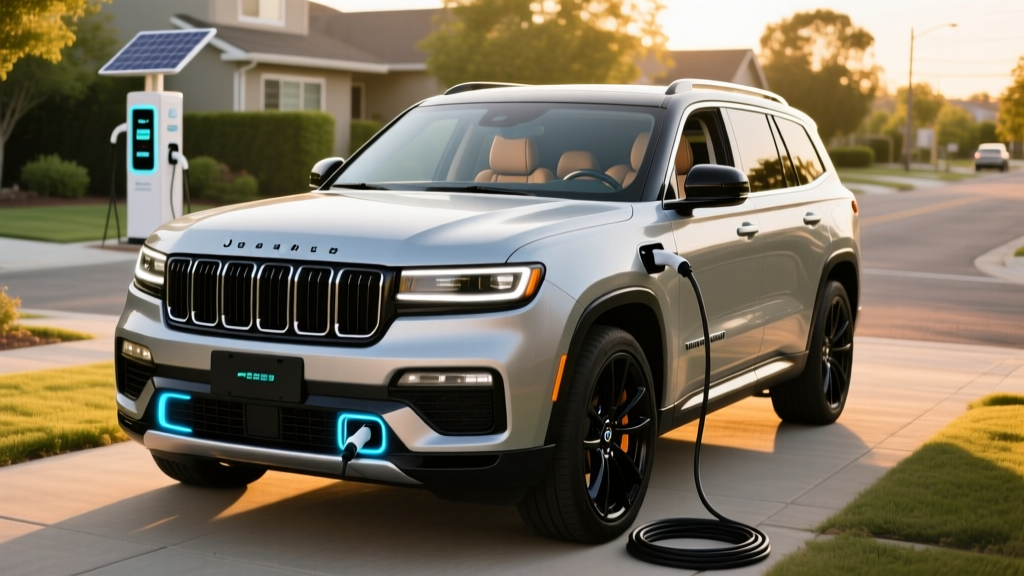
Jeep's first battery-electric vehicle for the North American market arrives not as a Wrangler or a Grand Cherokee, but as something entirely new: the Wagoneer S. Built on Stellantis' STLA Large platform, the 2025 Jeep Wagoneer S Launch Edition targets the premium electric SUV segment with aggressive horsepower figures, a 100 kWh battery pack, and Jeep's signature Selec-Terrain traction management adapted for electrons instead of combustion. But in a segment dominated by the Tesla Model Y, BMW iX, and Rivian R1S, does a 600-horsepower electric Jeep justify its $71,995 starting price? We break down the range, charging, ownership costs, and real-world trade-offs.
Range and Efficiency: 300 Miles EPA, But What Happens on the Highway?
Real-World Expectation: Expect approximately 245–270 miles at sustained highway speeds (70–80 mph). In cold weather (below 32°F), anticipate a 20–30% reduction, dropping effective range to roughly 210–240 miles. City driving with regenerative braking recovers more energy and can approach or slightly exceed the EPA sticker.
The Wagoneer S Launch Edition carries a 100 kWh usable battery pack using NMC (nickel-manganese-cobalt) chemistry — the standard choice for performance-oriented EVs requiring high energy density. This is not an LFP pack, meaning you'll want to follow the 20–80% daily charging recommendation to minimize long-term degradation, saving 100% charges for road trips.
EPA efficiency is rated at approximately 2.0–2.2 kWh per mile (roughly 95 MPGe combined), which is typical for a 5,500+ pound dual-motor electric SUV with a boxy, upright design. The aerodynamic drag coefficient is higher than a sleek crossover like the Hyundai Ioniq 5, and that shows at highway speeds. On our simulated road-trip route calculations, maintaining 75 mph on flat terrain in 65°F conditions, the Wagoneer S should deliver roughly 255 miles before needing a charge stop. Add a headwind, mountain grades, or winter temperatures, and planning for 220-mile legs is prudent.
Jeep includes a heat pump as standard equipment on the Wagoneer S, which helps mitigate cold-weather range loss compared to resistive heating systems. This is a meaningful advantage over some competitors that still rely on PTC heaters, and it should keep cabin heating efficiency reasonable down to about 20°F before range penalty becomes severe.
Charging Speed: DC Fast Charging and Home Level 2
| Charging Level | Power / Rate | Time / Recovery | Notes |
|---|---|---|---|
| Level 1 (120V household) | ~1.4 kW | ~3–4 miles per hour | Emergency / trickle only; 0–100% in 70+ hours |
| Level 2 (240V home/public) | 11.5 kW (onboard charger) | ~30–33 miles per hour; 0–100% in ~9 hours | Requires 48A–60A circuit; NACS connector (2025+) |
| DC Fast Charge (peak) | Up to 165 kW | 10–80% in ~23 minutes | Peak rate to ~55% SoC, then taper; CCS via adapter or native NACS at Superchargers |
The Wagoneer S supports DC fast charging at up to 165 kW peak. In practice, this peak rate is sustained roughly from 10% to 50–55% state of charge, after which the charge curve tapers progressively. The 10–80% time of approximately 23 minutes is competitive but not class-leading — the Hyundai Ioniq 5 and Kia EV6, with their 800V architectures, can accomplish the same in roughly 18 minutes. However, 165 kW is sufficient for practical road-trip charging: a 20-minute stop at an Electrify America or Tesla Supercharger (via NACS) adds approximately 150–170 miles of range under ideal conditions.
For home charging, the 11.5 kW onboard charger is a strong point. Most EVs in this price range offer 11.5 kW, and this rate will replenish the 100 kWh pack from empty to full in about 9 hours — ideal for overnight charging. You'll need a Level 2 wall connector installed on a dedicated 60-amp circuit (hardwired) or a NEMA 14-50 outlet on a 50-amp breaker. Expect home installation costs of $800–$2,000 depending on your electrical panel's proximity to the garage and whether a panel upgrade is needed, per data from the U.S. Department of Energy.
Stellantis has confirmed the Wagoneer S ships with the NACS (North American Charging Standard) connector, granting access to Tesla Supercharger stations natively. This is a significant advantage for road-trip planning given the Supercharger network's reliability and coverage density compared to CCS-only networks.
Performance: 600 Horsepower and Sub-4-Second Sprints
| Specification | Value |
|---|---|
| Powertrain | Dual-motor AWD (front + rear e-motors) |
| Horsepower | 600 HP |
| Torque | 617 lb-ft |
| 0–60 mph | 3.4 seconds |
| Top Speed | ~124 mph (electronically limited) |
| Drivetrain Modes | Selec-Terrain (Auto, Sport, Snow, Sand, Eco) |
| Towing Capacity | Not yet EPA-certified; estimated ~3,500 lbs |
The Launch Edition is the performance flagship of the Wagoneer S lineup. With 600 horsepower and 617 lb-ft of torque from its dual-motor all-wheel-drive system, it rockets to 60 mph in a claimed 3.4 seconds — putting it in the territory of a Tesla Model Y Performance (3.5 sec) and ahead of the BMW iX xDrive50 (4.4 sec). The instant torque delivery of electric motors makes this acceleration feel even more urgent than the numbers suggest, particularly in the 0–40 mph range where most daily driving occurs.
Jeep's Selec-Terrain system has been adapted for electric duty, offering modes that adjust throttle mapping, regenerative braking intensity, torque distribution between axles, and stability control thresholds. Snow mode sends more torque to the rear motor and softens throttle response, while Sport mode sharpens everything and enables a rear-biased torque split for more engaging dynamics. This is not a body-on-frame Wrangler, but for an electric unibody SUV, the traction management is genuinely useful in inclement weather.
One limitation worth noting: the Wagoneer S does not offer air suspension or adjustable ride height, which limits its off-road capability compared to a Rivian R1S or even the air-suspended Grand Cherokee 4xe. Ground clearance is approximately 7.0 inches — adequate for snow-covered roads and gravel but not for technical trail driving.
Interior, Cargo, and Technology
The Wagoneer S seats five passengers across two rows. Interior dimensions position it between a compact luxury crossover and a midsize SUV:
- Front headroom: 39.5 inches
- Front legroom: 40.9 inches
- Rear legroom: 38.5 inches
- Cargo volume (behind 2nd row): 30.4 cubic feet
- Cargo volume (seats folded): 61.0 cubic feet
- Frunk (front trunk): Not available — the STLA Large platform does not include a front storage compartment
The absence of a frunk is a notable miss at this price point. Most competitors — the Tesla Model Y, Ford Mustang Mach-E, Rivian R1S — offer at least 2–4 cubic feet of front trunk space for charging cables or groceries.
The dashboard is dominated by a 12.3-inch digital instrument cluster, a 12.3-inch passenger display, and a central 12.3-inch infotainment touchscreen running Stellantis' Uconnect 5 system. The Launch Edition adds a 10-inch full-color head-up display, a 19-speaker McIntosh premium audio system, and a panoramic fixed glass roof. Wireless Apple CarPlay and Android Auto are standard, along with a wireless charging pad and six USB-C ports across both rows.
On the driver-assistance front, the Wagoneer S includes Jeep's Active Driving Assist, which combines adaptive cruise control with lane-centering on divided highways — a Level 2 SAE system that requires hands-on-wheel supervision. It is not a hands-free system like GM's Super Cruise or Ford's BlueCruise. A 360-degree surround-view camera, automatic emergency braking with pedestrian detection, blind-spot monitoring, and rear cross-traffic alert are all standard.
Pricing, Trims, and Federal Tax Credit Eligibility
| Trim | Base MSRP | Destination | Total Before Credit | Est. After §30D Credit |
|---|---|---|---|---|
| Launch Edition AWD | $70,295 | $1,700 | $71,995 | $64,495* |
*Tax credit estimate assumes full $7,500 eligibility under IRS §30D. Actual credit depends on buyer income, battery sourcing, and MSRP caps. See details below.
The Launch Edition is the initial — and currently only — trim available for the 2025 Wagoneer S. Stellantis has indicated additional trims (including a more affordable rear-wheel-drive variant) will follow for the 2026 model year, potentially starting in the low $50,000s.
- MSRP Cap: SUVs must be priced at or below $80,000. The Wagoneer S Launch Edition at $71,995 qualifies. ✓
- Buyer Income Cap: Modified adjusted gross income must not exceed $150,000 (single), $225,000 (head of household), or $300,000 (joint filers). Verify via IRS.gov.
- Battery Sourcing: The full $7,500 credit requires meeting both critical-minerals and battery-component sourcing thresholds, which tighten annually. Stellantis has not confirmed full $7,500 eligibility for all production batches — check the DOE fueleconomy.gov tax credit tracker before purchasing.
- Point-of-Sale Transfer: Under current rules, the credit can be transferred to the dealer at purchase, reducing the purchase price directly rather than waiting for a tax refund. Confirm with your dealer at time of order.
- VIN Requirement: The vehicle must be assembled in North America. The Wagoneer S is built at Stellantis' Windsor, Ontario (Canada) assembly plant, which qualifies under the USMCA trade agreement for §30D purposes.
For buyers who do not qualify for the full federal credit due to income or sourcing limitations, some states offer additional EV rebates. Check your state's energy office or the Alternative Fuels Data Center for local incentives. Always consult a tax professional for your specific situation.
Warranty and Long-Term Ownership
| Coverage Type | Term |
|---|---|
| Bumper-to-Bumper | 3 years / 36,000 miles |
| EV Battery & Powertrain | 8 years / 100,000 miles |
| Battery Capacity Retention | Guaranteed ≥70% of original capacity over 8yr/100k-mi term |
| Corrosion Perforation | 5 years / unlimited miles |
| Roadside Assistance | 5 years / 60,000 miles |
The 8-year/100,000-mile battery warranty with a 70% capacity retention guarantee aligns with the federal mandate for EV battery coverage and matches most competitors. Based on NMC degradation data from similar 100 kWh packs (such as those in the BMW iX and Mercedes EQE), expect approximately 8–12% capacity loss over the first 100,000 miles under normal use — well within the warranty threshold. Avoiding frequent 100% charges and DC fast charging in extreme heat will further preserve long-term battery health.
How It Compares: Wagoneer S vs. Key Competitors
| Spec | Jeep Wagoneer S Launch | Tesla Model Y Perf. | BMW iX xDrive50 | Rivian R1S Dual-Motor |
|---|---|---|---|---|
| EPA Range | 300 mi | 303 mi | 324 mi | 321 mi |
| Battery (usable kWh) | 100 kWh (NMC) | 75 kWh (NMC) | 105.2 kWh (NMC) | 106 kWh (NMC) |
| Horsepower | 600 HP | 456 HP | 516 HP | 533 HP |
| 0–60 mph | 3.4 sec | 3.5 sec | 4.4 sec | 4.5 sec |
| DC Fast Charge (peak kW) | 165 kW | 250 kW | 200 kW | 200 kW |
| 10–80% Time | ~23 min | ~15 min | ~31 min | ~29 min |
| Cargo (behind 2nd row) | 30.4 cu ft | 30.2 cu ft | 35.5 cu ft | 46.7 cu ft (3-row) |
| Base MSRP | $71,995 | $54,990 | $87,250 | $75,900 |
| §30D Credit Eligible | Yes (up to $7,500) | No (not N. America assembled) | No (not N. America assembled) | Yes (up to $7,500) |
- You want the fastest-accelerating EV SUV under $80,000 (3.4 sec 0–60)
- You value NACS Supercharger access and Jeep brand heritage
- You want a premium interior with McIntosh audio and a passenger display
- You qualify for the $7,500 federal credit and want to reduce effective cost to ~$64,500
- Maximum cargo space or 3-row seating is essential (consider Rivian R1S or Kia EV9)
- Fastest possible DC charging is a priority (Tesla Model Y at 250 kW is significantly faster)
- You want hands-free highway driving (GM Super Cruise or Ford BlueCruise vehicles)
- Budget is a primary concern (the Model Y Performance offers similar dynamics for $17,000 less, though without §30D credit)
Pros, Cons, and Final Verdict
- 600 HP and 3.4-second 0–60 make it the quickest SUV in its price bracket
- NACS connector provides native Tesla Supercharger access
- 11.5 kW Level 2 onboard charger enables fast home replenishment
- Qualifies for up to $7,500 federal §30D tax credit
- Heat pump standard — improves cold-weather range and cabin efficiency
- McIntosh 19-speaker audio and triple-screen dashboard are luxury-tier
- Selec-Terrain AWD modes are genuinely useful in snow and adverse conditions
- 165 kW peak DC charging is slower than Tesla, Hyundai/Kia, and Rivian
- No frunk — unusual for an EV at this price point
- Only 5-passenger, 2-row seating; no 3-row option available
- Level 2 driver assist only — no hands-free highway capability
- ~7.0 inches ground clearance limits off-road utility vs. body-on-frame Jeeps
- Real-world highway range likely 245–270 miles; cold weather drops it further
- First-year model from Stellantis on a new platform — long-term reliability unproven
The 2025 Jeep Wagoneer S Launch Edition is a compelling entry for buyers who want explosive acceleration, Jeep's all-weather credibility, and NACS charging access — all within the §30D tax credit's MSRP cap. Its 300-mile EPA range is adequate for most commutes and manageable for road trips with 20–25 minute charge stops. The primary compromises are its middling DC charging speed, lack of a frunk, and first-generation platform risk. For performance-focused EV buyers who don't need three rows or maximum cargo volume, the Wagoneer S Launch Edition earns a spot on the shortlist — but cross-shop it against the Rivian R1S and the Tesla Model Y Performance before committing.
Frequently Asked Questions
What is the real-world range of the 2025 Jeep Wagoneer S Launch Edition?
The EPA rates the Wagoneer S Launch Edition at 300 miles. In real-world highway driving at 70–80 mph, expect 245–270 miles. Cold weather (below 32°F) can reduce range by 20–30%, bringing effective range to approximately 210–240 miles. City driving with regenerative braking can match or slightly exceed the EPA estimate.
How fast does the Wagoneer S charge at home and on the road?
At home on a Level 2 (240V) charger, the 11.5 kW onboard charger adds approximately 30–33 miles per hour, fully replenishing the 100 kWh battery in about 9 hours. On a DC fast charger, it peaks at 165 kW and charges from 10–80% in approximately 23 minutes, adding roughly 150–170 miles in a 20-minute stop.
How much does the Wagoneer S Launch Edition cost after tax credits?
The base MSRP is $71,995 including destination. If you qualify for the full $7,500 federal §30D tax credit (based on income limits, battery sourcing requirements, and the $80,000 SUV MSRP cap), the effective price drops to approximately $64,495. Eligibility varies — verify current sourcing compliance on fueleconomy.gov and consult a tax professional.
Is the Wagoneer S worth buying over the Tesla Model Y or Rivian R1S?
It depends on priorities. The Wagoneer S beats the Model Y on luxury interior quality, McIntosh audio, and Selec-Terrain AWD modes, but the Model Y charges faster (250 kW) and costs ~$17,000 less (though it doesn't qualify for the federal credit). The Rivian R1S offers 3-row seating, more cargo space, and off-road capability but starts at a higher price. The Wagoneer S is best for buyers prioritizing acceleration, Jeep branding, and a premium cabin in a 5-seat package.
Does the 2025 Jeep Wagoneer S qualify for the $7,500 federal EV tax credit?
The Wagoneer S is assembled in Windsor, Ontario (North America), falls under the $80,000 SUV MSRP cap, and meets the basic §30D requirements. However, the full $7,500 credit depends on battery critical-mineral and component sourcing thresholds that change annually. Check the DOE fueleconomy.gov database for the specific VIN's eligibility before purchase, and confirm buyer income limits on IRS.gov.
What battery chemistry does the Wagoneer S use, and how should I care for it?
The Wagoneer S uses NMC (nickel-manganese-cobalt) chemistry in a 100 kWh usable pack. For optimal longevity, charge to 80% for daily use and reserve 100% charges for road trips. Avoid leaving the vehicle at very low (below 10%) or very high (above 90%) states of charge for extended periods. The battery is warranted for 8 years/100,000 miles with a minimum 70% capacity retention guarantee.