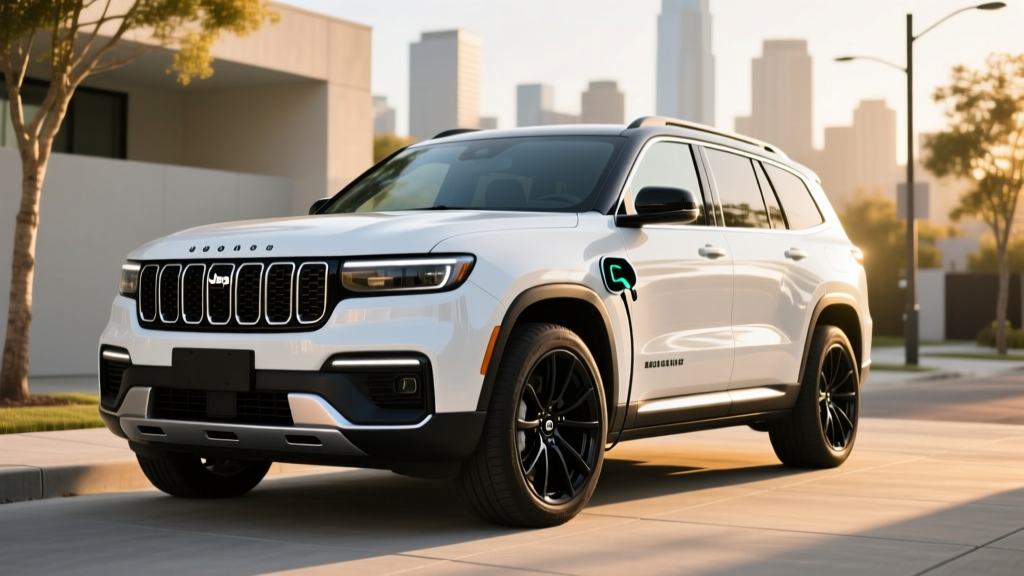
If you're researching the 2025 Jeep Wagoneer Electric, here's the quick answer: Jeep's first three-row electric SUV is built on the STLA Large platform, targeting an EPA range of up to 400 miles on higher trims, with a large battery pack (estimated 118 kWh usable), DC fast charging up to 350 kW peak, and a starting MSRP around $70,000 before incentives. However, as of early 2026, Stellantis has delayed the Wagoneer Electric's U.S. launch, and final EPA-certified specs remain unconfirmed. What follows is a detailed breakdown based on announced specifications, platform data from STLA Large sibling vehicles, and real-world ownership projections so you can decide whether to wait or explore alternatives.
What We Know: Announced Specs and Platform Details
The Wagoneer Electric rides on Stellantis's STLA Large Transverse platform, a flexible architecture supporting battery-electric, hybrid, and internal-combustion powertrains. The EV variant is expected to use a dual-motor all-wheel-drive layout with the following preliminary specifications:
| Attribute | Estimated / Announced |
|---|---|
| EPA Range (target) | Up to 400 mi (AWD, largest pack) |
| Battery Capacity (usable) | ~118 kWh (NMC chemistry) |
| Drivetrain | Dual-motor AWD |
| Horsepower | ~450-500 hp (est.) |
| 0-60 mph | ~5.0 sec (est.) |
| Peak DC Fast Charge | Up to 350 kW (800V architecture) |
| 10-80% Charge Time | ~23 min (target) |
| Level 2 Charging | 11.5 kW onboard charger |
| Seating | 3 rows / 6-7 passengers |
| Towing Capacity | TBD (target ~5,000 lb) |
| Base MSRP (est.) | ~$70,000 - $85,000+ |
| Battery/Powertrain Warranty | 8 yr / 100,000 mi (expected) |
Important context: These figures are Stellantis targets and platform-level estimates. The official Jeep brand page has not published final EPA-certified numbers. The 400-mile range target, if achieved, would place the Wagoneer Electric among the longest-range three-row EVs on the market — but real-world highway and cold-weather driving will reduce that figure by 15-30%, as it does for every EV.
Range Reality: EPA Sticker vs. What You'll Actually Get
Large battery packs like the expected 118 kWh unit help absorb range loss — you'll still have substantial buffer — but a 400-mile sticker doesn't mean 400 miles on a winter road trip through the Rockies. Factors that will pull range below the EPA number:
- Highway speeds above 70 mph: Aerodynamic drag on a boxy three-row SUV increases exponentially. Expect 310-330 mi at sustained 75-80 mph.
- Cold weather (below 32°F): Battery preconditioning and cabin heating consume energy. LFP chemistry would handle this better, but the Wagoneer Electric is expected to use NMC for its higher energy density.
- Towing: If the 5,000-lb target holds, towing will cut range roughly in half — to around 180-220 miles. This is typical for all electric SUVs under load.
- Terrain and elevation: Mountain passes with sustained climbs will reduce range, though regenerative braking on descents recovers some energy.
Charging Speed and Infrastructure: What 350 kW Actually Means
The Wagoneer Electric is expected to use an 800-volt architecture, enabling peak DC fast-charge rates up to 350 kW. That's impressive on paper — but sustained charge rate matters more than peak. Here's what to expect:
| Level | Power (kW) | Miles Added per Hour | Notes |
|---|---|---|---|
| Level 1 (120V household) | ~1.4 kW | ~3-4 mi/hr | Emergency/trickle only; 118 kWh pack takes ~85+ hours |
| Level 2 (240V home) | 11.5 kW | ~30-35 mi/hr | Full charge in ~10-11 hours; ideal for overnight |
| DC Fast Charge (350 kW peak) | Up to 350 kW | ~150+ mi in 10 min (est.) | Peak rate tapers above ~40% SoC; 10-80% in ~23 min |
Understanding the charge curve: No EV sustains its peak charge rate for the entire session. A 350 kW peak typically holds from roughly 10% to 35-40% state of charge (SoC), then tapers progressively. The 10-80% time of ~23 minutes is competitive with the Hyundai Ioniq 5 and Kia EV9, but you'll need a 350 kW-capable charger (like Electrify America's newest stations or Tesla Supercharger V4 with NACS adapter) to see those speeds. Most public chargers max out at 50-150 kW, where the Wagoneer Electric will likely charge at a sustained 80-120 kW — still fast, but a 10-80% session would stretch to 35-50 minutes.
Home charging setup: With an 11.5 kW onboard charger, you'll want a 48-amp Level 2 home charger on a 60-amp circuit. Installation costs typically range from $800-$2,500 depending on your electrical panel's capacity and the distance from panel to charger location. Homes with 100-amp service may need a panel upgrade ($1,500-$3,000) to support simultaneous EV charging and household loads.
EV vs. Gas Wagoneer: Cost and Capability Comparison
The current gas-powered Jeep Wagoneer starts around $62,000 and gets an EPA-rated 17-20 MPG combined depending on trim and drivetrain. Here's how the electric version compares on the metrics that matter for ownership:
| Factor | Gas Wagoneer (4x4) | Wagoneer Electric (AWD) |
|---|---|---|
| Base MSRP | ~$62,000 | ~$70,000 (est.) |
| Federal Tax Credit (§30D) | $0 | Up to $7,500 (if eligible — see below) |
| Fuel/Energy Cost (15,000 mi/yr) | ~$3,100/yr (gas at $3.50/gal, 17 MPG) | ~$750/yr (home charging at $0.14/kWh) |
| 5-Year Fuel/Energy Total | ~$15,500 | ~$3,750 |
| Maintenance (5-yr est.) | ~$3,500 (oil, filters, trans fluid) | ~$1,200 (cabin filter, tire rotation, brake fluid) |
| Estimated 5-yr Total Cost | ~$81,000 (purchase + fuel + maint.) | ~$67,450 (after credit, + fuel + maint.) |
| Towing | Up to 10,000 lb | ~5,000 lb (target) |
| Off-Road Capability | Proven (solid axle available) | TBD (likely air suspension, Selec-Terrain) |
The electric Wagoneer saves roughly $11,000-$14,000 over five years in fuel and maintenance, partially offsetting its higher purchase price. But the gas Wagoneer still wins on towing (10,000 vs. ~5,000 lb) and proven off-road capability. If you tow a boat or camper regularly, the EV's range halving under load is a serious limitation.
Federal Tax Credit: Do You Qualify?
The Wagoneer Electric's eligibility for the §30D Clean Vehicle Credit (up to $7,500) depends on several factors that Stellantis has not yet confirmed for the production vehicle. Based on current IRS rules for 2025-2026:
- MSRP cap: SUVs must be under $80,000 MSRP. Base trims should qualify; fully loaded trims may exceed the cap.
- Buyer income limits: AGI must not exceed $150,000 (single), $225,000 (head of household), or $300,000 (joint filers).
- Battery component sourcing: Battery components must be manufactured or assembled in North America (phasing percentages increase yearly — 100% by 2029).
- Critical minerals: A percentage of critical minerals must be sourced from the U.S. or FTA partners (increasing annually).
- Point-of-sale transfer: Eligible buyers can transfer the credit to the dealer at purchase, reducing the out-of-pocket price immediately rather than waiting for tax filing.
- Final assembly: Vehicle must undergo final assembly in North America.
Consult a tax professional and check fueleconomy.gov for the most current eligibility list once the Wagoneer Electric is EPA-certified.
Myths vs. Facts: Common Misconceptions About the Wagoneer Electric
| Myth | Fact |
|---|---|
| "400 miles means I'll never need to charge on road trips" | Real-world highway range will be ~310-340 mi. Plan charging stops every 250-280 mi for comfort and buffer. |
| "It'll charge at 350 kW everywhere" | Only at compatible 350 kW stations. Most public chargers deliver 50-150 kW, adding 150-300 mi in a 30-min stop. |
| "EV batteries need replacing every 5 years" | Modern NMC packs are warrantied for 8 yr/100,000 mi and typically retain 80-90% capacity at 150,000 mi based on industry data. |
| "I can't charge at home — I live in an apartment" | This is a real barrier. Public-only charging costs 2-3x more than home charging and requires reliable nearby infrastructure. Confirm your charging access before buying. |
| "It'll be as off-road capable as a gas Wrangler" | Unlikely. The Wagoneer Electric will likely use independent suspension and air springs — capable for light trails, but not a rock crawler. Ground clearance and approach/departure angles are TBD. |
Who Should Wait — And Who Should Buy Now?
- Wait if: You want a three-row EV with 350+ miles of real range, you have home Level 2 charging, you don't tow more than 4,000 lb, and you can defer your purchase 12-18 months for confirmed specs and pricing.
- Buy now if: You need a three-row EV today. The Kia EV9 (EPA 304 mi, ~$55,000, 10-80% in ~20 min) is proven and available. The Rivian R1S (EPA 410 mi max, ~$79,900) offers genuine off-road capability. The Tesla Model X (EPA 326 mi, ~$79,990) has the Supercharger network advantage.
- Consider a PHEV if: You regularly tow heavy loads or drive in remote areas with sparse charging. The Jeep Grand Cherokee 4xe PHEV (25 mi electric-only, ~$60,000) gives you electric commuting with gas-powered range for towing and road trips — no range anxiety.
- Don't buy any EV if: You lack reliable home or workplace charging AND your area has limited public DC fast-charging infrastructure. Public-only EV ownership is significantly more expensive and less convenient.
What First-Time EV Buyers Should Know Before Committing
If the Wagoneer Electric is your first EV, these ownership realities matter more than any spec sheet:
- Home charging is non-negotiable for most owners. Over 80% of EV charging happens at home. A Level 2 charger (240V, 48A) adds ~30-35 miles of range per hour — enough to fully replenish the Wagoneer's large pack overnight. Budget $1,200-$2,500 for a quality charger and professional installation.
- Electricity cost varies wildly. Home charging at $0.14/kWh (national average) costs roughly $16.50 for a full 118 kWh charge. Public DC fast charging at $0.35-$0.50/kWh costs $41-$59 for the same fill. Always check your utility's EV rate plans — some offer off-peak rates as low as $0.06-$0.08/kWh.
- Insurance may cost more. EVs typically carry 15-25% higher insurance premiums than equivalent gas vehicles due to higher repair costs and battery replacement risk. Get quotes before purchasing.
- Tires wear faster. Heavy EVs (the Wagoneer Electric will likely exceed 6,000 lb) wear tires 20-30% faster than comparable gas vehicles. Budget for premium EV-rated tires every 30,000-40,000 miles.
- Cold weather is real. If you live in the northern U.S., expect 20-35% range loss in winter. A heat pump (expected on the Wagoneer Electric) mitigates this but doesn't eliminate it. Garage parking and preconditioning while plugged in help significantly.
Frequently Asked Questions
When will the 2025 Jeep Wagoneer Electric actually be available?
Stellantis has delayed the Wagoneer Electric's production timeline multiple times. As of early 2026, the vehicle has not entered U.S. production, and dealer inventory is not expected until late 2026 at the earliest — more likely 2027. The "2025" model year designation may shift. Monitor Jeep's official channels and EPA's green vehicles database for certification updates.
Will the Wagoneer Electric qualify for the $7,500 federal tax credit?
It depends on final battery sourcing, MSRP, and your income. Base trims under $80,000 MSRP should qualify for buyers within the income caps, but Stellantis must confirm that battery components and critical minerals meet §30D sourcing requirements. This won't be confirmed until EPA certification closer to launch. Check irs.gov for the current eligible vehicle list.
Can the Wagoneer Electric use Tesla Superchargers?
Stellantis has announced that future EVs will adopt the NACS (North American Charging Standard) connector, which provides access to Tesla's Supercharger network. If the Wagoneer Electric launches with a native NACS port, it will have direct Supercharger access. If it launches with CCS, a NACS adapter will be needed. This detail is unconfirmed.
How does the Wagoneer Electric compare to the Kia EV9?
The EV9 is available now with EPA-certified specs: 304 miles max range, 210 kW peak DC charging, starting around $55,000. The Wagoneer Electric targets more range (400 mi) and faster charging (350 kW) but at a higher price (~$70,000+) and with no confirmed availability date. If you need a vehicle now, the EV9 is the pragmatic choice.
What will battery replacement cost?
No pricing exists yet for the Wagoneer Electric specifically. For context, large NMC battery pack replacements currently range from $12,000-$20,000+ for comparable EVs. However, most modern packs outlast the vehicle — industry data shows average degradation of 5-12% over 150,000 miles. The expected 8-year/100,000-mile warranty covers defects and excessive capacity loss (typically below 70% of original capacity).