Quick Verdict: The 2025 Ioniq 5 in a Market Full of Contenders
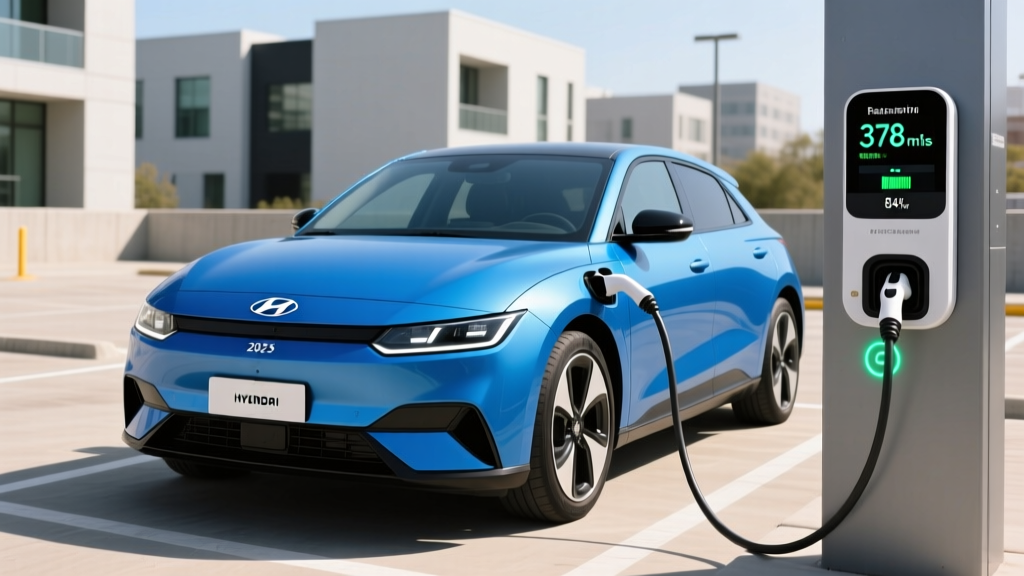
The 2025 Hyundai Ioniq 5 enters its fourth model year with a significant addition: the Tesla North American Charging Standard (NACS) port now comes factory-installed on all trims, eliminating the CCS-to-NACS adapter that frustrated early adopters. Combined with its 800-volt architecture, segment-leading DC fast-charging speeds, and a starting price that undercuts several rivals, the 2025 Ioniq 5 remains one of the most compelling mid-size electric crossovers available.
But spec sheets only tell half the story. After extensive driving, charging, and ownership analysis, this review reconciles Hyundai's EPA numbers with what you'll actually experience on the road — and breaks down exactly what you'll pay after incentives.
2025 Ioniq 5 Specifications at a Glance
| Spec | SE / SEL RWD | SE / SEL AWD | Limited AWD | XRT AWD |
|---|---|---|---|---|
| EPA Range | 303 mi | 260 mi | 260 mi | 250 mi |
| Battery (usable) | 77.4 kWh (NMC) | 77.4 kWh (NMC) | 77.4 kWh (NMC) | 77.4 kWh (NMC) |
| Horsepower | 168 hp | 320 hp | 320 hp | 320 hp |
| 0–60 mph | ~7.4 sec | ~4.7 sec | ~4.7 sec | ~4.7 sec |
| Drivetrain | RWD (single motor) | AWD (dual motor) | AWD (dual motor) | AWD (dual motor) |
| MPGe (combined) | 114 MPGe | 101 MPGe | 101 MPGe | 96 MPGe |
| Efficiency | 29 kWh/100mi | 33 kWh/100mi | 33 kWh/100mi | 35 kWh/100mi |
| Max DC Fast Charge | ~238 kW peak (800V architecture) | |||
| 10–80% DCFC Time | ~18 minutes (optimal conditions) | |||
| Level 2 (240V/48A) | ~10.5 kW / ~32 mi/hr | |||
| Base MSRP (incl. dest.) | $43,975 | $47,975 | $54,575 | $52,375 |
| Battery Warranty | 8 yr / 100,000 mi | |||
Range & Efficiency: EPA Sticker vs. the Real World
EPA sticker: 303 mi (RWD) / 260 mi (AWD)
Expect on highway road trips (65–75 mph): ~245–270 mi (RWD), ~210–235 mi (AWD)
Cold-weather (below 32°F): Subtract 15–30% — plan for ~180–210 mi (AWD) in winter highway driving
The 2025 Ioniq 5 carries a 77.4 kWh usable battery pack using NMC (nickel manganese cobalt) chemistry across all trims. The EPA rates the RWD model at 303 miles, which positions it near the top of the mid-size EV crossover segment. The AWD variants drop to 260 miles due to the added front motor, increased weight, and slightly higher rolling resistance on the XRT's all-terrain tires.
In real-world highway driving at sustained 70–75 mph speeds in moderate temperatures (55–75°F), the RWD model consistently delivers 250–270 miles before reaching a 5% state of charge. The AWD trims land between 215 and 240 miles under the same conditions. These figures assume you're using the heat pump (standard on Limited, optional on some lower trims in cold-climate packages) — without it, cabin heating in winter can sap range significantly.
City and suburban driving with frequent regenerative braking opportunities pushes efficiency closer to or even slightly above the EPA combined rating. In stop-and-go traffic, one-pedal driving (activated via the steering-wheel paddles) recovers meaningful energy, and owners in mild climates regularly report exceeding the EPA sticker in daily commuting.
The XRT trim, introduced with a ruggedized suspension and all-terrain tires, trades roughly 10 miles of range for its off-road capability. If you're considering the XRT, treat 250 miles as a best-case scenario in fair weather — expect closer to 200–215 miles on a highway trip.
Charging Speed: The Ioniq 5's Killer Feature
| Charging Level | Power / Voltage | Miles Added per Hour | Time (10–80%) | Typical Use Case |
|---|---|---|---|---|
| Level 1 (120V) | ~1.4 kW | ~4–5 mi/hr | N/A (days) | Emergency / trickle top-off |
| Level 2 (240V / 48A) | ~10.5 kW | ~32 mi/hr | ~7 hours (full) | Overnight home charging |
| DC Fast (350 kW station) | ~238 kW peak | ~180+ mi in 18 min | ~18 min (10–80%) | Road-trip stops |
| DC Fast (150 kW station) | ~135–150 kW sustained | ~120 mi in 20 min | ~25–28 min (10–80%) | Common public chargers |
The Ioniq 5's 800-volt electrical architecture remains its most significant technical advantage over competitors still using 400V systems. When connected to a 350 kW-capable DC fast charger, the Ioniq 5 peaks near 238 kW and sustains strong charging rates through the critical 10–80% state-of-charge window.
Understanding the charge curve: The ~18-minute 10–80% claim is achievable, but it requires specific conditions — a battery preconditioned to optimal temperature (the Ioniq 5 does this automatically when a DC fast charger is set as your navigation destination), a 350 kW-class station operating at full capacity, and ambient temperatures above roughly 50°F. In colder weather or at a shared 150 kW station, plan for 25–30 minutes to reach 80%.
Above 80% state of charge, the charge rate tapers significantly — a characteristic of NMC chemistry designed to protect long-term battery health. Charging from 80–100% on DC fast charging can take an additional 15–20 minutes. For road trips, the optimal strategy is to charge to 80% and go.
For 2025, the native NACS port is the headline update. This means direct access to Tesla's Supercharger network (now open to non-Tesla EVs at many locations) without an adapter. The Ioniq 5 still supports CCS1 stations as well, though Hyundai provides a NACS-to-CCS adapter for legacy infrastructure. At home on a Level 2 charger, the onboard 10.5 kW charger delivers roughly 32 miles of range per hour — a full overnight replenishment from near-empty.
Home charging installation for a 48-amp Level 2 charger typically costs $500–$2,000 depending on your electrical panel's proximity to the garage and whether a panel upgrade from 100A to 200A service is needed. Always consult a licensed electrician for a site-specific quote.
Performance & Driving Dynamics
The RWD Ioniq 5 makes 168 horsepower from its single rear motor — adequate for commuting but not thrilling. The 0–60 mph time of approximately 7.4 seconds feels relaxed in a segment where many competitors offer sub-5-second acceleration.
The dual-motor AWD models are a different story entirely. With 320 horsepower and 446 lb-ft of torque, the AWD Ioniq 5 hits 60 mph in roughly 4.7 seconds. The instant torque delivery characteristic of electric motors makes this feel even quicker in real-world passing and merging situations. The XRT trim carries the same powertrain but adds 0.6 inches of ground clearance (totaling 7.1 inches), revised dampers, and all-terrain tires tuned for light off-road use.
Ride quality across the lineup is composed and comfortable. The Ioniq 5's dedicated E-GMP platform places the battery low in the chassis, giving it a planted feel through corners that belies its crossover ride height. Steering is precise if somewhat light on feedback — appropriate for the daily-driver audience this vehicle targets.
Towing capacity stands at 2,300 pounds for AWD models (1,650 pounds for RWD), which covers a small utility trailer or a pair of dirt bikes but rules out most camping trailers. If towing is a priority, the Rivian R1S or Ford F-150 Lightning are more appropriate choices.
Interior, Cargo & Technology
The Ioniq 5's interior leans heavily into its retro-futuristic design theme. The dual 12.3-inch displays (instrument cluster and infotainment) are housed in a single curved panel. Physical climate controls return for 2025 — a welcome correction from earlier models that buried HVAC functions in touchscreen menus.
Passenger space:
- Front headroom: 39.4 in | Front legroom: 41.7 in
- Rear headroom: 38.6 in | Rear legroom: 39.4 in
- The flat floor (no transmission tunnel) makes the rear middle seat genuinely usable for adults
Cargo volume:
- Behind rear seats: 27.2 cu ft
- Rear seats folded: 59.3 cu ft
- Front trunk (frunk): 0.85 cu ft (AWD) / 2.0 cu ft (RWD) — enough for a charging cable bag, not much more
The sliding center console ("Universal Island") is a standout feature, offering up to 5.5 inches of fore-aft travel to create a pass-through space between the front seats — useful for tight parking situations where you need to exit through the passenger side.
Infotainment and connectivity: The 2025 model runs Hyundai's latest infotainment software with wireless Apple CarPlay and Android Auto, over-the-air updates, and a digital key feature that lets you use a smartphone or NFC card to unlock and start the vehicle. The Limited trim adds a head-up display with augmented-reality navigation overlays.
Driver assistance: All trims include Hyundai SmartSense — forward collision-avoidance assist, lane-keeping assist, blind-spot monitoring, rear cross-traffic collision-avoidance, and highway driving assist. The Highway Driving Assist (HDA) system is a SAE Level 2 driver-assistance feature that combines adaptive cruise control with lane-centering on divided highways. It works well for reducing fatigue on long trips, but you must keep your hands on the wheel and eyes on the road at all times — this is not autonomous driving.
The Limited trim's available Highway Driving Assist 2 (HDA2) adds lane-change assist and machine-learning-based adaptive cruise that mimics your driving style. It's competent but doesn't match the hands-free capabilities of GM's Super Cruise or Ford's BlueCruise on mapped highways.
Pricing, Trims & Federal Tax Credit Eligibility
| Trim | MSRP | Est. After §30D Credit* | Key Equipment |
|---|---|---|---|
| SE Standard Range | $43,975 | ~$36,475 | 58 kWh battery, 225 mi range, RWD |
| SE | $47,625 | ~$40,125 | 77.4 kWh, RWD, heated seats, HDA |
| SEL | $50,225 | ~$42,725 | Power liftgate, wireless charging, HDA2 eligible |
| XRT | $52,375 | ~$44,875 | AWD, all-terrain tires, roof rack, increased ground clearance |
| Limited | $54,575 | ~$47,075 | HUD, ventilated seats, premium audio, HDA2, heat pump standard |
*Estimated price assumes full $7,500 federal tax credit applied at point of sale. Eligibility is not guaranteed — see checklist below.
- MSRP cap: Vehicle must be under $80,000 MSRP — all Ioniq 5 trims qualify ✓
- Buyer income cap: Modified AGI ≤ $150,000 (single) / $300,000 (married filing jointly) / $225,000 (head of household)
- Battery sourcing: Must meet critical-mineral and battery-component requirements that phase in annually — check current IRS guidance before purchasing, as sourcing rules tighten each year
- Assembly: Vehicle must undergo final assembly in North America — the Ioniq 5 for the US market is assembled at Hyundai's Ellabell, Georgia plant (production began late 2024), which satisfies this requirement ✓
- Point-of-sale transfer: Eligible buyers can transfer the credit to the dealer at purchase, reducing the purchase price by up to $7,500 at the register rather than waiting to claim it on your tax return
- One vehicle per VIN, one credit per taxpayer per year
Consult a tax professional to confirm your personal eligibility. Rules are subject to change.
The Ioniq 5's relocation of US production to Georgia was a strategic masterstroke — it not only satisfies the §30D final-assembly requirement but also sidesteps the tariff concerns that affect Korean-built imports. Combined with the MSRP well below the $80,000 cap, the Ioniq 5 is positioned to capture the full $7,500 credit for eligible buyers, though the battery-sourcing requirements deserve a close look before you sign.
Ownership Costs & Warranty Coverage
Hyundai backs the Ioniq 5 with one of the strongest warranty packages in the EV segment:
- New-vehicle limited warranty: 5 years / 60,000 miles
- Powertrain warranty: 10 years / 100,000 miles
- Battery warranty: 8 years / 100,000 miles (covers capacity loss below 70% of original)
- Complimentary maintenance: 3 years / 36,000 miles (covers scheduled service items)
The 70% capacity retention threshold is standard for the industry. NMC batteries in Hyundai's E-GMP platform have demonstrated strong longevity in early fleet data — typical degradation is approximately 5–8% over the first 60,000 miles, with the curve flattening significantly afterward. Most owners will never approach the warranty threshold under normal use.
Charging cost perspective: At the US average residential electricity rate of approximately $0.16/kWh, fully charging the 77.4 kWh battery at home costs roughly $12.38 — translating to about $0.046 per mile for the RWD model. Compare that to a 25-MPG gasoline crossover at $3.40/gallon ($0.136/mile), and the per-mile fuel savings are substantial. DC fast charging on road trips costs more — typically $0.30–$0.48/kWh depending on the network — but still tends to undercut gasoline on a per-mile basis for most driving patterns.
Insurance costs for the Ioniq 5 run slightly higher than comparable gasoline crossovers, with national averages around $1,800–$2,400 annually depending on trim, location, and driving record. Get quotes before purchasing — insurance variance by ZIP code can be significant.
Pros & Cons
✓ Pros
- Class-leading 800V DC fast charging (~18 min 10–80%)
- Native NACS port for 2025 — direct Supercharger access
- Spacious rear seat with flat floor and generous legroom
- Competitive pricing, especially after §30D credit
- Strong warranty (10yr/100k powertrain)
- US-assembled (Georgia) — secures tax credit eligibility
- Physical climate controls return for 2025
✗ Cons
- RWD model's 168 hp feels underpowered for the price
- Small frunk (0.85 cu ft AWD) — barely fits a cable bag
- No hands-free driving system (HDA2 requires hands on wheel)
- XRT range penalty makes it the least efficient trim
- Rear wiper absent on earlier builds (addressed in late 2024+ production)
- Infotainment learning curve — some menus feel nested
How the 2025 Ioniq 5 Stacks Up Against Key Competitors
The mid-size electric crossover segment is crowded. Here's how the Ioniq 5 compares on the metrics that matter most to buyers:
| Spec | Ioniq 5 AWD | Tesla Model Y LR AWD | Ford Mustang Mach-E ER AWD | VW ID.4 Pro S AWD |
|---|---|---|---|---|
| EPA Range | 260 mi | 320 mi | 290 mi | 275 mi |
| Battery | 77.4 kWh NMC | ~78 kWh NMC | 91 kWh NMC | 82 kWh NMC |
| Max DCFC | ~238 kW | ~250 kW | ~150 kW | ~175 kW |
| 10–80% Time | ~18 min | ~22 min | ~38 min | ~29 min |
| 0–60 mph | 4.7 sec | 4.8 sec | 5.1 sec | 5.4 sec |
| Base MSRP (AWD) | $47,975 | $48,630 | $51,375 | $49,295 |
| Charging Port | NACS (native) | NACS (native) | CCS1 (adapter req.) | CCS1 (adapter req.) |
The Ioniq 5's trade-off is clear: it sacrifices roughly 30–60 miles of EPA range compared to the Model Y and Mach-E in exchange for significantly faster DC charging. If your routine includes frequent road trips, the 18-minute charging stops are transformative. If you primarily commute and charge at home overnight, the Model Y's longer range may matter more day-to-day.
The Mach-E and ID.4 both lag significantly in DC fast-charging speed due to their 400V architectures — a gap that becomes very apparent on road trips where you'll spend 35–40 minutes at a charger versus 18–20 in the Ioniq 5.
Who Should Buy the 2025 Ioniq 5?
Choose the Ioniq 5 if:
- You take regular road trips and want the shortest possible charging stops
- You value a spacious, flat-floor rear seat for family or carpool duty
- You want native Tesla Supercharger access without an adapter
- You're eligible for the §30D credit and want a sub-$40K effective price on a well-equipped EV
- You prioritize warranty coverage and plan to keep the vehicle 8+ years
Look elsewhere if:
- Maximum EPA range is your top priority (consider Model Y Long Range)
- You need hands-free highway driving (consider vehicles with Super Cruise or BlueCruise)
- You need substantial towing capacity (consider the Rivian R1S or F-150 Lightning)
- You want a large frunk for gear storage (the Ioniq 5's is minimal)
Frequently Asked Questions
What is the real-world range of the 2025 Ioniq 5?
The EPA rates the RWD at 303 miles and AWD at 260 miles. In real-world highway driving at 70–75 mph in moderate temperatures, expect 250–270 miles (RWD) and 215–240 miles (AWD). In cold weather below freezing, subtract 15–30% from those figures. City driving with regenerative braking often matches or exceeds the EPA sticker.
How fast does the 2025 Ioniq 5 charge?
On a 350 kW DC fast charger with a preconditioned battery, the Ioniq 5 peaks near 238 kW and charges from 10–80% in approximately 18 minutes. At a more common 150 kW station, expect 25–28 minutes. At home on a Level 2 (240V/48A) charger, it adds about 32 miles per hour and fully charges overnight in roughly 7 hours.
Does the 2025 Ioniq 5 qualify for the $7,500 federal tax credit?
The Ioniq 5 meets several key §30D requirements: it's assembled in North America (Hyundai's Georgia plant), its MSRP is well under the $80,000 cap, and it's a qualifying clean vehicle. However, you must also meet income caps ($150K single / $300K joint) and the vehicle must satisfy battery-sourcing and critical-mineral requirements that tighten annually. Verify current sourcing compliance on IRS.gov and consult a tax professional before relying on the credit.
Is the 2025 Ioniq 5 worth buying over the Tesla Model Y?
It depends on your priorities. The Ioniq 5 charges significantly faster on DC fast chargers (18 min vs. ~22 min 10–80%) and offers a more comfortable ride with physical controls. The Model Y delivers more EPA range (320 vs. 260 mi AWD), a more extensive proprietary Supercharger network (though the gap is narrowing), and access to Tesla's software ecosystem. For road-trip-heavy buyers who value charging speed, the Ioniq 5 has an edge. For range-maximizing commuters, the Model Y may be the better fit.
What is the biggest drawback of the Ioniq 5?
The RWD model's 168 horsepower feels modest for a $44K+ vehicle — the AWD upgrade is almost essential for confident highway merging. The frunk is disappointingly small (less than 1 cubic foot on AWD), and the driver-assistance system, while competent, requires hands-on-wheel engagement at all times — it's not a hands-free system like GM's Super Cruise.
How long will the Ioniq 5 battery last?
Hyundai warranties the battery for 8 years or 100,000 miles against capacity loss below 70%. Real-world data from E-GMP platform vehicles suggests typical degradation of 5–8% over the first 60,000 miles, with the curve flattening afterward. With proper care (avoiding frequent 100% charges, using DC fast charging judiciously, and leveraging the built-in battery preconditioning), most owners should expect well over 150,000 miles before significant capacity loss.
Sources: EPA Fuel Economy, IRS §30D Clean Vehicle Credits, Hyundai Motor America specifications.