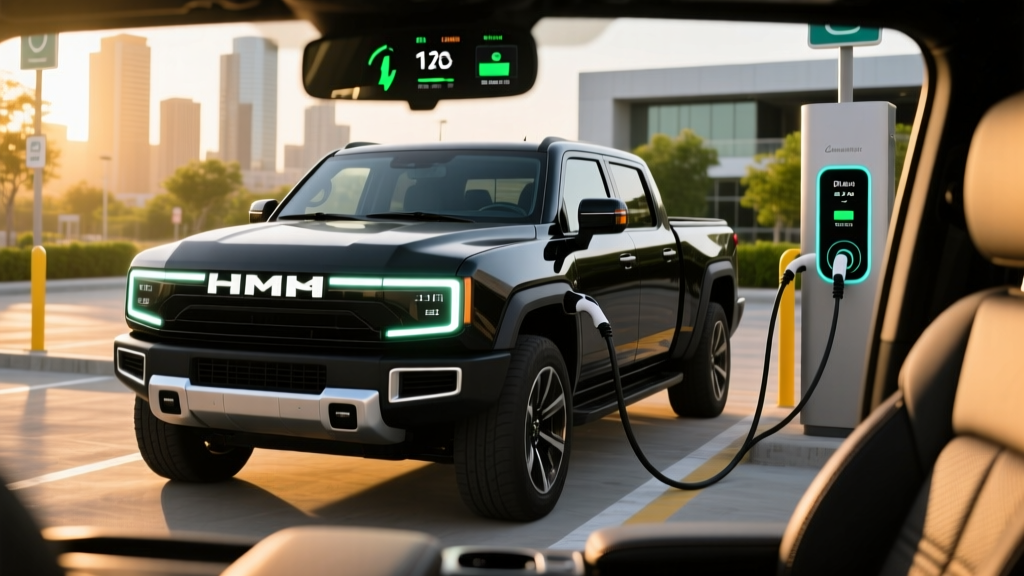
The GMC Hummer EV Pickup is an exercise in excess — a 9,000-pound electric supertruck that pairs 1,000 horsepower with a 24-module Ultium battery. For 2025, GMC continues the lineup with the Edition 1, 3X, and 2X trims, each offering a distinct blend of off-road capability, range, and luxury. But beneath the CrabWalk and Extract Mode theatrics lies a genuine question for buyers: does this massive EV deliver practical daily value, or is it purely a statement piece?
We've spent time analyzing the 2025 Hummer EV Pickup's specs, charging behavior, and ownership economics to answer exactly that. Here's what the numbers actually look like when you strip away the marketing.
Quick Verdict: Who the Hummer EV Pickup Is For
Buy it if: You need a full-size truck with genuine off-road capability, want the fastest-accelerating production pickup available, and have access to home Level 2 charging to manage its massive battery.
Skip it if: You prioritize efficiency, garage in tight spaces (it's 217 inches long), or need a truck primarily for fleet/commercial use where total cost of ownership matters more than performance.
Range, Battery, and Efficiency: The 9,000-Pound Reality
The 2025 Hummer EV Pickup is powered by GM's Ultium platform using a double-stacked battery pack with 24 modules of NMC (nickel manganese cobalt) chemistry. The 3X and Edition 1 trims carry approximately 212.7 kWh of usable capacity — the largest battery pack in any production passenger vehicle sold in the U.S. The 2X trim uses a smaller pack (estimated ~170 kWh usable) to hit a lower price point.
| Spec | 3X / Edition 1 | 2X |
|---|---|---|
| EPA Range | 329 miles | ~314 miles (est.) |
| Battery (usable) | 212.7 kWh (NMC) | ~170 kWh (NMC) |
| Horsepower | 1,000 hp (Watts to Freedom) | 625 hp |
| Torque | 12,000 lb-ft (wheel) | 7,400 lb-ft (wheel) |
| 0-60 mph | ~3.0 seconds | ~5.0 seconds |
| Drivetrain | Tri-motor AWD (e4WD) | Dual-motor AWD |
| MPGe (combined) | 47 MPGe | ~50 MPGe (est.) |
| Efficiency | ~72 kWh/100 mi | ~67 kWh/100 mi (est.) |
| Max Towing | 7,500 lbs | 7,500 lbs |
| Base MSRP | $106,495 (3X) | $99,995 |
Real-World Range Callout: The EPA rates the 3X at 329 miles. In real-world highway driving at 70-75 mph, expect approximately 260–285 miles before you need to plug in. Cold-weather driving (below 32°F) can reduce range by 25–35%, dropping effective range to roughly 215–245 miles. The Hummer EV's massive frontal area and 9,000-pound curb weight are efficiency penalties that no battery size fully overcomes.
At roughly 72 kWh per 100 miles (3X), the Hummer EV is among the least efficient EVs on the market. For comparison, a Rivian R1T achieves about 48 kWh/100 mi and a Ford F-150 Lightning about 49 kWh/100 mi. According to fueleconomy.gov, the combined MPGe sits at just 47 — a direct consequence of the truck's aerodynamics and mass.
Charging Speed: DC Fast, Level 2, and the 800-Volt Architecture
The 2025 Hummer EV Pickup supports GM's Ultium charge architecture with a peak DC fast-charging rate of 350 kW on compatible CCS-equipped stations (such as Electrify America's 350 kW stalls). The truck uses an 800-volt battery architecture, which enables this high charge rate while managing heat across the 24-module pack.
| Level | Power | Speed / Time |
|---|---|---|
| Level 1 (120V) | ~1.4 kW | ~2 mi/hr (essentially trickle) |
| Level 2 (240V, 48A) | 11.5 kW | ~14 mi/hr; full charge in ~19 hrs |
| Level 2 (240V, 80A) | 19.2 kW | ~24 mi/hr; full charge in ~11 hrs |
| DC Fast (peak 350 kW) | 350 kW peak | 10–80% in ~30 min; adds ~100 mi in 10 min |
Charging-curve reality check: The 350 kW peak is not sustained. Like all EVs, the Hummer EV tapers charge rate as the battery fills. Expect peak speeds between 10–40% SoC, with significant taper above 60% and steep taper above 80%. A 10–80% session takes approximately 30 minutes at a 350 kW-capable station, but plan for 40–50 minutes at a typical 150 kW stall. Preconditioning the battery via the navigation system before arriving at a charger is essential to hit peak rates.
For home charging, the 19.2 kW onboard charger (80A circuit) is a major advantage — it can add roughly 160 miles overnight in a 7-hour window. However, an 80A circuit requires a 100A breaker and likely a 200A or larger electrical panel. Budget $1,500–$3,500 for a professional Level 2 installation with a hardwired wall connector, and potentially $2,000–$5,000 more if your home needs a panel upgrade.
Performance and Drivetrain: 1,000 Horsepower in a Pickup
The 3X trim's tri-motor layout (one front, two rear) produces 1,000 horsepower and an eye-watering 12,000 lb-ft of wheel torque in Watts to Freedom launch mode. GMC's claimed 0-60 mph time of approximately 3.0 seconds makes this one of the quickest production vehicles ever built — gas or electric. The dual-motor 2X delivers 625 hp and reaches 60 mph in roughly 5.0 seconds, which is still brisk for a truck of this size.
Both trims feature e4WD with torque vectoring across the rear axle (3X). The Hummer EV also includes four-wheel steering, enabling the signature CrabWalk diagonal-drive mode for tight off-road trails, and an adaptive air suspension with Extract Mode that raises the ride height by nearly 6 inches for extreme obstacles. Ground clearance in Extract Mode reaches approximately 15.9 inches — genuine off-road territory.
Interior, Cargo, and Tech: Supersized in Every Dimension
The Hummer EV's cabin is dominated by a 13.4-inch infotainment touchscreen running GM's Ultifi software platform and a 12.3-inch digital instrument cluster. The interface supports wireless Apple CarPlay and Android Auto, over-the-air updates, and a suite of off-road telemetry displays (pitch/roll angle, torque distribution, tire pressure per wheel).
Interior space is generous, as you'd expect from a vehicle this large:
- Front legroom: ~45.6 inches
- Rear legroom: ~38.9 inches (crew cab)
- Bed length: 5 feet (short bed, Infinity Roof panels removable)
- Cargo bed volume: ~36.7 cu ft (bed), plus a front trunk (frunk) of approximately 8.5 cu ft
- Roof: Removable modular Infinity Roof panels stored in the frunk
The Super Cruise driver-assistance system is available on pre-mapped divided highways (over 750,000 miles of compatible roads in North America as of 2025). This is an SAE Level 2 system — despite hands-free operation on compatible roads, the driver must remain attentive and the system monitors via a steering-column camera. Super Cruise is not self-driving and does not handle city streets, construction zones, or unmapped routes.
ADAS Limitation Warning: Super Cruise is SAE Level 2 — a driver-assist feature, not an autonomous system. The driver must remain engaged, eyes on the road, and ready to take over at any time. It does not operate on non-mapped roads, in heavy construction zones, or in severe weather. No hands-free system currently sold to consumers is self-driving.
Pricing, Trims, and Federal Tax Credit Eligibility
The 2025 Hummer EV Pickup lineup starts at approximately $99,995 for the 2X and climbs to $106,495 for the 3X. The Edition 1 (initially the launch trim) has been phased out for 2025, though residual inventory may exist at dealers. Fully loaded 3X models with the Extreme Off-Road Package and premium paint options can push the as-tested price above $120,000.
| Trim | Base MSRP | §30D Credit Eligible? | Effective Price (est.) |
|---|---|---|---|
| 2X | $99,995 | Yes (meets MSRP cap for trucks: $80,000 — No, exceeds cap) | $99,995 |
| 3X | $106,495 | No — exceeds $80,000 MSRP cap for trucks | $106,495 |
Critical tax credit note: Under IRS §30D rules, the federal clean vehicle credit for new EVs has an MSRP cap of $80,000 for trucks, vans, and SUVs. Since every 2025 Hummer EV Pickup trim starts at or above $99,995, no trim qualifies for the $7,500 federal tax credit. Additionally, buyer income caps ($300,000 joint / $150,000 single) and battery critical-mineral sourcing requirements apply to vehicles that do meet the MSRP threshold. Consult a tax professional for your specific situation — but for the Hummer EV, the MSRP cap alone disqualifies it.
Some buyers may be eligible for state or utility incentives (e.g., California's CVRP or Colorado's state credit), which have their own rules. Check your local programs via official state energy-office websites.
Warranty and Long-Term Ownership
GMC backs the Hummer EV's battery and powertrain with an 8-year / 100,000-mile warranty, with a capacity-retention threshold of 70% State of Health (SoH) — meaning GMC will repair or replace modules if the battery degrades below 70% of original capacity within the warranty period. The bumper-to-bumper limited warranty covers 3 years / 36,000 miles.
Given the 212.7 kWh NMC pack, replacement cost out of warranty is a legitimate long-term concern. While GM has not published a flat replacement figure, industry estimates for Ultium packs of this size range from $25,000 to $40,000+ for a full module replacement. However, GM's modular Ultium design allows individual module swaps rather than full-pack replacement in many degradation scenarios, which could significantly reduce out-of-pocket cost.
Pros, Cons, and the Competition
Pros
- Tri-motor 1,000 hp; 0-60 in ~3.0 seconds
- 350 kW DC fast charging; 10-80% in ~30 min
- 329-mile EPA range despite massive weight
- Genuine off-road capability (Extract Mode, CrabWalk, locking diffs)
- Super Cruise hands-free highway driving
- 19.2 kW Level 2 onboard charger (fastest in class)
Cons
- Starts at ~$100k; no federal tax credit (exceeds MSRP cap)
- Worst-in-class efficiency at ~72 kWh/100 mi
- 9,000+ lbs curb weight stresses tires and brakes
- Real-world highway range drops to ~260-285 miles
- Requires 80A home circuit for max Level 2 speed (panel upgrade likely)
- Cold-weather range loss of 25-35%
Versus key competitors: The Rivian R1T (starting ~$79,900, 2X dual-motor, EPA range up to 420 mi with Max Pack) is lighter, more efficient, and more affordable — though it lacks the Hummer's sheer power and Super Cruise. The Ford F-150 Lightning (starting ~$55,000, EPA up to 320 mi) is far more practical for fleet and daily-driver use, with better efficiency and broader tax-credit eligibility. The Hummer EV Pickup occupies a niche: buyers who want maximum performance and off-road spectacle and are willing to pay the efficiency and price premium for it.
Frequently Asked Questions
What is the real-world range of the 2025 Hummer EV Pickup?
The EPA rates the 3X at 329 miles. Expect approximately 260–285 miles in real-world highway driving, and as low as 215–245 miles in cold weather (below 32°F) due to the truck's massive weight, poor aerodynamics, and battery thermal demands.
How fast does the Hummer EV charge at home and on the road?
On a 350 kW DC fast charger, it reaches 10–80% in approximately 30 minutes (adding ~100 miles in 10 minutes). At home on a 240V/80A Level 2 circuit (19.2 kW), it adds roughly 24 miles per hour and fully charges in about 11 hours. Level 1 (120V) is impractical for daily use at just ~2 miles per hour.
Does the 2025 Hummer EV Pickup qualify for the federal EV tax credit?
No. Under IRS §30D, the MSRP cap for trucks is $80,000. Since the cheapest Hummer EV Pickup trim (2X) starts at $99,995, no version qualifies for the $7,500 federal credit. State and utility incentives may still apply — check your local programs.
Is the Hummer EV Pickup worth buying over a Rivian R1T or F-150 Lightning?
If you want the most powerful production pickup ever made with genuine off-road hardware and don't mind paying $100,000+ with no tax credit, yes. If you value efficiency, lower cost of ownership, or tax-credit eligibility, the Rivian R1T or Ford F-150 Lightning are more rational choices. The Hummer EV is a performance and lifestyle vehicle, not a cost-optimized one.
How long will the Hummer EV battery last?
GMC warranties the Ultium battery for 8 years or 100,000 miles against degradation below 70% SoH. NMC chemistry in large packs with active thermal management typically retains 85–90% capacity at 100,000 miles based on industry data. Full pack replacement out of warranty is estimated at $25,000–$40,000+, though modular repair reduces typical costs.
Can I tow with the Hummer EV Pickup?
Yes — the Hummer EV is rated to tow up to 7,500 pounds. However, towing at or near max capacity will reduce range by 40–60%, bringing effective range down to roughly 130–190 miles depending on terrain, speed, and temperature. Plan charging stops accordingly on towing trips.