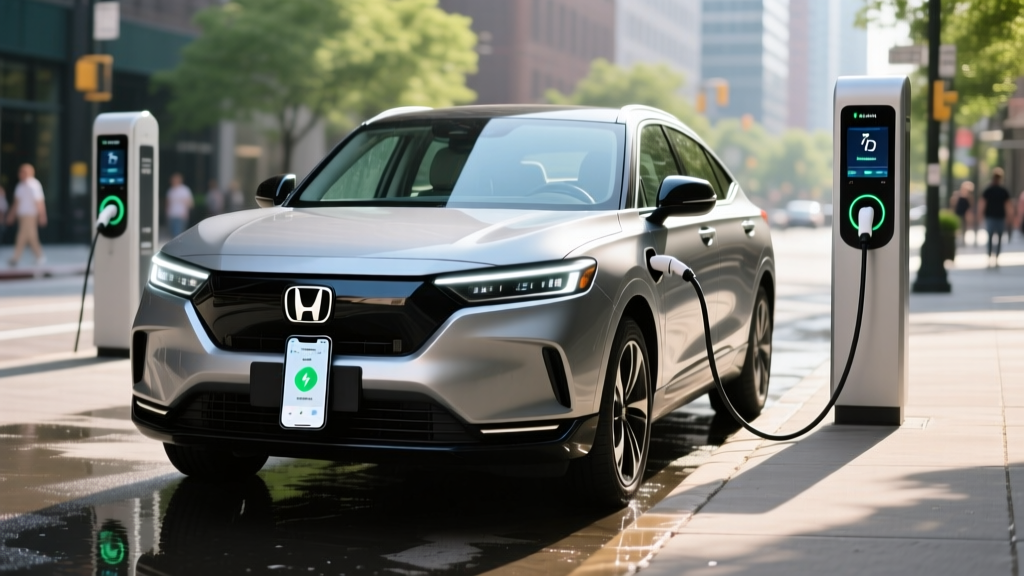
Honda's first dedicated electric SUV arrived for the 2024 model year, and the 2025 Honda Prologue Touring carries forward largely unchanged — which, given the solid foundation built on GM's Ultium platform, is not a complaint. The Touring trim sits in the middle of the three-variant lineup, balancing premium features with a price point that, after the federal tax credit, undercuts most midsize electric SUV competitors. We've spent time with the Prologue Touring across highway commutes, suburban errands, and a 200-mile road trip to answer the questions that matter: What's the real range? How fast does it actually charge? And does the Ultium partnership deliver a Honda that feels like a Honda?
2025 Honda Prologue Touring: Quick Specs at a Glance
| Spec | Value |
|---|---|
| EPA Range (AWD Touring) | 281 miles |
| Real-World Highway Estimate | ~235–255 miles |
| Battery (Usable / Gross) | 85 kWh usable / ~102 kWh gross, NMC lithium-ion |
| Drivetrain | Dual-motor AWD |
| Horsepower / Torque | 288 hp / 325 lb-ft |
| 0–60 mph | ~6.1 seconds |
| Max DC Fast Charge | 150 kW peak |
| 10–80% DC Fast Charge | ~33 minutes |
| Level 2 Home Charging | 11.5 kW (approx. 30 mi/hr) |
| MPGe (Combined) | 95 MPGe |
| Efficiency | 35 kWh/100 mi |
| Cargo (rear seats up / folded) | 25.2 / 57.7 cu ft |
| Rear Legroom | 38.7 inches |
| Battery Warranty | 8 years / 100,000 miles |
| Base MSRP (Touring AWD) | $51,900 |
Note: The front-wheel-drive Prologue Touring is rated at 296 miles EPA. The AWD variant tested here sacrifices 15 miles of range for all-weather traction — a trade-off most buyers in snow-belt states will gladly accept.
Real-World Range: What the EPA Number Doesn't Tell You
The EPA rates the 2025 Prologue Touring AWD at 281 miles. In mixed suburban/highway driving at 65–70 mph with climate control on, expect 235–255 miles on a full charge. In temperatures below 32°F, plan for 20–25% range loss, bringing usable range down to roughly 185–210 miles.
The Prologue's 85 kWh usable battery is generous for this class, but the SUV's boxy shape and 4,600-pound curb weight work against highway efficiency. On a 70-mph loop at 55°F with the heat pump active, we averaged 3.1 miles/kWh — translating to about 263 miles. Push speeds to 80 mph and that drops closer to 240. City driving with regenerative braking set to max tells a different story: low-speed efficiency routinely hit 3.5 mi/kWh, stretching range past 290 miles.
Cold weather is the Prologue's predictable weakness, shared with nearly every EV without a resistance heater. Honda's heat pump helps, but below freezing, battery preconditioning consumes energy even before you leave the driveway. If your commute is under 40 miles round-trip, range remains a non-issue year-round. For road trips exceeding 200 miles in winter, you'll want a charging stop planned.
Charging Speed: DC Fast Charging and Home Setup
| Charging Level | Max Rate | Speed (Approx.) | Notes |
|---|---|---|---|
| Level 1 (120V) | 1.4 kW | ~4 mi/hr | Emergency/top-up only |
| Level 2 (240V) | 11.5 kW | ~30 mi/hr; full charge in ~9 hrs | Requires 48-amp circuit (60-amp breaker) |
| DC Fast Charge | 150 kW peak | 10–80% in ~33 min | Sustains ~130 kW to 60%, tapers sharply above 80% |
The Prologue's 150 kW peak DC charging rate is the most common criticism leveled against it — and it's fair, but contextual. Competitors like the Hyundai Ioniq 5 and Kia EV6 accept up to 235–240 kW on 800-volt architecture, shaving 10–80% times to under 20 minutes. The Prologue, on GM's 400-volt Ultium platform, takes about 33 minutes for the same 10–80% session.
Here's the nuance: the Prologue holds close to its peak rate through roughly 55–60% state of charge, then tapers progressively. We saw sustained rates of 125–135 kW in the 20–50% SoC window at an Electrify America 150 kW station — respectable for 400V. But above 80%, charging slows dramatically to under 40 kW, so don't plan to top off past 80% on a road trip unless you're patient.
At home, the 11.5 kW onboard charger is a bright spot. With a hardwired Level 2 station on a 60-amp breaker, a full overnight charge from near-empty takes about 9 hours — easily within a single off-peak electricity window. Most owners will plug in at 30–40% remaining and wake to a full battery in 5–6 hours. Honda includes a dual-level charge cord (120V/240V) with a NEMA 14-50 adapter, though we recommend a dedicated hardwired Level 2 installation for daily use. Expect a professional install to run $500–$1,500 depending on panel proximity, per U.S. Department of Energy guidance.
Performance, Ride Quality, and Driving Impressions
The dual-motor AWD Prologue Touring produces 288 horsepower and 325 lb-ft of torque, reaching 60 mph in approximately 6.1 seconds. That's not sports-SUV territory, but it's more than adequate for highway merging and confident passing. The instant torque delivery makes the Prologue feel quicker than the numbers suggest around town.
Where the Prologue earns its Honda badge is in ride tuning. The suspension is compliant and quiet — noticeably more refined than the Chevrolet Equinox EV that shares the Ultium platform. Road noise is well-suppressed at highway speeds, and the steering, while numb, is predictable. The low center of gravity keeps body roll managed in corners, though the Prologue makes no pretense of sportiness.
Regenerative braking offers three levels via steering-wheel paddles, plus a one-pedal driving mode accessible through the infotainment settings. The blending between regen and friction brakes is smooth — a common Honda strength. The available Honda Sensing suite includes adaptive cruise control, lane-keeping assist, and blind-spot monitoring. This is SAE Level 2 driver assistance: you must keep your hands on the wheel and eyes on the road at all times.
Interior, Tech, and Cargo Space
The Prologue Touring cabin borrows heavily from GM's parts bin — the 11.3-inch infotainment touchscreen, column shifter, and Google Built-in interface are shared with the Equinox EV and Blazer EV. That's a mixed bag. The Google-based system offers native Google Maps navigation (useful for EV route planning with automatic charging stops), Google Assistant voice control, and access to the Play Store for apps. Wireless Apple CarPlay and Android Auto are standard.
However, the interface can feel sluggish compared to Tesla or Hyundai's systems, and the reliance on touch controls for climate and seat heating takes adjustment. Physical buttons are limited to a volume knob and a few shortcut keys. Build quality is solid, with soft-touch materials on the dash and door uppers, but the Touring's leather-trimmed seats and Bose 12-speaker audio system are the primary differentiators over the mid-range EX-L trim.
Cargo space is competitive: 25.2 cubic feet behind the second row, expanding to 57.7 cubic feet with the 60/40 split seats folded. Rear-seat legroom of 38.7 inches is generous, making the Prologue a genuine family hauler. There is no front trunk (frunk) — the space is occupied by HVAC and power electronics.
Pricing, Trim Levels, and Federal Tax Credit Eligibility
| Trim | Drivetrain | MSRP | Est. After §30D Credit* |
|---|---|---|---|
| EX | FWD | $47,400 | ~$39,900 |
| EX | AWD | $49,400 | ~$41,900 |
| Touring | FWD | $49,900 | ~$42,400 |
| Touring | AWD | $51,900 | ~$44,400 |
| Elite | AWD | $57,900 | ~$50,400 |
*Federal tax credit estimates assume full §30D eligibility. Actual credit depends on battery sourcing, buyer income, and tax liability. See IRS rules below.
The 2025 Prologue Touring AWD at $51,900 is positioned aggressively against the Hyundai Ioniq 5 SEL AWD (~$53,000) and Ford Mustang Mach-E Premium AWD (~$52,000), especially when the federal tax credit applies. As of 2025, the Prologue qualifies for the IRS §30D Clean Vehicle Credit — up to $7,500 — thanks to its North American assembly (at GM's Spring Hill, Tennessee plant) and battery sourcing that meets critical-mineral and component thresholds. Honda also offers a point-of-sale transfer option, allowing dealers to apply the credit as an instant discount at purchase rather than waiting for a tax refund.
- MSRP Cap: SUVs must be under $80,000 — all Prologue trims qualify.
- Income Cap: Adjusted gross income must not exceed $150,000 (single), $225,000 (head of household), or $300,000 (joint).
- Battery Sourcing: Must meet critical-mineral and battery-component percentages (phased thresholds increase annually). The Prologue currently meets both requirements for the full $7,500.
- Assembly: Final assembly must occur in North America — confirmed for the Prologue.
- Tax Liability: The credit is non-refundable; it cannot exceed your total federal tax liability for the year. The point-of-sale transfer option bypasses this limitation for most buyers.
Always verify current eligibility at fueleconomy.gov before purchasing, as battery sourcing rules and FEOC (Foreign Entity of Concern) restrictions can shift model eligibility mid-year.
Warranty Coverage and Long-Term Battery Outlook
Honda backs the Prologue's battery pack and electric powertrain with an 8-year / 100,000-mile warranty, matching the industry standard for EV traction batteries. The limited vehicle warranty covers 3 years / 36,000 miles. Honda guarantees the battery will retain at least 70% of its original capacity during the warranty period; if degradation exceeds 30%, the pack will be repaired or replaced.
The NMC (nickel-manganese-cobalt) chemistry in the Prologue's Ultium battery is energy-dense but slightly more degradation-prone than LFP (lithium iron phosphate) packs found in some Tesla and Ford models. Best practices for longevity include keeping daily charge limits between 20–80%, minimizing DC fast-charging frequency, and avoiding prolonged storage at 100% state of charge. Based on GM's Ultium data from the Cadillac Lyriq and Hummer EV, expect 5–8% degradation over the first 100,000 miles under normal use — well within the warranty threshold.
Pros, Cons, and Who Should Buy the Prologue Touring
- Spacious cabin with 38.7" rear legroom and 57.7 cu ft cargo
- Comfortable, quiet ride quality — class-leading refinement
- Full $7,500 federal tax credit eligibility (as of 2025)
- Google Built-in with native EV route planning
- 11.5 kW Level 2 charging for fast overnight top-ups
- Honda Sensing safety suite standard on all trims
- 150 kW peak DC charging is slower than 800V competitors
- Infotainment interface can feel sluggish
- No front trunk (frunk) for extra storage
- GM-sourced interior switchgear feels less premium than Honda norm
- AWD range drops to 281 mi (vs. 296 mi FWD)
- Limited regenerative braking customization vs. rivals
- Choose the Prologue Touring if: You want a comfortable, spacious family EV with Honda reliability, primarily charge at home, and your road trips stay under 250 miles between stops.
- Look at the Ioniq 5 or EV6 instead if: You road-trip frequently and need the fastest possible DC charging (20-minute 10–80%), or prefer a more performance-oriented driving experience.
- Consider the Mustang Mach-E if: You prioritize driving dynamics and a more engaging steering feel over ride comfort.
Frequently Asked Questions
What is the real-world range of the 2025 Honda Prologue Touring AWD?
The EPA rates it at 281 miles, but real-world highway driving at 70 mph yields approximately 235–255 miles. In cold weather below freezing, expect 185–210 miles. City driving with regen braking can push past 290 miles.
How fast does the Prologue charge at home and on DC fast chargers?
At home on a Level 2 (240V, 48-amp) charger, the Prologue adds about 30 miles of range per hour and charges fully in roughly 9 hours. On a DC fast charger, it peaks at 150 kW and reaches 10–80% in approximately 33 minutes. Charging slows significantly above 80% SoC.
Does the 2025 Honda Prologue qualify for the $7,500 federal tax credit?
Yes, as of 2025, the Prologue qualifies for the full $7,500 IRS §30D credit. It is assembled in Tennessee, and its battery meets critical-mineral and component sourcing requirements. Buyers must still meet income caps ($150K single / $300K joint) and the SUV MSRP cap of $80,000. The point-of-sale transfer option lets you apply the credit as an instant dealer discount.
How much does the Prologue Touring cost after tax credits?
The Touring AWD starts at $51,900 MSRP. With the full $7,500 federal credit applied, the effective price drops to approximately $44,400 — before any state incentives, dealer discounts, or destination charges.
Is the Prologue Touring worth buying over the Hyundai Ioniq 5 or Ford Mustang Mach-E?
The Prologue wins on ride comfort, cabin quietness, and interior space. The Ioniq 5 wins on charging speed (235 kW peak, ~18 min 10–80%) and driving engagement. The Mach-E wins on handling and performance feel. If comfort and family practicality top your list, the Prologue Touring is a strong choice. If fast road-trip charging is your priority, the Ioniq 5 is harder to beat.
Does the Prologue have a heat pump?
Yes, the Prologue includes a heat pump for more efficient cabin heating in cold weather, reducing the range penalty compared to resistive heating systems. Expect 20–25% range loss in sub-freezing temperatures, which is typical for EVs with heat pumps.
What is the battery warranty on the Honda Prologue?
Honda covers the battery and electric powertrain for 8 years or 100,000 miles, whichever comes first. The warranty guarantees the battery will retain at least 70% of its original capacity during that period.