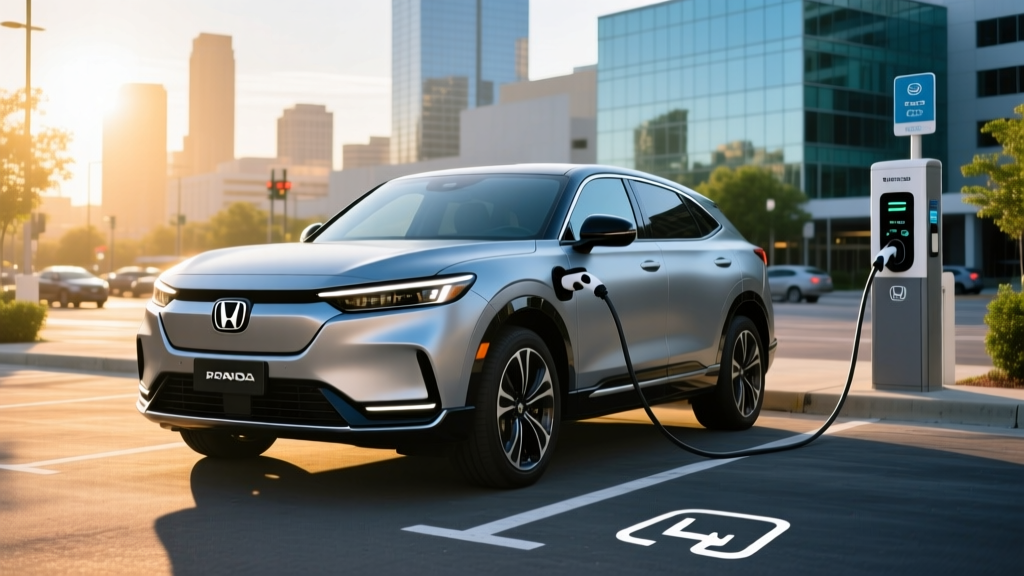
Honda's first dedicated electric SUV arrived with a familiar silhouette and an unfamiliar badge pairing: the 2025 Honda Prologue SUV is built on General Motors' Ultium platform, making it a mechanical twin to the Chevrolet Blazer EV. For Honda loyalists who've waited years for a homegrown EV, the Prologue represents a pragmatic bridge — a mid-size, two-row electric crossover that prioritizes comfort and daily usability over head-turning performance. But does a GM heart inside a Honda body deliver the goods for real-world EV buyers? We break down every number that matters.
2025 Honda Prologue SUV at a Glance: Core Specifications
| Spec | EX (FWD) | Touring (AWD) | Elite (AWD) |
|---|---|---|---|
| EPA Range | 308 miles | 281 miles | 273 miles |
| Battery (usable) | ~85 kWh (NMC lithium-ion) | ||
| Horsepower | 212 hp | 288 hp | 288 hp |
| 0–60 mph | ~7.9 sec | ~6.0 sec | ~5.8 sec |
| Max DC Fast Charge | 150 kW peak | ||
| 10–80% DC Time | ~34 minutes | ||
| Level 2 Home Charge | 11.5 kW (~26 mi/hr) | ||
| EPA MPGe (combined) | 95 MPGe | 90 MPGe | 87 MPGe |
| Base MSRP | $41,900 | $47,500 | $52,900 |
| Battery Warranty | 8 years / 100,000 miles | ||
Real-World Range: What the EPA Sticker Doesn't Tell You
The Prologue's 85 kWh usable battery pack uses NMC (nickel-manganese-cobalt) chemistry — the same cells found across GM's Ultium family. NMC delivers strong energy density, which is how Honda fits 308 miles into a mid-size SUV footprint. The trade-off versus LFP (lithium iron phosphate) chemistry is that NMC batteries prefer not to sit at 100% state of charge for extended periods. For daily driving, Honda recommends charging to 80–90% and saving 100% for road trips.
Efficiency on the FWD EX lands at roughly 33–35 kWh per 100 miles in mixed driving, which is competitive with the Hyundai Ioniq 5 (30–34 kWh/100mi) but slightly behind the Tesla Model Y's class-leading 28 kWh/100mi. The AWD models consume more, closer to 37–39 kWh/100mi on the highway.
Charging Speed: DC Fast Charging and Home Setup
The Prologue supports a 150 kW peak DC fast-charging rate on CCS-equipped models. Honda quotes a 10–80% charge in roughly 34 minutes under ideal conditions. In practice, the charge curve tapers meaningfully after 60% state of charge — you'll see the full 150 kW only briefly in the 10–30% window, dropping to 80–100 kW through the mid-range and falling below 50 kW past 70%. This is normal behavior for NMC packs managing thermal load, but it means your last 10% (80–90%) adds considerable time.
| Charging Level | Power / Rate | Miles Added per Hour | Typical Use Case |
|---|---|---|---|
| Level 1 (120V) | ~1.4 kW | ~4 mi/hr | Emergency / overnight trickle |
| Level 2 (240V, 48A) | 11.5 kW | ~26 mi/hr | Home daily charging (full in ~9 hrs) |
| DC Fast Charge | 150 kW peak | ~195 mi in 34 min (10–80%) | Road trips, quick top-ups |
For home charging, the Prologue's onboard charger accepts up to 11.5 kW on Level 2 (48 amps on a 60-amp circuit). A full 0–100% charge takes about 8.5–9 hours, which fits neatly into an overnight window. Home installation of a Level 2 charger typically runs $500–$2,000 depending on your panel capacity and conduit distance — budget extra if your electrical panel needs a 200-amp upgrade, which can add $1,500–$3,000. We recommend consulting a licensed electrician for a site-specific quote.
One notable development: Honda's agreement with Tesla grants future Honda EVs access to the NACS connector and Tesla Supercharger network. For the 2025 Prologue, however, the connector remains CCS1. Honda provides a NACS adapter for Supercharger access, which broadens your road-trip charging options significantly given Tesla's network reliability.
Performance, Drivetrain, and Ride Quality
The base EX runs a single front-mounted motor producing 212 horsepower and 236 lb-ft of torque — adequate for commuting and merging but not exactly thrilling. The 0–60 mph time of roughly 7.9 seconds places it behind sportier rivals. Step up to the Touring or Elite and you get a dual-motor AWD setup with 288 hp and 339 lb-ft, cutting the 0–60 time to around 5.8–6.0 seconds. That's a meaningful improvement for highway on-ramp confidence.
Ride quality is where the Prologue plays to Honda's strengths. The suspension tuning is comfortable and composed, absorbing potholes and expansion joints with the kind of compliance Honda owners expect. Cabin noise levels are low at highway speeds, aided by acoustic glass on higher trims. The steering is light and effortless rather than sporty — this is a family cruiser, not a canyon carver.
Towing capacity maxes out at 1,500 pounds across all trims, which is enough for a small utility trailer but rules out most campers. If you need serious towing, the Ford F-150 Lightning or Rivian R1S remain the EV benchmarks.
Interior Space, Cargo, and Daily Practicality
The Prologue slots into the mid-size SUV segment with competitive passenger and cargo dimensions:
- Front legroom: 41.4 inches
- Rear legroom: 38.6 inches
- Cargo behind rear seats: 25.2 cu ft
- Cargo with rear seats folded: 57.7 cu ft
- Front trunk (frunk): Not available — the Ultium platform packaging does not include a front storage compartment
The lack of a frunk is a missed opportunity for weather-sealed storage, but the rear cargo area is wide and flat-floored. The rear seats fold nearly flush, making the 57.7 cu ft total competitive with the Blazer EV (56.1 cu ft) and slightly behind the Hyundai Ioniq 5's 59.3 cu ft. Rear-seat passengers get generous headroom and a flat floor thanks to the skateboard battery architecture — no transmission tunnel hump to straddle.
Material quality on the Elite trim is a step up from the base model, with leather-trimmed seats, a heated steering wheel, and soft-touch surfaces on the dash and door panels. The EX and Touring use cloth and synthetic leather, respectively, with hard plastics on lower surfaces that feel appropriate for the price point but not premium.
Pricing, Trims, and Federal Tax Credit Eligibility
| Trim | Drivetrain | MSRP | Est. After §30D Credit* |
|---|---|---|---|
| EX | FWD | $41,900 | ~$34,400 |
| EX | AWD | $44,900 | ~$37,400 |
| Touring | AWD | $47,500 | ~$40,000 |
| Elite | AWD | $52,900 | ~$45,400 |
*Estimated effective price assumes full $7,500 federal tax credit via point-of-sale transfer. Actual eligibility depends on IRS §30D requirements.
The Prologue's eligibility for the federal §30D clean vehicle tax credit is one of its strongest selling points — but eligibility isn't automatic. Here's what determines whether you qualify:
- MSRP cap: SUVs must have an MSRP at or below $80,000. All Prologue trims qualify.
- Buyer income cap: Modified AGI must not exceed $150,000 (single), $225,000 (head of household), or $300,000 (married filing jointly).
- Battery sourcing: The vehicle must meet critical-mineral and battery-component requirements that phase in progressively each year. Because the Prologue is built on GM's Ultium platform with North American battery cell production, it has qualified for the full $7,500 credit. However, sourcing rules tighten annually — verify current-year eligibility at fueleconomy.gov before purchasing.
- Point-of-sale transfer: Since 2024, qualifying buyers can transfer the credit to the dealer at purchase, reducing the out-of-pocket price immediately rather than waiting for a tax refund.
We strongly recommend confirming credit eligibility with your tax professional before relying on the full $7,500 in your purchase budget, as battery-sourcing rules are subject to change.
Technology, Safety, and Driver Assistance
The Prologue runs a Google Built-in infotainment system on an 11.3-inch touchscreen (Touring and Elite) or an 11-inch screen (EX). Google Maps navigation, Google Assistant, and the Play Store for apps come standard. Wireless Apple CarPlay and Android Auto are supported on all trims. The system is responsive and familiar if you've used any modern Android device, though Honda's decision to move climate controls into the touchscreen frustrates some drivers who prefer physical knobs.
The Honda Sensing suite is standard across all trims and includes:
- Adaptive cruise control with stop-and-go
- Lane keeping assist and lane departure warning
- Collision mitigation braking
- Blind spot monitoring with rear cross-traffic alert
- Traffic sign recognition
The Prologue has not yet been crash-tested by the NHTSA or IIHS at the time of this writing, so independent safety ratings remain pending. The Ultium platform's structural battery pack contributes to a low center of gravity and robust side-impact protection in GM's internal testing.
How the Prologue Stacks Up Against Key Rivals
The mid-size electric SUV segment is crowded, and the Prologue faces direct competition from several well-established models:
| Model | EPA Range | Max DC kW | 10–80% Time | Starting MSRP |
|---|---|---|---|---|
| Honda Prologue (FWD) | 308 mi | 150 kW | ~34 min | $41,900 |
| Hyundai Ioniq 5 (RWD LR) | 303 mi | 240 kW | ~18 min | |
| Tesla Model Y (LR AWD) | 310 mi | 250 kW | ~20 min | |
| Chevrolet Blazer EV (RS AWD) | 279 mi | 190 kW | ~30 min | |
| Ford Mustang Mach-E (ER AWD) | 290 mi | 150 kW | ~35 min |
The Prologue's range is competitive, but its 150 kW peak charge rate is the weakest link in this comparison. The Ioniq 5's 800-volt architecture enables 240 kW charging, cutting 10–80% time nearly in half. For road-trip-heavy buyers, that's a meaningful difference — you'll spend roughly 15 extra minutes at each DC fast-charging stop compared to the Ioniq 5 or Model Y.
Where the Prologue wins is in brand familiarity and dealership experience. Honda's service network is extensive and trusted, and for buyers transitioning from a CR-V or Pilot, the Prologue's ergonomics, seating position, and ride quality feel immediately familiar. The Google Built-in infotainment is also a strong point versus Ford's occasionally laggy SYNC system.
Who Should Buy the 2025 Honda Prologue SUV?
- You're a current Honda owner who values brand familiarity and a trusted dealer network
- Your daily commute is under 60 miles round-trip and you can charge at home
- You want a comfortable, quiet ride over sporty performance
- Federal tax credit eligibility is important to your budget (confirm with your tax pro)
- You need a practical two-row family SUV with competitive cargo space
- You take frequent road trips and want the fastest possible DC charging (Ioniq 5 or Model Y)
- You need three rows of seating (consider the Kia EV9)
- You want a frunk for extra weather-sealed storage
- Performance and 0–60 times are a priority (Model Y Performance or Ioniq 5 N)
- You want the longest possible range in a single-charge scenario (Tesla Model Y LR or Rivian R1S Max)
Frequently Asked Questions
What is the real-world range of the 2025 Honda Prologue?
The FWD EX achieves an EPA-estimated 308 miles, but expect 245–265 miles in real-world highway driving and as low as 200–220 miles in freezing weather. The AWD Elite (EPA 273 miles) delivers roughly 220–240 miles on the highway and around 190–200 miles in cold conditions. City driving with regenerative braking recovers closer to the EPA figure.
How fast does the 2025 Honda Prologue charge?
On DC fast charging, the Prologue peaks at 150 kW and charges from 10–80% in approximately 34 minutes, though the charge curve tapers significantly above 60% SoC. At home on a Level 2 (240V) charger, it accepts 11.5 kW, adding roughly 26 miles of range per hour and achieving a full charge in about 8.5–9 hours.
Does the 2025 Honda Prologue qualify for the $7,500 federal EV tax credit?
The Prologue has qualified for the full $7,500 §30D credit thanks to its North American Ultium battery production. However, eligibility depends on your income (AGI caps apply), the vehicle's MSRP (must be ≤$80,000 for SUVs), and current-year battery sourcing rules. Always verify at fueleconomy.gov and consult a tax professional before purchase. The credit can be applied as a point-of-sale reduction.
Is the 2025 Honda Prologue worth buying over the Hyundai Ioniq 5 or Tesla Model Y?
The Prologue is worth buying if you prioritize Honda's dealer network, comfortable ride quality, and Google Built-in infotainment. However, the Ioniq 5 charges nearly twice as fast on DC (240 kW vs. 150 kW), and the Model Y offers greater efficiency, Supercharger network access without an adapter, and a slightly longer EPA range. If road-trip charging speed is your top priority, the Prologue's 150 kW cap is a genuine limitation.
What are the biggest pros and cons of the 2025 Honda Prologue?
- 308-mile EPA range on FWD EX
- Comfortable, quiet ride quality
- Google Built-in infotainment
- Federal tax credit eligible
- Trusted Honda dealer/service network
- Spacious rear seat and flat floor
- 150 kW DC charging is slower than rivals
- No frunk (front trunk)
- Climate controls buried in touchscreen
- AWD Elite range drops to 273 miles
- 1,500-lb towing limit is modest
- No NHTSA/IIHS crash ratings yet
What is the battery warranty on the 2025 Honda Prologue?
Honda covers the Prologue's battery pack and electric powertrain for 8 years or 100,000 miles, whichever comes first. The warranty guarantees the battery will retain a minimum percentage of its original capacity (typically 70%) over that period. The basic vehicle warranty is 3 years / 36,000 miles, which is standard for the segment.