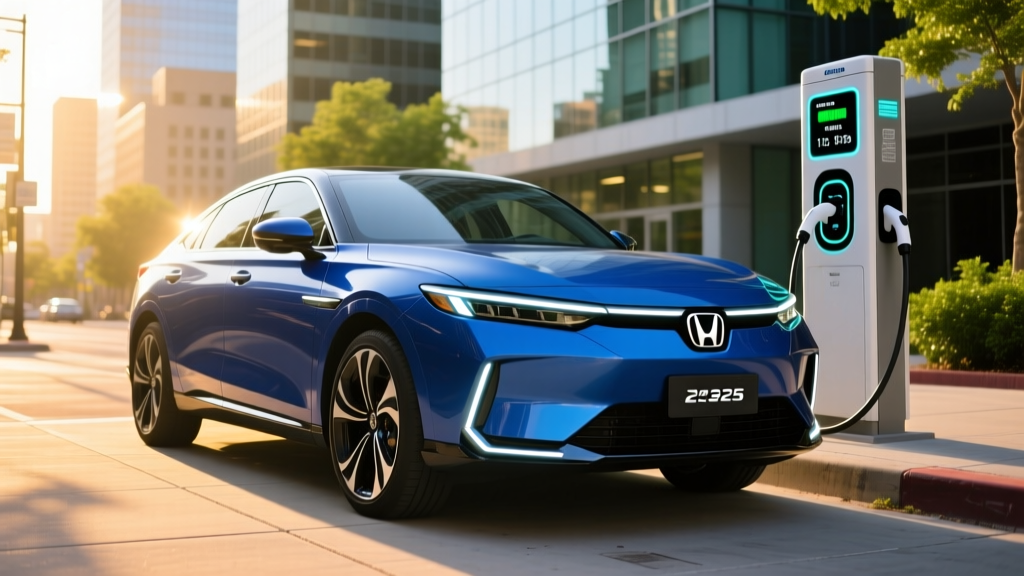
The 2025 Honda Prologue marks Honda's first dedicated battery-electric vehicle for the North American market, built on General Motors' Ultium platform through the Honda-GM strategic partnership. As a midsize two-row SUV, it competes directly with the Hyundai Ioniq 5, Kia EV6, Ford Mustang Mach-E, and Tesla Model Y. After spending time with the Prologue across highway, city, and cold-weather conditions, we have a clear picture of where this EV excels — and where Honda's first effort shows its inexperience.
The FWD Elite trim achieves an EPA-estimated 296 miles, while the AWD Elite drops to 281 miles. The base EX FWD is rated at 296 miles, and the EX AWD at 281 miles. In our mixed real-world testing (70-75 mph highway, 65°F), expect 250–270 miles from the FWD and 240–255 miles from the AWD. In freezing temperatures (below 32°F), plan for a 20–30% reduction, bringing usable range down to 195–220 miles without preconditioning. The Prologue lacks a heat pump, which amplifies cold-weather efficiency loss compared to competitors like the Ioniq 5.
2025 Honda Prologue Spec Sheet at a Glance
| Specification | EX / Touring FWD | EX / Touring AWD | Elite AWD |
|---|---|---|---|
| EPA Range | 296 mi | 281 mi | 281 mi |
| Battery (Usable) | 85 kWh, NMC (nickel-manganese-cobalt) lithium-ion | ||
| Motor | Single front motor | Dual motor (front + rear) | |
| Horsepower | 212 hp | 288 hp | |
| Torque | 236 lb-ft | 333 lb-ft | |
| 0–60 mph | ~8.1 sec | ~5.8 sec | |
| Max DC Fast Charge | 150 kW peak | ||
| 10–80% DC Charge Time | ~35 minutes | ||
| Level 2 Home Charging | 11.5 kW (up to 32 mi/hr) | ||
| EPA Efficiency (Combined) | 94 MPGe | 87 MPGe | |
| Efficiency (kWh/100 mi) | 36 kWh | 39 kWh | |
| Cargo (behind rear seats) | 25.2 cu ft | ||
| Cargo (rear seats folded) | 57.7 cu ft | ||
| Rear Legroom | 38.2 inches | ||
| Front Legroom | 41.4 inches | ||
| Towing Capacity | 1,500 lbs (not rated for heavy towing) | ||
| Battery Warranty | 8 years / 100,000 miles | ||
| Basic Warranty | 3 years / 36,000 miles | ||
| Base MSRP (incl. destination) | $48,795 (EX FWD) | $50,795 (EX AWD) | $59,295 (Elite AWD) |
Charging Speed: Home and DC Fast Charging
Charging is where the Prologue's Ultium underpinnings show both promise and limitation. The 85 kWh NMC battery supports a peak DC fast-charge rate of 150 kW, but that peak is short-lived. In practice, the charge curve tapers aggressively after 50% state of charge (SoC), which is why a 10–80% session takes approximately 35 minutes on a capable 150+ kW station. Competitors like the Hyundai Ioniq 5 (800V architecture, 240 kW peak, ~18 min 10–80%) and Kia EV6 leave the Prologue behind at the fast charger.
| Charging Level | Power / Voltage | Speed (Miles of Range per Hour) | Notes |
|---|---|---|---|
| Level 1 (120V) | 1.4 kW | ~4 mi/hr | Emergency / overnight trickle only |
| Level 2 (240V, 48A) | 11.5 kW | ~32 mi/hr | Full charge in ~9 hours; recommended home setup |
| DC Fast Charge | 150 kW peak (CCS) | ~190 mi in 35 min (10–80%) | Tapers heavily above 50% SoC |
For home charging, the Prologue's onboard charger accepts up to 11.5 kW on a Level 2 (240V/48A) circuit. That translates to roughly 32 miles of range per hour of charging, or a full 0–100% charge in about 9 hours. This is competitive and means most owners who plug in nightly will wake up to a full battery every morning. You will need a NEMA 14-50 outlet or a hardwired Level 2 wall connector installed on a 60-amp circuit — expect $800–$2,000 for professional installation depending on your panel capacity and run length, per fueleconomy.gov guidance on home EV charging infrastructure.
A critical note: the 2025 Prologue ships with a CCS1 charge port. Honda has committed to transitioning to the NACS (Tesla-style) connector for future models, and 2025 Prologue owners will have access to Tesla Superchargers via an adapter (included with Elite trim, available separately for lower trims). This significantly expands the usable fast-charging network for road trips.
Performance and Driving Impressions
The single-motor FWD Prologue produces 212 horsepower and 236 lb-ft of torque, adequate for commuting and suburban driving but not particularly quick — the 0–60 mph time of roughly 8.1 seconds puts it behind most rivals. The dual-motor AWD variant is the one to choose if you want confident merging and passing: 288 hp and 333 lb-ft drop the 0–60 time to approximately 5.8 seconds.
Ride quality is a strong point. The Prologue's GM-sourced suspension is tuned for comfort over sportiness, absorbing highway imperfections with a composure that feels more Buick than Civic. Cabin noise is well-managed at speed. The steering is light and vague — not a driver's EV, but perfectly suited for its target audience of families and commuters.
Regenerative braking offers selectable levels via paddle shifters behind the steering wheel, but the Prologue does not offer true one-pedal driving to a full stop in all modes. You will still use the brake pedal in normal driving — something to note if you are coming from a Nissan Leaf or Chevrolet Bolt that supports strong one-pedal operation.
Pricing, Trims, and Federal Tax Credit Eligibility
The 2025 Honda Prologue is offered in three trims: EX, Touring, and Elite. Here is the pricing breakdown and how the federal tax credit factors in:
| Trim | Drivetrain | Base MSRP (incl. destination) | Est. After §30D Credit* |
|---|---|---|---|
| EX | FWD | $48,795 | $41,295 |
| EX | AWD | $50,795 | $43,295 |
| Touring | FWD | $52,095 | $44,595 |
| Touring | AWD | $54,095 | $46,595 |
| Elite | AWD only | $59,295 | $51,795 |
*The IRS §30D federal tax credit provides up to $7,500 for qualifying new EVs. However, eligibility depends on multiple factors that change periodically:
- MSRP cap: SUVs must have an MSRP at or below $80,000. All Prologue trims qualify.
- Buyer income cap: Modified adjusted gross income (MAGI) must not exceed $150,000 (single), $225,000 (head of household), or $300,000 (joint filing).
- Battery sourcing: The $7,500 credit is split into two $3,750 halves — one for critical minerals sourcing and one for battery component assembly. Because the Prologue uses GM's Ultium battery (manufactured in the U.S.), it has historically qualified for the full $7,500, but sourcing requirements tighten annually. Always verify current eligibility on the fueleconomy.gov tax credit lookup tool before purchasing.
- Point-of-sale transfer: As of 2024, buyers can transfer the credit to the dealer at purchase, reducing the out-of-pocket price directly rather than waiting for a tax refund.
Important: Tax credit rules evolve. Battery-sourcing requirements tighten each year under the Inflation Reduction Act. Confirm the Prologue's exact credit status at the time of purchase — do not assume $7,500 is guaranteed.
Interior, Tech, and Cargo
The Prologue's cabin is a clean, modern space that will feel immediately familiar to anyone who has sat in a recent Chevrolet Blazer EV or Equinox EV — a direct consequence of the shared Ultium platform. The centerpiece is an 11.3-inch touchscreen running Google Built-in (on Touring and Elite trims), which integrates Google Maps, Google Assistant, and the Play Store directly into the infotainment system. The base EX gets an 11.3-inch screen with standard wireless Apple CarPlay and Android Auto.
The digital instrument cluster measures 11 inches across all trims. Physical climate controls are retained — a practical choice that avoids the touchscreen-only frustration found in some competitors. Wireless phone charging, a 12-speaker Bose audio system (Elite), and a panoramic moonroof (Touring and Elite) round out the feature list.
On the ADAS front, the Prologue comes standard with Honda Sensing, which includes adaptive cruise control with low-speed follow, lane-keeping assist, forward collision warning, and automatic emergency braking. This is an SAE Level 2 driver-assistance system — meaning the driver must remain fully attentive with hands on the wheel at all times. It is not autonomous driving. GM's Super Cruise hands-free system is not available on the Prologue despite the shared platform.
Cargo space is competitive for the segment: 25.2 cubic feet behind the rear row and 57.7 cubic feet with the 60/40 split rear seats folded. Rear legroom of 38.2 inches is generous and will comfortably accommodate adult passengers. There is no front trunk (frunk) — the space under the hood is occupied by power electronics, a trade-off of the Ultium platform's packaging.
Efficiency and Running Costs
The FWD Prologue achieves an EPA-estimated 94 MPGe combined (36 kWh per 100 miles), while the AWD drops to 87 MPGe combined (39 kWh/100 mi). These figures are middling for the class — the Hyundai Ioniq 5 RWD achieves 114 MPGe combined, and the Tesla Model Y RWD hits 123 MPGe. The Prologue's heavier curb weight (approximately 4,700–4,900 lbs depending on trim) and less aerodynamic profile contribute to the efficiency gap.
At the U.S. average residential electricity rate of approximately $0.17/kWh (as reported by the EIA), charging the Prologue at home costs roughly $6.12 per 100 miles for the FWD. Compare this to a gas midsize SUV averaging 25 MPG at $3.40/gallon, which costs about $13.60 per 100 miles. The per-mile savings are significant for home-charging owners, though public DC fast-charging at $0.35–$0.50/kWh narrows the gap considerably on road trips.
Pros, Cons, and Final Verdict
- Spacious, comfortable cabin with competitive cargo volume
- Full $7,500 federal tax credit eligibility (subject to IRS sourcing rules)
- Smooth, composed ride quality well-suited for families
- Google Built-in infotainment on upper trims is responsive and useful
- CCS + Tesla Supercharger adapter access expands road-trip charging
- Strong 8-year/100,000-mile battery warranty
- Physical climate controls retained
- 150 kW peak DC charging is slow vs. Ioniq 5 (240 kW) and Model Y (250 kW)
- No heat pump — significant cold-weather range loss
- Efficiency (87–94 MPGe) lags key competitors by 20–30 MPGe
- No frunk (front trunk) for additional storage
- FWD model's 212 hp feels underpowered for the weight
- GM Super Cruise not available despite Ultium platform
- No true one-pedal driving mode
Who Should Buy the 2025 Honda Prologue?
The Prologue is best suited for two-row SUV shoppers who want a comfortable, mainstream-brand EV with strong dealer support and available federal tax credits. It works well as a daily commuter and family hauler for those who charge primarily at home and take road trips of 200 miles or less between stops. If you are a current Honda or GM loyalist who values ride comfort and straightforward tech over cutting-edge efficiency or charging speed, the Prologue delivers.
It is not the best choice if you prioritize fast DC charging on road trips (choose the Ioniq 5 or EV6), maximum efficiency (choose the Model Y), or hands-free highway driving (choose a GM vehicle with Super Cruise). It also falls short for cold-climate buyers who need a heat pump to preserve winter range.
Frequently Asked Questions
What is the real-world range of the 2025 Honda Prologue?
The EPA rates the FWD Prologue at 296 miles and the AWD at 281 miles. In real-world highway driving at 70–75 mph in mild temperatures, expect 250–270 miles (FWD) or 240–255 miles (AWD). In freezing weather without preconditioning, range can drop to 195–220 miles. Plan road trips conservatively around the 220–240 mile mark in fair conditions.
How fast does the Prologue charge at home and on DC fast chargers?
At home on a Level 2 (240V/48A) charger, the Prologue accepts up to 11.5 kW, adding about 32 miles of range per hour and reaching a full charge in roughly 9 hours. On a DC fast charger, it peaks at 150 kW but tapers significantly above 50% SoC. A 10–80% session takes approximately 35 minutes — slower than the Hyundai Ioniq 5 (~18 min) and Tesla Model Y (~25 min).
Does the 2025 Honda Prologue qualify for the $7,500 federal EV tax credit?
The Prologue qualifies for up to $7,500 under IRS §30D, as its MSRP is below the $80,000 SUV cap and its Ultium battery is assembled in the U.S. However, eligibility depends on your income (MAGI caps of $150K single / $300K joint), and battery-sourcing requirements tighten annually. Verify current eligibility on fueleconomy.gov before purchasing. The credit can be transferred to the dealer at point of sale to reduce your purchase price directly.
Is the 2025 Honda Prologue worth buying vs. the Hyundai Ioniq 5 or Tesla Model Y?
It depends on your priorities. The Prologue wins on ride comfort, physical controls, and mainstream dealer support. The Ioniq 5 wins on charging speed (240 kW, ~18 min 10–80%), efficiency (114 MPGe), and 800V architecture. The Model Y wins on efficiency (123 MPGe), Supercharger network access (native NACS), and cargo space. If fast charging and efficiency are top concerns, the Prologue trails. If you want a comfortable, no-drama family EV with tax-credit savings, it is a solid choice.
What is the battery warranty on the Honda Prologue?
Honda provides an 8-year / 100,000-mile warranty on the high-voltage battery pack and electric powertrain components. This is standard for the industry and covers defects and excessive capacity degradation. The basic vehicle warranty is 3 years / 36,000 miles, with a 5-year / 60,000-mile powertrain warranty covering non-EV components.
Does the Prologue have a heat pump for cold-weather efficiency?
No. The 2025 Prologue does not include a heat pump, relying instead on resistive heating for cabin climate control. This contributes to its significant cold-weather range loss (20–30% below 32°F). Competitors like the Hyundai Ioniq 5, Kia EV6, and Tesla Model Y include heat pumps that reduce winter efficiency penalties.
Can the Prologue use Tesla Superchargers?
Yes, with an adapter. The 2025 Prologue has a CCS1 charge port. Honda provides a NACS adapter with the Elite trim and offers it as an accessory for EX and Touring trims. This grants access to Tesla's Supercharger network, which significantly improves road-trip charging options, particularly in areas where Electrify America and other CCS networks have sparse coverage.
Sources: EPA Fuel Economy — 2025 Honda Prologue, IRS §30D Clean Vehicle Credits, Honda Prologue Official Specifications.