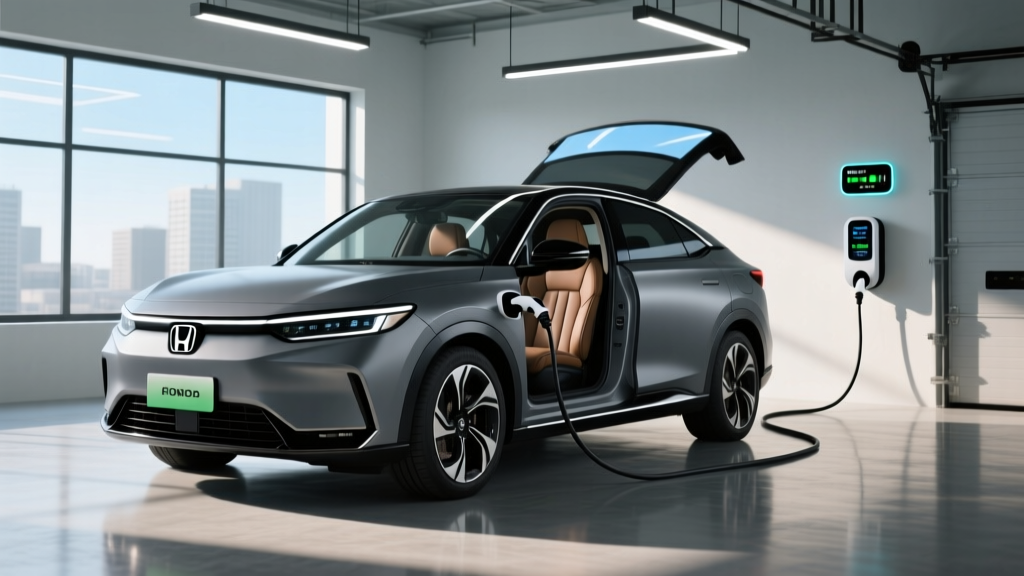
Honda's first dedicated battery-electric SUV, the 2025 Prologue, entered the market as a GM Ultium-platform product built in partnership with General Motors. For buyers scanning dealership ads and online listings, the most aggressive pull remains the 2025 Honda Prologue lease offer — often advertised well below MSRP thanks to stacked manufacturer incentives and the federal point-of-sale tax credit. But aggressive lease pricing doesn't automatically make this the right EV for your driveway. This review dissects the Prologue's real-world range, charging behavior, tax-credit eligibility under IRS §30D, and whether leasing or buying makes financial sense in today's market.
2025 Honda Prologue: At-a-Glance Specifications
| Specification | Prologue EX (FWD) | Prologue Touring (AWD) | Prologue Elite (AWD) |
|---|---|---|---|
| EPA Range | 296 miles | 281 miles | 273 miles |
| Usable Battery | 85 kWh (NMC lithium-ion, Ultium platform) | ||
| Horsepower | 212 hp | 288 hp | |
| Torque | 236 lb-ft | 333 lb-ft | |
| 0–60 mph | ~8.2 sec | ~6.2 sec | |
| Drivetrain | Single-motor FWD | Dual-motor AWD | |
| Max DC Fast Charge | 150 kW peak | ||
| 10–80% DC Charge | ~35 minutes | ||
| Level 2 Home Charging | 11.5 kW onboard (~32 mi/hr) | ||
| Efficiency (EX FWD) | 99 MPGe combined / 34 kWh/100 mi | ||
| Cargo (rear seats up) | 25.2 cu ft | ||
| Cargo (rear seats folded) | 57.7 cu ft | ||
| Base MSRP (incl. destination) | $48,795 | $52,395 | $58,795 |
| Battery Warranty | 8 years / 100,000 miles | ||
Source: fueleconomy.gov and Honda's official 2025 spec sheets.
Real-World Range vs. EPA Sticker: What to Expect
EPA Estimated Range: 296 mi (EX FWD) / 281 mi (Touring AWD) / 273 mi (Elite AWD)
Real-World Expectation: On sustained 75 mph highway driving in mild weather, expect 240–260 miles on the EX and 225–245 miles on AWD trims. In cold weather (below 32°F), cabin heating and battery conditioning can reduce range by 20–30%, potentially dropping AWD models to 190–210 miles per charge.
The Prologue's 85 kWh NMC battery pack provides competitive capacity for the midsize electric SUV segment, but the Ultium platform's thermal management system prioritizes battery longevity over aggressive range recovery. Unlike the Hyundai Ioniq 5 or Tesla Model Y, the Prologue lacks a standard heat pump — Honda uses a resistive PTC heater that draws significant energy in winter conditions.
For daily commuting under 40 miles round-trip, even the Elite AWD's real-world range is more than adequate. Road-trippers planning 300+ mile legs between charges should budget conservatively and use PlugShare or Honda's built-in route planner to identify DC fast-charger stops along the way.
Charging Speed: DC Fast and Home Level 2
| Charging Method | Max Power (kW) | Speed / Time | Connector |
|---|---|---|---|
| Level 1 (120V outlet) | ~1.4 kW | ~4 miles per hour | J1772 / NACS (adapter) |
| Level 2 (240V home) | 11.5 kW | ~32 miles per hour (0–100% in ~9 hrs) | J1772 / NACS (adapter) |
| DC Fast Charge | 150 kW peak | 10–80% in ~35 minutes | CCS1 / NACS (adapter) |
The Prologue's 150 kW peak DC fast-charge rate is the most common criticism among EV enthusiasts. Competitors like the Hyundai Ioniq 5 (peak 240 kW) and Kia EV6 (peak 235 kW) can complete a 10–80% charge in roughly 18 minutes — nearly half the Prologue's time. However, peak kW is only part of the story. The Prologue sustains close to its peak rate through roughly 50% state of charge before tapering, which is reasonable for a vehicle focused on comfort over charging speed.
One important note for 2025: Honda has begun equipping Prologue models with the North American Charging Standard (NACS) port, granting native access to Tesla's Supercharger network. Earlier 2025 models shipped with CCS1 ports and include a NACS adapter. Always confirm the port type at the dealership before signing paperwork — it affects your public charging flexibility significantly.
At home on a Level 2 charger (240V, 48-amp circuit), the 11.5 kW onboard charger replenishes the battery at roughly 32 miles of range per hour. A full overnight charge from 10% to 100% takes approximately 9 hours — perfectly manageable for drivers who plug in upon returning home each evening. Installation of a Level 2 home charger typically costs $500–$2,000 depending on electrical panel capacity and run length; consult a licensed electrician for a site-specific quote.
Lease Offers vs. Purchase: The $7,500 Federal Tax Credit Factor
The headline-grabbing 2025 Honda Prologue lease offer numbers you see advertised — sometimes as low as $199–$299/month — are made possible by a combination of Honda's aggressive subvention (below-market money factor and residual support) and the federal EV tax credit passed through at the point of sale.
| Trim | Base MSRP | Federal Credit (§30D) | Effective Price |
|---|---|---|---|
| EX (FWD) | $48,795 | Up to $7,500 | ~$41,295 |
| Touring (AWD) | $52,395 | Up to $7,500 | ~$44,895 |
| Elite (AWD) | $58,795 | Up to $7,500 | ~$51,295 |
IRS §30D Federal EV Tax Credit Requirements (2025):
- MSRP Cap: SUVs must be priced at or below $80,000 — all Prologue trims qualify.
- Buyer Income Cap: Adjusted gross income must not exceed $150,000 (single), $225,000 (head of household), or $300,000 (joint filing).
- Battery Sourcing: Critical minerals and battery components must meet phased-in domestic/free-trade sourcing thresholds for the full $7,500. Partial credit ($3,750) applies if only one requirement is met. The Prologue's GM Ultium battery sourcing has qualified for the full credit on most 2025 builds, but confirm with your dealer using the VIN-specific IRS lookup tool.
- Point-of-Sale Transfer: As of 2024, buyers can transfer the credit to the dealer at purchase, reducing the out-of-pocket price immediately rather than waiting for tax filing.
- Lease Loophole: Under the "commercial vehicle" interpretation of §45W, leased EVs may qualify for a $7,500 credit that the lessor (Honda Financial Services) can pass to the lessee as a capitalized-cost reduction — even if the lessee exceeds income caps. This is why lease offers often appear more aggressive than purchase deals.
Source: IRS.gov — Clean Vehicle Credits. Always consult a tax professional for your specific situation.
Typical lease structures for the 2025 Prologue EX in mid-2025 include 36-month terms with $2,999–$3,999 due at signing and monthly payments in the $249–$399 range depending on region, dealer markup or discount, and credit tier. Honda has been layering $5,000–$7,500 in total lease cash and loyalty incentives on top of the federal credit pass-through, which is what drives the most eye-catching advertisements.
Lease vs. Buy Decision: If you plan to keep the vehicle 5+ years and drive more than 12,000 miles annually, purchasing with the point-of-sale credit transfer may yield better long-term value despite higher monthly payments. If you prefer lower monthly costs, drive under 10,000–12,000 miles/year, and want to upgrade to newer EV technology in three years, the current lease environment is difficult to beat.
Driving Dynamics, Tech, and Interior
The Prologue rides on GM's BEV3 platform (shared with the Chevrolet Blazer EV and Cadillac Lyriq), and it shows in the driving experience. The AWD dual-motor configuration delivers 288 hp and 333 lb-ft of torque, propelling the 4,700-lb SUV to 60 mph in roughly 6.2 seconds. That's adequate for highway merging and confident passing but not thrilling — the Tesla Model Y Long Range AWD hits 60 in 4.8 seconds for comparison.
Ride quality is a strong point. The Prologue's suspension tuning favors comfort over sportiness, absorbing highway imperfections with the composure you'd expect from Honda. Cabin noise levels are low, aided by acoustic laminated glass on the front windows.
Infotainment: An 11.3-inch touchscreen runs Google Built-In (Google Maps, Google Assistant, Play Store) on the Touring and Elite trims, with wireless Apple CarPlay and Android Auto standard across all trims. The system is responsive but Honda's decision to use a GM-derived software stack means the interface feels slightly different from other Honda products — expect a learning curve if you're coming from a Civic or CR-V.
Driver Assistance: Honda Sensing is standard, including adaptive cruise control, lane-keeping assist, and automatic emergency braking. However, the Prologue does not offer hands-free driving capability like GM's Super Cruise (available on the Chevrolet Blazer EV). This is a notable omission for a vehicle built on the same platform. Honda has indicated a hands-free system is in development for future models.
Cargo and Passenger Space: The Prologue offers 25.2 cu ft behind the rear seats and 57.7 cu ft with the 60/40 split rear seats folded. Rear legroom measures 38.4 inches — generous for adults on longer trips. The flat load floor and wide liftgate opening make it practical for family hauling. There is no front trunk (frunk); Honda uses that space for HVAC and power electronics.
How the Prologue Compares to Key Competitors
| Spec | 2025 Honda Prologue Touring AWD | 2025 Hyundai Ioniq 5 SEL AWD | 2025 Tesla Model Y Long Range AWD |
|---|---|---|---|
| EPA Range | 281 mi | 290 mi | 320 mi |
| Battery | 85 kWh NMC | 77.4 kWh NMC | ~75 kWh (NCA/NMC) |
| DC Fast Charge Peak | 150 kW | 240 kW | 250 kW |
| 10–80% Charge | ~35 min | ~18 min | ~20 min |
| 0–60 mph | 6.2 sec | 5.2 sec | 4.8 sec |
| Heat Pump | No | Yes | Yes |
| Base MSRP (AWD) | $52,395 | $50,850 | $48,990 |
| Hands-Free ADAS | No | No (HDA-2 requires hands on wheel) | No (FSD Supervised = Level 2) |
Pros
- Competitive lease pricing when stacking incentives and federal credit
- Comfortable, quiet ride quality true to Honda's reputation
- Spacious rear seats and practical cargo area
- Google Built-In infotainment on upper trims
- NACS compatibility (native or via adapter) for Supercharger access
- 8-year / 100,000-mile battery warranty
Cons
- 150 kW peak DC charge rate is slow for the segment
- No heat pump — cold-weather range suffers more than competitors
- No hands-free driving feature despite GM platform sharing
- Higher MSRP than Tesla Model Y and Ioniq 5 before incentives
- No front trunk (frunk)
- Regenerative braking is not true one-pedal driving
Who Should Consider the 2025 Honda Prologue?
Choose the Prologue if:
- You're a Honda loyalist who wants a familiar dealership experience and service network.
- Your daily commute is under 60 miles round-trip and you charge at home nightly.
- You prioritize ride comfort and cabin quietness over sporty acceleration.
- You can take advantage of aggressive lease offers with the federal credit pass-through.
- You need a spacious rear seat for child seats or adult passengers.
Look elsewhere if:
- You road-trip frequently and need the fastest possible DC charging (Ioniq 5, EV6).
- You live in a cold climate where a heat pump meaningfully preserves winter range (Ioniq 5, Model Y).
- You want the longest possible EPA range in the segment (Model Y at 320 mi).
- Hands-free highway driving is a priority (wait for Honda's next-gen system or consider BlueCruise/Super Cruise vehicles).
Frequently Asked Questions
What is the real-world range of the 2025 Honda Prologue?
The EPA rates the Prologue EX (FWD) at 296 miles and the Touring AWD at 281 miles. In real-world highway driving at 70–75 mph, expect 240–260 miles for the EX and 225–245 miles for AWD trims. Cold weather below freezing can reduce these figures by 20–30% due to the lack of a heat pump and resistive cabin heating.
How fast does the Prologue charge at home and on the road?
At home on a 240V Level 2 charger, the Prologue charges at up to 11.5 kW, adding roughly 32 miles of range per hour and achieving a full charge in about 9 hours. On a DC fast charger, it peaks at 150 kW and reaches 10–80% in approximately 35 minutes — slower than the Ioniq 5 or Model Y but sufficient for planned road trips with 30-minute stops.
Does the 2025 Honda Prologue qualify for the $7,500 federal tax credit?
Yes, the Prologue qualifies for up to $7,500 under IRS §30D, provided the buyer meets income caps ($150K single / $300K joint), the MSRP is under $80,000 (all trims qualify), and the battery meets critical-mineral and component sourcing requirements. The credit can be transferred to the dealer at point of sale. For leases, the lessor may pass through the credit as a capitalized-cost reduction regardless of lessee income. Always verify VIN-specific eligibility via the IRS tool and consult a tax professional.
Is it better to lease or buy the Prologue in 2025?
Leasing is compelling right now due to Honda's aggressive subvention and the ability to pass through the $7,500 federal credit as a cap-cost reduction — even for buyers above the income cap. If you drive under 12,000 miles/year and plan to upgrade in three years, leasing likely wins. If you drive more, plan to keep the vehicle long-term, or want to avoid lease-end disposition fees, purchasing with the point-of-sale credit transfer is the better path.
Does the Prologue have Honda's hands-free driving system?
No. Despite being built on GM's Ultium platform (which supports Super Cruise on other vehicles), the 2025 Prologue only offers Honda Sensing — a Level 2 driver-assist suite requiring hands on the wheel at all times. It includes adaptive cruise control and lane centering but is not a hands-free or "self-driving" system. Honda has not confirmed a timeline for hands-free capability on the Prologue.
How does the Prologue's warranty compare?
Honda covers the Prologue's battery and electric powertrain for 8 years or 100,000 miles (whichever comes first), matching the industry standard for EV powertrain coverage. The basic vehicle warranty is 3 years / 36,000 miles. The battery warranty guarantees the pack will retain a minimum capacity threshold (typically 70% state of health) over the coverage period.
Final Verdict
The 2025 Honda Prologue is a comfortable, spacious, and practical electric SUV that benefits enormously from the current incentive environment. The lease offers are genuinely compelling — often making the Prologue one of the most affordable ways to get into a new midsize electric SUV with 280+ miles of range. However, buyers who prioritize fast charging, cold-weather efficiency, or cutting-edge driver assistance will find stronger options in the Ioniq 5, Model Y, or EV6. The Prologue's value proposition lives and dies with the deal: if you can lock in a lease under $350/month with the credit applied, it's a smart move. If you're paying close to MSRP, the competition offers more capability for the dollar.