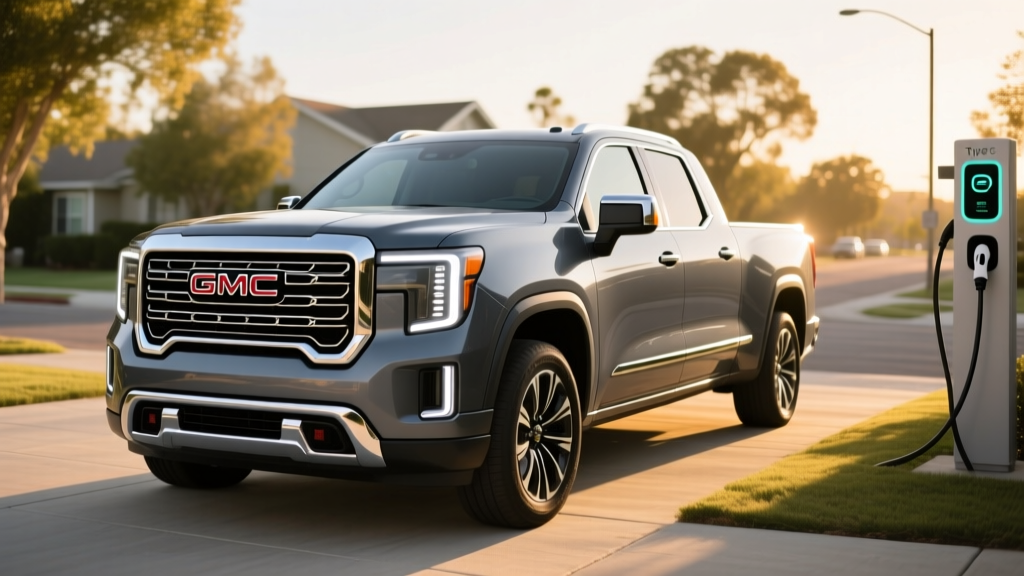
Quick Verdict: Who Should Buy the 2025 GMC Sierra Denali EV?
The 2025 GMC Sierra Denali EV Edition 1 delivers an EPA-estimated 440 miles of range from its ~200 kWh Ultium battery, peaks at 350 kW DC fast charging (10–80% in roughly 30 minutes under ideal conditions), and starts near $99,495. It qualifies for the federal §30D commercial clean vehicle credit (not the consumer credit, due to MSRP and sourcing rules — see below). Buy it if you need a premium electric truck with serious range, tow capability, and home Level 2 charging access. Skip it if your budget caps below $90K, you lack reliable charging, or you regularly tow heavy loads in sub-freezing weather where range can drop 30–40%.
Specs That Matter: Range, Battery, Charging & Performance
| Specification | 2025 Sierra Denali EV Edition 1 |
|---|---|
| EPA Range | 440 miles (Edition 1 / 4WT) |
| Real-World Range Expectation | ~350–380 mi highway; ~280–320 mi cold weather / towing |
| Battery Capacity (usable) | ~200 kWh (Ultium, NMC chemistry) |
| Peak DC Fast Charge Rate | 350 kW (800V architecture) |
| 10–80% DC Charge Time | ~30 minutes (ideal); ~40–45 min real-world with taper |
| Level 2 Charging (Home) | Up to 19.2 kW (~52 mi/hr added) |
| Horsepower | 754 hp (Wide Open Watts mode) |
| 0–60 mph | ~4.3 seconds |
| Max Towing Capacity | 9,500 lbs (Edition 1) |
| Starting MSRP | $99,495 (Edition 1) |
| Battery/Powertrain Warranty | 8 years / 100,000 miles |
The Sierra Denali EV rides on GM's BT1 electric truck platform with a dual-motor AWD setup. The massive ~200 kWh pack is among the largest in any production vehicle, which directly explains both the 440-mile EPA figure and the truck's 9,000+ lb curb weight. That weight matters: efficiency hovers around 47–49 MPGe combined per fueleconomy.gov, translating to roughly 68–72 kWh/100 miles. For comparison, a lighter EV sedan might use 25–30 kWh/100 miles.
Real-World Range Reality Check
The 440-mile EPA sticker is impressive, but physics applies. At sustained 75 mph highway speeds, expect 350–380 miles. In temperatures below 30°F, the NMC battery loses efficiency to cabin heating and cell conditioning — plan for 280–340 miles depending on conditions. Towing a 7,000 lb trailer? Range can halve to roughly 200–240 miles. The Sierra EV does include a heat pump for improved cold-weather efficiency, but no heat pump fully offsets the energy cost of heating a full-size truck cabin.
Charging the Sierra Denali EV: What You Actually Need
The 800V architecture enables 350 kW peak charging on compatible stations — but sustained speeds tell the real story. Like all large batteries, the Sierra EV's charge curve tapers significantly above 80% state of charge (SoC) to protect cell longevity. A 10–80% session on a 350 kW charger takes roughly 30 minutes under optimal battery temperature; on a 150 kW Electrify America or EVgo station, expect 55–70 minutes for the same 10–80% window.
| Charging Level | Power (kW) | Miles Added Per Hour | Typical Use Case |
|---|---|---|---|
| Level 1 (120V outlet) | 1.4–1.9 kW | ~3–4 mi/hr | Emergency / trickle only |
| Level 2 (240V, 48A) | 11.5 kW | ~28–30 mi/hr | Standard home charger |
| Level 2 (240V, 80A) | 19.2 kW | ~48–52 mi/hr | High-power home / depot |
| DC Fast (150 kW station) | 150 kW peak | N/A — 55–70 min 10–80% | Public road-trip charging |
| DC Fast (350 kW station) | 350 kW peak | N/A — ~30 min 10–80% | Fastest public charging |
Home charging is practically mandatory for Sierra EV ownership. A full Level 1 charge on a standard 120V outlet would take over 4 days for the ~200 kWh pack. With a Level 2 home charger at 11.5 kW, a full charge takes roughly 17–18 hours; at 19.2 kW, about 10–11 hours. Most owners will plug in nightly and wake up with a full battery, adding 100–200 miles overnight depending on daily driving.
Home Level 2 installation typically costs $800–$2,500 for equipment and electrician labor, assuming your electrical panel has capacity. A 200-amp panel upgrade (sometimes needed for high-amperage EV circuits) adds $1,500–$3,500. Always get a licensed electrician's assessment before purchasing charger hardware.
Sierra Denali EV vs. Gas Sierra Denali: The Real Cost Comparison
The most common question from truck buyers: does going electric actually save money? Here's a data-driven breakdown comparing the 2025 Sierra Denali EV Edition 1 against a comparably equipped 2025 GMC Sierra 1500 Denali gas model (6.2L V8, 420 hp, starting around $72,000).
| Cost Factor | Sierra Denali EV ($99,495) | Sierra Denali Gas (~$72,000) |
|---|---|---|
| Base MSRP | $99,495 | $72,000 |
| Federal Tax Credit (§30D) | Not eligible (MSRP/income/sourcing) | N/A |
| Out-of-Pocket Purchase | ~$99,495 | ~$72,000 |
| Annual Fuel/Energy (15K mi/yr) | ~$1,100–$1,600 (home charging) | ~$3,000–$3,600 (gas at $3.50/gal, 15 MPG) |
| Annual Maintenance | ~$200–$400 | ~$600–$1,000 |
| 5-Year Fuel/Energy Total | ~$5,500–$8,000 | ~$15,000–$18,000 |
| 5-Year Maintenance Total | ~$1,000–$2,000 | ~$3,000–$5,000 |
| Insurance (annual avg.) | ~$2,800–$3,500 | ~$2,200–$2,800 |
| 5-Year Total Operating Cost | ~$20,500–$27,500 | ~$29,000–$37,000 |
The EV saves roughly $6,000–$12,000 in operating costs over five years — but the $27,000+ higher purchase price means the gas Sierra remains cheaper on a pure total-cost basis unless you keep the truck 10+ years or drive significantly more than 15,000 miles annually. The EV makes financial sense for high-mileage drivers (20K+ miles/year), fleet operators, or buyers who prioritize the driving experience, instant torque, and zero tailpipe emissions over strict payback math.
Tax Credit Reality: What §30D Actually Means for This Truck
The IRS §30D Clean Vehicle Credit offers up to $7,500 for qualifying new EVs, but the 2025 Sierra Denali EV faces significant eligibility hurdles:
- MSRP Cap: Trucks must not exceed $80,000 MSRP. The Sierra Denali EV Edition 1 at $99,495 exceeds this cap and is ineligible for the consumer §30D credit.
- Income Caps: Even if a lower trim existed under $80K, buyer AGI must not exceed $150K (single), $225K (head of household), or $300K (joint).
- Battery Sourcing: Critical minerals and battery components must meet escalating domestic-content thresholds. GM's Ultium batteries use a mix of sourced materials that may or may not satisfy 2025/2026 thresholds depending on the specific build.
- Commercial Vehicle Credit (§45W): Fleet buyers and businesses may qualify for the separate Commercial Clean Vehicle Credit (up to $7,500 for vehicles under 14,000 lbs GVWR, up to $40,000 for heavier). This is the more realistic credit path for Sierra EV work-truck applications.
Always consult a tax professional and verify current-year rules on IRS.gov before counting on any credit in your purchase decision.
EV vs. Gas Truck: Common Misconceptions, Corrected
| Myth | Fact (With Data) |
|---|---|
| "EVs can't tow." | The Sierra Denali EV tows up to 9,500 lbs. However, towing at max capacity cuts range roughly in half — plan charging stops accordingly. |
| "The battery will need replacing in 5 years." | GM warranties the Ultium pack for 8 years/100,000 miles against degradation below 60% capacity. Real-world NMC data from similar packs shows ~10–15% degradation at 100K miles with proper care (avoiding frequent 100% charges and extreme heat exposure). |
| "Charging takes too long for road trips." | A 10–80% DC fast charge takes ~30 minutes at 350 kW — roughly the time for a meal stop. However, 350 kW chargers remain sparse; most public stations deliver 50–150 kW, extending stops to 45–70 minutes. |
| "EVs are worse in winter." | Range drops 20–35% in sub-freezing temperatures, and the Sierra EV's massive cabin requires significant heating energy. The heat pump helps, but preconditioning while plugged in is essential to preserve range. |
| "Home charging is too expensive to install." | A basic Level 2 install runs $800–$2,500. If your panel needs upgrading, total cost can reach $3,500–$5,000. Over 5 years, home charging saves $7,000–$12,000 vs. gas for a 15 MPG truck. |
Ownership Practicalities: What First-Time EV Truck Buyers Must Know
Home charging access is non-negotiable. The ~200 kWh battery makes public-only charging impractical and expensive. At public DC fast chargers, you'll pay $0.30–$0.55/kWh — making a full "tank" cost $60–$110. At home on a national average of $0.16/kWh, that same full charge costs roughly $32. Without a garage, driveway, or dedicated parking spot with electrical access, the Sierra EV becomes a logistical burden.
Insurance premiums run higher. EV trucks carry 20–40% higher insurance costs than gas equivalents due to battery replacement costs and specialized repair requirements. Expect $2,800–$3,500/year depending on your driving record, location, and coverage level. Get quotes before purchasing.
Depreciation is uncertain. Electric trucks are new enough that long-term resale values remain unproven. Early EV truck depreciation has been steeper than gas counterparts in some cases, driven by rapid technology advancement and price cuts from competitors. Factor in potential 40–55% depreciation over 5 years rather than the 30–40% typical of premium gas trucks.
Tire wear accelerates. The Sierra Denali EV's 9,000+ lb curb weight and 754 hp of instant torque wear tires 20–30% faster than a gas Sierra. Budget for tire replacement every 25,000–35,000 miles at $1,200–$2,000 per set for the large all-season or all-terrain tires this truck requires.
Decision Framework: Should You Buy the 2025 GMC Sierra Denali EV?
Buy the Sierra Denali EV If:
- You have reliable Level 2 home charging and drive 15,000+ miles per year
- You want 400+ mile range for daily driving and moderate road trips
- You value instant torque (754 hp, 4.3s 0–60) and a near-silent premium cabin
- You're a fleet/business buyer who can leverage the §45W commercial credit
- You rarely tow near max capacity in freezing weather
- You plan to keep the truck 7+ years to recoup the purchase premium through fuel savings
Stick With the Gas Sierra Denali (or Wait) If:
- Your budget caps below $85,000
- You lack home charging access (apartment, street parking, no 240V circuit)
- You regularly tow 7,000+ lbs in winter conditions
- You live in a charging desert with limited public DC fast infrastructure
- You trade vehicles every 3–4 years (depreciation risk is higher on the EV)
- You need the commercial §30D consumer credit to make the math work (this truck doesn't qualify)
Consider a Hybrid Alternative If:
- You want some electric efficiency without range or charging anxiety — the Ford F-150 PowerBoost hybrid or upcoming Silverado PHEV may offer a bridge solution with 20–25 MPG combined and no charging dependency
Frequently Asked Questions
Does the 2025 GMC Sierra Denali EV qualify for the $7,500 federal tax credit?
No. The Edition 1's $99,495 MSRP exceeds the §30D consumer credit's $80,000 truck cap. Lower trims may eventually qualify if priced under $80K and meeting battery-sourcing and buyer-income requirements, but as of current pricing, only the commercial §45W credit is a realistic path. Verify at IRS.gov.
How long does it take to charge the Sierra Denali EV at home?
On a Level 2 home charger at 11.5 kW (48A), a full charge from empty takes roughly 17–18 hours. At 19.2 kW (80A), about 10–11 hours. Most owners charge partially each night rather than from 0–100%, so a typical overnight session adds 100–200 miles in 4–6 hours.
What's the real-world range when towing?
Expect roughly 200–240 miles when towing a 7,000 lb trailer at highway speeds in moderate weather. Heavier loads, hilly terrain, and cold temperatures push this lower. Always plan charging stops conservatively when towing — DC fast chargers capable of 350 kW remain limited on many highway corridors.
How does the Sierra EV compare to the Ford F-150 Lightning and Chevy Silverado EV?
The Sierra Denali EV leads on range (440 mi vs. F-150 Lightning Extended Range at 320 mi) and peak charge rate (350 kW vs. Lightning's 155 kW). The Silverado EV 4WT shares GM's BT1 platform and similar range but targets fleet buyers. The Sierra Denali positions as the luxury option with premium materials, Super Cruise availability, and the MultiPro MidGate for extended bed length.
Is Super Cruise on the Sierra EV actually self-driving?
No. Super Cruise is an SAE Level 2 driver-assistance system — it handles steering and speed on pre-mapped divided highways, but the driver must remain attentive and ready to take over immediately. An infrared camera monitors driver eye gaze. This is not autonomous driving; it's advanced cruise control with lane-centering. The driver is legally responsible at all times.
What happens if the battery degrades significantly?
GM's Ultium battery warranty covers 8 years/100,000 miles with a capacity retention threshold (typically 60% of original capacity). If degradation exceeds this threshold within the warranty period, GM will repair or replace the battery at no cost. Out-of-warranty replacement for a ~200 kWh pack would be extremely expensive — estimates range from $20,000–$35,000+ depending on future cell pricing. Proper care (avoiding daily 100% charges, minimizing DC fast charging in extreme heat, preconditioning in cold) helps preserve long-term battery health.